


'It's an Annexation': Meltem Demirors Warns of Wall Street's Crypto Takeover
Demirors, founder of Crucible, stated that traditional institutions reaching out to crypto are not interested in the underlying values of decentralization and financial freedom, but in the opportunity to turn onchain structures into engines of new revenue for repackaged products.
Demirors: Onchain Assets Are the Next Goal for Institutions
While bitcoin and the crypto sector were born with clear ideals of building a decentralized economy, traditional finance institutions entering the industry are more interested in using this capital as a living profit tool.
This is the opinion of Meltem Demirors, former CSO at Coinshares and founder of Crucible, who believes that institutions are not adopting crypto in the truest meaning of the word, but annexing it.
For Demirors, since 2024, traditional finance has viewed crypto as a sector whose liquidity can be used to their own advantage, syphoning liquidity into offchain structures that can provide management fees to these middlemen.
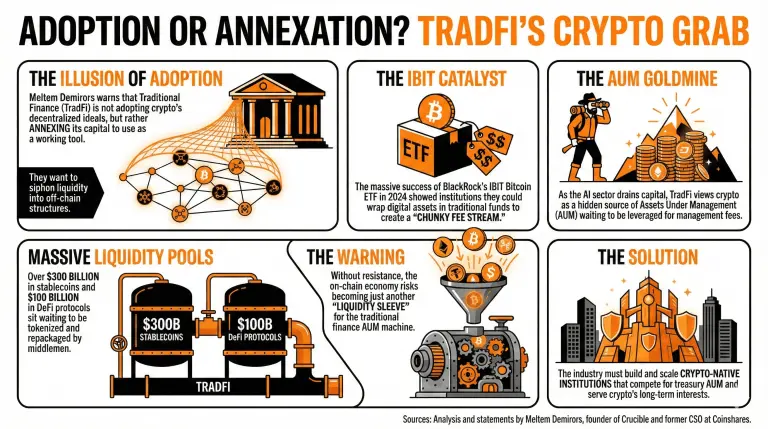
She mentions the launch of Blackrock’s IBIT Bitcoin ETF, which became the most successful exchange-traded fund of all time, as the event that kick-started this vision, showing institutions that they could take “ bitcoin and other digital assets, wrap it in a traditional fund structure, list it, and turn it into a nice chunky fee stream.”
Demirors explains that, as the artificial intelligence capital black hole keeps syphoning funds, crypto will be considered a potential asset under management (AUM) source hiding in plain sight, waiting to be leveraged.
Over $300 billion in stablecoins, close to $100 billion in decentralized finance protocols, and other products are just waiting to be tokenized and repackaged by these institutions, which will adopt them as a “fee-paying AUM base” without relying on saturated traditional channels.
Finally, Demirors warned about the effects of a major annexation, stating that the onchain economy risks turning into “just another liquidity sleeve for TradFi’s AUM machine.”
She concluded:
“The only way out is to build and scale our own native institutions… who can compete for treasury AUM and design products that serve crypto’s long-term interests. If we don’t prioritize collaboration with crypto native institutions now, ‘institutional adoption’ won’t be a victory, it will be an annexation.”
FAQ
- What is Meltem Demirors’ view on traditional finance’s approach to crypto?
Demirors believes traditional finance is not adopting crypto principles; instead, they are annexing it for their own financial benefit. - How has the launch of Blackrock’s IBIT Bitcoin ETF affected the crypto market?
This ETF’s success demonstrated to institutions that they could wrap digital assets in a traditional fund structure, creating a lucrative source of management fees. - What potential does Demirors see in the crypto sector moving forward?
She notes that there are substantial assets, like $300 billion in stablecoins, ready to be tokenized and repackaged for institutional profit, transforming crypto into a fee-paying asset base. - What warning does Demirors offer regarding the future of the on-chain economy?
She cautions that without strong partnerships with crypto-native institutions, the on-chain economy risks becoming a mere liquidity source for traditional finance’s asset management operations.