


Crypto Markets Steady Despite Iran Escalation, QCP Sees Rebound Setup
Bitcoin leverage resets sharply, but stable pricing and call accumulation point to controlled risk rather than market panic.
Crypto markets held firm despite rising tensions around Iran, avoiding the sharp dislocations many traders feared. Bitcoin briefly dropped to $63,000, while Ethereum touched $1,910 before both returned to familiar ranges.
Although derivatives markets reacted, positioning suggests controlled risk reduction rather than panic. In light of this, Singapore-based trading firm QCP Capital argues conditions may now favor a rebound.
Bitcoin Derivatives Reset Strengthens Market Structure
Over the weekend, a U.S. strike triggered roughly $300 million in long liquidations across futures exchanges. While notable, that figure remains modest compared with early February’s disorderly unwind. Positioning was lighter heading into the weekend, which limited forced selling pressure. As a result, spot markets absorbed the shock without structural damage.
QCP notes that amid rising Iran tensions, crypto markets remain range-bound, with Bitcoin briefly hitting $63k and Ethereum $1,910 before recovering. Saturday’s U.S. strike caused ~$300M in long liquidations but was contained, suggesting reduced positions and some capital…
— Wu Blockchain (@WuBlockchain) March 2, 2026
Aggregate Bitcoin futures open interest fell from cycle highs near $46 billion to the low-$20 billion range. In total, that marks a contraction of roughly 40% to 50%. However, the price retraced far less than the open interest. Such divergence signals mechanical position unwinds rather than large-scale capitulation.
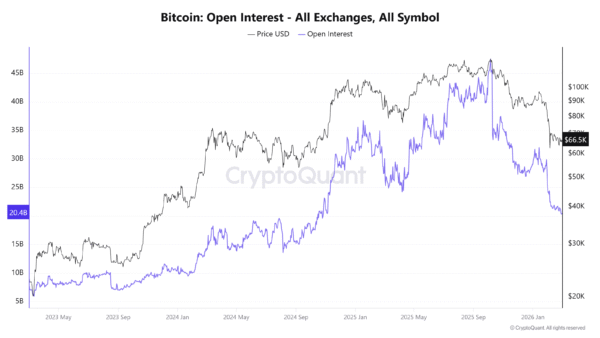
_Image Source: _CryptoQuant
In other words, traders reduced exposure voluntarily instead of being forced out at scale. That reset lowers the probability of cascading liquidations. At the same time, a thinner derivatives stack often creates a cleaner setup for price stability. Reduced crowding can also allow fresh capital to enter at lower risk levels.
For much of 2023 and early 2025, Bitcoin futures traded in steady contango, with longer-dated contracts pricing a 4% to 6% annualized premium. In recent months, that premium has narrowed across maturities, showing more cautious positioning.
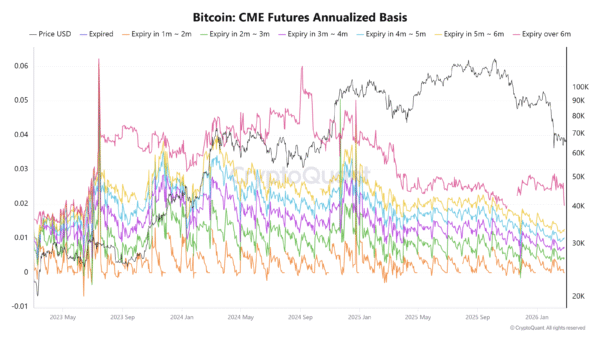
_Image Source: _CryptoQuant
Specifically, the longer-dated basis has narrowed, signaling caution and reduced appetite for leveraged carry trades. Even so, futures have not flipped into backwardation. Backwardation typically signals stress or aggressive hedging. Current pricing therefore reflects recalibrated risk, not systemic fear.
BTC Call Accumulation Signals Rebound Hopes Despite Iran Tensions
Options markets reacted quickly to headlines, as one-day implied volatility briefly surged toward 93% when news broke. Yet broader volatility metrics stayed contained, with front-end implied volatility struggling to sustain levels above 60%. Notably, comparable spot levels earlier in the week triggered a stronger volatility response.
Meanwhile, traders accumulated March call options, including 74,000 and 75,000 strike contracts expiring in late March 2026. In total, roughly 5,000 contracts were traded across those strikes. Such positioning suggests some investors expect recovery after five consecutive weak monthly closes.
Bitcoin’s relationship with gold adds another dimension, as correlation between the two assets fluctuates widely across cycles. During acute stress or liquidity expansion, correlation can spike. However, those phases usually do not last.
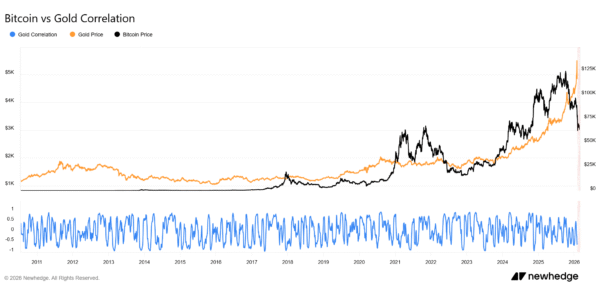
_Image Source: _NewHedge
In recent macro shocks, gold has shown steadier safe-haven performance. Meanwhile, Bitcoin continues to trade with a higher beta and sensitivity to broader risk sentiment. That dynamic challenges the narrative of Bitcoin as a reliable “weekend macro hedge.” Investors appear to favor traditional safe havens when uncertainty rises.
Muted safe-haven flows into Bitcoin during the latest escalation reinforce that view. Although investors have favored stability over volatility, crypto markets have avoided disorderly exits