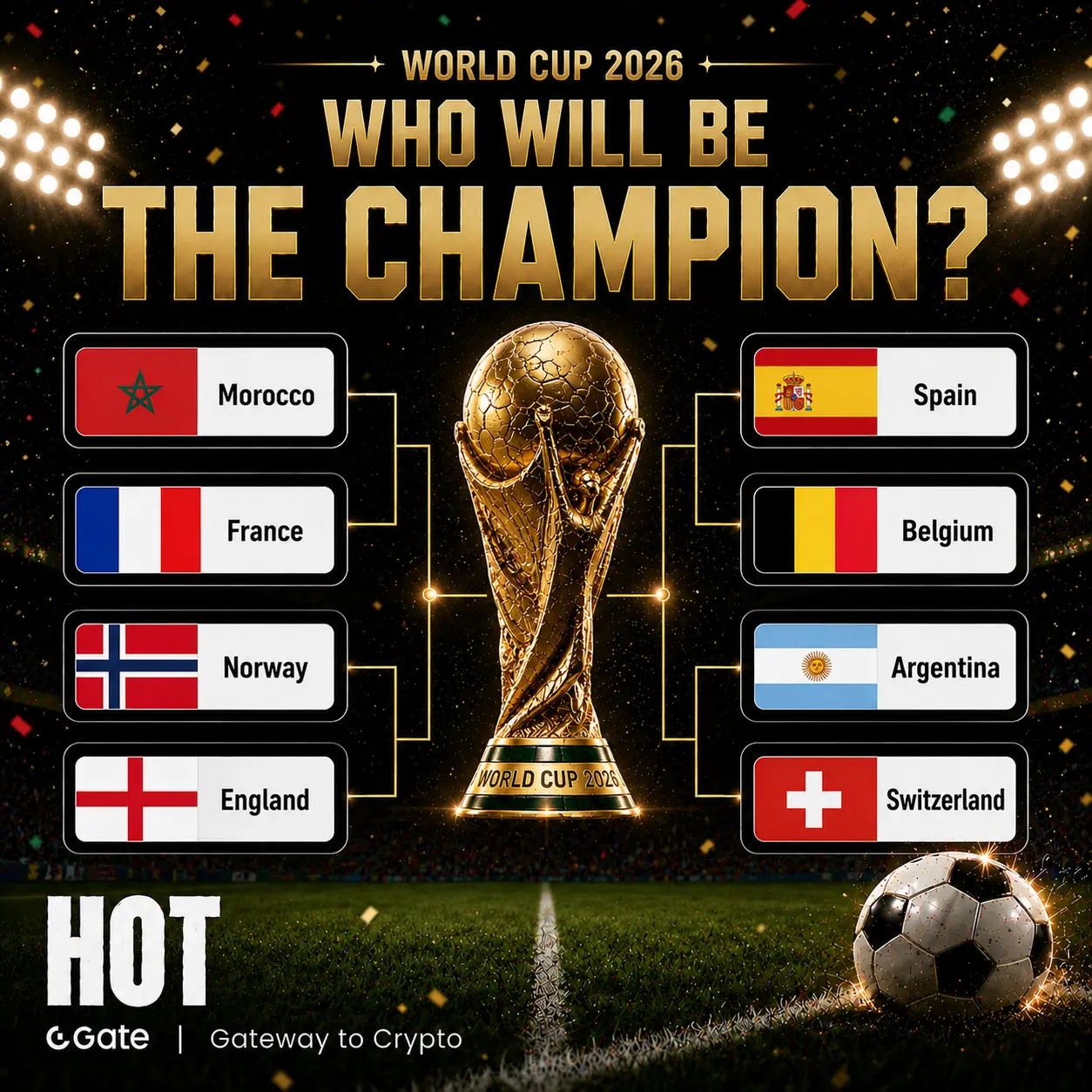
This set of data not only reflects the market's assessment of each team's overall strength, but also reveals the core logic of capital gaming in the knockout stage. After the fierce battles of the Round of 16, how did the distribution pattern of championship probabilities emerge? After Argentina's dramatic last-gasp victory, why does the market only give them a 19% probability of defending the title?
Why France Leads by a Clear Margin with 33% Probability
France tops the eight teams with a 33% championship probability, a figure that corroborates the odds given by betting markets. In the Round of 16, France beat Paraguay 1-0, with Mbappé scoring the decisive penalty. Looking at the match, France's progression was not flashy, but it demonstrated a typical trait of tournament-winning teams—relying on the individual ability of key players to solve problems when the game is tight.
A 33% probability means the market believes France's chance of winning is roughly double that of any of the other seven teams. The logical basis for this judgment lies in France's absolute advantage in squad depth—from Mbappé up front to Tchouaméni and Camavinga in midfield, to Saliba and Upamecano in defense, France boasts world-class players in every position. In a high-frequency, high-intensity knockout format, squad depth determines a team's flexibility in dealing with injuries, fatigue, and tactical adjustments.
Furthermore, France's side of the bracket also supports their championship probability. In the quarterfinal, France will face Morocco, the weakest team on paper among the eight. If they advance smoothly, their potential semifinal opponent will be the winner of Spain vs. Belgium. Although this path is not easy, the pressure in France's half of the bracket is relatively manageable compared to the possibility of Argentina and England meeting in the semifinals in the lower half.
Is Argentina's 19% Defending Probability Underestimated?
Argentina played one of the most dramatic matches of this World Cup so far in the Round of 16. Facing Egypt, they fell behind 0-2, and Messi missed a penalty in the first half. However, in the final 13 minutes, Romero, Messi, and Enzo Fernández scored three consecutive goals to complete a 3-2 comeback victory.
Yet, it is the process of this match that partly explains why the market only gives Argentina a 19% championship probability. The defending champions exposed obvious defensive problems in the Round of 16—against an opponent like Egypt, which is not a traditional powerhouse, Argentina had their defense breached twice in open play. After entering the quarterfinals, Argentina will face Switzerland in the quarterfinal; Switzerland eliminated Colombia on penalties in the Round of 16 and boasts a very solid defensive system.
From a schedule perspective, Argentina's half of the bracket includes two teams with strong attacking firepower: England and Norway. If Argentina beats Switzerland, their potential semifinal opponent will be the winner of Norway vs. England. This means the defending champions may need to face high-intensity confrontations consecutively, and the defensive stability Argentina has shown in the group stage and Round of 16 is not yet convincing enough for the market.
Nevertheless, the 19% probability also means the market has not ruled out Argentina's chances of defending. As the defending champions, Argentina has Messi, a player who can change the course of a game in an instant, and the comeback from 2-0 down itself proves the team's psychological resilience in adversity.
Spain and England: Different Logics Behind 19% and 16%
Spain shares the second spot with Argentina at 19% probability, a figure that differs from some analytical models. Some analyses point out that Goldman Sachs Economic Research, through 50,000 Monte Carlo simulations, gave Spain a 26% championship probability. In the Round of 16, Spain beat Portugal 1-0, with the match content reflecting typical Spanish control—dominating possession and seeking efficiency in limited attacking opportunities.
Spain's strength lies in the maturity and stability of its tactical system. Unlike France's reliance on individual ability or Argentina's dependence on star moments, Spain's competitiveness is built on a long-refined overall framework. The advantage of this system in the knockout stage is predictability and low volatility—Spain rarely produces big-score games but is also rarely upset.
England ranks fourth with 16% probability. In the Round of 16, England narrowly beat hosts Mexico 3-2, with Bellingham scoring two goals in two minutes in the first half and Kane extending the lead from a penalty. England's attacking firepower ranks among the top of the eight teams, but the laxity in defense after a two-goal lead raised market concerns. The 16% probability indicates that the market recognizes England's attacking talent but is cautious about the stability of their midfield and defense.
Norway 6%: The Quality and Ceiling of a Dark Horse
Norway ranks fifth with a 6% championship probability, which is quite significant for a team that is not a traditional powerhouse. In the Round of 16, Norway beat Brazil 2-1, with Haaland scoring a brace to help his team reach the World Cup quarterfinals for the first time in history.
The 6% probability reflects the market's recognition of Norway's "dark horse quality" and a rational judgment of their ceiling. Norway's attack boasts a top-level finisher like Haaland, and any defense faces difficulty keeping a clean sheet against him. However, Norway's squad depth and big-game experience lag significantly behind teams like France and Spain. In the knockout stage, the outcome of a single match often hinges on details—set-piece defense, substitutions, penalty shootout psychology—aspects that Norway has not yet fully tested at the highest level.
Morocco, Belgium, and Switzerland: Structural Factors Behind Low Probabilities
The championship probabilities of Morocco (3%), Belgium (2%), and Switzerland (2%) reflect the market's cautious assessment of these teams' paths to the title.
Morocco beat Canada 3-0 in the Round of 16, showing good form. However, facing France in the quarterfinal, Morocco's advancement is extremely difficult. The 3% probability is not a denial of Morocco's strength but rather an acknowledgment that their path requires consecutive wins over France and then Spain or Belgium, which statistically is a low-probability event.
Belgium eliminated the USA 4-1, with an impressive attacking display. But Belgium's "Golden Generation" is in the later stages of their careers, and squad aging is an undeniable fact. The 2% probability suggests the market believes Belgium will struggle to maintain consistency in consecutive high-intensity knockout matches.
Switzerland eliminated Colombia on penalties, reaching the quarterfinals for the first time in 72 years. Switzerland's defensive system is extremely tight; they conceded no goals in regular and extra time of the Round of 16. However, the 2% probability reflects market concerns about Switzerland's attacking ability—if they cannot score in open play, relying solely on defense and penalties will make it very difficult to go all the way.
How Prediction Market Probabilities Form: The Game of Capital, Information, and Sentiment
The gap between 33% and 19% is essentially a collective judgment formed by the market through real-money gaming. The core mechanism of prediction markets is that each price (or probability) represents the result of market participants voting with their money. When a large amount of capital is concentrated on France, France's implied probability rises; conversely, when the market has doubts about Argentina's prospects of defending, its probability comes under pressure.
The effectiveness of this mechanism is based on two premises: first, that market participants have sufficient information acquisition and analysis capabilities; second, that the free flow of capital can fully reflect the game between different views. The World Cup champion prediction market, as the most liquid single contract in global sports prediction, provides price signals with high reference value.
However, prediction markets are not crystal balls. Probabilities themselves reflect the market's collective judgment at a specific point in time, not a deterministic prediction of the future. As the quarterfinals, semifinals, and final progress, the result of each match will trigger a repricing of probabilities.
How the Quarterfinal Matchups Affect Subsequent Probability Evolution
The quarterfinal matchups provide a clear path for subsequent probability evolution:
Upper half: France vs. Morocco, Spain vs. Belgium. If both France and Spain advance, the semifinal will be a heavyweight clash between France and Spain. This matchup pattern means that only one team from the upper half can reach the final, and the probabilities of France (33%) and Spain (19%) will change significantly around the semifinals.
Lower half: Norway vs. England, Argentina vs. Switzerland. If England and Argentina each advance, the semifinal will be England vs. Argentina. This potential matchup poses a direct challenge to Argentina's path to defending—England's attacking firepower is precisely the weak point of Argentina's defense.
From the logic of probability evolution, the biggest variable facing France's leading 33% position in the quarterfinal stage is Spain. If Spain smoothly beats Belgium, France will face the opponent with the strongest possession ability in this tournament in the semifinals. Whether Argentina's 19% probability can increase depends on two factors: first, whether they can keep a clean sheet against Switzerland in the quarterfinal, proving their defensive issues are resolved; second, whether they can show competitiveness higher than market expectations in a potential match against England.
Summary
As of July 8, 2026, Gate prediction market data shows France leading the eight teams with a 33% championship probability, Argentina and Spain tied for second at 19%, and England closely behind at 16%. This probability distribution reflects the market's comprehensive assessment based on multiple factors including squad depth, knockout stage performance, schedule difficulty, and tactical compatibility.
France's leading position stems from its squad depth and relatively favorable bracket situation; Argentina's 19% reflects the market's balance between concerns about the defending champions' defensive issues and recognition of their championship pedigree; Spain and England have gained market approval through tactical stability and attacking firepower, respectively; the low probabilities of Norway, Morocco, Belgium, and Switzerland reflect the structural difficulties in their respective paths.
Prediction market probabilities are dynamic. As the quarterfinals progress, the result of each match will reshape the distribution pattern of championship probabilities. Whether France's 33% lead is solid, and whether Argentina's 19% defending probability can increase, the answers will gradually be revealed in the upcoming matches.
FAQ
Q: How is the championship probability calculated on Gate prediction market?
The probability in the prediction market is determined by the buying and selling behavior of market participants. When users purchase a "champion" contract for a team, that team's implied probability rises; conversely, it falls. The probability reflects the collective judgment formed by the market through capital gaming, not a single mathematical model prediction.
Q: What does France's 33% championship probability mean?
A 33% probability means that, in the market's view, France's chance of winning the title is roughly double that of any of the other seven teams. This judgment is based on France's squad depth, knockout stage performance, and relatively favorable bracket situation.
Q: Why is Argentina's defending probability only 19%?
Argentina exposed obvious defensive issues in the Round of 16, conceding two goals against Egypt. After entering the quarterfinals, Argentina may face Switzerland and then England, with defensive stability being the market's main concern. However, the 19% probability also means the market has not ruled out the possibility of defending.
Q: Will the prediction market probabilities change?
Yes. As the quarterfinals, semifinals, and final take place, the result of each match will trigger a repricing of probabilities. France's leading 33% position is not set in stone; subsequent match results will directly affect each team's championship probability.
Q: Do low-probability teams have absolutely no chance of winning?
Probabilities reflect statistical likelihood, not certainty. The 6% for Norway, 3% for Morocco, 2% for Belgium, and 2% for Switzerland mean that these teams winning the title is a low-probability event, but in a single-elimination football tournament, low-probability events are not impossible.