
Blockchain analytics platform Artemis’ latest data shows that in February, the stablecoin 30-day rolling adjusted trading volume reached $7.2 trillion, marking the first time it surpassed the $6.8 trillion recorded in the same period by the United States Automatic Clearing House (ACH) network. This is a historic milestone for an asset class that has existed for less than 12 years—ACH is a core backbone of the U.S. payment system, responsible for processing about 93% of wage payments in the United States.
The historical significance of stablecoins surpassing ACH: the fundamental differences between two payment systems
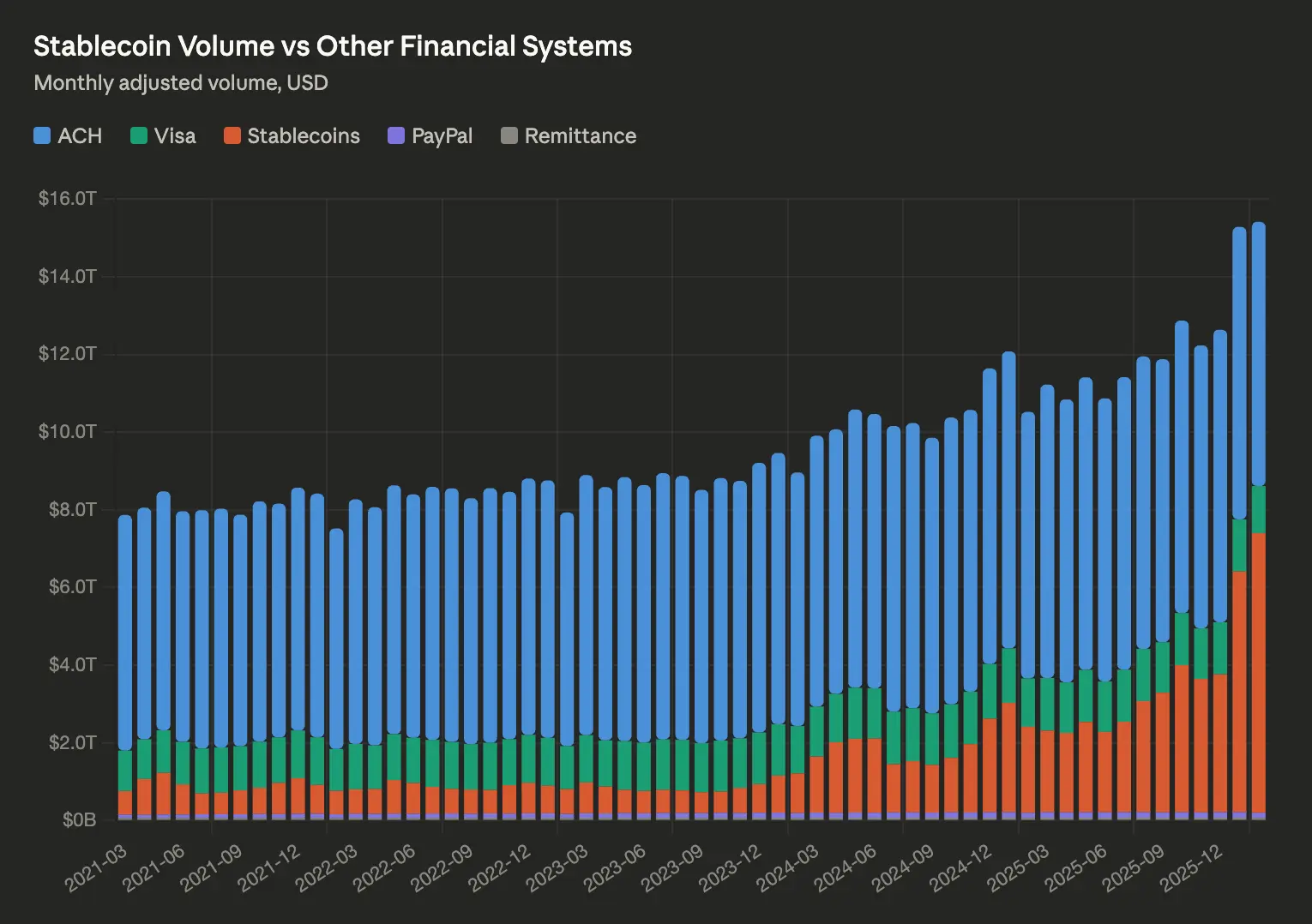 (Source: Artemis)
The ACH network is the most core payment infrastructure in the U.S. financial system. It is jointly managed with the Federal Reserve by the National Automated Clearing House Association (Nacha), and 93% of U.S. payrolls are disbursed through it. The significance of stablecoins surpassing this system lies not only in the absolute number of transactions, but also in the fundamental differences between the two systems.
ACH relies on bank authorization, operates during business hours, and is constrained by national borders; meanwhile, stablecoins can operate 24/7 in any corner of the world, without needing any approval from any intermediary institution, and without being limited by weekends and holidays.
It’s also worth noting that Artemis’ data excludes MEV arbitrage activities and internal trades within centralized exchanges, making it a relatively conservative and comparable horizontal comparison benchmark—not just a simple accumulation of total volumes.
Stablecoin’s explosive growth trajectory: supply increases more than 10x in six years
The stablecoin market has gone through near-exponential expansion over the past six years:
2020: Total stablecoin supply is less than $30 billion
Q1 2026: Total supply reaches $315 billion, up $8 billion from Q1 2025
Record-high market share: Stablecoins account for 75% of total crypto trading volume in Q1 2026, setting a new all-time high
Monthly trading volume keeps setting records: Feb $7.2T → Mar $7.5T, and the trend is still moving upward
GSR content director Frank Chapparo bluntly said that banks or financial technology companies that ignore the explosive growth of stablecoins will “be done for,” pointing out that the growth of supply from $30 billion to $300 billion is already a signal the industry cannot avoid.
Regulatory catalysts and the $2T target for 2028
Sustained growth in the stablecoin market has clear support from regulation and institutional-level factors. The GENIUS Act is viewed by the market as a key legislative catalyst for institutional adoption of stablecoins and is currently in the Senate review stage, as the U.S. regulatory environment keeps heating up.
Standard Chartered analysts predict that by 2028, the total market value of stablecoins will reach $2 trillion—an increase of more than 530% from the current $315 billion. If this prediction comes true, the stablecoin market’s size would enter the absolute scale of “systemic importance” in traditional finance, comparable to the M2 supply levels of some major currencies.
Frequently Asked Questions
Does stablecoins surpassing the ACH network’s trading volume mean it has become a bigger payments system?
This comparison needs context. Artemis’ data is a 30-day rolling adjusted figure that excludes some speculative activity, and it is compared horizontally with ACH’s daily average trading volume. The two have overlapping but not identical use cases: ACH mainly serves bank-to-bank transfers within the United States, while stablecoin trading volume includes a variety of scenarios such as cross-border payments, DeFi trading, and institutional settlement. But an asset class that has existed for less than 12 years being on par with the United States’ most core payment network is indeed a milestone of far-reaching significance.
Why do stablecoins account for 75% of total crypto trading volume?
Stablecoins—mainly USDC and USDT—play two core roles in the crypto market: first, as a pricing currency and intermediate asset for trading (traders typically use stablecoins as a transit when moving in and out of different crypto assets); second, as liquidity tools across chains and across platforms. These two functions drive extremely high turnover, giving stablecoins a dominant position in total trading volume across the crypto market.
What is the basis for Standard Chartered’s $2 trillion prediction for 2028?
Key drivers include: accelerated institutional adoption after regulatory frameworks such as the GENIUS Act take effect, the trend of major global banks issuing their own stablecoins, and the continued expansion of cross-border payments and the DeFi ecosystem. The $2 trillion target represents more than 530% growth, but the stablecoin supply has already grown by more than 10x from $30 billion in 2020 to $315 billion in 2026, giving this forecast a certain degree of historical credibility.
Disclaimer: The information on this page may come from third parties and does not represent the views or opinions of Gate. The content displayed on this page is for reference only and does not constitute any financial, investment, or legal advice. Gate does not guarantee the accuracy or completeness of the information and shall not be liable for any losses arising from the use of this information. Virtual asset investments carry high risks and are subject to significant price volatility. You may lose all of your invested principal. Please fully understand the relevant risks and make prudent decisions based on your own financial situation and risk tolerance. For details, please refer to
Disclaimer.


