
The Internal Revenue Service (IRS) is expected to release a proposed new regulation on Friday, which plans to mandate that cryptocurrency exchanges submit Form 1099-DA to users electronically, removing the current option for users to choose paper forms. The most controversial aspect of the new regulation is that if existing customers refuse to receive tax forms electronically, exchanges will be permitted to “terminate” their relationship with the customer. Once the proposal is approved, it will take effect on January 1 of the calendar year following the IRS’s publication of the final rules.
Key Provisions of the New Regulation: Mandatory Electronic Filing and Termination Mechanism
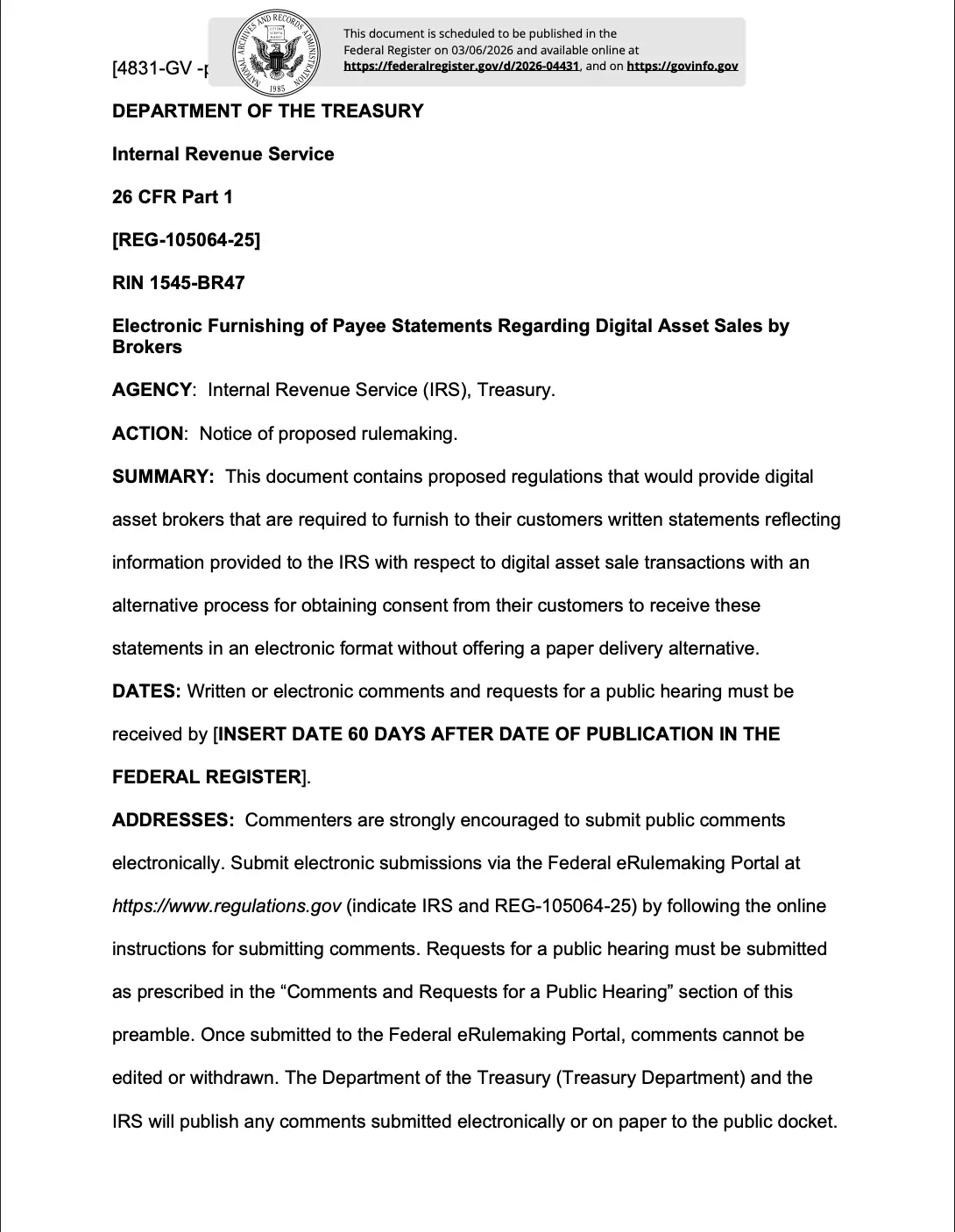 (Source: Internal Revenue Service)
Under current regulations, cryptocurrency exchanges are required to provide a paper copy of Form 1099-DA when requested by users. The proposed regulation would eliminate this requirement, shifting all reporting to an electronic format, and introduce two controversial clauses:
Customer Relationship Termination Authorization: If existing customers explicitly refuse to accept electronic tax forms, exchanges are allowed to terminate their service relationship, potentially closing their accounts.
Revocation of Consent Ban: Once users agree to receive electronic tax forms, they cannot retroactively withdraw that consent, removing flexibility to change the reporting method.
Retrospective Cancellation: These two provisions together substantially restrict users’ options to choose their preferred reporting method.
The IRS states that the push for mandatory electronic filing aims to improve tax compliance efficiency and ensure standardization and traceability of tax form submissions.
1099-DA Tax Form Structure: Reporting Scope and Cost Basis Responsibility
 (Source: National Crypto Association)
Form 1099-DA is a dedicated tax form used by the IRS to record transaction data of users on centralized exchanges. The core information required includes the customer’s name, Tax Identification Number (TIN), and the gross proceeds from each transaction.
It is noteworthy that the IRS requires exchanges to report users’ transaction proceeds but does not require tracking the cost basis—the price paid for each crypto asset purchase. The responsibility for calculating and recording the cost basis remains with individual investors. The IRS has explicitly exempted exchanges from this obligation for the 2025 tax year.
According to data from the National Crypto Association (NCA), about one-fifth of Americans—approximately 55 million people—hold digital assets. A survey of 54,000 respondents by the NCA shows that 10% consider crypto taxation one of the main barriers to adopting cryptocurrencies, and about 39% want to learn more about the tax implications of crypto.
DeFi Regulation Background: New Controversies After the Repeal of Old Rules
The proposed regulation is closely related to recent developments in U.S. crypto tax regulation. In December 2024, the IRS issued the “DeFi Broker Rules,” classifying decentralized exchanges (DEXs) and DeFi platforms as brokers, requiring them to collect Know Your Customer (KYC) information and report user sales to the IRS.
In April 2025, President Trump signed legislation to repeal these rules, which was welcomed by the crypto industry. However, industry executives are now warning about the pending CLARITY Market Structure Act, which contains vague language that could cause DeFi platforms to face KYC reporting obligations again, effectively reintroducing the repealed DeFi broker rules.
Frequently Asked Questions
What impact does the Form 1099-DA have on cryptocurrency users?
Form 1099-DA is a dedicated IRS tax form used to record crypto transactions, requiring centralized exchanges to provide users with their total sales proceeds. Users must report capital gains or losses based on this data. If the new regulation passes, users will no longer be able to opt for paper forms, and those refusing electronic filing may face account termination risks.
What does the “termination of customer relationship” clause in the IRS regulation specifically mean?
Under the proposed regulation, if existing customers refuse to accept Form 1099-DA electronically, exchanges are permitted to terminate their service relationship, which could result in account closure. Users will need to choose between accepting electronic reporting or discontinuing use of the platform.
Are DeFi platforms subject to this IRS regulation?
The proposed regulation mainly targets centralized exchanges and crypto brokers. DeFi platforms are currently outside the scope of this regulation. However, the ongoing CLARITY Market Structure Act contains vague provisions that could reimpose KYC reporting obligations on DeFi platforms, and industry groups have issued clear warnings about this risk.
Disclaimer: The information on this page may come from third parties and does not represent the views or opinions of Gate. The content displayed on this page is for reference only and does not constitute any financial, investment, or legal advice. Gate does not guarantee the accuracy or completeness of the information and shall not be liable for any losses arising from the use of this information. Virtual asset investments carry high risks and are subject to significant price volatility. You may lose all of your invested principal. Please fully understand the relevant risks and make prudent decisions based on your own financial situation and risk tolerance. For details, please refer to
Disclaimer.


