Bitcoin traded flat near $66,000 on Feb. 18, showing little momentum despite sharp intraday swings. The day’s debate centered on comments from Cryptoquant’s CEO, Ki Young Ju, who questioned whether dormant coins — including Satoshi Nakamoto’s 1.1 million bitcoins — should ever be frozen at the protocol level.
Bitcoin Stagnates in Narrow Range
Bitcoin exhibited a characteristic lack of momentum on Wednesday, remaining largely range-bound even as the community descended into a fierce ideological civil war. Throughout the preceding 24-hour window, the top cryptocurrency oscillated between $65,840 and $68,000. While the price experienced several instances of high-velocity “whipsaw” movements—straying briefly before a rapid corrective snapback—it ultimately found its gravity within that narrow corridor.
As of 3 p.m. EST, bitcoin was again trading just below the $66,000 mark, logging a 2.6% decline over the day. This price action left the total market capitalization of the crypto-economy essentially drifting lower, alongside reflecting a “wait-and-see” approach from institutional desk traders.
The day’s primary narrative was dominated by Cryptoquant CEO Ki Young Ju, whose latest X article has sent shockwaves through the ecosystem. Ju has posed a pointed question to the community: Should it authorize a protocol-level “freeze” on dormant coins, particularly Satoshi Nakamoto’s storied 1.1 million BTC trove?
“Would you support freezing dormant coins, including Satoshi’s, to save BTC from quantum attacks? Or is it against Bitcoin’s core ethos? If this alone already divides us, the quantum debate must start now,” the Cryptoquant executive wrote.
Ju estimates that 6.89 million BTC are currently housed in legacy P2PK (pay-to-public-key) addresses. Because these older address types expose public keys directly on the blockchain, they are theoretically vulnerable to future quantum computing attacks that could derive private keys and drain the funds.
Critics, however, have decried the idea of such changes as a fundamental betrayal of bitcoin’s core value proposition. To freeze these coins, the network would require a drastic protocol upgrade, effectively breaking the rule of immutability. While there is a broad consensus regarding the long-term threat of quantum computing, the community remains bitterly divided over whether the cure is worse than the disease.
Geopolitical Winds: The ‘Risk-off’ Pivot
Despite the high-stakes debate over Satoshi’s coins, bitcoin’s price action on Feb. 18 appeared largely detached from internal politics, focusing instead on the escalating drums of war in the Middle East. Media reports suggest that U.S. and Israeli military strikes on Iran are imminent, a development that threatens to plunge the region into a state of total kinetic conflict.
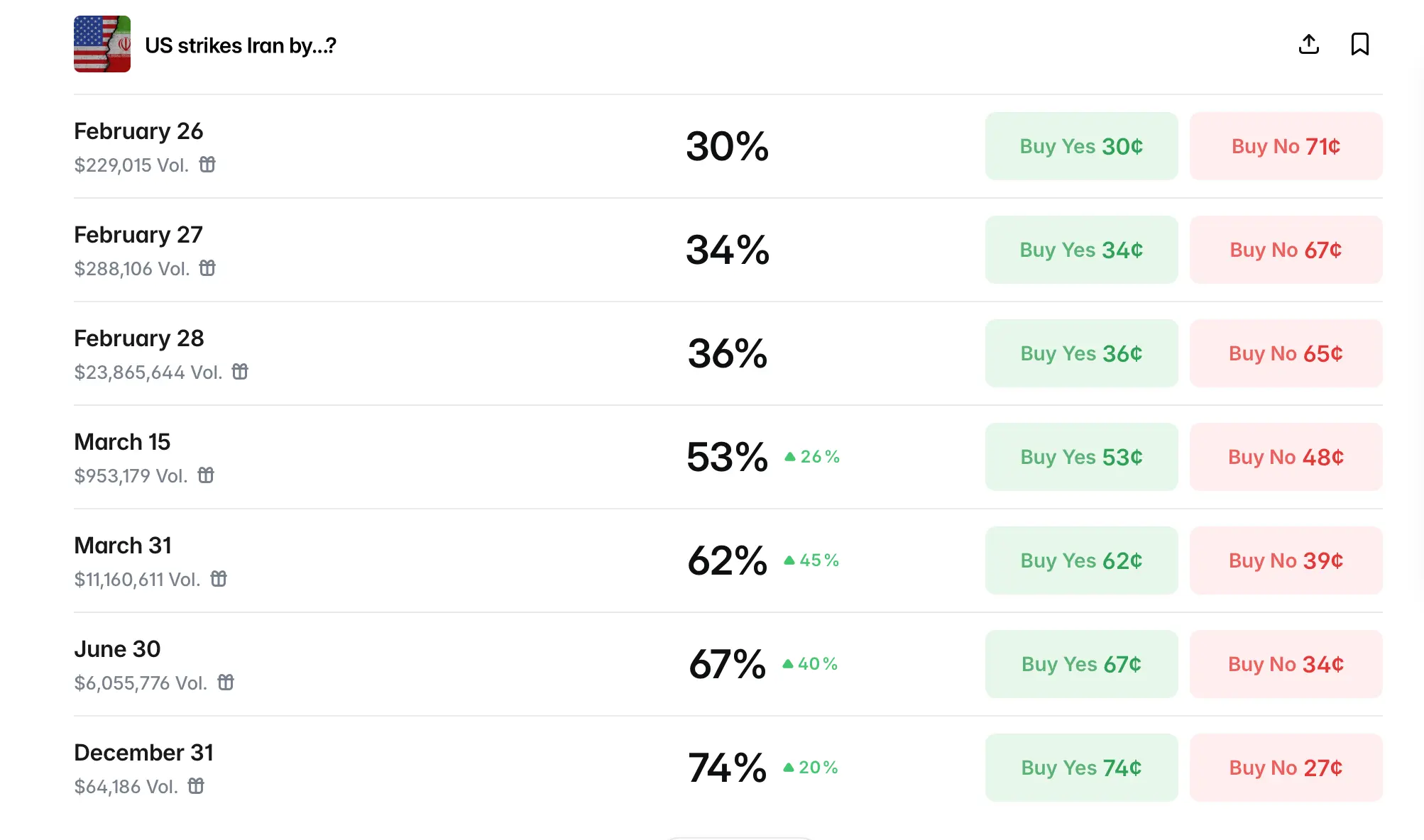 Polymarket odds on the escalation between the U.S. and Iran on Feb. 18, 2026, at 3 p.m. EST.
A wider conflict is expected to disrupt critical trade arteries and send crude oil prices into a vertical climb. For bitcoin, the impact remains a subject of intense speculation. While long touted as digital gold, recent price correlations suggest bitcoin has behaved more like a risk-on tech asset. This means, in the event of a regional conflagration, the initial reflex from investors may be a flight to traditional safe-haven assets, including U.S. Treasuries and gold.
Polymarket odds on the escalation between the U.S. and Iran on Feb. 18, 2026, at 3 p.m. EST.
A wider conflict is expected to disrupt critical trade arteries and send crude oil prices into a vertical climb. For bitcoin, the impact remains a subject of intense speculation. While long touted as digital gold, recent price correlations suggest bitcoin has behaved more like a risk-on tech asset. This means, in the event of a regional conflagration, the initial reflex from investors may be a flight to traditional safe-haven assets, including U.S. Treasuries and gold.
This will potentially put further downward pressure on bitcoin as liquidity tightens across global markets.
FAQ ❓
- Where is bitcoin trading now? It hovered between $67K and $68K, showing little momentum.
- What sparked the community debate? Cryptoquant’s CEO proposed freezing dormant coins, including Satoshi’s stash.
- Why is the proposal controversial? Critics say freezing coins breaks bitcoin’s immutability despite quantum risks.
- How do geopolitics affect bitcoin? Escalating Middle East tensions, specifically between Iran and the U.S., have pushed investors toward gold and Treasuries, pressuring BTC.
Disclaimer: The information on this page may come from third parties and does not represent the views or opinions of Gate. The content displayed on this page is for reference only and does not constitute any financial, investment, or legal advice. Gate does not guarantee the accuracy or completeness of the information and shall not be liable for any losses arising from the use of this information. Virtual asset investments carry high risks and are subject to significant price volatility. You may lose all of your invested principal. Please fully understand the relevant risks and make prudent decisions based on your own financial situation and risk tolerance. For details, please refer to
Disclaimer.
Related Articles
Ledger Executive: If the US Bans Stablecoin Yields, Other Countries May Fill the Regulatory Gap
Ledger Asia-Pacific Head Shibayama stated that if the US implements a stablecoin yield ban, international discussions will increase. Countries like Australia have already provided regulatory exemptions, and currently most stablecoins do not offer yields to users. US regulatory bill progress has been slow due to opposition to prohibition clauses supported by the banking industry. Asian financial institutions' focus has shifted toward financial product tokenization and stablecoin issuance, rather than crypto-native products like DeFi.
GateNews9m ago
Cambridge Study Finds Bitcoin Can Withstand 72% of Submarine Cable Failures
A study published by the Cambridge Centre for Alternative Finance on March 12, 2026, analyzing 11 years of peer-to-peer network data against 68 verified submarine cable fault events, found that 72% to 92% of inter-country submarine cables would need to fail simultaneously before more than 10% of Bitcoin network nodes disconnect.
CryptopulseElite9m ago
Will stablecoin yields be banned by the US? Ledger executive warns: the global regulatory landscape may be reshaped
Ledger's Asia-Pacific head Shibayama stated that if the US bans stablecoin yield distribution, it will trigger a new global cryptocurrency regulatory landscape, with some countries potentially introducing more attractive policies. The Asian market focuses more on blockchain infrastructure and tokenization of financial products, while large institutions show less interest in direct cryptocurrency asset investments. As regulation improves, institutional investors are becoming more cautious when selecting custodial service providers.
GateNews11m ago
Bitcoin Surpasses $72,000, but Market Increasingly Dependent on Leverage
Bitcoin enters the weekend fluctuating around the 72,000 USD mark, considerably lower than last week's peak above 74,000 USD and still quite far from the highs reached in early year. Looking at price movements alone, the market appears relatively stable.
However, the underlying structure paints a dimmer picture.
TapChiBitcoin18m ago
10x Research: Unusual Adjustments in Bitcoin On-Chain Capital Flows and Position Changes
10x Research posted a message on the X platform stating that Bitcoin prices are rising slowly, with abnormal capital flows appearing in the market. Recently, funding rates and risk indicators have undergone significant adjustments, market trends are being influenced by position structures, and changes in positions for Ethereum and Bitcoin require attention, with options trading before the end of March being particularly critical.
GateNews19m ago
BlockFills Entities File Bankruptcy After Withdrawals Halted, Court Froze Bitcoin
In brief
BlockFills entities have filed for Chapter 11 bankruptcy after suspending client withdrawals, following an asset freeze for 70 BTC earlier this month.
A lawsuit filed by its creditor, Dominion Capital, alleges BlockFills commingled assets and had a $77 million shortfall.
The
Decrypt24m ago


