The central bank will focus on designing a regulatory framework for the so-called institutional VASPs, defined as organizations that operate infrastructure and provide crypto services to other institutions. The move would bring clarity to companies like Fireblock, Ripple, and Bitgo in the Brazilian market.
Brazil to Regulate Institutional VASPs by 2027
Brazil is advancing fast to bring clarity to all sectors of the crypto market, including Business-to-Business (B2B) interactions.
Local reports indicate that the Central Bank of Brazil will advance regulations regarding the operation of institutional virtual asset service providers (VASPs) in the country before 2027.
Institutional VASPs are defined as companies that construct, provide, and operate crypto infrastructure to serve other institutions, focusing their action on serving other businesses rather than end users.
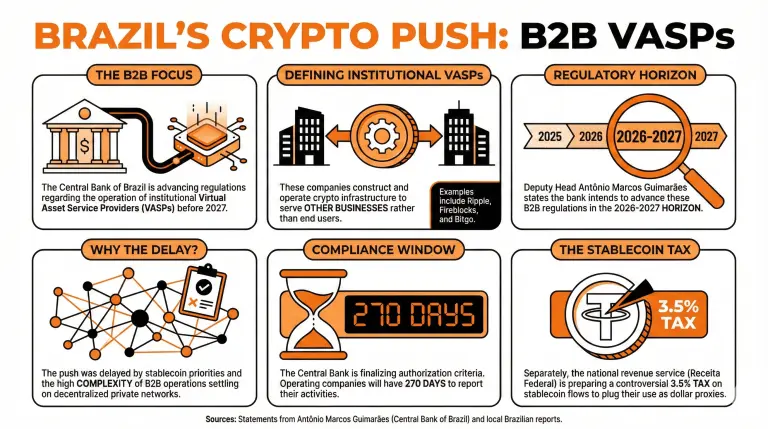
Companies like Ripple, which operates crypto-based payment networks; Fireblocks, which provides various crypto infrastructure products and services; and Bitgo, a custody provider, would fall under this classification.
During a live transmission, Antônio Marcos Guimarães, deputy head of the bank’s Regulation Department, stated that the bank would “intend to advance in the regulation of institutional VASPs (B2B)” in the 2026-2027 horizon.
Furthermore, he stated that the proposal to regulate these institutions’ activities was born of the bank’s public consultations. Nonetheless, other regulatory activities involving stablecoins and more pressing matters took the bank’s attention before this.
An element that has taken this regulatory push aback is the complexity of these businesses’ activities, as there is no brokerage between them, and transactions or deals are settled using decentralized private networks.
In addition, Guimarães added that the bank is finalizing the authorization criteria for companies operating in the country, which will have 270 days to report their activities.
Brazil has been hard at work regarding crypto regulation in 2026, having already streamlined new rules for banks entering the crypto market.
In addition, the national revenue service (Receita Federal) is reportedly preparing a controversial measure that would tax stablecoin flows with 3.5%, aiming to plug a loophole that allowed users and institutions to benefit from using these solutions as dollar proxies for payments and remittances.
FAQ
- What steps is Brazil taking towards crypto regulation?
Brazil is advancing regulations for institutional virtual asset service providers (VASPs) to clarify operations in the B2B sector before 2027.
- What defines an institutional VASP in Brazil?
Institutional VASPs are companies that provide and manage crypto infrastructure specifically to serve other businesses rather than individual users.
- What is the Central Bank’s timeline for these regulations?
Deputy head Antônio Marcos Guimarães indicated that the regulation of institutional VASPs is expected to progress during the 2026-2027 timeframe.
- Are there additional regulatory measures related to stablecoins?
Yes, Brazil’s national revenue service is preparing to implement a 3.5% tax on stablecoin flows to close a loophole in their use as dollar proxies for payments.
Disclaimer: The information on this page may come from third parties and does not represent the views or opinions of Gate. The content displayed on this page is for reference only and does not constitute any financial, investment, or legal advice. Gate does not guarantee the accuracy or completeness of the information and shall not be liable for any losses arising from the use of this information. Virtual asset investments carry high risks and are subject to significant price volatility. You may lose all of your invested principal. Please fully understand the relevant risks and make prudent decisions based on your own financial situation and risk tolerance. For details, please refer to
Disclaimer.
Related Articles
Bitcoin Policy Institute 警告美国国会需在数月内通过小额比特币交易免税政策
Gate News 消息,3 月 14 日,Bitcoin Policy Institute 发出警告,美国国会仅剩几个月的时间来通过针对小额比特币交易的微量免税政策。该机构已与 19 个国会办公室会面,推动这一政策变革。
GateNews2h ago
Federal Court Ends Custodia Bank Bid for Federal Reserve Master Account
A federal court upheld the Federal Reserve's discretion in granting master accounts, rejecting Custodia Bank's five-year legal bid for access. The ruling highlighted risks of crypto banking and affirmed the Fed's role as a gatekeeper for payment infrastructure.
TheNewsCrypto8h ago
美众议院金融服务委员会主席:《CLARITY法案》有望填补《GENIUS法案》监管空白
美国众议院金融服务委员会主席French Hill表示,《CLARITY法案》将解决《GENIUS法案》中未覆盖的监管问题,旨在明确稳定币及数字资产的运作方式。同时,政策制定者对加密公司监管展开讨论,原则上达成共识,即稳定币不应向持有者支付收益。
GateNews9h ago
Paraguay Strenghtens Mandatory Reporting Requirements for VASPs and Individuals
Individuals transacting cryptocurrency on offshore platforms or independently must now report their movements when the amount of crypto transacted surpasses $5,000 per year. Users must now deliver sensitive data, including the purpose of each transaction, hashes, and destination addresses.
Coinpedia11h ago
Swissborg Secures MiCA License From France’s AMF, Expanding Regulated Crypto Services Across EU
Europe’s Markets in Crypto-Assets regulation is rapidly reshaping the region’s crypto industry, with Swissborg obtaining regulatory approval in France that allows the platform to expand digital asset services across the European Union.
Swissborg Secures MiCA Approval From French AMF, Expanding
Coinpedia12h ago
BPI thúc đẩy miễn thuế cho giao dịch Bitcoin nhỏ nhằm thúc đẩy ứng dụng tiền điện tử
The Bitcoin Policy Institute (BPI) advocates for a de minimis tax exemption for small Bitcoin transactions to ease tax reporting burdens and encourage cryptocurrency use. They are collaborating with stakeholders to build support for the bill during a crucial legislative period. The proposed exemption aims to simplify tax regulations and promote Bitcoin for daily payments, potentially impacting the cryptocurrency market significantly.
TapChiBitcoin14h ago


