The bill, introduced by Federal Deputy Tabata Amaral, amends the current regulation and establishes the crime of cryptocurrency tax evasion, aiming to curb the rising volume of remittances and settlement alternatives using dollar proxies, including stablecoins.
Brazil Aims To Criminalize Undeclared Stablecoin Transactions In New Bill
Brazil is taking measures to tighten its grip on rising volumes of crypto outflows, especially those involving stablecoins, by imposing penalties on undeclared cryptocurrency transactions.
Bill 746/2026, introduced by Federal Deputy Tabata Amaral, explicitly defines the crime of cryptocurrency tax evasion, getting stablecoin exchanges outside a gray zone classified as a loophole by some regulators and government officials.
The crime of foreign currency tax evasion is defined in Brazilian regulation as “carrying out an unauthorized exchange operation, with the purpose of promoting the evasion of foreign currency from the country.”
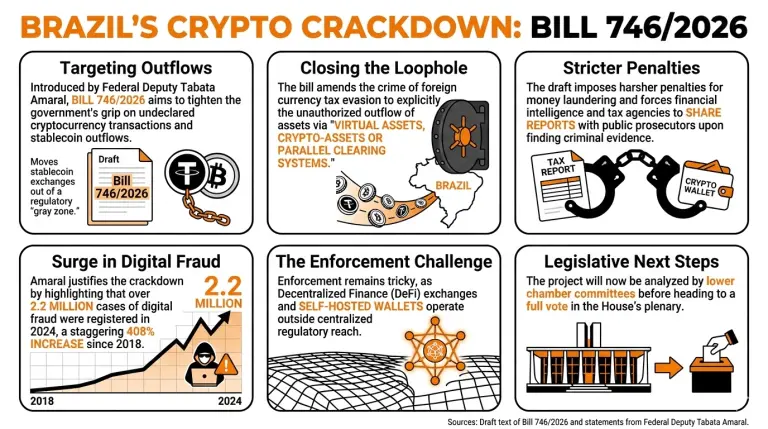
The new bill proposes to amend part of this definition, including a new paragraph that extends this crime to “anyone who, in any capacity, promotes, without legal authorization, the outflow of currency or foreign exchange abroad, or maintains undeclared deposits abroad, including through the use of virtual assets, crypto-assets or parallel clearing systems.”
The draft also imposes harsher penalties for money laundering involving crypto assets, forcing financial intelligence units and tax agencies to share reports with the public prosecution if they identify criminal evidence.
Amaral justifies these changes by stating that economic crime is transforming in Brazil, highlighting that during the last decade, crime has migrated to include digital and crypto assets, partnering with corporate structures to obfuscate money laundering and tax evasion crimes.
Over 2.2 million cases of digital fraud were registered in 2024, an increase of 408% since 2018. Amaral states that this growth has been “fueled by the feeling of anonymity and the difficulty of tracking virtual assets.”
As with other measures targeting crypto assets, its degree of applicability will be key, as decentralized finance exchanges and self-hosted wallets might be outside regulatory reach, given that they are not managed by centralized authorities that could deliver information about their owners.
The project will now be analyzed by the committees in the lower chamber. If approved, it will be directed for a full vote in the House’s plenary.
FAQ
- What measures is Brazil taking to address crypto outflows?
Brazil is introducing Bill 746/2026 to impose penalties on undeclared cryptocurrency transactions, particularly focusing on stablecoins.
- What does Bill 746/2026 define as tax evasion?
The bill specifies that crypto tax evasion includes unauthorized exchange operations aimed at evading foreign currency regulations, extending this to virtual assets.
- What penalties does the new bill propose?
It introduces harsher penalties for money laundering involving crypto assets and mandates financial intelligence units to report findings to public prosecution.
- Why are these regulations necessary, according to Deputy Amaral?
Amaral highlights a significant rise in digital fraud, with over 2.2 million cases reported in 2024, driven by the anonymity of virtual assets and their growing use in economic crimes.
Disclaimer: The information on this page may come from third parties and does not represent the views or opinions of Gate. The content displayed on this page is for reference only and does not constitute any financial, investment, or legal advice. Gate does not guarantee the accuracy or completeness of the information and shall not be liable for any losses arising from the use of this information. Virtual asset investments carry high risks and are subject to significant price volatility. You may lose all of your invested principal. Please fully understand the relevant risks and make prudent decisions based on your own financial situation and risk tolerance. For details, please refer to
Disclaimer.
Related Articles
Bank–Crypto Clash Slows Senate Clarity Act Progress
Dispute over stablecoin reward programs between banks and crypto firms has slowed progress on the Senate Clarity Act.
Banks warn rewards could trigger deposit flight, while crypto advocates say evidence of major shifts is limited.
Lawmakers including Sens. Alsobrooks and Tillis are
CryptoFrontNews25m ago
Bitcoin Policy Institute calls for revising U.S. tax rules that currently treat all BTC payments as capital gains
Gate News reports that on March 13, the Bitcoin Policy Institute called for modifications to current U.S. tax rules. Under existing regulations, all payments made using BTC are treated as capital gains transactions, requiring the payment of corresponding taxes. The institute argues that this regulation limits the practical application of Bitcoin as a means of payment.
GateNews2h ago
The first list of "Stablecoin Licenses" in Hong Kong is about to be announced! Rumors suggest they will go to HSBC, Standard Chartered, and OSL.
Hong Kong's first batch of "Stablecoin Issuer License" list will be announced next week. The three main applicants are HSBC, Standard Chartered Bank, and virtual asset platform OSL. This licensing round may favor banks due to their capital strength and regulatory advantages, while OSL possesses rich practical experience. Although rumors suggest the main list is finalized, the actual situation may still change.
区块客2h ago
US Crypto Regulatory "Civil War" Ceasefire: SEC and CFTC's Decade-Long Power Struggle Reaches a Turning Point
The U.S. cryptocurrency industry has long faced regulatory confusion, primarily reflected in the determination of crypto asset classification and the division of regulatory authority. Divergences between the SEC and CFTC have created multiple regulatory challenges for enterprises. Recently, the two agencies signed a memorandum of understanding to begin coordinating efforts to resolve regulatory conflicts and promote the establishment of an adaptive regulatory framework, aimed at forming a comprehensive digital asset regulatory system. This marks a gradual clarification of rule-making in America's digital finance era.
PANews3h ago
SEC and CFTC Sign MOU to Align Crypto Oversight Rules
SEC and CFTC signed an MOU to coordinate crypto oversight and align regulatory frameworks across digital asset markets.
Agreement supports data sharing, joint enforcement coordination, and clearer guidance for crypto firms.
Initiative links to the Harmonization plan and CLARITY Act
CryptoFrontNews3h ago
HSBC and Standard Chartered Expected to Receive Hong Kong’s First Stablecoin Licenses
HSBC and Standard Chartered are set to receive Hong Kong's first stablecoin licenses, supporting the region's aim to become a regulated global crypto hub. This move aligns with the HKMA's initiative to create a controlled digital-asset ecosystem.
TheNewsCrypto4h ago


