
- Meta is weighing integrating stablecoins into its family of social media platforms, including Facebook, Instagram, and WhatsApp.
- A company spokesperson stressed that the company has no plans to issue its own stablecoin after previous crashes with regulators.
Social media giant Meta is exploring how it can integrate stablecoins into its vast social media platforms, sources with knowledge of the matter have revealed.
Speaking to one crypto news outlet, one of the sources revealed that the company’s stablecoin plan centers around a partnership with a third-party that would handle the heavy lifting. The project is set to begin early in the second half of the year as Meta races to compete with Telegram and X, which have both announced plans to integrate payments into their apps.
Telegram already has the closely-linked TON network, which supports most major stablecoins like USDC and USDT, making integration easier.
Speaking to a separate outlet, another source revealed that Meta has already issued a request for product (RFP) to stablecoin processors as it evaluates the best candidate. The sources say Stripe is the most likely potential partner. Stripe CEO Patrick Collison is a member of the Meta board, and the company has integrated some of its payment services on Meta-owned apps, such as a ‘pay directly’ feature on WhatsApp.
Stripe has become a significant player in the stablecoin circles in recent months following the acquisition of Bridge in February last year for over $1 billion. Bridge offers infrastructure that enables businesses move money globally through stablecoins. It does not issue its own stablecoin, however.
Meta’s Second Try at Stablecoin Payments
Following the reports, Meta spokesperson Andy Stone reiterated the company’s message that it does not plan to issue its own stablecoin. He stated:
“Nothing has changed; there is still no Meta stablecoin. This is about enabling people and businesses to make payments on our platforms using their preferred method.”
He added that the company already supports several currencies and payment methods globally, from digital wallets and instant account-to-account payments to national payment systems like India’s UPI and Brazil’s PIX.
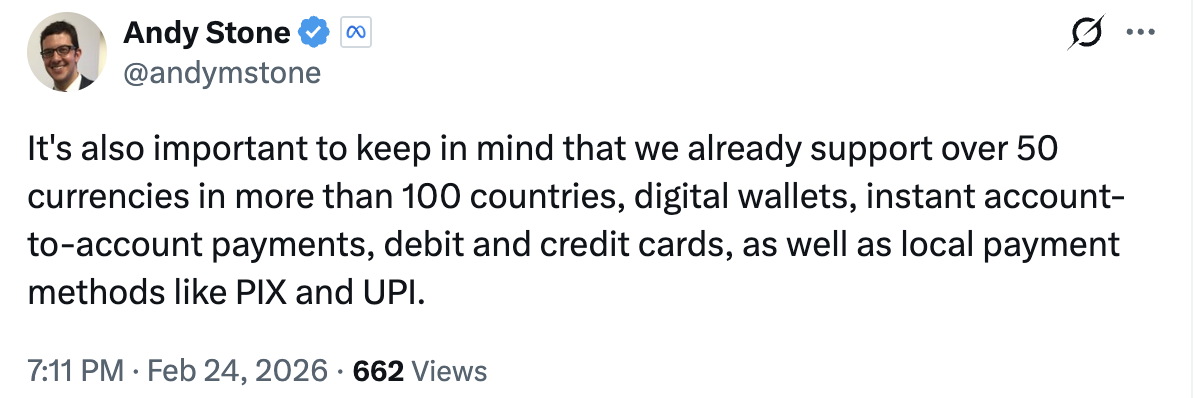
Image courtesy of Andy Stone.
It’s not the first time the social media giant has been reported to be exploring stablecoins. Last year, Fortune Magazine claimed that the company was in discussions with crypto firms to introduce stablecoins to manage payouts, as we reported. It added that the company had hired a new vice president of product to lead the discussions. Stone dismissed the report, reiterating that the company is not developing a stablecoin.
Meta was among the first companies to recognize the vast market that stablecoins could unlock, back in 2019, when Tether’s USDT market cap was just $60 billion (it now stands at $183 billion). However, regulators argued that by issuing its own currency, then known as Libra, the company would be competing with central banks. It was also at the height of its scandal with Cambridge Analytica over illegal access to users’ accounts, which made regulators wary.
A rebrand to Diem and the signing of influential partners like Visa, Uber, and eBay were not enough to save the project, and in 2022, the company sold its stablecoin assets to Silvergate Bank.
Disclaimer: The information on this page may come from third parties and does not represent the views or opinions of Gate. The content displayed on this page is for reference only and does not constitute any financial, investment, or legal advice. Gate does not guarantee the accuracy or completeness of the information and shall not be liable for any losses arising from the use of this information. Virtual asset investments carry high risks and are subject to significant price volatility. You may lose all of your invested principal. Please fully understand the relevant risks and make prudent decisions based on your own financial situation and risk tolerance. For details, please refer to
Disclaimer.
Related Articles
US Senate Passes CBDC Digital Dollar Ban! Funds Turn to LiquidChain for Omnichain Liquidity Deployment
The U.S. Senate passed the "21st Century Housing Act," which prohibits the Federal Reserve from issuing a digital dollar, with restrictions lasting until 2031, reflecting concerns about financial surveillance and personal privacy. Despite opposition from the House of Representatives and political uncertainties, decentralized finance platforms like LiquidChain are seizing market opportunities to drive liquidity innovation.
ChainNewsAbmedia8m ago
Hedera Taps USDT0 to Expand DeFi Interoperability
Hedera, a decentralized, sustainable public network that utilizes a fast, secure, and energy-efficient Hashgraph consensus, has declared its strategic partnership with USDT0, the omnichain deployment of Tether’s USDT. USDT0 is now live on Hedera. This collaboration brings native, smooth,
BlockChainReporter1h ago
Mastercard Includes Solana in Global Crypto Program, Will SOL Price Face a Key Breakthrough?
Mastercard launches a global crypto partnership program, integrating over 80 crypto and fintech companies to drive the convergence of digital assets and traditional finance. Solana, as one of the participants, shares development collaboration with PayPal and others. Related technologies have begun transitioning from pilot to application, such as Kazakhstan's launch of a Solana-based stablecoin payment. Mastercard hopes to narrow the gap with Visa, while Solana's price fluctuates within key ranges, with market attention focused on its application prospects and ecosystem implementation.
GateNews1h ago
Hong Kong Stablecoin Regulation Enters Implementation Stage: HSBC and Standard Chartered Bank May Be First to Obtain Stablecoin Issuance Licenses
HSBC and Standard Chartered are expected to become the first institutions in Hong Kong to obtain stablecoin issuance licenses, marking the imminent launch of Hong Kong's stablecoin regulatory framework. The new regulations require stablecoin issuers to obtain approval and comply with strict management requirements. The approval of both banks will drive traditional financial institutions' participation in blockchain payments and strengthen digital asset compliance.
GateNews2h ago
Ripple CEO Pushes Enterprise-Grade Crypto Applications; Stablecoins and XRPL May Lead Next Wave of Institutional Adoption
Ripple Chief Executive Officer Brad Garlinghouse stated that the company will focus on developing enterprise blockchain applications, particularly the application of stablecoins in financial scenarios. Financial institutions' attention to digital assets continues to rise, and the efficiency improvements of blockchain technology in core business areas such as fund management have become a focus for management. Major institutions are actively deploying stablecoins to advance the development of enterprise-grade cryptocurrency payments.
GateNews2h ago
Privacy Coins Gaining Institutional Attention Again? Bitcoin Mining Pool Operator Foundry Digital Launches Zcash Mining Pool
Bitcoin mining pool operator Foundry Digital plans to launch a Zcash mining pool in April to serve institutional miners and promote the development of privacy blockchains. Despite Zcash's significant price pullback, institutions remain bullish on its long-term value, believing that privacy technology may play an important role in the financial system.
GateNews2h ago


