2025 KAVA Price Prediction: Analyzing Market Trends, Technical Indicators, and Growth Potential in the DeFi Landscape

Introduction: KAVA's Market Position and Investment Value
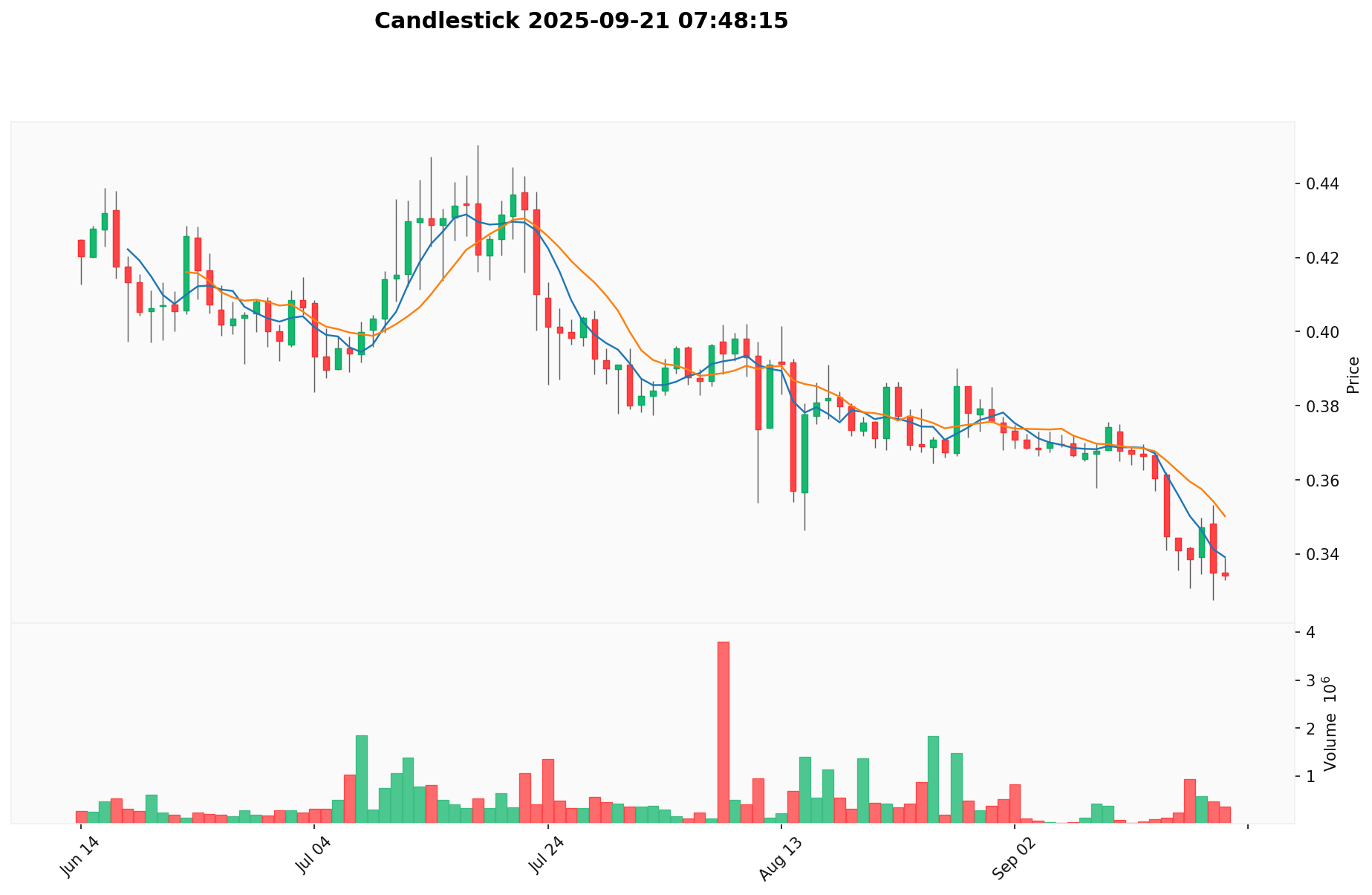
Kava (KAVA), as a cross-chain decentralized finance platform, has achieved significant milestones since its inception. As of 2025, Kava's market capitalization has reached $364,163,486, with a circulating supply of approximately 1,082,853,067 tokens, and a price hovering around $0.3363. This asset, often referred to as the "DeFi hub," is playing an increasingly crucial role in providing cross-chain DeFi applications and services.
This article will comprehensively analyze Kava's price trends from 2025 to 2030, considering historical patterns, market supply and demand, ecosystem development, and macroeconomic factors to provide investors with professional price predictions and practical investment strategies.
I. KAVA Price History Review and Current Market Status
KAVA Historical Price Evolution
- 2021: KAVA reached its all-time high of $9.12 on August 30, 2021, marking a significant milestone in its price history.
- 2024: The token experienced a substantial downturn, hitting its all-time low of $0.247359 on August 5, 2024.
- 2025: KAVA has shown signs of recovery, with the price currently stabilizing around $0.3363.
KAVA Current Market Situation
As of September 21, 2025, KAVA is trading at $0.3363, with a market capitalization of $364,163,486. The token has experienced a slight decline of 0.26% in the past 24 hours, indicating a relatively stable short-term performance. However, looking at longer timeframes, KAVA has faced more significant downward pressure, with a 7-day decrease of 7.23% and a 30-day drop of 9.45%.
The current circulating supply of KAVA stands at 1,082,853,067 tokens, which is also its total supply. The token's 24-hour trading volume is $104,785, suggesting moderate market activity. KAVA's market dominance is currently at 0.0084%, reflecting its position as a mid-cap cryptocurrency in the overall market.
Click to view the current KAVA market price
KAVA Market Sentiment Indicator
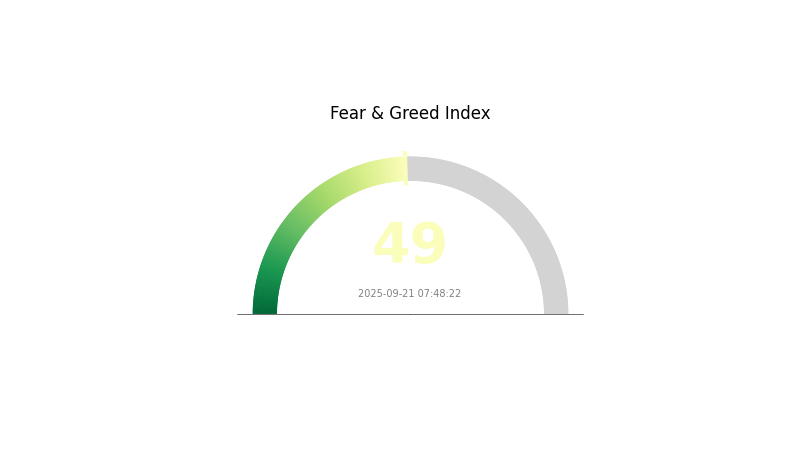
2025-09-21 Fear and Greed Index: 49 (Neutral)
Click to view the current Fear & Greed Index
The cryptocurrency market sentiment for KAVA remains balanced today, with the Fear and Greed Index hovering at 49, indicating a neutral stance. This suggests that investors are neither overly fearful nor excessively greedy. Such equilibrium often presents opportunities for rational decision-making in trading strategies. However, traders should remain vigilant, as market conditions can swiftly change. As always, conducting thorough research and maintaining a diversified portfolio are crucial strategies in navigating the volatile crypto landscape.
KAVA Holdings Distribution
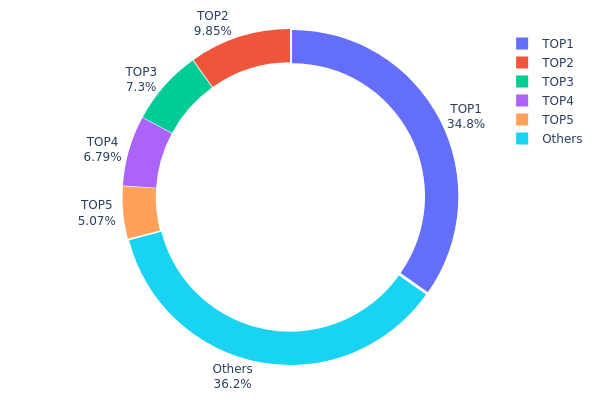
The address holdings distribution data for KAVA reveals a significant concentration of tokens among a small number of addresses. The top address holds 34.78% of the total supply, with the top five addresses collectively controlling 63.78% of KAVA tokens. This high concentration indicates a relatively centralized token distribution, which could potentially impact market dynamics.
Such a concentrated distribution raises concerns about market stability and susceptibility to price manipulation. Large holders, often referred to as "whales," have the potential to significantly influence token price through their trading activities. This concentration also suggests that KAVA's on-chain governance and decision-making processes may be dominated by a small group of token holders.
While some level of concentration is common in many cryptocurrencies, KAVA's distribution appears particularly skewed. This could pose challenges for achieving true decentralization and may increase volatility risk. However, it's worth noting that 36.22% of tokens are held by smaller addresses, indicating some level of wider distribution among the community.
Click to view the current KAVA Holdings Distribution
| Top | Address | Holding Qty | Holding (%) |
|---|---|---|---|
| 1 | 0xf354...4EbC35 | 376712.51K | 34.78% |
| 2 | 0x4feA...D39391 | 106676.61K | 9.85% |
| 3 | 0x0c79...35b5Bd | 79089.65K | 7.30% |
| 4 | 0x8021...Bb8b45 | 73541.05K | 6.79% |
| 5 | 0xed54...bD9D37 | 54892.86K | 5.06% |
| - | Others | 391940.40K | 36.22% |
II. Key Factors Influencing KAVA's Future Price
Supply Mechanism
- Circulating Supply: The current circulating supply of KAVA is 1,082,853,067 tokens.
- Total Supply: The total supply of KAVA is also 1,082,853,067 tokens.
- Current Impact: With an infinite supply model, the constant increase in supply may put downward pressure on the price if demand doesn't keep pace.
Institutional and Whale Dynamics
- Corporate Adoption: Kava has been focusing on building its ecosystem and attracting developers and projects to its platform.
Macroeconomic Environment
- Inflation Hedging Properties: As a cryptocurrency, KAVA may be seen as a potential hedge against inflation, similar to other digital assets.
Technological Development and Ecosystem Building
- Cross-chain Interoperability: Kava is based on Cosmos SDK, enabling connection to over 30 blockchains through IBC, facilitating over $6.25 billion in on-chain asset transfers.
- Ecosystem Applications: Kava is actively working on expanding its DApp ecosystem and improving its platform for developers and users.
III. KAVA Price Prediction for 2025-2030
2025 Outlook
- Conservative prediction: $0.31276 - $0.3363
- Neutral prediction: $0.3363 - $0.39515
- Optimistic prediction: $0.39515 - $0.45401 (requires favorable market conditions and increased adoption)
2027-2028 Outlook
- Market phase expectation: Potential growth phase with increasing adoption
- Price range forecast:
- 2027: $0.31207 - $0.55693
- 2028: $0.37333 - $0.60667
- Key catalysts: Expanding ecosystem, technological improvements, and broader market recovery
2029-2030 Long-term Outlook
- Base scenario: $0.56259 - $0.60479 (assuming steady market growth and continued project development)
- Optimistic scenario: $0.60479 - $0.66527 (assuming strong market performance and significant ecosystem expansion)
- Transformative scenario: $0.66527 - $0.70000 (assuming breakthrough innovations and mass adoption)
- 2030-12-31: KAVA $0.60479 (potential 79% increase from 2025 levels)
| 年份 | 预测最高价 | 预测平均价格 | 预测最低价 | 涨跌幅 |
|---|---|---|---|---|
| 2025 | 0.45401 | 0.3363 | 0.31276 | 0 |
| 2026 | 0.56507 | 0.39515 | 0.32403 | 17 |
| 2027 | 0.55693 | 0.48011 | 0.31207 | 42 |
| 2028 | 0.60667 | 0.51852 | 0.37333 | 54 |
| 2029 | 0.64698 | 0.56259 | 0.38256 | 67 |
| 2030 | 0.66527 | 0.60479 | 0.38706 | 79 |
IV. KAVA Professional Investment Strategy and Risk Management
KAVA Investment Methodology
(1) Long-term Holding Strategy
- Suitable for: Long-term investors with high risk tolerance
- Operation suggestions:
- Accumulate KAVA during market dips
- Monitor project developments and ecosystem growth
- Store tokens securely in non-custodial wallets
(2) Active Trading Strategy
- Technical analysis tools:
- Moving Averages: Use to identify trends and potential reversals
- Relative Strength Index (RSI): Helps determine overbought/oversold conditions
- Key points for swing trading:
- Set clear entry and exit points
- Use stop-loss orders to manage risk
KAVA Risk Management Framework
(1) Asset Allocation Principles
- Conservative investors: 1-3% of crypto portfolio
- Aggressive investors: 5-10% of crypto portfolio
- Professional investors: Up to 15% of crypto portfolio
(2) Risk Hedging Solutions
- Diversification: Spread investments across multiple crypto assets
- Stop-loss orders: Implement to limit potential losses
(3) Secure Storage Solutions
- Hot wallet recommendation: Gate Web3 Wallet
- Cold storage solution: Hardware wallets for long-term holding
- Security precautions: Enable two-factor authentication, use strong passwords
V. Potential Risks and Challenges for KAVA
KAVA Market Risks
- Volatility: Cryptocurrency markets are highly volatile
- Competition: Increasing competition in the DeFi space
- Market sentiment: Susceptible to broader crypto market trends
KAVA Regulatory Risks
- Regulatory uncertainty: Evolving global regulations may impact DeFi platforms
- Compliance challenges: Potential difficulties in adhering to new regulatory requirements
- Cross-border operations: Varying legal frameworks in different jurisdictions
KAVA Technical Risks
- Smart contract vulnerabilities: Potential for exploits or bugs in the protocol
- Scalability issues: Challenges in handling increased network load
- Interoperability concerns: Risks associated with cross-chain operations
VI. Conclusion and Action Recommendations
KAVA Investment Value Assessment
KAVA presents long-term potential in the DeFi sector but faces short-term volatility and competitive pressures. The project's success depends on continued ecosystem growth and adoption of its financial services.
KAVA Investment Recommendations
✅ Beginners: Start with small positions and focus on learning about DeFi ✅ Experienced investors: Consider KAVA as part of a diversified DeFi portfolio ✅ Institutional investors: Conduct thorough due diligence and monitor regulatory developments
Ways to Participate in KAVA Trading
- Spot trading: Buy and sell KAVA on cryptocurrency exchanges
- Staking: Participate in network security and earn rewards
- DeFi integration: Utilize KAVA in various DeFi applications within its ecosystem
Cryptocurrency investments carry extremely high risk. This article does not constitute investment advice. Investors should make decisions carefully based on their own risk tolerance and are advised to consult professional financial advisors. Never invest more than you can afford to lose.
FAQ
How high will KAVA go?
KAVA might reach $0.99 by 2025 and could surge to $4.60 in the future, based on current predictions. The current price is $0.33665578.
How much will KNC coin prices be in 2030?
Based on current market analysis, KNC coin is projected to reach a high of $0.440482 and a low of $0.344361 in 2030.
What is the KAVA stock price?
KAVA's price is $0.34, with a 24-hour trading volume of $7.6 million. This represents a slight decline in recent trading.
What is KAVA crypto?
KAVA is a utility cryptocurrency for the Kava platform, enabling users to borrow USDX by locking cryptocurrencies as collateral. Users earn KAVA rewards based on collateral type and USDX minted. USDX is over-collateralized for borrower security.
Share
Content
Introduction: KAVA's Market Position and Investment Value
I. KAVA Price History Review and Current Market Status
II. Key Factors Influencing KAVA's Future Price
III. KAVA Price Prediction for 2025-2030
IV. KAVA Professional Investment Strategy and Risk Management
V. Potential Risks and Challenges for KAVA
VI. Conclusion and Action Recommendations
FAQ
How to Buy Cryptocurrency


Trending Cryptocurrencies



What will be the market capitalization of USDC in 2025? Analysis of the stablecoin market landscape.

How is DeFi different from Bitcoin?

What is DeFi: Understanding Decentralized Finance in 2025

USDC stablecoin 2025 Latest Analysis: Principles, Advantages, and Web3 Eco-Applications

Development of Decentralized Finance Ecosystem in 2025: Integration of Decentralized Finance Applications with Web3

2025 USDT USD Complete Guide: A Must-Read for Newbie Investors
What Is SocialFi? Is This Emerging as a New Trend in the Crypto Market?
Best Crypto Wallets for 2025: A Review of Leading Options

Everything About Automated Market Makers

Are NFTs Dead? A Guide to NFT Applications
Six Cryptocurrencies That Achieved Over 1,000x Total Growth