This comprehensive article compares ARCH and BTC investment potential across multiple dimensions including historical price trends, supply mechanisms, institutional adoption, and technical ecosystems. ARCH, a Bitcoin Layer 2 solution, declined 99.3% from peak while BTC experienced a 37.6% decline, reflecting significantly different risk profiles. The analysis examines institutional adoption patterns, with BTC demonstrating stronger mainstream acceptance, and explores 2026-2031 price projections for both assets. Strategic recommendations differentiate between investor types: beginners should prioritize BTC for established market positioning and clarity, while experienced investors may diversify with selective ARCH allocation. The article emphasizes BTC's role as digital gold with institutional-grade infrastructure, contrasting with ARCH's emerging Layer 2 ecosystem positioning, providing investors with actionable insights on portfolio allocation and risk management strategies.
Introduction: Investment Comparison Between ARCH and BTC
In the cryptocurrency market, the comparison between ARCH and BTC has consistently been a topic of interest for investors. These two assets differ significantly in market capitalization ranking, application scenarios, and price performance, representing distinct positioning within the crypto asset landscape.
ARCH (Archway): An incentivized smart contract platform designed to reward developers and facilitate the creation of next-generation decentralized applications (dApps). The protocol provides tools for building and launching scalable cross-chain dApps, with a focus on democratizing access to value creation for developers globally.
BTC (Bitcoin): Since its introduction in 2008, Bitcoin has been recognized as digital gold and remains one of the cryptocurrencies with notable trading volume and market capitalization globally. It operates as a decentralized peer-to-peer digital currency based on cryptographic principles and a distributed network.
This article will analyze the investment value comparison between ARCH and BTC across multiple dimensions, including historical price trends, supply mechanisms, institutional adoption, technical ecosystems, and future projections, while addressing a key question for investors:
"Which is the better buy right now?"
I. Historical Price Comparison and Current Market Status
Price History of ARCH (Coin A) and BTC (Coin B)
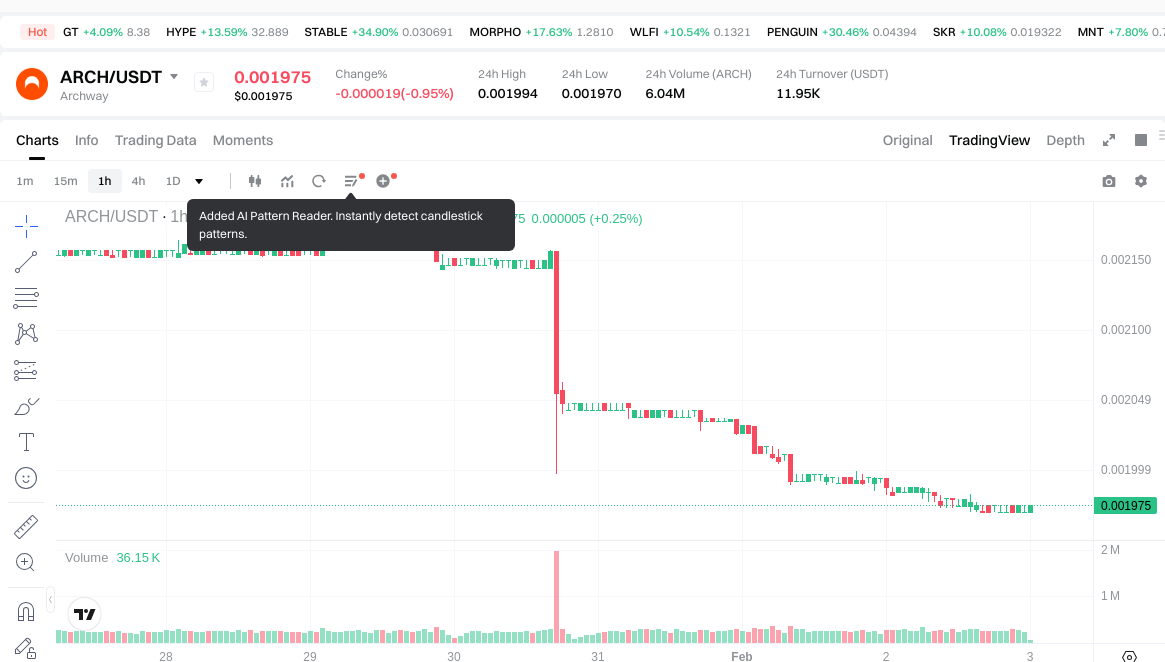
- 2023: ARCH reached its historical high of $0.28899 on December 24, 2023, as the project launched its incentivized smart contract platform.
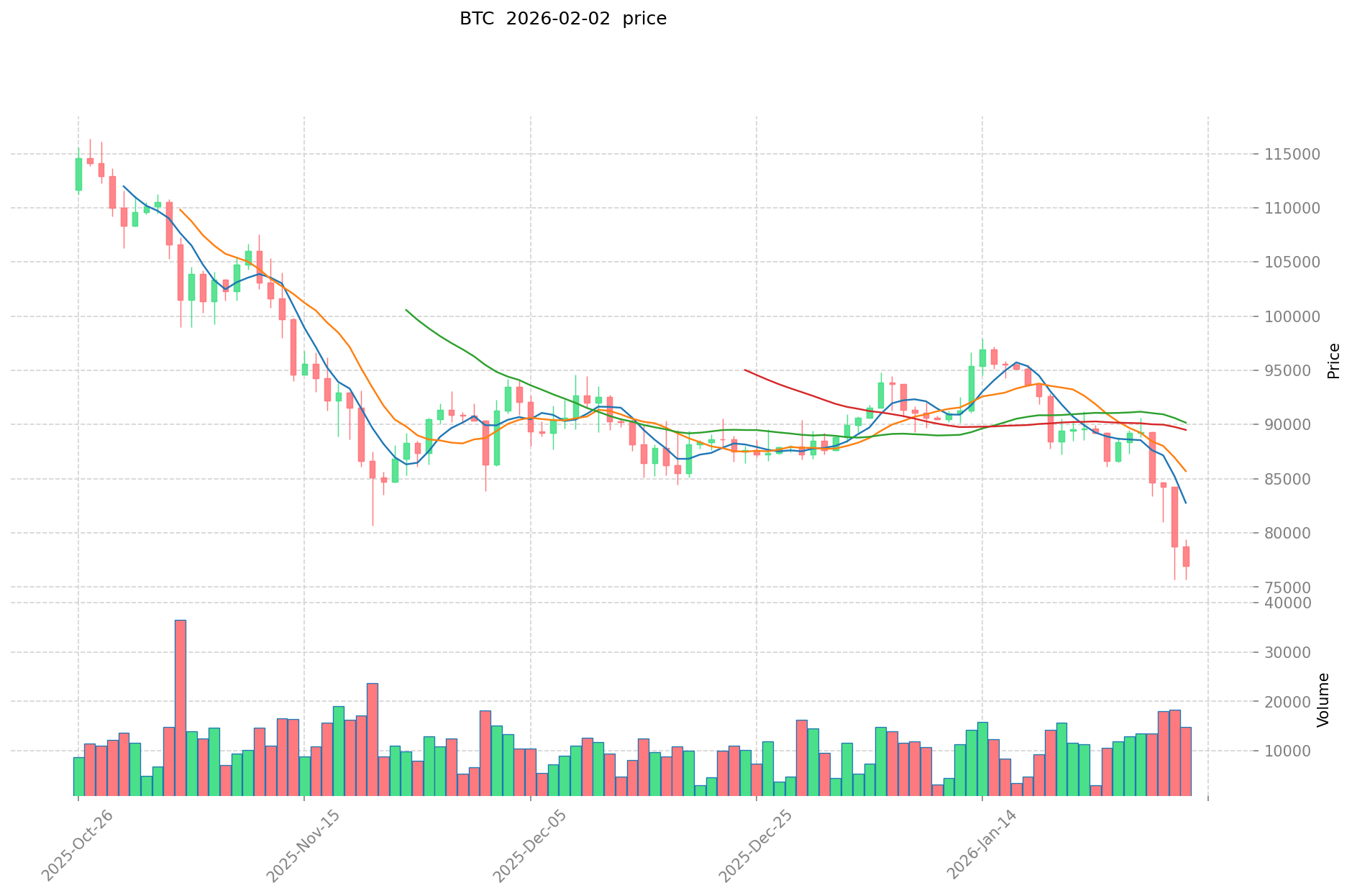
- 2025: BTC experienced significant volatility, reaching an all-time high of $126,080 on October 7, 2025, driven by institutional adoption and spot ETF approvals.
- 2026: ARCH declined to its historical low of $0.00197 on February 2, 2026, while BTC showed relative resilience with substantial price fluctuations.
- Comparative Analysis: During the current market cycle, ARCH decreased from its peak of $0.28899 to $0.00197, representing a decline of approximately 99.3%, while BTC experienced a decrease from $126,080 to approximately $78,696, representing a decline of approximately 37.6%.
Current Market Status (February 3, 2026)
- ARCH Current Price: $0.00197
- BTC Current Price: $78,696.3
- 24-Hour Trading Volume: ARCH $11,996.30 vs BTC $1,646,067,040.45
- Market Sentiment Index (Fear & Greed Index): 14 (Extreme Fear)
View real-time prices:
- View ARCH current price Market Price
- View BTC current price Market Price
II. Core Factors Influencing ARCH vs BTC Investment Value
Supply Mechanism Comparison (Tokenomics)
- BTC: Features a fixed supply cap of 21 million coins with a halving mechanism that reduces mining rewards approximately every four years, creating a deflationary model that has historically influenced price cycles.
- ARCH: Specific supply mechanism details are not available in the provided materials.
- 📌 Historical Pattern: Supply mechanisms play a significant role in driving price cycle changes, with scarcity-driven models often correlating with long-term value appreciation.
Institutional Adoption and Market Application
- Institutional Holdings: BTC demonstrates stronger institutional preference, with established frameworks for institutional investment and custody solutions.
- Enterprise Adoption: BTC has gained traction in cross-border payments, settlement systems, and investment portfolios, being recognized as a store of value asset. ARCH focuses on Bitcoin Layer 2 solutions, aiming to enhance Bitcoin's functionality without requiring bridge mechanisms.
- National Policies: Regulatory attitudes vary across jurisdictions, with BTC receiving more established regulatory frameworks in major economies, while Layer 2 solutions like ARCH operate within evolving regulatory landscapes.
Technology Development and Ecosystem Building
- BTC Technology Development: Continues to strengthen its foundational architecture as a decentralized, peer-to-peer digital currency, with ongoing improvements in network security and scalability considerations.
- ARCH Technology Development: Positions itself as a Bitcoin-based Layer 2 solution, utilizing a Rust-based zero-knowledge virtual machine (ArchVM) to expand Bitcoin's application capabilities.
- Ecosystem Comparison: BTC maintains a mature ecosystem with established presence in store of value use cases. ARCH aims to extend Bitcoin's functionality into DeFi and smart contract applications through Layer 2 infrastructure, though specific ecosystem metrics are limited in available materials.
Macroeconomic Environment and Market Cycles
- Performance During Inflation: BTC demonstrates stronger anti-inflation properties due to its longer market history and recognition as "digital gold," serving as a hedge against currency devaluation.
- Macroeconomic Monetary Policy: Interest rates and dollar index movements influence both assets, with BTC showing more established correlation patterns due to its longer trading history.
- Geopolitical Factors: Cross-border transaction demand and international situations impact both assets, with BTC benefiting from its established role in international value transfer and ARCH positioned to enhance Bitcoin's cross-border functionality through Layer 2 solutions.
III. 2026-2031 Price Prediction: ARCH vs BTC
Short-term Prediction (2026)
- ARCH: Conservative $0.0016–$0.0020 | Optimistic $0.0020–$0.0028
- BTC: Conservative $68,452–$78,680 | Optimistic $78,680–$113,299
Mid-term Prediction (2028-2029)
- ARCH may enter a gradual growth phase, with estimated price range of $0.0026–$0.0053
- BTC may enter a maturation phase, with estimated price range of $83,036–$142,948
- Key drivers: institutional capital inflows, ETF developments, ecosystem expansion
Long-term Prediction (2030-2031)
- ARCH: Baseline scenario $0.0028–$0.0055 | Optimistic scenario $0.0044–$0.0074
- BTC: Baseline scenario $82,826–$144,617 | Optimistic scenario $103,533–$186,359
View detailed price predictions for ARCH and BTC
Disclaimer
ARCH:
| Year |
Predicted High Price |
Predicted Average Price |
Predicted Low Price |
Price Change |
| 2026 |
0.002844 |
0.001975 |
0.00156025 |
0 |
| 2027 |
0.00351787 |
0.0024095 |
0.001758935 |
22 |
| 2028 |
0.0043862538 |
0.002963685 |
0.0026080428 |
50 |
| 2029 |
0.005255206242 |
0.0036749694 |
0.002903225826 |
86 |
| 2030 |
0.00553670889804 |
0.004465087821 |
0.00281300532723 |
126 |
| 2031 |
0.007351320588494 |
0.00500089835952 |
0.004350781572782 |
153 |
BTC:
| Year |
Predicted High Price |
Predicted Average Price |
Predicted Low Price |
Price Change |
| 2026 |
113299.344 |
78680.1 |
68451.687 |
0 |
| 2027 |
114227.76918 |
95989.722 |
81591.2637 |
21 |
| 2028 |
142947.8940024 |
105108.74559 |
83035.9090161 |
33 |
| 2029 |
138911.718171744 |
124028.3197962 |
100462.939034922 |
57 |
| 2030 |
144617.0208823692 |
131470.018983972 |
82826.11195990236 |
67 |
| 2031 |
186358.75190978031 |
138043.5199331706 |
103532.63994987795 |
75 |
IV. Investment Strategy Comparison: ARCH vs BTC
Long-term vs Short-term Investment Strategies
- ARCH: Suitable for investors with higher risk tolerance who are interested in Bitcoin Layer 2 ecosystem development and emerging smart contract platforms, focusing on potential technological innovation in extending Bitcoin's functionality.
- BTC: Suitable for investors seeking value preservation characteristics, anti-inflation properties, and established market positioning, with focus on long-term wealth preservation and participation in institutional-grade digital assets.
Risk Management and Asset Allocation
- Conservative Investors: ARCH 5-10% vs BTC 90-95%
- Aggressive Investors: ARCH 20-30% vs BTC 70-80%
- Hedging Tools: stablecoin allocation, options strategies, cross-asset portfolio diversification
V. Potential Risk Comparison
Market Risk
- ARCH: Experiences elevated price volatility with significant drawdown from historical peaks, subject to market sentiment shifts and limited liquidity conditions as reflected in current trading volumes.
- BTC: Demonstrates substantial price fluctuations influenced by macroeconomic factors, institutional flows, and regulatory developments, though with relatively established market depth and liquidity infrastructure.
Technical Risk
- ARCH: Scalability considerations and network stability associated with Layer 2 infrastructure development, dependency on Bitcoin's underlying protocol.
- BTC: Mining power distribution patterns, network security maintenance, transaction throughput limitations under high-demand periods.
Regulatory Risk
- Global regulatory frameworks impact both assets differently, with BTC receiving more established regulatory treatment in major jurisdictions, while Layer 2 solutions like ARCH operate within evolving regulatory considerations regarding smart contract platforms and DeFi applications.
VI. Conclusion: Which Is the Better Buy?
📌 Investment Value Summary:
- ARCH Advantages: Positions within Bitcoin Layer 2 ecosystem expansion, potential participation in Bitcoin's extended functionality through smart contract capabilities, lower entry price point relative to historical ranges.
- BTC Advantages: Established market recognition as digital store of value, mature institutional adoption frameworks, demonstrated resilience across market cycles, stronger liquidity profile.
✅ Investment Recommendations:
- Beginner Investors: Consider prioritizing BTC allocation for foundational exposure to established digital assets with clearer market dynamics and educational resources.
- Experienced Investors: May explore diversified approaches combining BTC core holdings with selective ARCH allocation based on risk capacity and interest in Bitcoin Layer 2 development trajectories.
- Institutional Investors: Focus on BTC positioning within portfolio construction frameworks, with consideration of regulatory clarity, custody solutions, and alignment with institutional investment mandates.
⚠️ Risk Disclosure: Cryptocurrency markets exhibit elevated volatility characteristics. This content does not constitute investment advice.
VII. FAQ
Q1: What is the fundamental difference between ARCH and BTC in terms of their core use cases?
BTC serves as a decentralized peer-to-peer digital currency and store of value (often referred to as "digital gold"), while ARCH is a Bitcoin Layer 2 solution designed to extend Bitcoin's functionality through smart contract capabilities. BTC focuses on value preservation and established transactional infrastructure, whereas ARCH aims to enhance Bitcoin's utility by enabling decentralized applications (dApps) and DeFi functionalities without requiring bridge mechanisms.
Q2: Which asset experienced greater price volatility from its historical peak to current levels?
ARCH experienced significantly greater volatility, declining approximately 99.3% from its peak of $0.28899 (December 24, 2023) to $0.00197 (February 2, 2026). In comparison, BTC declined approximately 37.6% from its all-time high of $126,080 (October 7, 2025) to approximately $78,696. This demonstrates ARCH's substantially higher risk profile and price sensitivity compared to BTC's relatively more established market positioning.
Q3: How do the supply mechanisms of ARCH and BTC differ, and what impact does this have on investment considerations?
BTC features a fixed supply cap of 21 million coins with a halving mechanism that reduces mining rewards approximately every four years, creating a deflationary model that historically correlates with price cycles and scarcity-driven value appreciation. Specific supply mechanism details for ARCH are not available in current materials. BTC's transparent and proven supply dynamics provide investors with clearer long-term scarcity characteristics, while ARCH's tokenomics require additional research for comprehensive evaluation.
Q4: What are the recommended portfolio allocation strategies for conservative versus aggressive investors?
Conservative investors should consider allocating 5-10% to ARCH and 90-95% to BTC, prioritizing established market positioning and value preservation characteristics. Aggressive investors with higher risk tolerance may explore 20-30% ARCH allocation combined with 70-80% BTC holdings, accepting elevated volatility in exchange for potential exposure to Bitcoin Layer 2 ecosystem growth. Both strategies should incorporate risk management tools including stablecoin allocations, options strategies, and cross-asset diversification.
Q5: How does institutional adoption differ between ARCH and BTC?
BTC demonstrates substantially stronger institutional adoption, with established frameworks for institutional investment, custody solutions, and regulatory clarity in major jurisdictions. It has gained traction in cross-border payments, settlement systems, and investment portfolios as a recognized store of value asset. ARCH, as a Bitcoin Layer 2 solution, operates within evolving regulatory landscapes with limited information on institutional adoption patterns. This disparity significantly impacts liquidity profiles, market depth, and accessibility for institutional capital deployment.
Q6: What are the primary technical risks associated with each asset?
ARCH faces technical risks related to scalability considerations and network stability associated with Layer 2 infrastructure development, along with dependency on Bitcoin's underlying protocol performance. BTC's technical risks include mining power distribution patterns, network security maintenance requirements, and transaction throughput limitations during high-demand periods. Both assets operate within different technical risk spectrums, with ARCH's emerging infrastructure facing development-stage challenges while BTC manages maturity-stage optimization considerations.
Q7: Based on the 2026-2031 price predictions, what growth trajectories are projected for both assets?
For 2026, ARCH's conservative range is projected at $0.0016–$0.0020 with an optimistic range of $0.0020–$0.0028, while BTC's conservative range is $68,452–$78,680 with an optimistic range of $78,680–$113,299. By 2031, ARCH's baseline scenario projects $0.0028–$0.0055 (optimistic: $0.0044–$0.0074), while BTC's baseline scenario projects $82,826–$144,617 (optimistic: $103,533–$186,359). These projections suggest different growth velocity patterns, with ARCH showing higher percentage potential from current levels but within a substantially smaller absolute value framework compared to BTC's established market capitalization trajectory.
Q8: Which asset is better suited for beginners entering the cryptocurrency market?
BTC is recommended for beginner investors seeking foundational exposure to established digital assets. It offers clearer market dynamics, extensive educational resources, established custody solutions, and more predictable regulatory frameworks compared to emerging Layer 2 solutions. BTC's longer market history provides accessible information for risk assessment and portfolio management, while its institutional-grade infrastructure supports more straightforward onboarding processes. Beginners should prioritize understanding BTC's fundamentals before exploring higher-risk alternatives like ARCH that require deeper technical knowledge of Layer 2 ecosystems.
* The information is not intended to be and does not constitute financial advice or any other recommendation of any sort offered or endorsed by Gate.