Best Graphics Card for Mining: Updated GPU Rankings
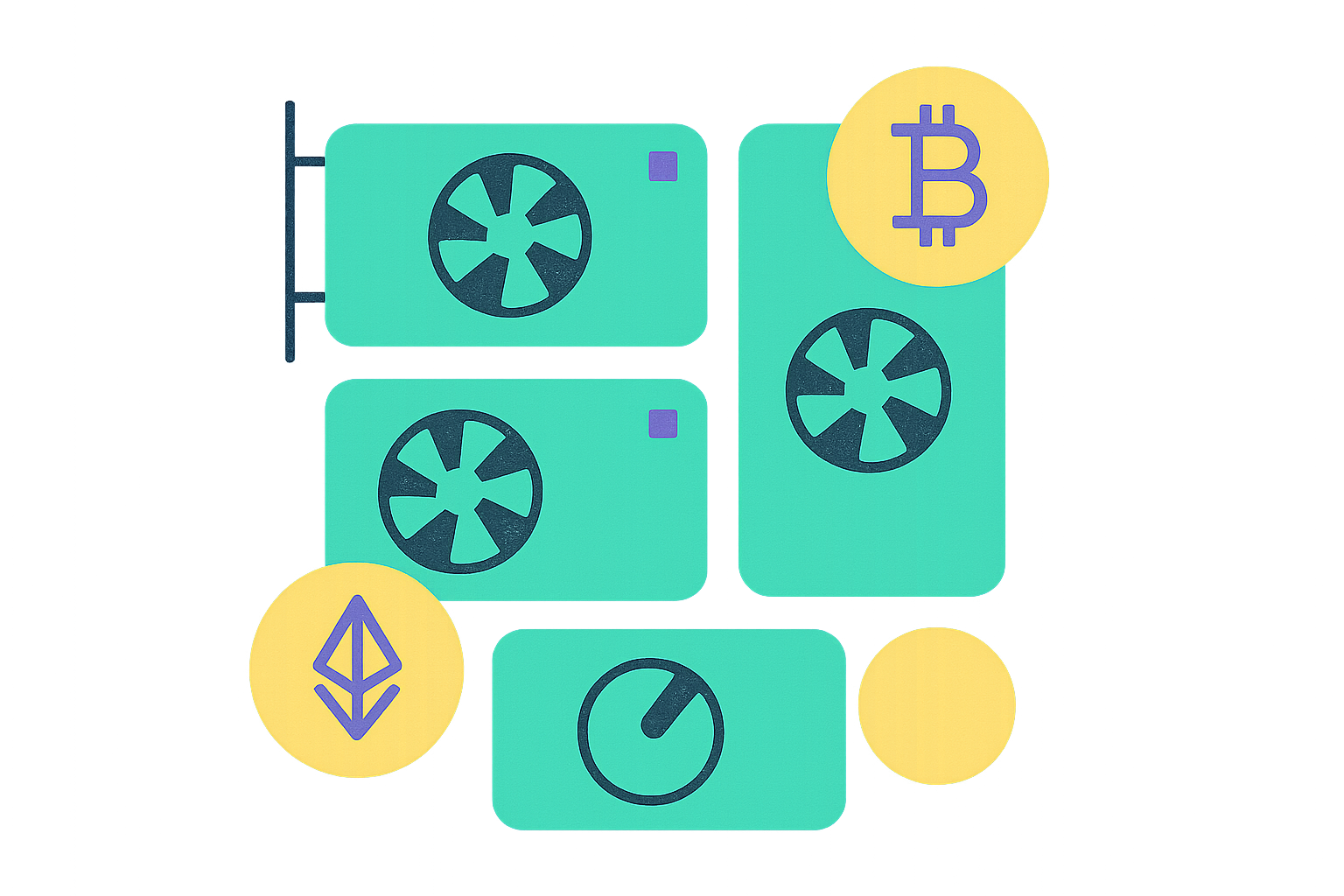
Best Graphics Cards for Mining Today: Specifications, Pros, and Cons
Choosing the right graphics card for cryptocurrency mining is crucial to building a successful mining operation. The current market features a broad selection of GPUs from top manufacturers—NVIDIA and AMD—each offering unique performance, efficiency, and cost profiles. This section highlights the most current mining GPU models, reviews their technical specs, and helps identify the best choices for various use cases.
Latest Mining GPUs
The newest generation of graphics processors marks a major technological leap for cryptocurrency mining. These cards come equipped with advanced architectures, expanded memory, and enhanced energy efficiency.
NVIDIA GeForce RTX 5090
Specifications:
- Release year: Recent
- Memory: 32 GB GDDR7
- Memory bus: 512-bit
- TDP: ~575 W
- Hashrates: Ethereum Classic ~216 MH/s, Ravencoin ~96 MH/s, Kaspa ~2.0 GH/s
- Estimated price: about $2,000
The RTX 5090 stands as the flagship of the RTX 50 series, purpose-built for professional mining setups. It delivers exceptional performance thanks to its massive, high-speed GDDR7 memory and wide 512-bit bus. Despite its substantial 575 W power draw, the card achieves impressive hashrates on popular mining algorithms. This GPU is ideal for large-scale farms with advanced cooling and reliable power infrastructure.
NVIDIA GeForce RTX 5080
Specifications:
- Release year: Recent
- Memory: 16 GB GDDR7
- TDP: ~360 W
- Hashrates: Ethereum Classic ~130 MH/s, Ravencoin ~60 MH/s
- Estimated price: about $1,000
The RTX 5080 offers a balanced alternative within the RTX 50 lineup. At half the flagship’s price, it delivers solid performance and significantly lower power consumption (360 W). This makes the RTX 5080 a compelling option for mid-tier miners seeking the best mix of performance, efficiency, and initial cost.
AMD Radeon RX 9070 XT
Specifications:
- Release year: Recent
- Memory: 16 GB GDDR6
- TDP: ~304 W
- Estimated price: about $600
Powered by the latest RDNA 4 architecture, the RX 9070 XT strikes an excellent balance between cost and performance. It features 16 GB of GDDR6 memory and sustains stable hashrates with moderate energy consumption (304 W). This model is particularly attractive for miners committed to AMD or aiming to minimize upfront investment without sacrificing much performance.
AMD Radeon RX 9070
Specifications:
- Release year: Recent
- Memory: 16 GB GDDR6
- TDP: ~220 W
- Estimated price: about $550
The base RX 9070 is a budget-friendly choice for miners focused on energy efficiency. With just 220 W power draw and 16 GB of memory, it's a smart fit for small home farms or regions with high electricity costs. Its low heat output also simplifies cooling requirements.
Proven Previous Generation Models
Older-generation graphics cards remain viable for mining due to their track record for reliability, broad secondary market availability, and well-understood specs. These models are ideal for miners with limited budgets or those wanting to minimize risk when starting out.
NVIDIA GeForce RTX 4090
NVIDIA’s former flagship, released several years ago, continues to deliver outstanding mining performance. Its high memory bandwidth and powerful compute core enable consistently high hashrates across multiple algorithms. Estimated price: new ~$1,500–1,600, used ~$1,200. Despite the premium, the RTX 4090 remains a strong choice for serious miners seeking top-tier results.
NVIDIA GeForce RTX 4070 Ti
This high-performance, energy-efficient GPU debuted several years ago and is well-suited for mid-level mining operations. It offers an excellent balance of performance and power efficiency, making it popular for mid-sized farms. Estimated price: new ~$750–800, used ~$500. Strong secondary market availability and attractive pricing make the RTX 4070 Ti a sought-after solution.
NVIDIA GeForce RTX 3080
The RTX 3080, an icon of the GPU mining boom, continues to deliver high performance across most algorithms with proven reliability. Estimated secondary market price: ~$400. The widespread adoption of this model ensures easy access to parts and robust optimization resources.
NVIDIA GeForce RTX 3060 Ti
One of the most popular budget mining GPUs, released several years ago, the RTX 3060 Ti offers an excellent price-to-performance ratio, making it a favorite for both newcomers and small-scale miners. Estimated secondary market price: ~$200–250. Affordable entry and dependable performance make it an ideal starter card.
AMD Radeon RX 7900 XTX
AMD’s flagship model from several years ago features a massive 24 GB of video memory and delivers strong hashrates for memory-intensive algorithms. Built on the RDNA 3 architecture, it offers excellent efficiency for its class. Estimated price: new ~$800–900, used ~$600–700. The RX 7900 XTX is a powerful alternative to top NVIDIA offerings.
AMD Radeon RX 6800 XT
This successful RDNA 2-era AMD card, launched several years ago, has proven reliable and stable for mining. With 16 GB of GDDR6 memory, it offers solid performance on a range of algorithms with reasonable power consumption. Estimated secondary market price: ~$300–350. Its attractive cost makes the RX 6800 XT a popular pick for farm expansion.
AMD Radeon RX 6600 XT
An energy-efficient budget solution introduced several years ago, the RX 6600 XT is ideal for home mining setups. Its low power draw (about 120 W) and respectable performance enable rapid payback in regions with moderate electricity rates. Estimated price: new ~$200, used ~$150–170. It's among the most affordable entry points for mining with minimal investment.
Key Considerations for Choosing a Mining GPU
Selecting the right graphics card for mining requires balancing financial resources, performance needs, and operating conditions. While the latest GPUs deliver top performance and efficiency, they demand significant upfront investment. In contrast, proven older models remain relevant for their stability, wide availability, and faster return on investment.
When choosing a card, weigh factors beyond hashrate and price—consider power draw, regional availability, electricity costs, and cooling capabilities. For large professional farms, it's reasonable to invest in the newest, highest-performing models. For home mining or newcomers, previous-generation cards with optimal price and performance may be the more practical choice.
What Is Cryptocurrency Mining?
Cryptocurrency mining is the process of generating new digital coins by solving complex mathematical problems within a blockchain network. Miners use computing power from specialized hardware (GPUs, ASIC miners) to verify transactions, earning new coins and transaction fees as rewards.
This process is essential for the crypto ecosystem—it secures networks, prevents double spending, and sustains blockchain decentralization. Different cryptocurrencies rely on distinct consensus and mining algorithms, shaping hardware requirements and potential profitability.
GPU Mining: Features and Operating Principles
Mining with graphics cards (GPUs) remains one of the most popular and accessible methods for cryptocurrency extraction. Unlike dedicated ASIC miners, GPUs are versatile and efficiently support a range of mining algorithms, allowing flexibility in coin selection.
How to Set Up GPU Mining
There are several ways to organize GPU mining. New miners can start by mining with a single graphics card in a standard computer, gaining hands-on experience with minimal investment and evaluating potential returns.
For larger setups, miners combine multiple GPUs into a dedicated mining rig or farm. Typical rigs feature 4 to 12 graphics cards connected to a single motherboard via PCI-E risers, providing scalable computing power and enabling higher total hashrates.
Mining can be done solo or as part of a pool, where multiple miners combine resources for more consistent and predictable earnings. Pools distribute rewards based on each participant’s contribution, which is especially valuable for miners with limited hardware who can't compete with large farms in solo mining.
Mining GPU Payback: Calculation and Key Factors
The return on investment for mining GPUs depends on multiple factors. Key variables include upfront hardware cost, current coin price, network difficulty, hashrate, and—critically—local electricity rates.
To accurately estimate profitability and payback period, use specialized mining calculators like Whattomine. These tools let you input hardware specs and electricity costs to calculate projected income based on current market conditions. Keep in mind, profitability fluctuates with crypto price volatility and shifting mining difficulty.
Experienced miners advise building in a payback buffer and not relying solely on current profit figures, since the crypto market is highly volatile.
Advantages of GPU Mining
GPU mining offers several key benefits, making it an attractive option for a wide range of miners:
-
Low entry barrier: Used mining GPUs are available at affordable prices, making mining accessible even to budget-conscious beginners.
-
Wide hardware selection: Numerous GPU models spanning price and performance tiers let you tailor solutions to any mining setup.
-
Versatility: Graphics cards mine many different cryptocurrencies and algorithms, enabling flexibility and the ability to switch coins for optimal returns.
-
High liquidity: GPUs can be easily resold on the secondary market, minimizing exit or upgrade risks.
-
Interchangeability: GPUs from different brands and generations work together in a single rig, making scaling and maintenance easier.
-
Alternative uses: Unlike ASIC miners, GPUs can be repurposed for gaming, design, or machine learning if mining ceases to be profitable.
Disadvantages of GPU Mining
Despite its strengths, GPU mining has notable drawbacks to consider:
-
Learning curve: Beginners need to understand crypto markets, blockchain basics, mining software setup, and GPU tuning.
-
Additional expenses: Beyond GPUs, you’ll need to invest in supporting hardware (motherboard, CPU, power supplies, risers), cooling, and a suitable location.
-
High noise levels: Mining farms generate significant fan noise, which can be disruptive in residential spaces.
-
Heat output: Mining GPUs produce considerable heat, requiring robust ventilation and potentially increasing cooling costs.
-
Technical skills: Basic PC hardware knowledge is needed for setup, configuration, and maintenance.
-
Equipment wear: Continuous, high-load operation accelerates GPU wear and may cause failures.
What Cryptocurrencies Can You Mine with a GPU?
GPUs support mining a wide array of cryptocurrencies using different consensus algorithms. Top coins for GPU mining include:
Ethereum Classic (ETC): A leading coin for GPU mining using the Ethash algorithm. After Ethereum moved to Proof-of-Stake, many miners switched to Ethereum Classic.
Ravencoin (RVN): Built for GPU mining with the KawPow algorithm, it offers relatively low network difficulty and steady profitability.
Ergo (ERG): A promising coin using the Autolykos v2 algorithm, which is optimized for GPUs with large memory.
Kaspa (KAS): A fast-growing coin utilizing the kHeavyHash algorithm, showing excellent performance on modern GPUs.
Flux (FLUX): Runs on the ZelHash algorithm, delivering stable returns for mid-level miners.
Dogecoin (DOGE) and other Scrypt-based coins can be mined with certain GPUs, though ASICs tend to be more efficient for these algorithms.
Choose the best coin to mine based on current profitability (as checked with calculators like Whattomine), project outlook, and your hardware’s specifications.
Where to Buy Mining GPUs: New vs. Used
When assembling a mining farm, one central decision is whether to buy new or used GPUs. Each option has its own pros and cons.
New Mining GPUs
Advantages of buying new GPUs:
- Manufacturer warranty: Usually 1–3 years, protecting your investment
- Peak performance: New cards operate at their maximum rated specs, with no prior wear
- Predictable lifespan: No history of use means you can expect reliable, long-term operation
- Latest tech: Access to cutting-edge GPU architecture and improved efficiency
Disadvantages:
- High upfront cost: New GPUs are much more expensive than used models
- Longer payback period: Given current crypto prices, ROI may take a year or longer
- Risk of obsolescence: Rapid tech advances mean new cards can become outdated before paying off
Used Mining GPUs
Advantages of buying used GPUs:
- Lower entry cost: Secondary market prices may be 30–60% less than new cards
- Wide model selection: Used listings include GPUs from different generations and price brackets
- Faster payback: Lower purchase cost shortens ROI period
- Chance to test: Many sellers allow you to verify card functionality before purchase
Disadvantages:
- No warranty: Most used GPUs are sold without official coverage
- Potential hidden defects: Heavy prior use can lead to early breakdowns
- Unknown usage history: Actual condition and lifespan may be hard to assess
- Possible cooling issues: Worn thermal pads or paste may need replacement
You can find used GPUs on popular classifieds, mining forums, and major marketplaces. Always check the card’s condition carefully, request stress test results, and, if possible, verify operation before payment.
FAQ
Which GPU Is Best for Mining in 2024?
For 2024, NVIDIA GeForce RTX 4060 Ti (payback: 62 months), RTX 3060 Ti (79 months), and RTX 2080 Ti (84 months) are recommended. These cards deliver the ideal balance of performance and efficiency.
What Is the Payback Period and Profitability for Modern GPU Mining?
GPU mining payback typically ranges from 8–12 months at current electricity and crypto rates. Monthly profit depends on the GPU model and network difficulty. ASIC miners pay off faster, but GPUs offer greater flexibility for algorithm selection.
How Do NVIDIA and AMD Mining GPUs Differ?
NVIDIA uses CUDA cores; AMD relies on stream processors. NVIDIA drivers are more universal and easier for mining. AMD may require firmware updates for optimal performance, but allows older models to be boosted through overclocking.
What Technical Specs Matter Most for Effective Mining GPUs?
Key specs: memory bandwidth, number of compute cores (CUDA/Stream Processors), VRAM capacity, and efficiency. High bandwidth and core count directly impact hashrate. At least 6 GB of memory is required for modern algorithms.
What Is the Average Electricity Cost Needed for GPU Mining Payback?
To achieve payback with GPU mining, electricity costs should be under $0.30 per day. Typical card earnings are $0.30–0.80 per day, so low power rates are critical for profitability.
What Are the Most Profitable Cryptocurrencies for GPU Mining?
The most profitable coins for GPU mining are Ethereum Classic (ETC) and Kaspa (KAS), which offer high block rewards and relatively low network difficulty. Bitcoin is also possible, but requires specialized hardware.
Share
Content
Best Graphics Cards for Mining Today: Specifications, Pros, and Cons
Latest Mining GPUs
Proven Previous Generation Models
Key Considerations for Choosing a Mining GPU
What Is Cryptocurrency Mining?
GPU Mining: Features and Operating Principles
How to Set Up GPU Mining
Mining GPU Payback: Calculation and Key Factors
Advantages of GPU Mining
Disadvantages of GPU Mining
What Cryptocurrencies Can You Mine with a GPU?
Where to Buy Mining GPUs: New vs. Used
New Mining GPUs
Used Mining GPUs
FAQ
How to Buy Cryptocurrency


Trending Cryptocurrencies



XZXX: A Comprehensive Guide to the BRC-20 Meme Token in 2025

Survey Note: Detailed Analysis of the Best AI in 2025

Detailed Analysis of the Best 10 GameFi Projects to Play and Earn in 2025

Kaspa’s Journey: From BlockDAG Innovation to Market Buzz
Best Crypto Wallets 2025: How to Choose and Secure Your Digital Assets
Popular GameFi Games in 2025
2026 TAKER Price Prediction: Expert Analysis and Market Forecast for the Coming Year
2026 DEFI Price Prediction: Expert Analysis and Market Forecast for Decentralized Finance Tokens

2026 DPR Price Prediction: Expert Analysis and Market Forecast for the Upcoming Year

2026 EDGEN Price Prediction: Expert Analysis and Market Forecast for the Next Generation Blockchain Token

Tapalki (clickers): What are they, and how much can you earn using them