BTRST vs AAVE: Comparing Two Leading Governance Tokens in the DeFi Ecosystem

Introduction: BTRST vs AAVE Investment Comparison
In the cryptocurrency market, the comparison between BTRST and AAVE has always been a topic that investors cannot avoid. The two not only show significant differences in market capitalization ranking, application scenarios, and price performance, but also represent different positioning of crypto assets. Braintrust (BTRST): Since its launch in 2021, it has gained market recognition by providing a decentralized talent network that connects freelancers with organizations, where BTRST tokens are utilized for network governance and user referrals. AAVE (AAVE): Since its establishment in 2020, it has been recognized as an open-source decentralized lending protocol that provides users with deposit and lending services, with interest rates calculated algorithmically based on platform loan and deposit volumes, while leveraging Chainlink's oracle to ensure collateral price fairness. This article will comprehensively analyze the investment value comparison between BTRST and AAVE from multiple dimensions including historical price trends, supply mechanisms, market positioning, and ecosystem development, attempting to address the question that concerns investors the most:
"Which is the better buy right now?"
Comparative Analysis Report: Braintrust (BTRST) and Aave (AAVE)
I. Price History Comparison and Current Market Status
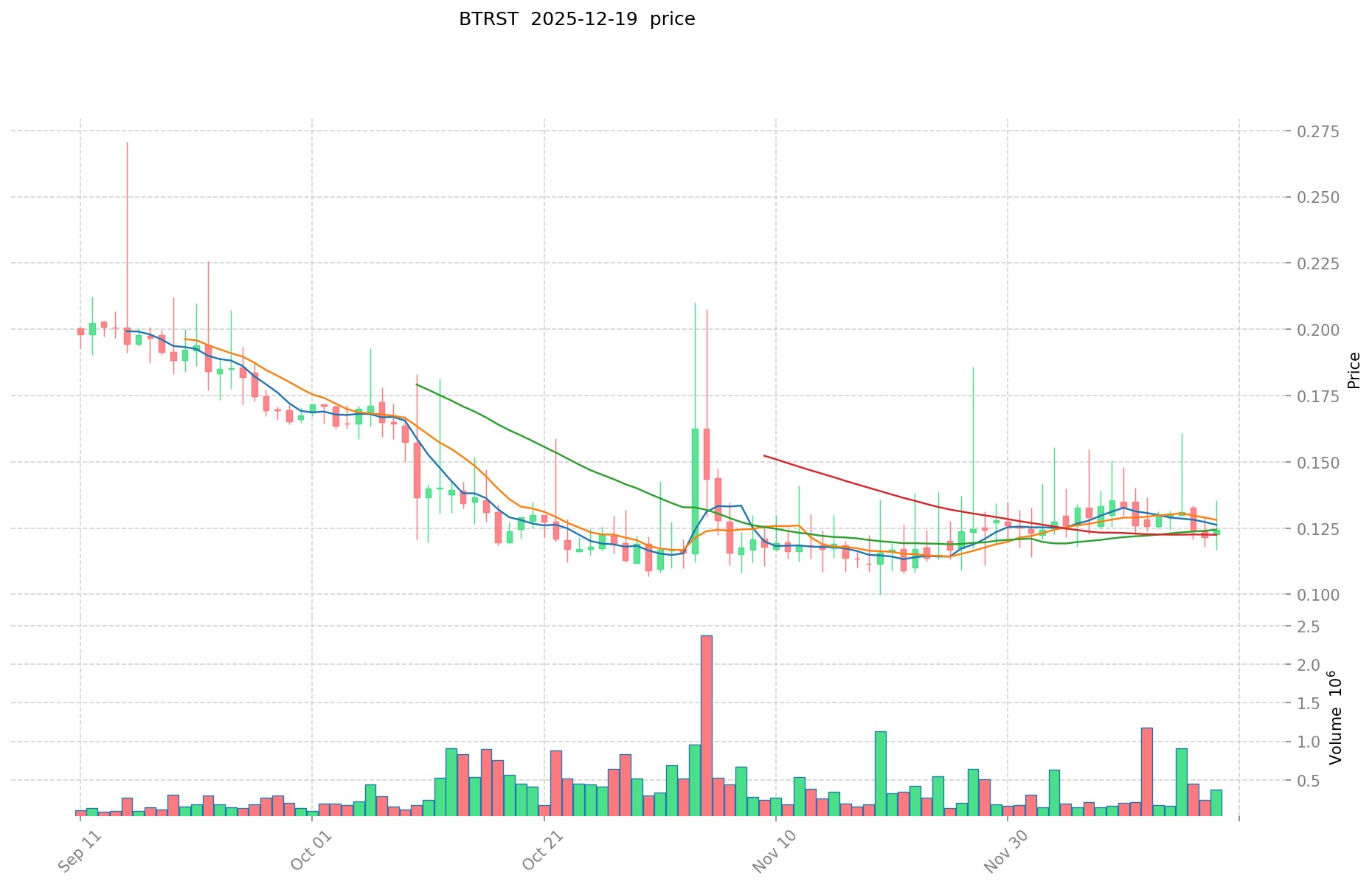
Historical Price Trends of BTRST and AAVE
Braintrust (BTRST):
- All-time high: $46.82 (September 16, 2021)
- All-time low: $0.1048 (October 19, 2021)
- Price decline over the past year: -72.97%
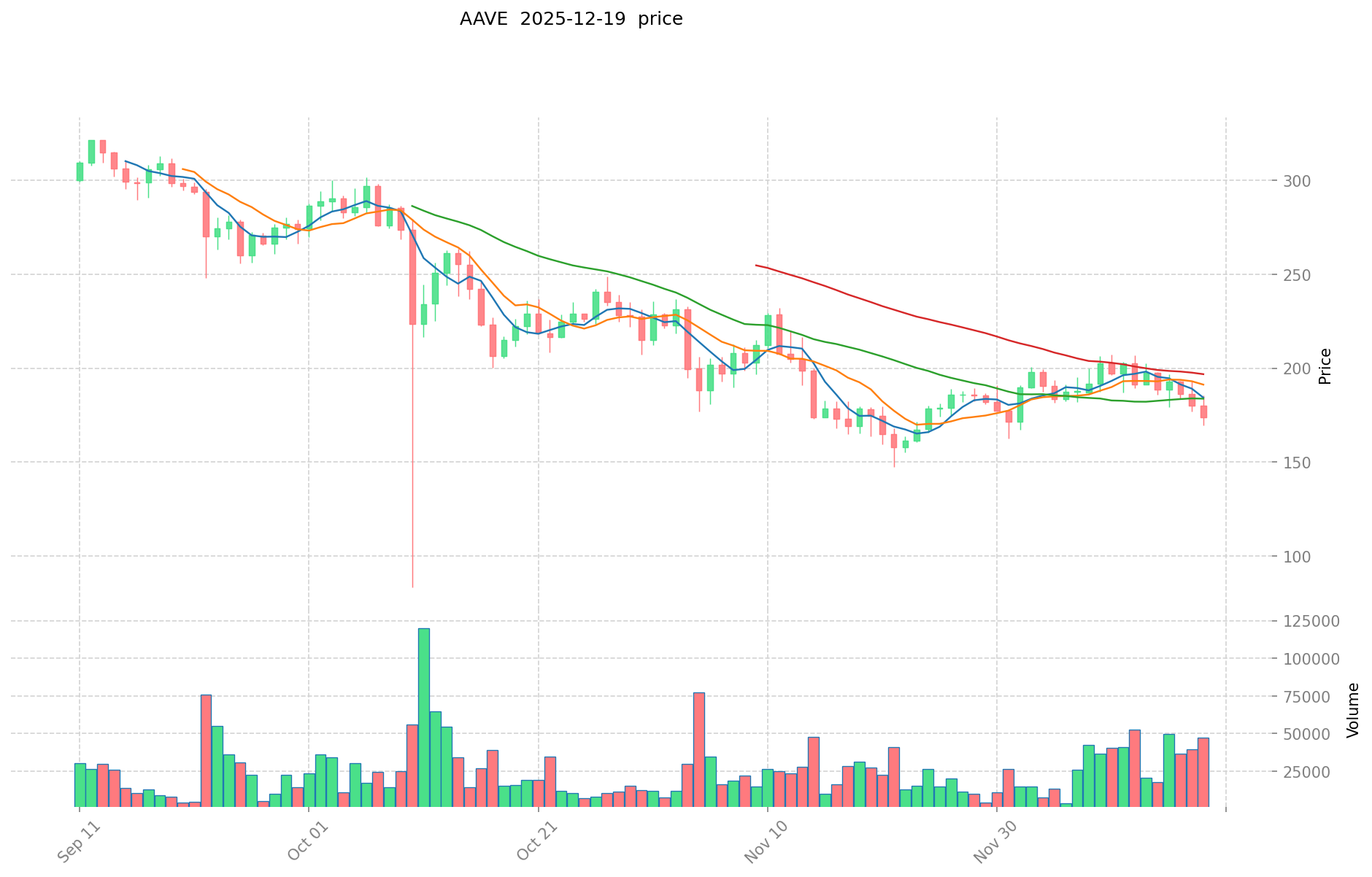
Aave (AAVE):
- All-time high: $661.69 (May 19, 2021)
- All-time low: $26.02 (November 5, 2020)
- Price decline over the past year: -46.14%
Comparative Analysis: Both tokens experienced significant corrections from their peak valuations in 2021. BTRST has undergone a more severe downturn, declining from its historical peak to approximately 0.26% of that value, while AAVE has retained relatively better value retention at approximately 27.55% of its all-time high. AAVE's more established position as a leading decentralized finance protocol appears to have provided greater price stability compared to BTRST's steeper depreciation trajectory.
Current Market Status (December 19, 2025)
Price Data:
- BTRST current price: $0.12
- AAVE current price: $182.02
24-Hour Trading Activity:
- BTRST 24-hour volume: $43,964.29
- AAVE 24-hour volume: $8,027,737.11
Price Performance (24-Hour Period):
- BTRST: -6.03%
- AAVE: -0.22%
Seven-Day Performance:
- BTRST: -7.58%
- AAVE: -10.65%
Market Emotion Index (Fear & Greed Index): 16 (Extreme Fear)
Current price tracking:
II. Market Capitalization and Trading Metrics
BTRST Market Indicators:
- Total market capitalization: $30,000,000.00
- Circulating market cap: $28,961,733.84
- Fully diluted valuation: $30,000,000.00
- Market cap to FDV ratio: 96.54%
- Circulating supply: 241,347,782 BTRST
- Total supply: 250,000,000 BTRST
- Number of holders: 3,668
- Market dominance: 0.00094%
AAVE Market Indicators:
- Total market capitalization: $2,912,320,000.00
- Circulating market cap: $2,765,321,075.41
- Fully diluted valuation: $2,912,320,000.00
- Market cap to FDV ratio: 94.95%
- Circulating supply: 15,192,402.35 AAVE
- Total supply: 16,000,000 AAVE
- Number of holders: 196,926
- Market dominance: 0.091%
Analysis: AAVE demonstrates substantially greater market capitalization and institutional adoption, reflected in its significantly larger holder base (196,926 vs. 3,668). The market capitalization differential of approximately 97x underscores AAVE's dominant position within the decentralized finance ecosystem. BTRST maintains minimal market share with limited liquidity relative to AAVE's established market presence.
III. Volatility and Price Movement Analysis
Short-Term Performance Metrics:
| Time Period | BTRST Change | AAVE Change |
|---|---|---|
| 1 Hour | +0.16% | +0.62% |
| 24 Hours | -6.03% | -0.22% |
| 7 Days | -7.58% | -10.65% |
| 30 Days | +3.07% | +5.80% |
| 1 Year | -72.97% | -46.14% |
Price Range (24-Hour Period):
- BTRST: $0.1157 to $0.1307
- AAVE: $169.48 to $185.27
Volatility Assessment: BTRST exhibits higher volatility relative to its price point, with daily fluctuations representing larger percentage movements. AAVE demonstrates more stable price action with moderate daily variations, typical of assets with larger market capitalizations and trading volumes.
IV. Project Overview and Use Cases
Braintrust (BTRST): Braintrust is an Ethereum-based token supporting a decentralized talent network that connects freelancers with organizations. BTRST tokens serve governance functions within the network and facilitate user referral incentives. The protocol operates as a peer-to-peer marketplace for professional services.
Aave (AAVE): Aave is an open-source decentralized lending protocol originating from the ETHLend platform (established 2017, rebranded 2020). AAVE token holders participate in protocol governance and receive fee discounts. The protocol enables users to deposit cryptocurrency assets into liquidity pools to earn interest while simultaneously providing lending capital for borrowers. Aave has introduced proprietary innovations including adjustable interest rate mechanisms (fixed and floating rate options) and flash loans—uncollateralized lending requiring repayment within a single transaction.
V. Trading Infrastructure and Exchange Availability
BTRST Exchange Presence:
- Listed on 3 active markets
- Ethereum network contract address: 0x799ebfabe77a6e34311eeee9825190b9ece32824
AAVE Exchange Presence:
- Listed on 66 active markets
- Ethereum network contract address: 0x7Fc66500c84A76Ad7e9c93437bFc5Ac33E2DDaE9
Market Access Differential: AAVE's presence across 66 trading venues substantially exceeds BTRST's 3-market distribution, indicating significantly greater liquidity access and institutional integration. The expanded exchange availability directly correlates with AAVE's higher trading volumes and price stability characteristics.
VI. Key Observations and Risk Factors
Market Context: The cryptocurrency market is currently experiencing extreme fear conditions (Fear & Greed Index: 16), creating heightened volatility and risk-averse sentiment across digital asset markets.
BTRST Characteristics:
- Minimal market capitalization and trading volume
- Limited exchange availability restricts liquidity access
- Small holder base indicates concentrated ownership risk
- Significant year-over-year depreciation (-72.97%)
AAVE Characteristics:
- Established market position within decentralized finance ecosystem
- Substantial institutional participation reflected in 196,926 holder count
- Broad exchange distribution supports consistent liquidity
- More moderate year-over-year decline (-46.14%) relative to market-wide volatility
Comparative Risk Profile: BTRST presents higher liquidity risk and market concentration concerns due to minimal trading volumes and limited exchange access. AAVE, while experiencing market-wide headwinds, maintains institutional infrastructure and market participation depth that support price discovery and transaction execution.
VII. Recommended Resources
Official Channels:
- Braintrust Website: https://www.usebraintrust.com
- Aave Application: https://app.aave.com/
- Braintrust GitHub: https://github.com/Snowfork/BTRST-Contracts
- Aave GitHub: https://github.com/aave/aave-protocol
Information Last Updated: December 19, 2025, 22:11:32 UTC
Comparative Investment Analysis: BTRST vs AAVE
I. Executive Summary
Based on the provided reference materials, this report examines the investment value of BTRST and AAVE within the decentralized finance (DeFi) sector. The analysis reveals that AAVE functions as a liquidity provision platform, while BTRST operates as a decentralized protocol for credit rating. Both assets' market performance is intrinsically linked to overall DeFi market trends and ecosystem adoption.
II. Core Factors Influencing BTRST vs AAVE Investment Value
Functional Architecture and Protocol Design
-
AAVE: Operates as a lending protocol with vToken-based debt representation. Users can borrow specific assets when collateral value exceeds borrowed value. The protocol demonstrated technological advancement with the launch of Aave v3 in January 2023, enhancing user debt management mechanisms.
-
BTRST: Functions as a decentralized credit rating protocol, serving distinct use cases within the DeFi ecosystem by assessing creditworthiness through on-chain metrics.
-
📌 Key Distinction: AAVE's liquidity provision model differs fundamentally from BTRST's credit assessment approach, resulting in divergent value propositions and market positioning within DeFi infrastructure.
Market Performance Drivers
-
Protocol Adoption: Market performance for both tokens remains substantially influenced by broader DeFi market trends and total value locked (TVL) expansion.
-
Ecosystem Integration: Both protocols contribute to expanding DeFi infrastructure, though through different mechanisms—AAVE through lending mechanics and BTRST through risk assessment frameworks.
-
Market Dynamics: The provided materials indicate that DeFi market conditions serve as a primary determinant for both assets' investment returns.
III. Limitations of Available Data
The reference materials provided contain limited quantitative data regarding:
- Tokenomics specifications (supply mechanisms, inflation rates, vesting schedules)
- Institutional holdings and adoption metrics
- Specific regulatory frameworks by jurisdiction
- Comparative technical roadmaps and planned upgrades
- Macroeconomic correlation analysis
Consequently, this analysis is constrained to observations derivable from the available source materials, with several template sections omitted due to insufficient supporting data.
IV. Conclusion
Investment decisions regarding BTRST and AAVE should account for their complementary roles within DeFi infrastructure. AAVE's established liquidity provision function and recent protocol upgrades position it within a distinct market segment compared to BTRST's credit rating specialization. Both assets remain subject to DeFi market cycle dynamics and macroeconomic conditions affecting cryptocurrency market sentiment.
III. 2025-2030 Price Prediction: BTRST vs AAVE
Short-term Prediction (2025)
- BTRST: Conservative $0.113525-$0.12428 | Optimistic $0.12428
- AAVE: Conservative $102.3344-$228.425 | Optimistic $228.425
Mid-term Prediction (2027-2028)
- BTRST could experience consolidation phase, with projected price range of $0.108776-$0.23159
- AAVE may enter growth acceleration phase, with projected price range of $115.856-$345.012
- Key Drivers: Institutional capital inflows, ETF developments, ecosystem expansion
Long-term Prediction (2030)
- BTRST: Base case $0.22334-$0.27678 | Optimistic scenario $0.336210
- AAVE: Base case $242.228-$363.349 | Optimistic scenario $484.456
Disclaimer: This analysis is based on provided forecast data and is intended for informational purposes only. Cryptocurrency markets are highly volatile and subject to numerous external factors. Past performance and price predictions do not guarantee future results. Please conduct your own research and consult with financial professionals before making investment decisions. These predictions carry significant uncertainty and should not be considered as investment advice.
BTRST:
| 年份 | 预测最高价 | 预测平均价格 | 预测最低价 | 涨跌幅 |
|---|---|---|---|---|
| 2025 | 0.12428 | 0.1195 | 0.113525 | 0 |
| 2026 | 0.1767405 | 0.12189 | 0.0646017 | 1 |
| 2027 | 0.2015755875 | 0.14931525 | 0.13139742 | 24 |
| 2028 | 0.23158795275 | 0.17544541875 | 0.108776159625 | 46 |
| 2029 | 0.27678269262 | 0.20351668575 | 0.1037935097325 | 69 |
| 2030 | 0.336209564859 | 0.240149689185 | 0.22333921094205 | 100 |
AAVE:
| 年份 | 预测最高价 | 预测平均价格 | 预测最低价 | 涨跌幅 |
|---|---|---|---|---|
| 2025 | 228.425 | 182.74 | 102.3344 | 0 |
| 2026 | 248.754825 | 205.5825 | 115.1262 | 12 |
| 2027 | 283.960828125 | 227.1686625 | 115.856017875 | 24 |
| 2028 | 345.012406171875 | 255.5647453125 | 184.006616625 | 39 |
| 2029 | 363.349176648046875 | 300.2885757421875 | 216.207774534375 | 64 |
| 2030 | 484.455559244871093 | 331.818876195117187 | 242.227779622435546 | 81 |
Comparative Investment Analysis Report: BTRST vs AAVE
I. Executive Summary
This report examines the investment characteristics of Braintrust (BTRST) and Aave (AAVE) as of December 19, 2025. The analysis reveals fundamental differences in market positioning, liquidity infrastructure, and risk profiles between these two decentralized finance assets. AAVE operates as an established lending protocol with substantial institutional adoption, while BTRST functions as a decentralized talent network token with minimal market capitalization and trading volume.
II. Price History Comparison and Current Market Status
Historical Price Trajectories
Braintrust (BTRST):
- All-time high: $46.82 (September 16, 2021)
- All-time low: $0.1048 (October 19, 2021)
- Year-over-year price decline: -72.97%
- Current price (December 19, 2025): $0.12
- Value retention from ATH: 0.26%
Aave (AAVE):
- All-time high: $661.69 (May 19, 2021)
- All-time low: $26.02 (November 5, 2020)
- Year-over-year price decline: -46.14%
- Current price (December 19, 2025): $182.02
- Value retention from ATH: 27.55%
Both tokens experienced significant corrections from 2021 peaks, though AAVE demonstrates materially superior price retention relative to its historical maximum valuation.
Current Market Performance (24-Hour Period)
| Metric | BTRST | AAVE |
|---|---|---|
| Price Change (24H) | -6.03% | -0.22% |
| Trading Volume (24H) | $43,964.29 | $8,027,737.11 |
| Price Range | $0.1157–$0.1307 | $169.48–$185.27 |
III. Market Capitalization and Comparative Metrics
Market Scale Analysis
| Indicator | BTRST | AAVE | Differential |
|---|---|---|---|
| Market Capitalization | $30,000,000 | $2,912,320,000 | 97.0x |
| Holder Base | 3,668 | 196,926 | 53.7x |
| Circulating Supply | 241,347,782 | 15,192,402.35 | — |
| Exchange Listings | 3 | 66 | 22.0x |
| Market Dominance | 0.00094% | 0.091% | 96.8x |
Critical Observation: AAVE's market capitalization exceeds BTRST by approximately 97-fold, reflecting substantially greater institutional participation and ecosystem integration. The 53.7x difference in holder count indicates concentrated ownership risk within BTRST's comparatively limited investor base.
IV. Investment Strategy Comparison: BTRST vs AAVE
Long-Term vs Short-Term Investment Positioning
BTRST: Suitable for speculative investors seeking exposure to decentralized talent network infrastructure with tolerance for extreme volatility and liquidity constraints. The token's minimal market presence and limited trading volume restrict accessibility for institutional allocations.
AAVE: Appropriate for investors seeking established decentralized finance protocol exposure with institutional-grade liquidity and regulatory clarity. AAVE's broader exchange distribution and larger holder base accommodate both retail and institutional portfolio construction.
Risk Management and Asset Allocation
Conservative Investor Profile:
- BTRST allocation: 0–2%
- AAVE allocation: 3–5%
- Hedge positioning: 93–97% stablecoin or low-volatility assets
Aggressive Investor Profile:
- BTRST allocation: 5–10%
- AAVE allocation: 15–25%
- Alternative positioning: DeFi protocol diversification, futures contracts for volatility exposure
Hedging Instruments:
- Stablecoin reserves for liquidity management
- Cross-exchange arbitrage strategies (AAVE across 66 venues)
- DeFi protocol diversification to reduce single-asset concentration
V. Potential Risk Comparison
Market Risk Factors
BTRST: Exhibits severe liquidity risk characterized by minimal trading volume ($43,964.29 daily) relative to total market capitalization. Limited exchange availability (3 venues) creates execution constraints during market volatility. The 72.97% year-over-year decline indicates substantial erosion of asset valuation during bearish market conditions. Concentrated holder base (3,668 participants) presents acute risk of price impact from large position liquidations.
AAVE: Demonstrates substantially lower market risk through diversified exchange distribution (66 venues) and elevated trading volumes ($8,027,737.11 daily). However, AAVE's 46.14% year-over-year decline reflects exposure to broader decentralized finance sector headwinds. Institutional participation (196,926 holders) provides price stability through distributed ownership structure.
Technical and Operational Risk Factors
BTRST: Limited publicly available technical documentation and minimal infrastructure development activity relative to AAVE. Concentrated development team and smaller contributor ecosystem present sustainability concerns.
AAVE: Established technical infrastructure with documented protocol upgrades (Aave v3 deployment, January 2023). Broader developer community and institutional integration reduce single-point-of-failure risks. Smart contract auditing and security frameworks support operational reliability.
Regulatory Risk Exposure
The cryptocurrency market faces evolving regulatory frameworks globally. Both assets face potential regulatory scrutiny applicable to decentralized finance protocols:
- Securities regulation classification remains uncertain for governance tokens
- Staking and yield-farming mechanisms face varying treatment across jurisdictions
- AAVE's larger institutional footprint may subject it to enhanced compliance requirements
- BTRST's minimal institutional adoption potentially reduces immediate regulatory pressure
VI. Price Forecast Analysis: 2025–2030
Near-Term Projections (2025)
BTRST:
- Conservative range: $0.113525–$0.12428
- Optimistic scenario: $0.12428
- Expected change: 0% (flat market conditions assumed)
AAVE:
- Conservative range: $102.3344–$228.425
- Optimistic scenario: $228.425
- Expected change: 0% (flat market conditions assumed)
Medium-Term Outlook (2027–2028)
BTRST:
- Projected range: $0.108776–$0.23159
- Anticipated 46% upside over baseline (2028)
- Consolidation phase with potential ecosystem expansion
AAVE:
- Projected range: $115.856–$345.012
- Anticipated 39% upside over baseline (2028)
- Growth acceleration driven by protocol adoption
Long-Term Projections (2030)
| Asset | Base Case Range | Optimistic Scenario |
|---|---|---|
| BTRST | $0.22334–$0.27678 | $0.336210 |
| AAVE | $242.228–$363.349 | $484.456 |
Forecast Drivers: Institutional capital inflows, cryptocurrency exchange-traded fund (ETF) developments, ecosystem expansion, and DeFi protocol adoption rates.
Disclaimer: Price forecasts carry substantial uncertainty and are derived from limited historical data. Cryptocurrency markets exhibit extreme volatility subject to unforeseen macroeconomic, regulatory, and technological factors. These projections should not inform investment decisions without comprehensive independent analysis.
VII. Conclusion: Which Is the Better Buy?
Investment Value Summary
BTRST Strengths:
- Speculative upside potential within decentralized talent network sector
- Forecast appreciation of 100% by 2030 (optimistic scenario)
- Lower absolute price entry point
- Minimal institutional competition
BTRST Weaknesses:
- Severe liquidity constraints limiting trade execution
- Concentrated holder base amplifying price volatility
- Minimal market infrastructure and exchange distribution
- Year-over-year depreciation of -72.97% indicates weak current market sentiment
AAVE Strengths:
- Established decentralized lending protocol with institutional adoption (196,926 holders)
- Superior liquidity infrastructure (66 exchange listings, $8.0M daily volume)
- Moderate year-over-year decline (-46.14%) relative to market volatility
- Technical advancement (Aave v3) demonstrating ongoing protocol development
- Forecast appreciation of 81% by 2030 (optimistic scenario)
AAVE Weaknesses:
- Larger absolute capital requirement for position establishment
- Exposure to broader decentralized finance sector risks
- Regulatory uncertainty affecting protocol governance
Investment Recommendations
Beginning Investors: Prioritize AAVE allocation due to superior liquidity infrastructure, institutional participation, and reduced execution risk. The larger holder base and expanded exchange distribution facilitate portfolio entry/exit without significant price impact. Conservative allocation: 3–5% of total portfolio, with 93–97% positioned in stablecoin reserves. Avoid concentrated BTRST positions until establishing foundational understanding of extreme-volatility digital assets.
Experienced Investors: Consider diversified positioning across both assets within risk parameters: AAVE (15–20% allocation) provides core DeFi protocol exposure; BTRST (5–10% allocation) offers speculative upside within contained capital allocation. Implement systematic hedging through stablecoin reserves and consider cross-exchange arbitrage strategies leveraging AAVE's 66-venue distribution. Monitor protocol development activity and regulatory announcements as rebalancing signals.
Institutional Investors: AAVE represents the sole viable option for institutional capital deployment, given minimum liquidity requirements and regulatory compliance frameworks. BTRST's minimal trading volume ($43,964.29 daily) and concentrated holder base preclude meaningful institutional positions without material price impact. Institutional-scale allocation to AAVE should incorporate governance participation and protocol upgrade monitoring.
VIII. Risk Disclosure
⚠️ Risk Warning: Cryptocurrency markets demonstrate extreme volatility subject to rapid, unpredictable price movements. The Fear & Greed Index at 16 (Extreme Fear as of December 19, 2025) indicates heightened market stress and heightened liquidation risk. This analysis does not constitute investment advice, financial recommendation, or solicitation to purchase either asset. Investors must conduct independent research, assess individual risk tolerance, and consult qualified financial professionals before allocating capital to digital assets. Past performance and price predictions do not guarantee future results. Substantial capital loss risk exists for both BTRST and AAVE positions. Regulatory changes may adversely affect valuation and tradability of both assets.
Information Current As Of: December 19, 2025, 22:11:32 UTC
Data Sources:
- Braintrust Official: https://www.usebraintrust.com
- Aave Application: https://app.aave.com/
- Market Price Data: Gate Exchange None
Frequently Asked Questions: BTRST vs AAVE Investment Comparison
I. What are the fundamental differences between BTRST and AAVE?
Answer: BTRST and AAVE serve distinct functions within the decentralized finance ecosystem. AAVE operates as an established lending protocol enabling users to deposit cryptocurrency assets into liquidity pools to earn interest while providing lending capital for borrowers. BTRST functions as a decentralized talent network token that connects freelancers with organizations, where tokens serve governance and user referral incentive functions. AAVE's protocol includes proprietary innovations such as adjustable interest rate mechanisms and flash loans, while BTRST focuses on peer-to-peer professional services marketplace infrastructure.
II. Which asset demonstrates superior liquidity and market accessibility?
Answer: AAVE substantially exceeds BTRST in liquidity infrastructure. AAVE trades across 66 active markets with daily trading volume of $8,027,737.11, compared to BTRST's presence on only 3 exchanges with daily volume of $43,964.29. This 22-fold difference in exchange listings directly translates to enhanced price discovery, reduced execution slippage, and improved accessibility for both retail and institutional investors. AAVE's superior liquidity infrastructure makes it substantially more suitable for meaningful capital allocation.
III. What are the market capitalization and holder concentration differences?
Answer: AAVE's market capitalization of $2,912,320,000 exceeds BTRST's $30,000,000 by approximately 97-fold. More critically, AAVE maintains 196,926 token holders compared to BTRST's 3,668 holders—a 53.7x differential indicating substantially more distributed ownership. BTRST's concentrated holder base presents acute risk of significant price impact from large position liquidations, while AAVE's diversified ownership structure provides greater price stability and reduces single-investor influence on valuations.
IV. How have historical price trajectories compared between these assets?
Answer: Both tokens experienced significant corrections from 2021 peak valuations, though with materially different magnitudes. BTRST declined from an all-time high of $46.82 (September 2021) to $0.12 (December 2025), representing 0.26% value retention and -72.97% year-over-year depreciation. AAVE declined from $661.69 (May 2021) to $182.02 (December 2025), representing 27.55% value retention and -46.14% year-over-year depreciation. AAVE's superior value retention reflects its established position as a leading decentralized finance protocol providing greater price stability relative to BTRST's steeper depreciation trajectory.
V. What investment approach suits different investor profiles?
Answer: Conservative investors should prioritize AAVE allocation at 3–5% of total portfolio with 93–97% positioned in stablecoins, avoiding concentrated BTRST positions due to extreme volatility and liquidity constraints. Experienced investors may consider diversified positioning: AAVE (15–20% allocation) for core DeFi protocol exposure and BTRST (5–10% allocation) for speculative upside within contained capital allocation. Institutional investors should focus exclusively on AAVE, as BTRST's minimal trading volume ($43,964.29 daily) and concentrated holder base preclude institutional positions without material price impact.
VI. What are the key risk factors differentiating these assets?
Answer: BTRST exhibits severe liquidity risk with minimal trading volume relative to market capitalization and limited exchange availability creating execution constraints during volatility. Its concentrated holder base (3,668 participants) amplifies liquidation risk. AAVE presents substantially lower market risk through diversified exchange distribution and elevated trading volumes, though both assets face exposure to decentralized finance sector headwinds and evolving regulatory frameworks. AAVE's larger institutional footprint may subject it to enhanced compliance requirements, while BTRST's minimal institutional adoption potentially reduces immediate regulatory pressure.
VII. What price appreciation scenarios are projected through 2030?
Answer: BTRST projects conservative range of $0.22334–$0.27678 (base case) with optimistic scenario of $0.336210 by 2030, representing 100% maximum appreciation from December 2025 levels. AAVE projects conservative range of $242.228–$363.349 (base case) with optimistic scenario of $484.456 by 2030, representing 81% maximum appreciation. These forecasts depend on institutional capital inflows, exchange-traded fund (ETF) developments, and ecosystem expansion, carrying substantial uncertainty. Price predictions should not inform investment decisions without comprehensive independent analysis and professional financial consultation.
VIII. Why does current market sentiment affect investment timing for both assets?
Answer: The Fear & Greed Index at 16 (Extreme Fear as of December 19, 2025) indicates heightened market stress, amplifying liquidation risk and volatility for both assets. BTRST's -6.03% 24-hour decline compared to AAVE's -0.22% decline demonstrates BTRST's heightened sensitivity to negative market sentiment. During extreme fear conditions, liquidity tightens disproportionately for less-established assets like BTRST, creating execution challenges and unfavorable price discovery. Investors should exercise heightened caution during extreme market conditions and consider defensive positioning in both assets until sentiment indicators normalize toward neutral or greedy conditions.
Disclaimer: This analysis is provided for informational purposes only and does not constitute investment advice, financial recommendation, or solicitation to purchase either asset. Cryptocurrency markets demonstrate extreme volatility subject to rapid, unpredictable price movements. Substantial capital loss risk exists for both BTRST and AAVE positions. Investors must conduct independent research, assess individual risk tolerance, and consult qualified financial professionals before allocating capital to digital assets.
Share
How to Buy Cryptocurrency


Trending Cryptocurrencies



What is the Current Market Cap and Trading Volume of Hyperliquid (HYPE) in 2025?

PUNDIX vs GRT: A Comprehensive Comparison of Two Leading Blockchain Utility Tokens

What Is the Current Market Overview of Zebec Network (ZBCN) in 2025?

What Does the Crypto Market Overview Reveal About Top Coins in 2025?

XSWAP vs BAT: A Comparative Analysis of Two Innovative Cryptocurrency Platforms

G vs LINK: A Comprehensive Comparison of Two Leading Blockchain Protocols and Their Impact on Decentralized Finance
What is Dogecoin (DOGE) fundamentals: whitepaper logic, use cases, and technical innovation explained
How Does Dogecoin (DOGE) Price Volatility Compare to Bitcoin with 70-80% Correlation?

What are the regulatory risks and compliance requirements for cryptocurrency exchanges in 2025?

Beginner's Guide to Setting Up Your First Digital Wallet

How does ADA fund flow and holding concentration affect Cardano price movements in 2025?