This comprehensive guide evaluates whether Biswap (BSW) is a sound investment by analyzing the BNB Chain decentralized exchange platform's fundamentals, market dynamics, and future prospects. As of February 2026, BSW trades at $0.002311 with a $1.15 million market cap, offering competitive 0.1% transaction fees and serving 169,344 holders across 7 exchanges. The article examines BSW's significant price decline of -94.8% over one year while presenting price forecasts ranging from conservative to optimistic scenarios through 2031. Key investment considerations include tokenomics with 71.28% circulation ratio, technology infrastructure on BNB Chain, and competitive risks within the DeFi sector. Detailed investment strategies cater to conservative, aggressive, and professional investors, emphasizing proper asset allocation, risk hedging through dollar-cost averaging, and secure storage solutions. The analysis addresses critical risks including market volatility, regulatory uncertainty, and technical vulnerabiliti
Introduction: Biswap (BSW) Investment Position and Market Outlook
BSW is a notable asset in the cryptocurrency space. Launched in July 2021, it has established itself as a decentralized exchange platform on the BNB Chain. As of February 3, 2026, BSW maintains a market capitalization of approximately $1.15 million, with a circulating supply of around 498.98 million tokens, and a current price of approximately $0.002311. Positioned as a decentralized trading platform featuring three types of referral systems and a competitive 0.1% transaction fee structure, BSW has become a subject of interest among investors evaluating "Is Biswap (BSW) a good investment?" This article provides a comprehensive analysis of BSW's investment characteristics, historical price movements, future price considerations, and associated risks to serve as a reference for investors.
Biswap operates as a decentralized exchange platform on the BNB Chain, offering BEP-20 token trading services alongside an NFT marketplace and gaming features. The platform has positioned itself with a focus on competitive transaction costs and referral mechanisms within the decentralized finance ecosystem. With 169,344 holders recorded and trading activity across 7 exchanges, BSW represents a segment of the broader DEX infrastructure on the BNB Chain. The token's market performance has shown variability, with a 24-hour change of 4.52%, while experiencing a decline of 13.58% over the past week and 25.09% over 30 days. Understanding these dynamics is essential for evaluating BSW's position within the current market environment.
I. BSW Price History Review and Investment Value Status
BSW was launched in July 2021 with an initial offering price of $0.6421. The token experienced notable price movements during its early trading period. In December 2021, BSW reached a peak level of $2.1, representing a period of increased market interest in decentralized exchange platforms on the BNB Chain.
Following the broader cryptocurrency market adjustments in 2022-2023, BSW underwent significant price corrections along with many digital assets in the decentralized finance sector. The token's value declined as the market transitioned through various cycles, reflecting changing investor sentiment toward DEX platforms and DeFi protocols.
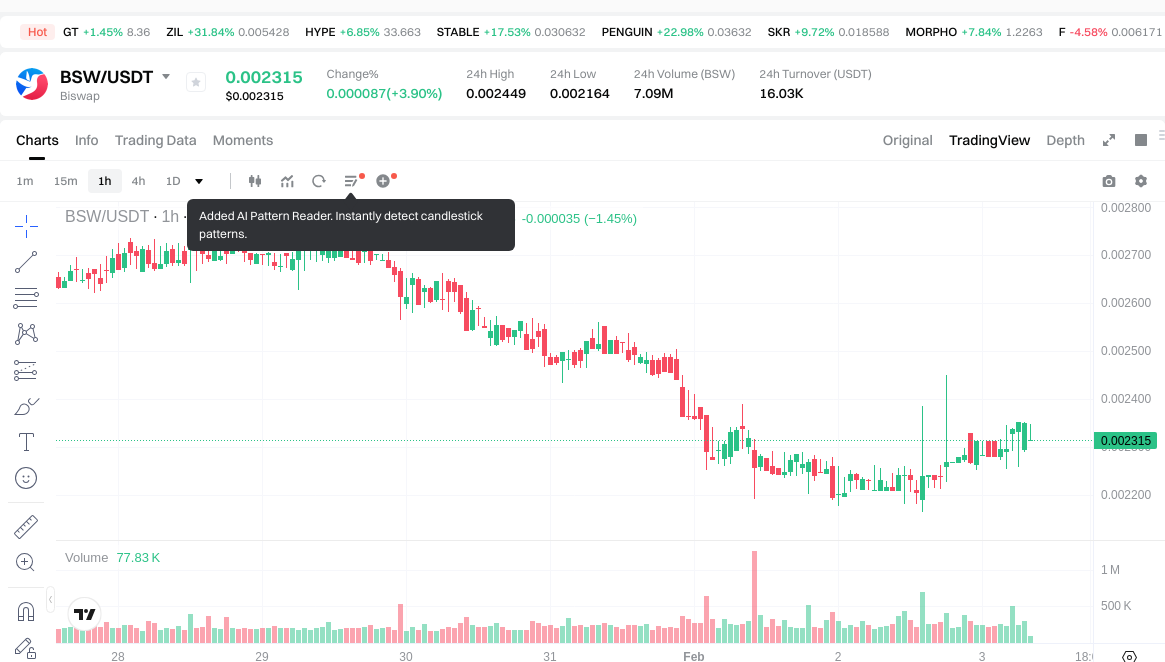
As of February 2026, BSW recorded a low point of $0.0021886 on February 2, 2026, indicating a substantial decline from earlier price levels. This downturn occurred amid continued adjustments in the cryptocurrency market and shifts in trading dynamics within the BNB Chain ecosystem.
Current BSW Investment Market Status (February 2026)
- BSW Current Price: $0.002311 (as of February 3, 2026)
- 24-Hour Price Change: +4.52%
- 24-Hour Trading Volume: $16,025.57
- Market Capitalization: $1,153,138.62
- Circulating Supply: 498,978,200 BSW
- Total Supply: 576,898,100 BSW
- Maximum Supply: 700,000,000 BSW
- Circulation Ratio: 71.28%
- Fully Diluted Valuation: $1,333,211.51
- Market Dominance: 0.000048%
- Number of Holders: 169,344
- Available on 7 Exchanges
Recent Price Trends:
- 1-Hour Change: +1.92%
- 7-Day Change: -13.58%
- 30-Day Change: -25.09%
- 1-Year Change: -94.8%
Click to view real-time BSW market price
II. Core Factors Affecting Whether BSW is a Good Investment
Supply Mechanism and Scarcity (BSW investment scarcity)
- Supply structure: BSW has a maximum supply of 700,000,000 tokens, with current circulating supply of 498,978,200 tokens, representing a circulation ratio of 71.28%
- Market capitalization dynamics: The current market cap stands at $1,153,138.62, with fully diluted valuation at $1,333,211.51, showing a market cap to FDV ratio of 71.28%
- Investment implication: The relatively high circulation ratio indicates limited supply-side pressure, though the token's scarcity factor remains moderate compared to its total supply ceiling
Institutional Investment and Mainstream Adoption (Institutional investment in BSW)
- Platform positioning: Biswap operates as a decentralized exchange platform on the BNB Chain, featuring the lowest platform transaction fee in the market at 0.1%
- Holder distribution: The platform currently serves 169,344 holders, reflecting its user base scale
- Exchange accessibility: BSW is listed on 7 exchanges, indicating a moderate level of market accessibility for institutional and retail participants
Macroeconomic Environment Impact on BSW Investment
- Price performance context: BSW experienced a 24-hour price increase of 4.52%, though it declined 13.58% over the past 7 days and 25.09% over the past 30 days
- Volatility characteristics: The token's 24-hour trading range between $0.002164 and $0.002449 demonstrates significant short-term price fluctuation
- Long-term trajectory: Over the past year, BSW declined 94.8%, reflecting broader market conditions and sector-specific challenges affecting decentralized exchange tokens
Technology & Ecosystem Development (Technology & Ecosystem for BSW investment)
- Platform infrastructure: Biswap features three types of referral systems and operates as a decentralized trading platform for BEP-20 token exchanges on the BNB Chain
- Ecosystem expansion: The platform has developed its own NFT marketplace and NFT gaming applications, diversifying its value proposition beyond standard DEX functionality
- Cross-chain capabilities: Recent platform improvements include enhanced cross-chain routing that factors in bridge fees and slippage estimates, potentially reducing costs for multi-chain swap operations
- Strategic positioning: Biswap aims to establish itself as a benchmark DEX platform, focusing on delivering value through low-cost trading infrastructure and ecosystem diversification
III. BSW Future Investment Prediction and Price Outlook (Is Biswap(BSW) worth investing in 2026-2031)
Short-term Investment Prediction (2026, short-term BSW investment outlook)
- Conservative Forecast: $0.0019 - $0.0023
- Neutral Forecast: $0.0023 - $0.0028
- Optimistic Forecast: $0.0070 - $0.0097
Mid-term Investment Outlook (2027-2029, mid-term Biswap(BSW) investment forecast)
- Market Stage Expectation: BSW is expected to experience gradual recovery as the DeFi sector continues to expand and the platform attracts more users through its low-fee structure and innovative features.
- Investment Return Prediction:
- 2027: $0.0014 - $0.0030
- 2028: $0.0017 - $0.0034
- 2029: $0.0026 - $0.0040
- Key Catalysts: Expansion of decentralized exchange features, growth in NFT marketplace activity, enhanced tokenomics, and broader adoption within the BNB Chain ecosystem.
Long-term Investment Outlook (Is BSW a good long-term investment?)
- Baseline Scenario: $0.0024 - $0.0043 (assuming steady platform development and moderate user growth)
- Optimistic Scenario: $0.0059 - $0.0097 (assuming accelerated DeFi adoption and successful ecosystem expansion)
- Risk Scenario: Below $0.0022 (under adverse market conditions or intense competitive pressure)
Check BSW long-term investment and price prediction: Price Prediction
2026-02-03 - 2031 Long-term Outlook
- Base Scenario: $0.0024 - $0.0043 USD (corresponding to steady progress and gradual mainstream application improvement)
- Optimistic Scenario: $0.0059 - $0.0097 USD (corresponding to large-scale adoption and favorable market environment)
- Transformative Scenario: Above $0.010 USD (such as breakthrough progress in ecosystem and mainstream popularization)
- 2031-12-31 Predicted High: $0.0059 USD (based on optimistic development assumptions)
Disclaimer: Price predictions are based on historical data analysis and market forecasts, and actual performance may vary significantly due to market volatility, regulatory changes, technological developments, and other unforeseen factors. This content does not constitute investment advice.
| Year |
Predicted High Price |
Predicted Average Price |
Predicted Low Price |
Price Change |
| 2026 |
0.00280115 |
0.002315 |
0.0018983 |
0 |
| 2027 |
0.00304410925 |
0.002558075 |
0.00140694125 |
10 |
| 2028 |
0.0034173323925 |
0.002801092125 |
0.00165264435375 |
21 |
| 2029 |
0.004041975936375 |
0.00310921225875 |
0.002580646174762 |
34 |
| 2030 |
0.004934319854636 |
0.003575594097562 |
0.002395648045366 |
54 |
| 2031 |
0.005871840627017 |
0.004254956976099 |
0.002680622894942 |
84 |
IV. Biswap Investment Strategy and Risk Management (How to invest in Biswap)
Investment Methodology (Biswap investment strategy)
Long-term Holding (HODL Biswap): This strategy is suitable for conservative investors who believe in the long-term development of decentralized exchange platforms. Given BSW's role as a governance and utility token within the Biswap ecosystem, holders may benefit from platform growth, potential fee-sharing mechanisms, and participation in ecosystem governance. However, investors should consider that BSW has experienced significant price decline from its historical high, with a one-year performance showing a substantial decrease.
Active Trading: This approach relies on technical analysis and swing trading operations. Traders may capitalize on BSW's price volatility, as evidenced by recent short-term fluctuations (24-hour change of +4.52% and 7-day change of -13.58%). Active traders should monitor trading volume patterns, support and resistance levels, and correlation with broader BNB Chain ecosystem developments. The token's relatively low transaction fees on the Biswap platform (0.1%) may also create arbitrage opportunities for sophisticated traders.
Risk Management (Risk management for Biswap investment)
Asset Allocation Ratios:
- Conservative Investors: Allocate no more than 1-3% of cryptocurrency portfolio to BSW, given its mid-to-lower market capitalization ranking and historical volatility.
- Aggressive Investors: May allocate 5-10% of their crypto holdings, accepting higher risk for potential returns from DeFi platform growth.
- Professional Investors: Could consider 3-8% allocation as part of a diversified DeFi portfolio, with active monitoring and rebalancing strategies.
Risk Hedging Solutions:
- Implement a multi-asset portfolio approach by combining BSW with more established cryptocurrencies and stablecoins
- Consider dollar-cost averaging (DCA) to mitigate entry point risk
- Set clear stop-loss levels based on individual risk tolerance
- Diversify across different blockchain ecosystems rather than concentrating solely in BNB Chain-based projects
Secure Storage:
- Hot Wallets: For active traders, use reputable wallets compatible with BNB Chain (BSC) such as MetaMask or Trust Wallet, maintaining only trading amounts
- Cold Wallets: For long-term holders, transfer majority of BSW holdings to hardware wallets (such as Ledger or Trezor that support BEP-20 tokens) or dedicated cold storage solutions
- Security Best Practices: Enable two-factor authentication, verify contract addresses (0x965F527D9159dCe6288a2219DB51fc6Eef120dD1 for BSC), and never share private keys or seed phrases
V. Biswap Investment Risks and Challenges (Risks of investing in Biswap)
Market Risk: BSW exhibits high volatility characteristics common to mid-cap cryptocurrencies. The token has experienced substantial price fluctuations, with recent data showing a 30-day decline of -25.09% and a one-year decline of -94.8%. The relatively modest 24-hour trading volume of approximately $16,025 suggests potential liquidity concerns that could amplify price swings during market stress. Additionally, with a market capitalization of approximately $1.15 million and circulating supply of 498.98 million tokens (71.28% of max supply), the token may be susceptible to price manipulation by larger holders.
Regulatory Risk: As a decentralized exchange platform, Biswap operates in an evolving regulatory environment. Different jurisdictions maintain varying approaches to regulating DeFi platforms and their associated tokens. Potential regulatory developments could impact the platform's operational model, user access, or token utility. Changes in securities regulations, taxation policies for DeFi protocols, or restrictions on decentralized trading platforms in major markets could materially affect BSW's value and usability. Investors should monitor regulatory developments in key markets where Biswap operates or has significant user bases.
Technical Risk: The platform's infrastructure built on the BNB Chain (BSC) exposes it to potential network security vulnerabilities, smart contract risks, and dependency on the broader BNB Chain ecosystem health. Any security breaches, exploits of the Biswap protocol, or failures in platform upgrades could result in loss of user funds or confidence, directly impacting BSW token value. Additionally, the competitive DeFi landscape on BSC means that technological advantages such as the platform's 0.1% transaction fee may be eroded by competing protocols offering similar or superior features. The project's ability to maintain technical innovation and security will be critical for long-term viability.
VI. Conclusion: Is Biswap a Good Investment?
Investment Value Summary: Biswap (BSW) represents a project within the decentralized exchange sector on the BNB Chain, featuring competitive transaction fees and an established platform with multiple products including an NFT marketplace. However, the token has experienced substantial price depreciation from its historical levels, and its current market position reflects moderate trading activity and market capitalization. Long-term investment potential depends on the platform's ability to maintain competitive advantages, grow user adoption, and navigate an increasingly competitive DeFi landscape. Short-term price movements may continue to exhibit significant volatility based on broader market conditions and platform-specific developments.
Investor Recommendations:
✅ Beginners: Consider dollar-cost averaging with small allocations, prioritize secure wallet storage using hardware wallets or reputable cold storage solutions, and thoroughly research the platform's fundamentals before investing. Limit exposure to a small percentage of overall cryptocurrency holdings.
✅ Experienced Investors: May employ swing trading strategies based on technical analysis, maintain diversified portfolio allocation across multiple DeFi protocols and blockchain ecosystems, and actively monitor platform developments, trading volumes, and ecosystem growth metrics. Consider both fundamental and technical factors in position sizing and timing.
✅ Institutional Investors: Conduct comprehensive due diligence on platform security, tokenomics, and competitive positioning before considering any strategic allocation. Evaluate BSW within the context of broader DeFi sector exposure and BNB Chain ecosystem investments, with appropriate risk management frameworks and compliance considerations.
⚠️ Disclaimer: Cryptocurrency investments carry substantial risk, including potential complete loss of capital. This content is provided for informational purposes only and does not constitute investment, financial, legal, or tax advice. Investors should conduct independent research and consult with qualified professionals before making investment decisions. Past performance does not guarantee future results.
VII. FAQ
Q1: What is Biswap (BSW) and what makes it different from other DEX platforms?
Biswap is a decentralized exchange platform built on the BNB Chain that facilitates BEP-20 token trading, NFT marketplace activities, and gaming features. What distinguishes Biswap from competitors is its competitive 0.1% transaction fee structure—positioned as the lowest among comparable platforms—and its implementation of three types of referral systems designed to incentivize user participation and platform growth. The platform also features enhanced cross-chain routing capabilities that factor in bridge fees and slippage estimates, potentially reducing costs for multi-chain swap operations. As of February 2026, BSW serves 169,344 holders and is available on 7 exchanges, positioning it as a moderate-scale player within the BNB Chain DeFi ecosystem.
Q2: How has BSW's price performed historically and what is its current market status?
BSW launched in July 2021 at $0.6421 and reached a peak of $2.1 in December 2021 during the broader DeFi market expansion. However, the token has experienced substantial price depreciation since then. As of February 3, 2026, BSW trades at approximately $0.002311 with a market capitalization of $1.15 million and 24-hour trading volume of $16,025.57. Recent performance shows mixed signals: a 24-hour increase of +4.52% contrasts with a 7-day decline of -13.58%, 30-day decline of -25.09%, and a striking one-year decline of -94.8%. The token reached its recent low of $0.0021886 on February 2, 2026, reflecting broader market adjustments and sector-specific challenges affecting decentralized exchange tokens.
Q3: What are the price predictions for BSW through 2031?
Price forecasts for BSW vary significantly based on market scenarios. For 2026, conservative estimates range from $0.0019-$0.0023, neutral forecasts suggest $0.0023-$0.0028, and optimistic projections indicate $0.0070-$0.0097. Mid-term outlook for 2027-2029 shows gradual recovery potential, with 2027 predictions of $0.0014-$0.0030, 2028 at $0.0017-$0.0034, and 2029 at $0.0026-$0.0040. Long-term projections through 2031 present a baseline scenario of $0.0024-$0.0043, an optimistic scenario of $0.0059-$0.0097, and a risk scenario below $0.0022. The 2031 predicted high stands at $0.0059 under optimistic development assumptions. However, investors should note that these predictions are subject to significant uncertainty due to market volatility, technological developments, and regulatory changes.
Q4: What are the main risks associated with investing in BSW?
BSW investment carries several significant risks. Market risk is substantial, as evidenced by the token's -94.8% one-year decline and high volatility, with relatively low trading volume ($16,025.57 daily) suggesting potential liquidity concerns. Regulatory risk stems from the evolving legal framework surrounding DeFi platforms, with potential policy changes in major markets possibly affecting platform operations and token utility. Technical risk includes exposure to BNB Chain network vulnerabilities, smart contract exploits, and dependency on the broader BSC ecosystem health. Additionally, the competitive DeFi landscape means that Biswap's advantages, such as its 0.1% fee structure, could be eroded by competing protocols. The token's modest market capitalization of $1.15 million also makes it potentially susceptible to price manipulation by larger holders.
Q5: What investment strategies are recommended for different types of BSW investors?
Investment approaches should align with risk tolerance and experience level. Conservative investors might allocate only 1-3% of their cryptocurrency portfolio to BSW, employing a long-term holding (HODL) strategy based on belief in decentralized exchange platform development, while utilizing dollar-cost averaging to mitigate entry point risk. Aggressive investors could allocate 5-10% and engage in active trading strategies based on technical analysis and price volatility patterns (recent 24-hour ranges of $0.002164-$0.002449). Professional investors might consider 3-8% allocation within a diversified DeFi portfolio, implementing active monitoring and rebalancing strategies. All investors should prioritize secure storage: hot wallets (MetaMask, Trust Wallet) for active trading amounts only, and cold wallets (Ledger, Trezor) for long-term holdings, while maintaining proper security practices including two-factor authentication and verified contract addresses.
Q6: Is BSW a good long-term investment compared to other DeFi tokens?
BSW's long-term investment viability depends on multiple factors that present both opportunities and challenges. On the positive side, the platform offers competitive transaction fees, an established user base of 169,344 holders, diversified ecosystem features including NFT marketplace and gaming applications, and strategic positioning within the BNB Chain infrastructure. However, significant concerns include the dramatic -94.8% one-year price decline, relatively modest trading volume and market capitalization, intense competition within the DeFi sector, and substantial circulating supply (71.28% of maximum supply already in circulation). Compared to established DeFi tokens, BSW represents a higher-risk, potentially higher-reward proposition suitable primarily for investors with strong risk tolerance and portfolio diversification across multiple blockchain ecosystems. The investment thesis relies heavily on the platform's ability to maintain technological innovation, grow user adoption, and navigate regulatory developments—factors that remain uncertain in the evolving DeFi landscape.
* The information is not intended to be and does not constitute financial advice or any other recommendation of any sort offered or endorsed by Gate.