Fireverse (FIR) is a decentralized music creation platform combining AI technology with blockchain-based copyright protection, launched in 2025 on Binance Smart Chain. As of February 2026, FIR trades at $0.00464 with an $807,870 market cap and 174,110,000 circulating tokens (17.41% of total supply). This article provides comprehensive investment analysis addressing whether FIR represents a sound investment opportunity. It examines price history showing an 85.25% decline from peak valuation, current market metrics including 80,423 holders across 5 exchanges including Gate, and multiple investment scenarios ranging from $0.0039 to $0.0097 through 2031. The analysis covers core investment factors including tokenomics, ecosystem development, and macroeconomic impacts, alongside strategic frameworks for conservative, aggressive, and professional investors. Critical discussion of market, regulatory, and technical risks highlights the speculative nature of this early-stage Web3 music asset, requiring careful positio
Introduction: Fireverse (FIR)'s Investment Position and Market Prospects
FIR is a digital asset in the cryptocurrency sector, launched in 2025 and designed to serve the decentralized music creation ecosystem. As of February 4, 2026, Fireverse maintains a market capitalization of approximately $807,870, with a circulating supply of 174,110,000 tokens out of a maximum supply of 1,000,000,000 tokens. The current price stands at around $0.00464, with a 24-hour trading volume of $12,744.90. Positioned as an AI and blockchain-powered music creation platform, Fireverse has attracted attention from participants exploring the intersection of Web3 technologies and creative industries. With a holder count of 80,423 and availability on 5 exchanges, FIR has established a presence in the digital asset landscape. This article examines Fireverse's investment characteristics, historical price movements, future price analysis, and associated risks to provide reference information for those researching "Is Fireverse (FIR) a good investment?"
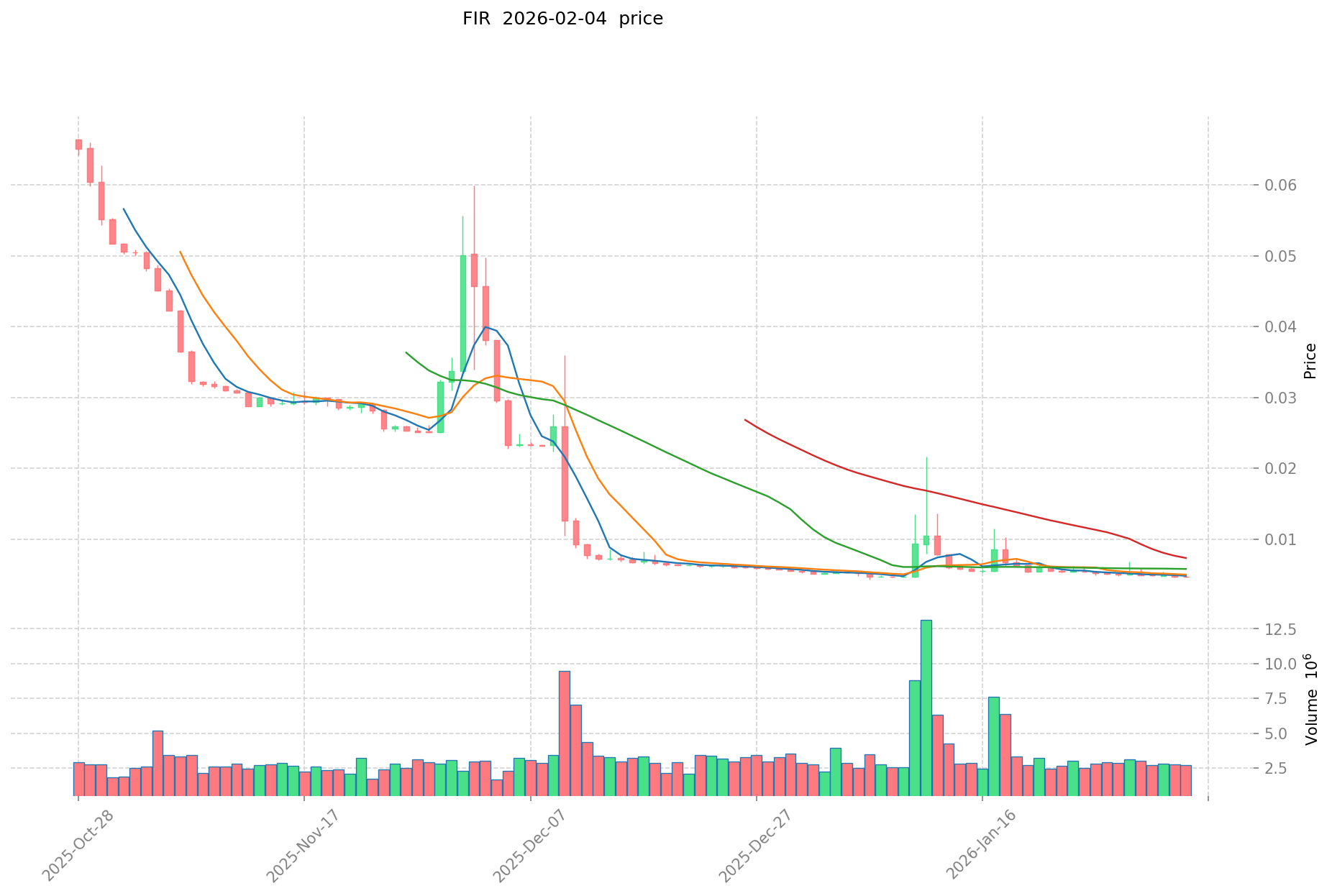
I. Fireverse (FIR) Price History Review and Current Investment Value
Historical Price Movements and Investment Returns
- August 2025: FIR token launched at $0.081, experiencing initial trading activity following platform debut
- August 2025: Price reached $0.13662 during early trading phase, reflecting initial market interest in AI-powered music creation concepts
- January 2026: Market conditions led to price movement from $0.13662 to $0.004254, demonstrating significant volatility
- February 2026: Current trading shows price stabilization around $0.00464, with ongoing platform development activities
Current FIR Investment Market Status (February 2026)
- Current FIR Price: $0.00464
- 24-Hour Trading Volume: $12,744.90
- Market Capitalization: $807,870.40
- Circulating Supply: 174,110,000 FIR (17.41% of total supply)
- Total Supply: 1,000,000,000 FIR
- Holder Count: 80,423 addresses
- Exchange Availability: Listed on 5 trading platforms
- Token Standard: BEP-20 (BSC)
View real-time FIR market price
The token demonstrates characteristics typical of early-stage Web3 projects in the music creation sector, with price movements reflecting broader market conditions and platform adoption dynamics. The circulating supply ratio of 17.41% indicates ongoing token distribution mechanisms, while the holder base suggests initial community formation around the platform's AI music generation features.
II. Core Factors Affecting Whether FIR is a Good Investment
Supply Mechanism and Scarcity (FIR Investment Scarcity)
- Supply Structure → Fireverse (FIR) has a maximum supply of 1,000,000,000 tokens, with a current circulating supply of 174,110,000 tokens, representing approximately 17.41% of the total supply. This controlled release mechanism may influence price dynamics and investment considerations.
- Price Performance Context → FIR has experienced notable price fluctuations, with the token trading at $0.00464 as of February 4, 2026. The price has declined approximately 85.25% over the past year, indicating significant volatility in market valuation.
- Investment Consideration → The substantial portion of tokens yet to enter circulation (over 82%) represents a supply-side factor that investors should consider when evaluating long-term holding strategies.
Institutional Investment and Mainstream Adoption (Institutional Investment in FIR)
- Holder Base → The token has attracted 80,423 holders as of the latest data, indicating a degree of community participation in the FIR ecosystem.
- Exchange Availability → FIR is listed on 5 exchanges, with Gate.com among the platforms supporting trading, providing investors with multiple access points for market participation.
- Ecosystem Development → Fireverse operates as a decentralized music creation platform integrating AI and blockchain technology, offering features including AI music generation, copyright protection mechanisms, and token incentive systems within the Web3 music ecosystem.
Macroeconomic Environment's Impact on FIR Investment
- Market Context → As of February 4, 2026, FIR's market capitalization stands at approximately $807,870, representing 0.00017% of the broader crypto market, positioning it as a smaller-cap digital asset subject to broader market dynamics.
- Volatility Profile → Recent price performance shows negative trends across multiple timeframes: -0.43% (1H), -0.42% (24H), -8.48% (7D), -11.87% (30D), and -85.25% (1Y), reflecting significant price pressure and market sentiment shifts.
- Market Position → FIR ranks #2666 in the cryptocurrency market, indicating its position within the highly competitive digital asset landscape where macro factors may have amplified effects on smaller tokens.
Technology and Ecosystem Development (Technology & Ecosystem for FIR Investment)
- Platform Features → Fireverse combines AI-powered music generation with blockchain-based copyright protection, enabling users to create, trade digital assets, and participate in a Web3 music ecosystem.
- Token Utility → The FIR token serves as an incentive mechanism within the platform, facilitating transactions and engagement in the decentralized music creation and monetization framework.
- Technical Infrastructure → The token is deployed on the Binance Smart Chain (BSC) network using the BEP-20 standard (contract address: 0x238d72e179a581c98dc1996417a49818c7e509dc), leveraging blockchain infrastructure for platform operations.
- Community Channels → Fireverse maintains presence through multiple channels including Twitter, Discord, and documentation via GitBook, providing resources for user engagement and project information access.
III. FIR Future Investment Prediction and Price Outlook (Is Fireverse(FIR) worth investing in 2026-2031)
Short-term Investment Prediction (2026, short-term FIR investment outlook)
- Conservative prediction: $0.0039 - $0.0046
- Neutral prediction: $0.0046 - $0.0054
- Optimistic prediction: $0.0054 - $0.0068
Mid-term Investment Outlook (2027-2028, mid-term Fireverse(FIR) investment forecast)
-
Market stage expectation: The token shows a gradual recovery trend following earlier declines, with technical indicators suggesting mixed signals. The circulating supply ratio remains relatively low at 17.41%, which may influence price dynamics as more tokens enter circulation.
-
Investment return prediction:
- 2027: $0.0038 - $0.0069
- 2028: $0.0044 - $0.0073
-
Key catalysts: Platform development progress, AI music generation technology adoption, blockchain-based copyright protection implementation, and Web3 music ecosystem expansion.
Long-term Investment Outlook (Is FIR a good long-term investment?)
- Base scenario: $0.0057 - $0.0082 (assuming steady platform growth and moderate user adoption)
- Optimistic scenario: $0.0075 - $0.0097 (assuming accelerated ecosystem development and favorable market conditions)
- Risk scenario: $0.0039 - $0.0055 (considering market volatility and competitive pressures)
View FIR long-term investment and price prediction: Price Prediction
2026-2031 Long-term Outlook
- Base scenario: $0.0057 - $0.0075 (corresponding to steady progress and gradual mainstream application enhancement)
- Optimistic scenario: $0.0068 - $0.0097 (corresponding to large-scale adoption and favorable market environment)
- Transformative scenario: Above $0.010 (if the ecosystem achieves breakthrough progress and mainstream adoption)
- 2031-12-31 predicted high: $0.0097 (based on optimistic development assumptions)
Disclaimer: Cryptocurrency investments carry substantial risk. Price predictions are based on historical data and market analysis models, and actual results may vary significantly. This analysis does not constitute investment advice.
| Year |
Predicted High Price |
Predicted Average Price |
Predicted Low Price |
Price Change |
| 2026 |
0.0068208 |
0.00464 |
0.0038976 |
0 |
| 2027 |
0.006933784 |
0.0057304 |
0.003839368 |
23 |
| 2028 |
0.0072819058 |
0.006332092 |
0.0044324644 |
36 |
| 2029 |
0.008236468669 |
0.0068069989 |
0.00544559912 |
46 |
| 2030 |
0.00782260313588 |
0.0075217337845 |
0.00707042975743 |
62 |
| 2031 |
0.009666932259839 |
0.00767216846019 |
0.006598064875763 |
65 |
IV. Fireverse Investment Strategy and Risk Management (How to invest in AI-powered Music Creation Tokens)
Investment Methodology (Fireverse investment strategy)
Long-term Holding (HODL Fireverse): Suitable for Conservative Investors
For investors seeking stable exposure to the Web3 music ecosystem, a long-term holding strategy may be considered. Fireverse operates in the intersection of AI, blockchain, and music creation, positioning itself within an emerging sector. Long-term holders typically focus on the project's fundamental development, including platform adoption rates, user growth, and ecosystem expansion. Given the token's current circulation ratio of approximately 17.41% (174,110,000 tokens out of 1,000,000,000 maximum supply), investors should monitor potential token unlock schedules that may impact future supply dynamics.
Active Trading: Based on Technical Analysis and Swing Operations
Active traders may leverage price volatility for short-term gains. Recent performance data shows the token experienced fluctuations with a 24-hour high of $0.00471 and low of $0.004619. The 7-day decline of approximately 8.48% and 30-day decline of around 11.87% suggest sustained downward pressure. Technical traders might utilize support and resistance levels, with the historical low of $0.004254 (recorded on January 6, 2026) potentially serving as a support zone, while the all-time high of $0.13662 (August 19, 2025) represents a significant resistance level. Daily trading volume of approximately $12,744.90 indicates relatively modest liquidity, which traders should factor into their execution strategies.
Risk Management (Risk management for Fireverse investment)
Asset Allocation Ratio: Conservative / Aggressive / Professional Investors
- Conservative Investors: Consider allocating 1-3% of total crypto portfolio to emerging tokens like FIR, maintaining majority holdings in established assets
- Aggressive Investors: May allocate 5-10% to high-risk, high-potential tokens within the AI and Web3 music sector
- Professional Investors: Should conduct thorough due diligence on tokenomics, team credentials, and competitive landscape before determining appropriate position sizing
Risk Hedging Solutions: Multi-asset Portfolio + Risk Mitigation Tools
Investors might consider diversifying across multiple blockchain sectors rather than concentrating exclusively in music-focused tokens. Portfolio construction could include:
- Core holdings in established cryptocurrencies
- Exposure to various Web3 sectors (DeFi, NFTs, AI)
- Stablecoin reserves for opportunistic purchases during market corrections
Given FIR's limited exchange availability (5 exchanges) and market cap of approximately $807,870, liquidity risk should be carefully managed through position sizing and gradual entry/exit strategies.
Secure Storage: Hot and Cold Wallets + Hardware Wallet Recommendations
FIR operates on the BSC (BNB Smart Chain) network using the BEP-20 standard (contract address: 0x238d72e179a581c98dc1996417a49818c7e509dc). Recommended storage approaches include:
- Cold Storage: Hardware wallets supporting BSC network (such as Ledger or Trezor with BEP-20 compatibility) for long-term holdings
- Hot Wallets: MetaMask or Trust Wallet for active trading, configured to BSC network
- Security Practices: Verify contract addresses through official channels (BscScan), enable two-factor authentication, and never share private keys
With approximately 80,423 holders, the token demonstrates some community distribution, though investors should remain vigilant about wallet security given the relatively nascent stage of the project.
V. Fireverse Investment Risks and Challenges (Risks of investing in AI-powered Music Creation Tokens)
Market Risk: High Volatility and Price Manipulation
FIR has demonstrated significant price volatility, with a year-to-date decline of approximately 85.25% from its all-time high of $0.13662 to current levels around $0.00464. This substantial drawdown illustrates the extreme price fluctuations common in emerging crypto assets. The token's relatively small market capitalization ($807,870) and modest daily trading volume ($12,744.90) may increase susceptibility to price manipulation or large-order impact. The current price represents approximately 96.89% below the all-time high, suggesting either severe market correction or fundamental reassessment by market participants. Investors should anticipate continued high volatility and prepare for potential further downside movements.
Regulatory Risk: Policy Uncertainty Across Different Countries
As a platform combining AI-generated music, blockchain-based copyright protection, and tokenized incentives, Fireverse operates at the intersection of multiple regulatory domains:
- Copyright and Intellectual Property: Jurisdictions may have varying interpretations of AI-generated content ownership and blockchain-based copyright systems
- Securities Regulations: Token classification may differ across regions, potentially affecting trading access and compliance requirements
- Data Privacy: AI music generation may involve user data processing subject to regulations like GDPR or similar frameworks
- Cross-border Operations: As a decentralized platform, regulatory compliance across multiple jurisdictions presents ongoing challenges
Investors should monitor regulatory developments in their respective jurisdictions and understand that policy changes could materially impact token utility or accessibility.
Technical Risk: Network Security Vulnerabilities and Upgrade Failures
Several technical considerations warrant attention:
- Smart Contract Risk: The BEP-20 token contract on BSC should be regularly audited for vulnerabilities; investors should verify whether independent security audits have been conducted
- Platform Dependencies: As a BSC-based token, FIR inherits both benefits and risks associated with the BNB Smart Chain infrastructure
- AI Integration Risks: The platform's AI music generation features represent novel technology integration that may encounter technical challenges or performance issues
- Scalability Concerns: As the platform grows, ability to handle increased transaction volumes and user activity remains to be demonstrated
- Development Execution: With only 17.41% of tokens currently in circulation, successful platform development and roadmap execution become critical factors for long-term viability
The relatively early stage of the project (launched in February 2025, approximately one year ago) means the platform's technical robustness has not been extensively tested over extended market cycles.
VI. Conclusion: Is AI-powered Music Creation Token a Good Investment?
Investment Value Summary
Fireverse represents an experimental investment in the convergence of artificial intelligence, blockchain technology, and music creation. The platform's core value proposition—combining AI music generation, copyright protection via blockchain, and Web3 monetization mechanisms—addresses potential inefficiencies in traditional music industry structures. However, the token's performance since launch has been challenging, with substantial decline from peak valuation. The current market capitalization of approximately $807,870 and limited exchange availability indicate early-stage positioning with corresponding liquidity constraints. Long-term investment potential depends heavily on successful platform adoption, user base expansion, and sustained development execution. Short-term price movements have shown considerable volatility, with notable downward pressure across multiple timeframes.
Investor Recommendations
✅ Beginners: Consider dollar-cost averaging approach with minimal allocation + secure wallet storage on BSC-compatible hardware wallets. Prioritize education about Web3 music platforms and BEP-20 token management before investing.
✅ Experienced Investors: May employ tactical trading strategies leveraging technical analysis + portfolio diversification across multiple blockchain sectors. Monitor platform development milestones, user metrics, and competitive landscape within AI-music creation space.
✅ Institutional Investors: Conduct comprehensive due diligence including tokenomics analysis, team background verification, and competitive positioning assessment. Consider pilot allocation as part of broader Web3 ecosystem exposure rather than concentrated position.
⚠️ Disclaimer: Cryptocurrency investments carry substantial risk including potential total loss of capital. This content is provided for informational purposes only and does not constitute investment advice, financial guidance, or recommendation to buy or sell any asset. Investors should conduct independent research and consult qualified financial advisors before making investment decisions.
VII. FAQ
Q1: What is the current investment value of Fireverse (FIR) in February 2026?
As of February 4, 2026, FIR trades at approximately $0.00464 with a market capitalization of $807,870, representing a decline of about 85.25% from its all-time high. The token serves as the native asset for a decentralized AI-powered music creation platform on the Binance Smart Chain. With 174,110,000 tokens in circulation (17.41% of total supply), modest daily trading volume of $12,744.90, and availability on 5 exchanges, FIR represents an early-stage, high-risk investment in the Web3 music ecosystem. The investment value depends heavily on platform adoption and development execution, with price predictions ranging from $0.0039-$0.0068 for 2026 under various scenarios.
Q2: How does Fireverse's tokenomics affect its long-term investment potential?
Fireverse has a maximum supply of 1,000,000,000 tokens with only 17.41% currently circulating, meaning over 82% of tokens remain to be distributed. This supply structure creates potential downward pressure as additional tokens enter the market through various distribution mechanisms. The controlled release may support price stability if accompanied by corresponding ecosystem growth and user adoption, but represents a significant consideration for long-term holders. Investors should monitor token unlock schedules and distribution timelines, as increased supply without proportional demand growth could negatively impact price performance. The low circulating ratio suggests the project is still in early distribution phases, requiring careful attention to supply-side dynamics.
Q3: What are the primary risks associated with investing in FIR tokens?
FIR investment carries three major risk categories: First, market risk manifested through extreme volatility with an 85.25% year-over-year decline, small market cap ($807,870) susceptible to manipulation, and limited liquidity ($12,744.90 daily volume). Second, regulatory uncertainty affects the platform's multi-jurisdictional operations involving AI-generated content copyright, token classification across regions, and data privacy compliance requirements. Third, technical risks include smart contract vulnerabilities on BSC, platform development execution challenges, AI integration complexities, and scalability concerns. The project's early stage (launched February 2025) means limited track record in handling market cycles or technical stress tests, amplifying these risks for potential investors.
Q4: How should different investor types approach FIR investment?
Conservative investors should consider 1-3% portfolio allocation using dollar-cost averaging and hardware wallet storage (Ledger/Trezor with BSC support), focusing on long-term platform fundamentals and ecosystem development. Aggressive investors might allocate 5-10% for higher risk exposure, employing active trading strategies based on technical analysis of support levels ($0.004254) and resistance zones, while monitoring the 7-day (-8.48%) and 30-day (-11.87%) trend patterns. Professional investors should conduct comprehensive due diligence on tokenomics, competitive positioning within AI-music creation, team credentials, and smart contract security audits before establishing positions. All investor types should maintain diversified portfolios across multiple blockchain sectors rather than concentrated exposure to music-focused tokens.
Q5: What factors could drive FIR price recovery or further decline?
Positive catalysts include successful platform adoption with measurable user growth, technological breakthroughs in AI music generation features, strategic partnerships within the music industry, favorable regulatory clarity for blockchain-based copyright systems, and broader Web3 ecosystem expansion. The platform's GitBook documentation, Discord/Twitter community engagement, and continuous development updates serve as indicators of project vitality. Negative factors include additional token supply entering circulation without proportional demand, intensifying competition from established music platforms or other blockchain music projects, regulatory restrictions on AI-generated content or crypto assets, technical vulnerabilities or platform failures, and broader cryptocurrency market downturns. The current holder base of 80,423 addresses provides some community foundation, though substantial growth would be needed to support meaningful price appreciation from current levels.
Q6: Is FIR suitable as a long-term investment through 2031?
FIR's long-term investment suitability remains highly speculative given its early stage and significant price decline since launch. Price predictions through 2031 range from base scenarios ($0.0057-$0.0075) to optimistic scenarios ($0.0068-$0.0097), with transformative scenarios exceeding $0.010 if breakthrough adoption occurs. However, these projections assume successful platform development, meaningful user acquisition, and favorable market conditions—outcomes that remain uncertain. The intersection of AI, blockchain, and music creation represents an innovative sector with growth potential, but also faces adoption challenges, competitive pressures, and execution risks. Long-term holders should view FIR as a speculative allocation within a diversified crypto portfolio, prepared for extended volatility and potential further drawdowns. The investment is most appropriate for those with high risk tolerance and deep understanding of Web3 music ecosystems.
Q7: How does FIR compare to other Web3 music platform investments?
FIR occupies a niche position combining AI music generation with blockchain-based copyright protection, differentiating itself through technology integration rather than pure music streaming or NFT marketplaces. Its BEP-20 standard deployment on BSC provides lower transaction costs compared to Ethereum-based alternatives, potentially benefiting platform scalability. However, the token's small market cap ($807,870) and limited exchange availability (5 platforms) contrast with more established music crypto projects with broader liquidity and institutional recognition. The platform's focus on decentralized music creation and token-based incentives addresses similar market inefficiencies as competitors but lacks the track record or market validation of longer-operating projects. Comparative advantage depends on successful AI technology differentiation and community building around its 80,423+ holder base, while disadvantages include limited liquidity, nascent stage operations, and fierce competition in the evolving Web3 music landscape.
Q8: What security measures should FIR investors implement?
Investors should implement multi-layered security practices specific to BSC-based tokens: First, use hardware wallets (Ledger Nano S/X or Trezor Model T with BSC compatibility) for long-term storage, transferring tokens off exchanges after purchase. Second, verify the official contract address (0x238d72e179a581c98dc1996417a49818c7e509dc) through BscScan before any transactions to avoid counterfeit tokens. Third, configure MetaMask or Trust Wallet with BSC Mainnet settings for active trading, enabling two-factor authentication and regularly updating software. Fourth, never share private keys or seed phrases, and be vigilant against phishing attempts through social media channels. Fifth, for larger holdings, consider multi-signature wallet solutions and maintain offline backups of recovery phrases in secure physical locations. Given the project's relatively small holder base and emerging status, enhanced security vigilance is essential to protect investments from both external threats and potential platform-related vulnerabilities.
* The information is not intended to be and does not constitute financial advice or any other recommendation of any sort offered or endorsed by Gate.