This comprehensive analysis examines whether MerlinSwap (MP) represents a viable investment opportunity for 2024-2031. As a Bitcoin Layer 2 decentralized exchange launched in April 2024, MP currently trades at $0.0001474 with a market capitalization of approximately $464,310, though it peaked at $0.009488 in early 2024. The article evaluates MP's investment characteristics through multiple lenses: historical price performance showing significant volatility, current market fundamentals including 66,009 holders and limited exchange liquidity, and detailed price forecasts projecting potential ranges from $0.00011-$0.00036 through 2031 under various scenarios. Beyond technical analysis, the guide addresses critical factors including token supply mechanics, market position within Bitcoin ecosystem infrastructure, and comprehensive risk assessments covering market volatility, regulatory uncertainty, and technical vulnerabilities. Strategic allocation recommendations differentiate between conservative, moderate, and
Introduction: MerlinSwap (MP) Investment Position and Market Outlook
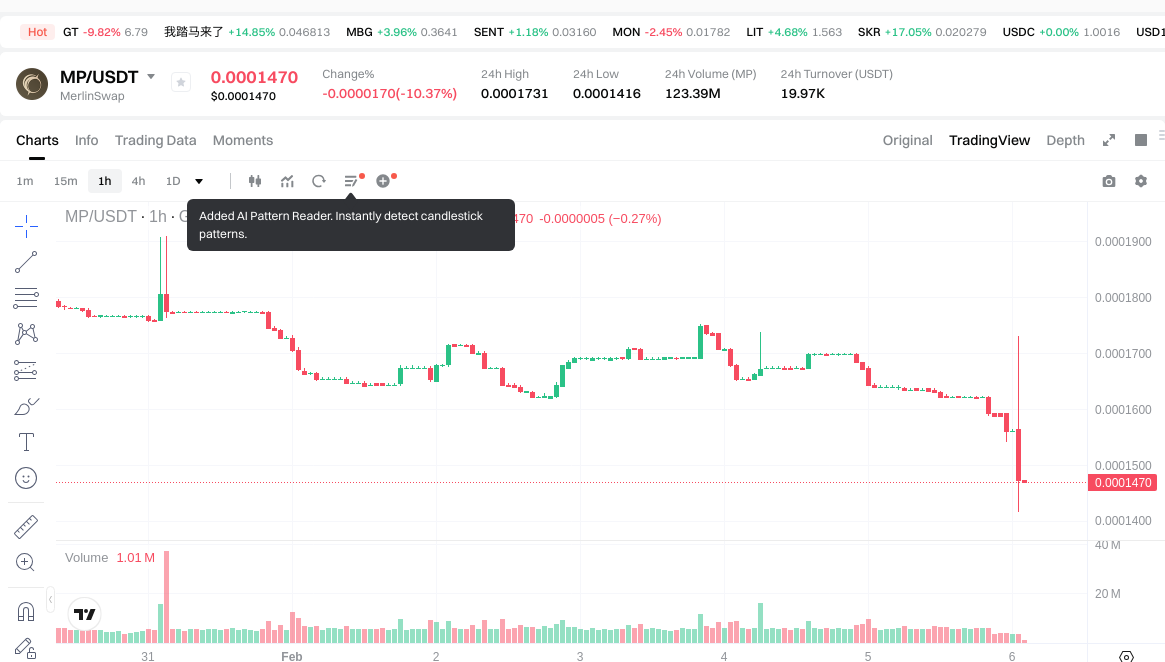
MP is a significant asset in the cryptocurrency sector, launched in 2024 and positioning itself within the Bitcoin ecosystem's decentralized exchange landscape. As of February 2026, MP maintains a market capitalization of approximately $464,310, with a circulating supply of 3.15 billion tokens, and a current price around $0.0001474. Branded as a decentralized exchange aimed at becoming a liquidity hub for BTC and Bitcoin ecosystem assets across Bitcoin Layer 2, MerlinSwap has attracted attention with approximately 66,009 holders. With a 24-hour trading volume of $20,013 and a market dominance of 0.00012%, MP represents a micro-cap asset in the broader cryptocurrency market. This article comprehensively analyzes MP's investment characteristics, historical performance, future price outlook, and associated risks to provide reference materials for investors evaluating "Is MerlinSwap (MP) a good investment?"
I. MerlinSwap (MP) Price History Review and Current Investment Value
- April 2024: MP launched at $0.001 and reached a peak of $0.009488 → Early investors experienced significant gains during the initial trading period
- April 2024 to February 2026: Market correction phase → Price declined from $0.009488 to $0.0001416, representing a substantial adjustment over the two-year period
- 2025: Trading activity remained limited with MP listed on only one exchange → Price volatility reflected concentrated market dynamics and lower liquidity conditions
Current MP Investment Market Status (February 2026)
- MP current price: $0.0001474
- 24-hour trading volume: $20,013.15
- Market capitalization: $464,310 (circulating supply represents 15.0% of total supply)
- Circulation: 3.15 billion MP tokens out of 21 billion maximum supply
- Holder base: 66,009 addresses holding MP tokens
Click to view real-time MP market price
Recent Performance Indicators:
- 1-hour change: -14.85%
- 24-hour change: -10.25%
- 7-day change: -18.52%
- 30-day change: -31.81%
- 1-year change: -63.12%
MP's price trajectory reflects the typical volatility patterns observed in decentralized exchange tokens within the Bitcoin ecosystem. The token's positioning as a liquidity hub for BTC and Bitcoin-native assets across Layer 2 networks represents its core value proposition, though market performance has faced considerable headwinds since launch.
II. Core Factors Influencing Whether MP is a Good Investment (Is MerlinSwap(MP) a Good Investment)
Supply Mechanism and Scarcity (MP investment scarcity)
- Total supply of 21,000,000,000 MP tokens with a maximum supply cap → influences long-term price dynamics and investment considerations
- Current circulating supply of 3,150,000,000 MP represents 15% of total supply → indicates controlled token release schedule
- Investment consideration: The defined supply structure with maximum cap may contribute to potential scarcity dynamics over time
- 24-hour trading volume of $20,013.15 → reflects current market liquidity levels
- Price volatility observed across different timeframes: -14.85% (1H), -10.25% (24H), -18.52% (7D), -31.81% (30D), -63.12% (1Y) → indicates significant price fluctuations
- Holder base of 66,009 addresses → demonstrates user adoption and distribution
- Trading availability on 1 exchange platform → affects accessibility for potential investors
Market Position and Ecosystem Role (Ecosystem positioning for MP investment)
- Functions as the decentralized exchange within the Bitcoin ecosystem → aims to serve as liquidity hub for BTC and Bitcoin ecosystem assets
- Operates on Merlin Chain infrastructure → provides technical foundation for platform operations
- Market capitalization of $464,310 with fully diluted valuation of $3,095,400 → represents current valuation metrics
- Market dominance of 0.00012% → indicates relative position within broader cryptocurrency market
Investment Outlook Considerations (Investment forecast perspectives)
- Mixed analytical perspectives exist regarding 2026 investment potential, with various quantitative technical indicators suggesting different scenarios
- Price range observations: 24-hour high of $0.0001731 and low of $0.0001416 → demonstrates intraday volatility patterns
- Current price of $0.0001474 compared to historical price points → provides context for valuation assessment
III. MP Future Investment Forecast and Price Outlook (Is MerlinSwap(MP) worth investing in 2026-2031)
Short-term Investment Forecast (2026, short-term MP investment outlook)
Based on current market data, MerlinSwap (MP) is trading at $0.0001474 as of February 06, 2026, showing a 24-hour decline of 10.25%. The token has experienced significant price volatility, with recent performance indicating downward pressure across multiple timeframes (1-hour: -14.85%, 7-day: -18.52%, 30-day: -31.81%).
- Conservative forecast: $0.00011025 - $0.00014700
- Neutral forecast: $0.00014700 - $0.00016537
- Optimistic forecast: $0.00016537 - $0.00018375
The short-term outlook suggests MP may continue to face headwinds, with the token trading near its historical low of $0.0001416 (recorded February 05, 2026). The 24-hour trading range of $0.0001416 - $0.0001731 reflects ongoing market uncertainty.
Mid-term Investment Outlook (2027-2029, mid-term MerlinSwap(MP) investment forecast)
-
Market phase expectations: The mid-term period may witness gradual recovery and stabilization as the Bitcoin ecosystem continues to develop. MerlinSwap's position as a decentralized exchange within the Bitcoin Layer 2 infrastructure could benefit from increased adoption of Bitcoin-based DeFi solutions.
-
Investment return projections:
- 2027: $0.00015049 - $0.0002414
- 2028: $0.0001607 - $0.0002949
- 2029: $0.0001669 - $0.0003314
-
Key catalysts: Expansion of Bitcoin Layer 2 ecosystems, increased liquidity for BTC and Bitcoin eco-assets, broader adoption of decentralized exchanges within the Bitcoin network, and potential partnerships or integrations with major Bitcoin infrastructure projects.
Long-term Investment Outlook (Is MP a good long-term investment?)
- Base scenario: $0.0002234 - $0.0002904 (assuming steady development and moderate ecosystem growth through 2030)
- Optimistic scenario: $0.0003005 - $0.0003635 (assuming accelerated adoption and favorable market conditions through 2031)
- Risk scenario: Below $0.0001416 (under conditions of severe market downturns or fundamental project challenges)
For detailed MP long-term investment analysis and price predictions: Price Prediction
2026-2031 Long-term Outlook
- Base scenario: $0.00011 - $0.00029 (corresponding to steady progress and gradual mainstream application growth)
- Optimistic scenario: $0.00030 - $0.00036 (corresponding to large-scale adoption and favorable market environment)
- Transformative scenario: Above $0.00036 (contingent upon breakthrough ecosystem developments and mainstream penetration)
- December 31, 2031 projected high: $0.00036 (based on optimistic development assumptions)
Disclaimer: The projections presented are analytical estimates based on current market data and should not be construed as investment advice. Cryptocurrency markets are highly volatile and subject to numerous unpredictable factors. Current market conditions show MP trading significantly below its all-time high of $0.009488 (April 08, 2024), with a year-to-date decline of 63.12%. The token's circulating supply represents only 15% of the maximum supply of 21 billion tokens, which may influence future price dynamics. Investors should conduct thorough due diligence and consider their risk tolerance before making investment decisions.
| Year |
Predicted High Price |
Predicted Average Price |
Predicted Low Price |
Price Change |
| 2026 |
0.00018375 |
0.000147 |
0.00011025 |
0 |
| 2027 |
0.0002414475 |
0.000165375 |
0.00015049125 |
12 |
| 2028 |
0.0002949463125 |
0.00020341125 |
0.0001606948875 |
37 |
| 2029 |
0.000331407779062 |
0.00024917878125 |
0.000166949783437 |
69 |
| 2030 |
0.000310613809767 |
0.000290293280156 |
0.00022352582572 |
96 |
| 2031 |
0.000363548789403 |
0.000300453544961 |
0.000276417261364 |
103 |
IV. MP Investment Strategy and Risk Management (How to invest in MerlinSwap)
Investment Methodology (MP investment strategy)
Long-term Holding (HODL MP)
For conservative investors seeking stable exposure to Bitcoin ecosystem infrastructure, long-term holding of MP may align with fundamental value accumulation strategies. This approach focuses on MerlinSwap's positioning as a liquidity hub within Bitcoin Layer 2 networks, potentially benefiting from the broader adoption of Bitcoin-based decentralized finance protocols.
Active Trading
Active trading strategies for MP typically rely on technical analysis and swing trading patterns. Given the token's price volatility, traders may identify opportunities through chart patterns, volume analysis, and market momentum indicators. This approach requires continuous market monitoring and risk assessment capabilities.
Risk Management (Risk management for MP investment)
Asset Allocation Ratios
- Conservative investors: Limit MP exposure to 1-3% of total crypto portfolio
- Moderate investors: Allocate 3-7% depending on risk tolerance and market conditions
- Experienced investors: May consider 7-15% allocation with active management strategies
Risk Hedging Solutions
Implementing a diversified portfolio approach combining MP with established digital assets and traditional hedging instruments can help mitigate concentration risk. Correlation analysis with Bitcoin and major Layer 2 protocols may inform hedging decisions.
Secure Storage
- Cold wallet storage: Recommended for long-term holdings to minimize online security risks
- Hot wallet allocation: Limited amounts for active trading purposes
- Hardware wallet options: Consider reputable devices supporting Merlin Chain network
V. MP Investment Risks and Challenges (Risks of investing in MerlinSwap)
Market Risks
MP demonstrates significant price volatility, with historical data showing substantial percentage fluctuations across various timeframes. The token's relatively limited exchange availability and market depth may contribute to price sensitivity. Investors should be prepared for potential rapid value changes inherent in emerging DeFi protocols.
Regulatory Risks
Decentralized exchange tokens face evolving regulatory landscapes across different jurisdictions. Policy developments regarding cryptocurrency trading platforms, DeFi protocols, and Bitcoin Layer 2 solutions may impact MP's operational environment and market accessibility. Regulatory uncertainty varies significantly between regions.
Technical Risks
As a decentralized exchange protocol, MerlinSwap faces technical considerations including:
- Smart contract security vulnerabilities
- Network performance and scalability challenges
- Protocol upgrade implementation risks
- Integration dependencies with underlying blockchain infrastructure
VI. Conclusion: Is MerlinSwap a Good Investment?
Investment Value Summary
MP represents exposure to Bitcoin ecosystem DeFi infrastructure, particularly focused on liquidity provision across Bitcoin Layer 2 networks. The token's value proposition is tied to MerlinSwap's adoption and trading volume within the Bitcoin DeFi landscape. However, investors should recognize the token's price volatility and emerging market positioning.
Investor Recommendations
✅ Beginners: Consider dollar-cost averaging strategies combined with secure wallet storage practices. Start with minimal allocation to understand market dynamics.
✅ Experienced Investors: May explore swing trading opportunities while maintaining diversified portfolio allocation. Monitor protocol development and ecosystem growth metrics.
✅ Institutional Investors: Evaluate strategic positioning within Bitcoin Layer 2 infrastructure themes. Consider pilot allocation with comprehensive due diligence.
⚠️ Important Notice: Cryptocurrency investments carry substantial risk. This content is for informational purposes only and does not constitute investment advice. Conduct thorough research and consider your financial circumstances before making investment decisions.
VII. FAQ
Q1: What is MerlinSwap (MP) and what makes it different from other decentralized exchanges?
MerlinSwap (MP) is a decentralized exchange protocol launched in 2024, specifically designed to function as a liquidity hub for Bitcoin (BTC) and Bitcoin ecosystem assets across Bitcoin Layer 2 networks. Unlike traditional DEXs operating on Ethereum or other smart contract platforms, MerlinSwap positions itself within the Bitcoin infrastructure ecosystem, operating on Merlin Chain. Its core differentiation lies in its focus on facilitating trading and liquidity provision for Bitcoin-native assets and Bitcoin Layer 2 tokens, rather than competing in the more saturated EVM-compatible DEX market. With a maximum supply of 21 billion MP tokens and approximately 66,009 holders as of February 2026, the platform aims to capture value from the growing Bitcoin DeFi sector.
Q2: How has MP performed since its launch and what is its current market position?
MP launched in April 2024 at approximately $0.001 and reached an all-time high of $0.009488 shortly after launch. However, the token has experienced significant correction, currently trading at around $0.0001474 as of February 6, 2026—representing an 84% decline from its peak. The token demonstrates substantial volatility with recent performance showing -10.25% (24H), -18.52% (7D), -31.81% (30D), and -63.12% (1Y). With a market capitalization of approximately $464,310 and a 24-hour trading volume of $20,013, MP remains a micro-cap asset with 0.00012% market dominance. The circulating supply of 3.15 billion tokens represents only 15% of the maximum supply, suggesting a controlled token release schedule that may influence future supply dynamics.
Q3: What are the primary factors investors should consider when evaluating MP as an investment?
Key evaluation factors include: (1) Supply Dynamics – The defined maximum supply of 21 billion tokens with only 15% currently circulating creates potential scarcity mechanics over time; (2) Ecosystem Positioning – MP's role as a Bitcoin Layer 2 liquidity hub positions it to benefit from Bitcoin DeFi adoption, though this remains an emerging sector; (3) Liquidity Concerns – Current 24-hour trading volume of approximately $20,013 and availability on only one exchange indicate limited market depth and accessibility challenges; (4) Volatility Profile – Historical price action demonstrates significant fluctuations across all timeframes, requiring substantial risk tolerance; (5) Holder Distribution – A base of 66,009 holders suggests moderate adoption but concentration risk may exist depending on token distribution patterns.
Q4: What price forecasts exist for MP in the short-term and long-term?
Short-term forecasts for 2026 suggest MP may trade within ranges of $0.00011025-$0.00018375 depending on market conditions, with the token currently experiencing downward pressure near historical lows. Mid-term projections (2027-2029) anticipate potential gradual recovery, with estimates ranging from $0.00015049 (conservative 2027) to $0.0003314 (optimistic 2029), contingent on Bitcoin Layer 2 ecosystem development and broader DeFi adoption. Long-term outlooks through 2031 project base scenarios of $0.00022-$0.00029, optimistic scenarios of $0.00030-$0.00036, with transformative scenarios potentially exceeding $0.00036 if breakthrough ecosystem developments occur. However, these projections remain highly speculative, and investors should note the risk scenario of prices falling below $0.0001416 under adverse market conditions. All forecasts should be viewed as analytical estimates rather than guaranteed outcomes.
Q5: What are the main risks associated with investing in MP?
Primary risks include: (1) Market Risk – Extreme price volatility demonstrated across all timeframes, with potential for rapid value fluctuations due to limited liquidity and exchange availability; (2) Liquidity Risk – Trading on only one exchange with relatively low daily volume creates challenges for position entry and exit, particularly for larger allocations; (3) Regulatory Risk – Evolving regulatory frameworks for DeFi protocols and Bitcoin Layer 2 solutions may impact operational viability and market access across different jurisdictions; (4) Technical Risk – Smart contract vulnerabilities, network performance issues, protocol upgrade complications, and integration dependencies with underlying blockchain infrastructure; (5) Concentration Risk – Micro-cap market position with 0.00012% market dominance suggests susceptibility to market manipulation and extreme price swings; (6) Adoption Risk – Success depends on broader adoption of Bitcoin DeFi and Layer 2 solutions, which remain emerging and unproven sectors.
Q6: What investment allocation strategies are recommended for different investor profiles?
Investment allocation should align with risk tolerance and experience levels: Conservative investors should limit MP exposure to 1-3% of total cryptocurrency portfolio, utilizing dollar-cost averaging strategies and secure cold wallet storage. This approach minimizes concentration risk while maintaining limited exposure to Bitcoin ecosystem infrastructure themes. Moderate investors may allocate 3-7% depending on market conditions and individual risk tolerance, potentially implementing swing trading strategies based on technical analysis while maintaining core long-term holdings. Experienced investors with active management capabilities might consider 7-15% allocation, leveraging market volatility through active trading strategies while employing hedging techniques and diversification across Bitcoin Layer 2 protocols. All investor categories should prioritize secure storage solutions, with cold wallets for long-term holdings and minimal hot wallet allocations for active trading purposes.
Q7: How should investors approach MP from a risk management perspective?
Effective risk management requires multi-layered strategies: (1) Position Sizing – Strictly limit MP allocation based on personal risk tolerance, never exceeding amounts one can afford to lose completely; (2) Diversification – Combine MP with established digital assets and uncorrelated instruments to mitigate concentration risk, analyzing correlation patterns with Bitcoin and major Layer 2 protocols; (3) Entry Strategies – Employ dollar-cost averaging rather than lump-sum investments to smooth entry prices across market volatility cycles; (4) Stop-Loss Implementation – For active traders, establish predetermined exit points to limit downside exposure, acknowledging that limited liquidity may affect execution; (5) Security Protocols – Utilize hardware wallets and cold storage for long-term holdings, maintaining operational security through multi-factor authentication and regular security audits; (6) Continuous Monitoring – Track protocol development metrics, ecosystem adoption indicators, and regulatory developments that may impact MP's fundamental value proposition.
Q8: Is MerlinSwap a suitable investment for beginners in cryptocurrency?
For cryptocurrency beginners, MP presents significant challenges and may not represent an ideal entry-level investment. The token's extreme volatility, limited exchange availability, micro-cap market position, and emerging protocol status create complexity unsuitable for investors without substantial risk tolerance and market understanding. Beginners considering MP exposure should: (1) First establish foundational knowledge through more established cryptocurrency assets; (2) Allocate only minimal portfolio percentages (1-2% maximum) as learning positions; (3) Prioritize security education and implement cold storage solutions immediately; (4) Commit to continuous learning about Bitcoin Layer 2 ecosystems and DeFi protocols; (5) Avoid leveraged positions or derivative instruments entirely; (6) Maintain emergency reserves separate from cryptocurrency investments. More experienced investors entering MP should acknowledge the speculative nature of the investment, the limited track record of the protocol, and the potential for complete capital loss inherent in micro-cap cryptocurrency assets within emerging ecosystem niches.
* The information is not intended to be and does not constitute financial advice or any other recommendation of any sort offered or endorsed by Gate.