Is NeuroWebAI (NEURO) a good investment?: A Comprehensive Analysis of Market Potential, Risk Factors, and Expert Predictions for 2024

Introduction: NeuroWebAI (NEURO) Investment Position and Market Prospects
NeuroWebAI (NEURO) is a utility token within the cryptocurrency sector, launched in May 2024 as part of the NeuroWeb Network, a decentralized AI blockchain. The network aims to incentivize knowledge creation, connectivity, and sharing through Knowledge Mining. As of February 3, 2026, NEURO has a market capitalization of approximately $1.2 million, with a circulating supply of 199.98 million tokens out of a total supply of 1 billion. The current price stands at approximately $0.006011, reflecting significant volatility since its launch. Positioned as a network for creating Knowledge Assets on the OriginTrail Decentralized Knowledge Graph, NEURO has become a subject of interest among investors evaluating "Is NeuroWebAI (NEURO) a good investment?" This article provides a comprehensive analysis of NEURO's investment characteristics, historical price movements, future price considerations, and associated investment risks to serve as a reference for potential investors.
I. NeuroWebAI (NEURO) Price History Review and Current Investment Value Status
NEURO Historical Price Trends and Investment Performance
- 2022: NeuroWeb Network launched as a decentralized AI blockchain on the Polkadot parachain, establishing its position in the knowledge economy ecosystem
- Early 2024: The network extended its parachain slot for an additional two years, reinforcing long-term operational commitment and technological infrastructure
- January 2025: NEURO reached a notable price level of $0.3 on January 6, 2025, reflecting market interest during a period of heightened attention to AI-blockchain integration
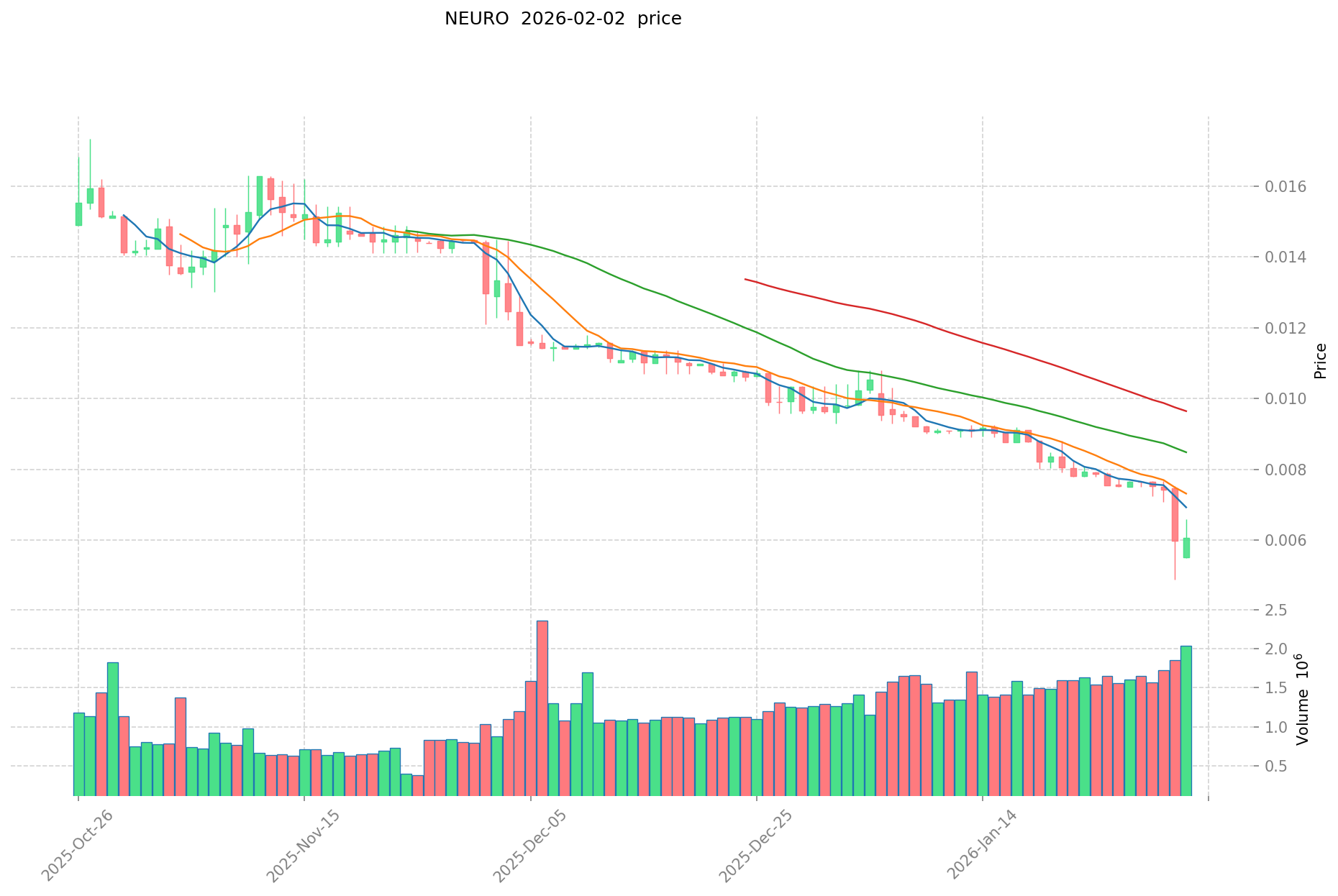
- January 2026: Price declined to $0.004875 on January 31, 2026, representing a significant retracement from prior levels amid broader market adjustments
Current NEURO Investment Market Status (February 2026)
- NEURO current price: $0.006011
- 24-hour price change: +8.99%
- 24-hour trading volume: $12,511.66
- Market capitalization: $1,202,091.80
- Circulating supply: 199,982,000 NEURO (19.9982% of total supply)
- Fully diluted valuation: $6,011,000
Click to view real-time NEURO market price
II. Core Factors Influencing Whether NEURO is a Good Investment (Is NeuroWebAI(NEURO) a Good Investment)
Supply Mechanism and Scarcity (NEURO investment scarcity)
- Total supply capped at 1,000,000,000 NEURO tokens with current circulating supply of 199,982,000 tokens, representing approximately 20% circulation → influences price dynamics and potential investment value
- Limited supply structure with defined maximum cap may contribute to scarcity considerations for long-term investment positioning
- Investment significance: constrained token supply relative to maximum cap represents a fundamental consideration for evaluating long-term investment potential
Institutional Investment and Mainstream Adoption (Institutional investment in NEURO)
- NeuroWeb operates as a Polkadot parachain with its slot extended through 2026, indicating continued network infrastructure commitment
- Positioned as the leading network for creating Knowledge Assets on the OriginTrail network, with reported ranking as second highest in transaction volume among Polkadot parachains
- Integration with OriginTrail's Decentralized Knowledge Graph ecosystem provides potential utility within AI knowledge economy applications
Macroeconomic Environment Impact on NEURO Investment
- Reference materials indicate cautiously optimistic outlook for January 2026 underpinned by improving macroeconomic conditions
- Market dynamics influenced by broader cryptocurrency market trends and regulatory developments affecting decentralized AI blockchain projects
- Investment considerations should account for volatility patterns, including observed price changes of -0.97% (1H), +8.99% (24H), -17.5% (7D), -40.01% (30D), and -88.14% (1Y) as of February 3, 2026
Technology and Ecosystem Development (Technology & Ecosystem for NEURO investment)
- Knowledge Mining mechanism designed to incentivize knowledge creation, connectivity and sharing through the OriginTrail Decentralized Knowledge Graph
- NEURO utility token structured to reward contributions to AI knowledge economy infrastructure
- Network launched in 2022 with parachain slot extension secured through early 2024 for additional two-year period, supporting continued ecosystem development
- Ecosystem positioning within Polkadot parachain infrastructure and OriginTrail network integration represents technical foundation for potential long-term value considerations
III. NEURO Future Investment Predictions and Price Outlook (Is NeuroWebAI(NEURO) worth investing in 2026-2031)
Short-term Investment Prediction (2026, short-term NEURO investment outlook)
- Conservative forecast: $0.00415 - $0.00550
- Neutral forecast: $0.00550 - $0.00600
- Optimistic forecast: $0.00600 - $0.00637
Mid-term Investment Outlook (2027-2028, mid-term NeuroWebAI(NEURO) investment forecast)
- Market stage expectation: The asset may experience gradual growth as the decentralized AI and knowledge economy sector develops, with potential volatility influenced by broader market conditions and adoption rates of OriginTrail ecosystem.
- Investment return prediction:
- 2027: $0.00365 - $0.00910
- 2028: $0.00558 - $0.00964
- Key catalysts: Expansion of OriginTrail Decentralized Knowledge Graph adoption, continued operation within Polkadot parachain ecosystem, and developments in AI-driven knowledge mining applications.
Long-term Investment Outlook (Is NEURO a good long-term investment?)
- Baseline scenario: $0.00578 - $0.00928 (assuming steady development of knowledge asset infrastructure and sustained parachain operations)
- Optimistic scenario: $0.00928 - $0.01124 (assuming increased adoption of AI knowledge economy solutions and enhanced utility within the OriginTrail network)
- Risk scenario: $0.00365 - $0.00558 (in case of prolonged market downturns or limited ecosystem expansion)
Click to view NEURO long-term investment and price prediction: Price Prediction
2026-2031 Long-term Outlook
- Base scenario: $0.00578 - $0.00928 (corresponding to steady progress and gradual mainstream application improvement)
- Optimistic scenario: $0.00928 - $0.01124 (corresponding to large-scale adoption and favorable market environment)
- Transformative scenario: Above $0.01124 (if the ecosystem achieves breakthrough developments and mainstream adoption)
- 2031-12-31 predicted high: $0.01139 (based on optimistic development assumptions)
Disclaimer: Price predictions are based on historical data and market analysis models. Cryptocurrency markets are highly volatile and subject to various unpredictable factors. These forecasts should not be considered as investment advice, and actual results may differ significantly from predictions.
| Year | Predicted High Price | Predicted Average Price | Predicted Low Price | Price Change |
|---|---|---|---|---|
| 2026 | 0.00637272 | 0.006012 | 0.00414828 | 0 |
| 2027 | 0.0091027692 | 0.00619236 | 0.0036534924 | 3 |
| 2028 | 0.009635931396 | 0.0076475646 | 0.005582722158 | 27 |
| 2029 | 0.0099380101977 | 0.008641747998 | 0.00578997115866 | 43 |
| 2030 | 0.011240753708398 | 0.00928987909785 | 0.00678161174143 | 54 |
| 2031 | 0.011394501207467 | 0.010265316403124 | 0.005748577185749 | 70 |
IV. NEURO Investment Strategy and Risk Management (How to invest in NeuroWebAI)
Investment Methodology (NEURO investment strategy)
Long-term Holding (HODL NEURO): Suitable for Conservative Investors
For investors seeking steady exposure to the decentralized AI blockchain sector, long-term holding of NEURO may be considered as part of a diversified portfolio strategy. This approach focuses on the fundamental development of the NeuroWeb Network ecosystem, including its role in the OriginTrail Decentralized Knowledge Graph and its position within the Polkadot parachain ecosystem. Given the project's operational history since 2022 and its parachain slot extension through early 2026, long-term holders may evaluate the network's sustained development trajectory. However, investors should note the significant price decline of approximately 88.14% over the past year, which underscores the importance of thorough due diligence and risk assessment before committing capital.
Active Trading: Technical Analysis and Swing Operations
Active traders may approach NEURO through technical analysis, considering its 24-hour price volatility range between $0.005709 and $0.0063. The token has demonstrated notable short-term fluctuations, with an 8.99% increase over 24 hours contrasted against a 17.5% decline over 7 days. Traders utilizing swing strategies should monitor key support and resistance levels, volume patterns (current 24h volume: $12,511.66), and broader market sentiment indicators. The relatively limited exchange availability (1 exchange) and modest market capitalization ($1.20 million) suggest lower liquidity conditions, which may result in wider spreads and slippage during position entries and exits.
Risk Management (Risk management for NEURO investment)
Asset Allocation Proportion: Conservative / Aggressive / Professional Investors
- Conservative Investors: Given NEURO's market capitalization ranking (#2391) and significant historical volatility, conservative portfolios might limit exposure to 1-3% of total crypto holdings, treating it as a speculative allocation within a broader diversified strategy.
- Aggressive Investors: Those with higher risk tolerance may allocate 5-10% to NEURO, accepting potential downside in exchange for exposure to the decentralized AI and knowledge economy sector.
- Professional Investors: Institutional or experienced traders might employ dynamic allocation strategies, adjusting positions based on technical indicators, network development milestones, and correlation with broader Polkadot ecosystem performance.
Risk Hedging Strategies: Multi-asset Portfolio + Hedging Tools
Investors may consider portfolio diversification across different blockchain sectors (DeFi, Layer 1/Layer 2, infrastructure tokens) to mitigate concentration risk. Correlation analysis with major assets (BTC, ETH) and Polkadot ecosystem tokens (DOT, other parachains) can inform hedging decisions. For those with access to derivatives markets, strategies such as protective puts or collar options might be explored, though liquidity constraints on NEURO-specific derivatives may limit availability. Position sizing techniques, including fixed fractional allocation and Kelly Criterion adaptations, can help manage exposure relative to portfolio volatility targets.
Secure Storage: Hot/Cold Wallets + Hardware Wallet Recommendations
NEURO operates as a native token on the NeuroWeb Network, a Polkadot parachain. Appropriate storage solutions include:
- Cold Storage: Hardware wallets supporting Polkadot-compatible tokens (such as Ledger devices with Polkadot.js integration) provide enhanced security for long-term holdings by keeping private keys offline.
- Hot Wallets: For active trading purposes, users may utilize Polkadot.js browser extension or other Substrate-compatible wallets, understanding the increased exposure to online security risks.
- Exchange Custody: While convenient for frequent trading, maintaining substantial holdings on exchanges carries counterparty risk. Investors should evaluate exchange security practices and insurance coverage.
- Multi-signature Solutions: Advanced users may implement multi-signature wallet configurations for additional security layers, particularly for larger holdings.
V. NEURO Investment Risks and Challenges (Risks of investing in NeuroWebAI)
Market Risks: High Volatility and Price Manipulation Concerns
NEURO has exhibited substantial price volatility, with historical fluctuations ranging from an all-time high of $0.30 (January 6, 2025) to an all-time low of $0.004875 (January 31, 2026). This represents a peak-to-trough decline exceeding 98%, illustrating the extreme price swings characteristic of lower-capitalization digital assets. The current circulating supply represents only 19.99% of the maximum supply (199.982 million of 1 billion tokens), suggesting potential future dilution effects as additional tokens enter circulation. With a modest market capitalization of approximately $1.20 million and limited exchange availability, the token may be susceptible to significant price impacts from relatively small trading volumes. These liquidity constraints can amplify both upward and downward price movements, creating challenges for investors attempting to execute large orders without substantial slippage.
Regulatory Risks: Policy Uncertainty Across Jurisdictions
As a decentralized AI blockchain project, NeuroWeb operates in an evolving regulatory landscape where jurisdictions worldwide continue developing frameworks for digital assets, particularly those involving artificial intelligence applications. Regulatory classifications of utility tokens, securities determinations, and AI-specific governance requirements vary significantly across regions. Changes in regulatory stance—including potential restrictions on trading, taxation policies, or compliance requirements—could materially impact NEURO's accessibility, liquidity, and valuation. Investors should monitor regulatory developments in their jurisdictions and consider how shifts in policy frameworks might affect their holdings, particularly given the project's focus on AI knowledge economy applications, which may attract additional scrutiny as AI regulations evolve globally.
Technical Risks: Network Security Vulnerabilities and Upgrade Failures
While NeuroWeb operates as a Polkadot parachain and benefits from the shared security model of the Relay Chain, project-specific technical risks remain. These include potential vulnerabilities in the network's implementation of knowledge mining mechanisms, smart contract exploits within the OriginTrail Decentralized Knowledge Graph integration, and challenges associated with future protocol upgrades. The parachain slot extension through early 2026 provides operational continuity, but subsequent slot renewals depend on auction outcomes and ongoing development activity. Network performance metrics, such as transaction throughput and latency, may affect adoption rates for knowledge asset creation. Additionally, dependencies on the broader Polkadot ecosystem mean that issues affecting the Relay Chain or cross-chain communication protocols could indirectly impact NeuroWeb's functionality and user experience.
VI. Conclusion: Is NeuroWebAI a Good Investment?
Investment Value Summary
NEURO presents a specialized investment opportunity within the intersection of decentralized AI and knowledge economy infrastructure. The project's positioning as a leading network for creating Knowledge Assets on OriginTrail and its ranking as the second-highest transaction volume parachain within Polkadot demonstrates operational activity within its niche. However, the token has experienced significant price depreciation, declining approximately 88.14% over the past year and currently trading substantially below its all-time high. The limited market capitalization ($1.20 million), restricted exchange availability (1 exchange), and modest circulating supply ratio (19.99%) indicate an early-stage investment with corresponding high-risk characteristics. While the network's extension of its parachain slot through early 2026 provides near-term operational continuity, long-term value proposition depends on sustained ecosystem development, increased adoption of knowledge mining mechanisms, and broader market recognition of decentralized AI infrastructure.
Investor Recommendations
✅ Beginners: New investors should approach NEURO with caution, treating it as a highly speculative allocation if considered at all. Dollar-cost averaging (DCA) with minimal position sizes (not exceeding 1-2% of total portfolio) and secure storage in hardware wallets compatible with Polkadot ecosystems are recommended. Prioritizing education about both the NeuroWeb project fundamentals and broader crypto market dynamics is essential before committing capital.
✅ Experienced Investors: Those with established crypto portfolios and higher risk tolerance may explore swing trading strategies based on technical analysis, given NEURO's volatility patterns. Portfolio allocation should remain conservative (3-5%) relative to total crypto holdings, with clear stop-loss parameters and profit-taking strategies. Monitoring network development milestones, transaction volume trends, and Polkadot ecosystem dynamics can inform position adjustments.
✅ Institutional Investors: Professional participants evaluating NEURO should conduct comprehensive due diligence on the project's technology stack, tokenomics structure, competitive positioning within decentralized AI infrastructure, and correlation with broader market factors. Any strategic allocation should be contextualized within thematic exposure to AI-blockchain convergence, with appropriate risk management frameworks accounting for liquidity constraints and regulatory uncertainties.
⚠️ Disclaimer: Cryptocurrency investments carry substantial risk, including potential total loss of capital. This content provides informational analysis only and does not constitute investment advice, financial guidance, or recommendations to buy, sell, or hold any digital asset. Investors should conduct independent research, consult qualified financial advisors, and carefully assess their risk tolerance and financial circumstances before making investment decisions.
VII. FAQ
Q1: Is NeuroWebAI (NEURO) a good investment for beginners in 2026?
For beginners, NEURO presents significant risks and should only be considered as a highly speculative allocation, if at all. The token has declined approximately 88.14% over the past year, demonstrating extreme volatility characteristic of micro-cap cryptocurrencies. With a modest market capitalization of $1.20 million and limited exchange availability (only 1 exchange), liquidity constraints may result in substantial slippage during trades. New investors should prioritize established cryptocurrencies with stronger fundamentals, deeper liquidity, and proven track records. If beginners choose to explore NEURO despite these risks, allocation should not exceed 1-2% of their total portfolio, implementing dollar-cost averaging strategies and secure cold storage solutions compatible with Polkadot ecosystem wallets.
Q2: What are the main factors affecting NEURO's price performance?
NEURO's price is primarily influenced by its role within the Polkadot parachain ecosystem and OriginTrail Decentralized Knowledge Graph adoption. Key factors include: (1) Network development milestones and transaction volume growth—currently ranked second highest among Polkadot parachains in transaction volume; (2) Broader cryptocurrency market sentiment and correlation with major assets like BTC and ETH; (3) Token supply dynamics, with only 19.99% of the 1 billion maximum supply currently circulating, creating potential dilution pressure; (4) Adoption rates of Knowledge Mining mechanisms and knowledge asset creation on the platform; (5) Regulatory developments affecting AI-blockchain projects; and (6) Polkadot ecosystem performance, including parachain slot auction outcomes and Relay Chain security updates.
Q3: How does NEURO's tokenomics structure impact long-term investment potential?
NEURO's tokenomics present a mixed outlook for long-term investors. The total supply is capped at 1 billion tokens, with current circulation at 199.982 million (19.99%), indicating substantial future token releases that may create downward price pressure through supply expansion. The limited circulating supply relative to maximum cap provides scarcity considerations, but the release schedule and distribution mechanisms for remaining 80% of tokens require careful evaluation. The token's utility is centered on incentivizing knowledge creation through Knowledge Mining rewards, meaning intrinsic value depends on ecosystem adoption and transaction activity growth. The current fully diluted valuation of $6.011 million versus market cap of $1.202 million suggests approximately 5x dilution risk if all tokens enter circulation at current prices, representing a significant consideration for long-term position sizing.
Q4: What are the technical risks associated with investing in NEURO?
NEURO faces several technical risk vectors that investors should evaluate. As a Polkadot parachain, the network benefits from shared security through the Relay Chain but remains dependent on successful parachain slot renewals—the current slot extends through early 2026, requiring future auction participation for continued operation. Project-specific risks include potential vulnerabilities in knowledge mining implementations, smart contract exploits within OriginTrail integration layers, and challenges executing protocol upgrades. Network performance metrics such as transaction throughput, latency, and cross-chain communication efficiency affect user experience and adoption potential. Dependencies on broader Polkadot ecosystem health mean that Relay Chain issues, governance decisions, or cross-chain messaging protocol failures could indirectly impact NeuroWeb functionality. Additionally, the relatively early-stage nature of decentralized AI infrastructure introduces uncertainty regarding technical architecture viability for scaling knowledge asset creation.
Q5: How should investors approach NEURO portfolio allocation and risk management?
Portfolio allocation for NEURO should follow tiered risk frameworks based on investor experience and risk tolerance. Conservative investors should limit exposure to 1-3% of total crypto holdings, treating NEURO as a speculative position within a diversified strategy that emphasizes established cryptocurrencies. Aggressive investors with higher risk appetite may allocate 5-10%, accepting potential downside for exposure to decentralized AI and knowledge economy sectors. Professional investors might employ dynamic allocation strategies, adjusting positions based on technical indicators, network development milestones, and correlation analysis with Polkadot ecosystem tokens. Risk management techniques should include: (1) Diversification across blockchain sectors to mitigate concentration risk; (2) Position sizing aligned with volatility targets; (3) Clear stop-loss parameters given historical price swings; (4) Secure storage using hardware wallets supporting Polkadot-compatible tokens; and (5) Regular portfolio rebalancing to maintain target allocation percentages as prices fluctuate.
Q6: What is the realistic price outlook for NEURO through 2031?
Price predictions for NEURO through 2031 span a wide range reflecting high uncertainty. Short-term forecasts for 2026 suggest $0.00415-$0.00637, representing potential modest appreciation from current levels ($0.006011) under neutral scenarios. Mid-term projections for 2027-2028 range from $0.00365-$0.00964, dependent on OriginTrail ecosystem adoption rates and broader market conditions. Long-term baseline scenarios estimate $0.00578-$0.00928 by 2031, assuming steady knowledge asset infrastructure development. Optimistic scenarios project $0.00928-$0.01124 if AI knowledge economy solutions achieve significant adoption. However, risk scenarios acknowledge downside to $0.00365-$0.00558 during prolonged market downturns. These forecasts are based on historical data and market analysis models but cannot account for unpredictable factors including regulatory changes, technological breakthroughs, or competitive dynamics. Investors should treat price predictions as general guidance rather than definitive targets, recognizing that cryptocurrency markets exhibit extreme volatility exceeding traditional asset classes.
Q7: What regulatory considerations affect NEURO investment decisions?
NEURO operates in an evolving regulatory landscape characterized by jurisdictional variations and policy uncertainty. As a utility token within a decentralized AI blockchain project, NEURO faces regulatory scrutiny across multiple dimensions: (1) Token classification determinations—whether authorities classify NEURO as a utility token, security, or other category affects trading restrictions and compliance requirements; (2) AI-specific regulations—emerging frameworks governing artificial intelligence applications may impose additional obligations on knowledge mining and knowledge asset creation activities; (3) Cross-border considerations—investors must navigate different regulatory approaches in their jurisdictions regarding cryptocurrency trading, taxation, and reporting obligations; (4) Exchange compliance—limited exchange availability (currently 1 exchange) may reflect regulatory barriers or listing requirements that affect liquidity and accessibility; and (5) Polkadot ecosystem regulations—broader regulatory treatment of parachain tokens and cross-chain protocols influences NEURO's operational environment. Investors should monitor regulatory developments in their jurisdictions and consult qualified legal advisors regarding compliance obligations before establishing positions.
Q8: How does NEURO compare to other AI-blockchain infrastructure investments?
NEURO occupies a specialized niche within AI-blockchain infrastructure, focusing on knowledge economy applications through OriginTrail integration rather than competing directly with larger AI tokens or general-purpose blockchain platforms. Compared to established AI cryptocurrency projects, NEURO's market capitalization ($1.20 million) and trading volume ($12,511.66 over 24 hours) represent significantly smaller scale, indicating early-stage positioning with corresponding higher risk-reward profiles. Its ranking as second highest in transaction volume among Polkadot parachains demonstrates operational activity within a specific ecosystem rather than standalone infrastructure. Unlike AI tokens with broader computational focus, NEURO emphasizes knowledge asset creation and Knowledge Mining incentive mechanisms. Investors evaluating NEURO against alternatives should consider: (1) Liquidity differences—larger AI tokens typically offer deeper markets and tighter spreads; (2) Technology maturity—established projects may have more proven track records; (3) Ecosystem dependencies—NEURO's success links closely to Polkadot and OriginTrail adoption; and (4) Use case specificity—knowledge economy focus versus general AI computation applications.
Share
Content
Introduction: NeuroWebAI (NEURO) Investment Position and Market Prospects
I. NeuroWebAI (NEURO) Price History Review and Current Investment Value Status
II. Core Factors Influencing Whether NEURO is a Good Investment (Is NeuroWebAI(NEURO) a Good Investment)
III. NEURO Future Investment Predictions and Price Outlook (Is NeuroWebAI(NEURO) worth investing in 2026-2031)
IV. NEURO Investment Strategy and Risk Management (How to invest in NeuroWebAI)
V. NEURO Investment Risks and Challenges (Risks of investing in NeuroWebAI)
VI. Conclusion: Is NeuroWebAI a Good Investment?
VII. FAQ
How to Buy Cryptocurrency


Trending Cryptocurrencies



Survey Note: Detailed Analysis of the Best AI in 2025

What Is the Best AI Crypto in 2025?

What is the Best AI Now?

Why ChatGPT is Likely the Best AI Now?

How Does Solidus Ai Tech's Market Cap Compare to Other AI Cryptocurrencies?
MomoAI: AI-Powered Social Gaming Revolution on Solana

What is SMURFCAT: A Complete Guide to Understanding This Emerging Technology and Its Applications
What is OVL: A Comprehensive Guide to Decentralized Virtual Worlds and Digital Asset Ownership

What is BST: A Comprehensive Guide to Binary Search Trees and Their Applications in Computer Science

Understanding NGMI and WAGMI: Key Terms in the Cryptocurrency Industry

2026 SMURFCAT Price Prediction: Expert Analysis and Market Forecast for the Upcoming Year