Understanding Cryptocurrency Wallets: A Guide to Choosing the Best Type

What Are the 5 Types of Cryptocurrency Wallets and Their Characteristics?
What Is a Crypto Wallet?
A crypto wallet is a fundamental tool designed to facilitate interaction with blockchain networks, enabling users to manage, send, and receive digital assets such as Bitcoin, Ethereum, and Solana. Unlike traditional wallets that physically store currency, crypto wallets serve as digital interfaces that provide access to blockchain-based assets and related services.
crypto wallets offer multifaceted functionality beyond simple asset storage. They are available in various forms, with some compatible across multiple devices while others are purpose-built for specific platforms. These wallets enable users to connect to decentralized applications (DApps), including blockchain-based trading platforms and play-to-earn gaming platforms. Additionally, crypto wallets are essential for managing non-fungible tokens (NFTs) and other blockchain-based digital assets.
The versatility of crypto wallets makes them indispensable for anyone engaging with the cryptocurrency ecosystem, whether for trading, investing, or exploring decentralized finance applications.
How Do Crypto Wallets Work?
Contrary to popular misconception, crypto wallets do not physically store digital assets. Instead, they provide the technical infrastructure necessary to access and manage cryptocurrency holdings. Specifically, crypto wallets generate the essential cryptographic information required for sending and receiving assets through blockchain transactions.
At their core, crypto wallets contain one or more pairs of public and private keys, along with a wallet address. The wallet address is an alphanumeric identifier derived from these keys that functions as a specific location on the blockchain. Similar to how you share your email address to receive messages, you share your wallet's public address to receive cryptocurrency funds from other users.
The private key functions analogously to a password for your wallet. It grants access to your cryptocurrency regardless of the wallet application used. This means that if your device is lost or damaged, you can still access your funds on another device provided you retain the appropriate private key or seed phrase. It is critical that private keys and seed phrases remain confidential and secure at all times, as their disclosure compromises your assets.
When you initiate a cryptocurrency transaction or interact with a decentralized application, the crypto wallet creates a unique digital signature—essentially a cryptographic fingerprint that authenticates the transaction and verifies it originates from you.
Custodial vs. Non-Custodial Wallets
Crypto wallets are primarily categorized into two types: custodial and non-custodial, distinguished primarily by the control and management of private keys.
Custodial wallets are administered by third-party entities, such as cryptocurrency exchanges, that store and manage your private keys on your behalf. These wallets prioritize convenience and ease of use, offering simplified account recovery if you forget your password or lose access credentials. However, custodial wallets require placing trust in the custodian's security infrastructure and operational reliability, as you do not maintain direct control over your assets.
Non-custodial wallets, by contrast, grant you absolute control over your seed phrases and private keys, ensuring complete ownership and autonomy over your cryptocurrency. This independence enhances both security and privacy but demands greater personal responsibility. If your keys are lost or compromised, recovery becomes virtually impossible, placing full burden on the user to maintain secure backups.
Each wallet type serves distinct user preferences: custodial wallets accommodate those prioritizing convenience and ease of recovery, while non-custodial wallets appeal to users emphasizing autonomy and security.
Why Are Crypto Wallets Important?
Crypto wallets represent essential infrastructure for secure storage and management of digital assets, particularly non-custodial varieties that provide users with complete ownership and direct access to their funds, thereby fostering financial independence and eliminating intermediary reliance.
Ownership and Control
Unlike conventional financial systems where banks and intermediaries hold your funds, non-custodial crypto wallets empower you with complete autonomy to store and manage your money independently. You hold the private keys that serve as cryptographic proof of ownership and authorization for all transactions.
Direct peer-to-peer transactions become possible, offering significant advantages in transaction speed and cost efficiency. This capability proves particularly valuable for individuals in underbanked or unbanked regions, enabling them to access financial services and participate meaningfully in the global economy without traditional banking infrastructure.
Accessibility
Crypto wallets provide unprecedented access to your funds at any time and from any location, provided an internet connection is available. You can send and receive cryptocurrency, monitor your account balances, and engage with decentralized applications continuously. This accessibility proves especially valuable for unbanked populations, those seeking financial autonomy, or individuals desiring participation in the decentralized economy.
Interoperability
Many crypto wallets demonstrate compatibility with multiple cryptocurrencies and blockchain networks simultaneously. This interoperability capability allows comprehensive management of diverse digital assets within a unified interface. Users can trade across multiple cryptocurrencies, participate in blockchain airdrops and community initiatives, and explore decentralized applications spanning various blockchain ecosystems without requiring separate wallet applications for each network.
Adoption
Crypto wallets play a pivotal role in driving widespread adoption and utilization of cryptocurrencies by providing accessible tools for individuals to participate in the crypto ecosystem. Well-designed wallets simplify complex cryptocurrency concepts, making digital asset management comprehensible and practicable for both technical and non-technical users. User-friendly wallet applications lower barriers to entry, attracting newcomers and facilitating their integration into the cryptocurrency community.
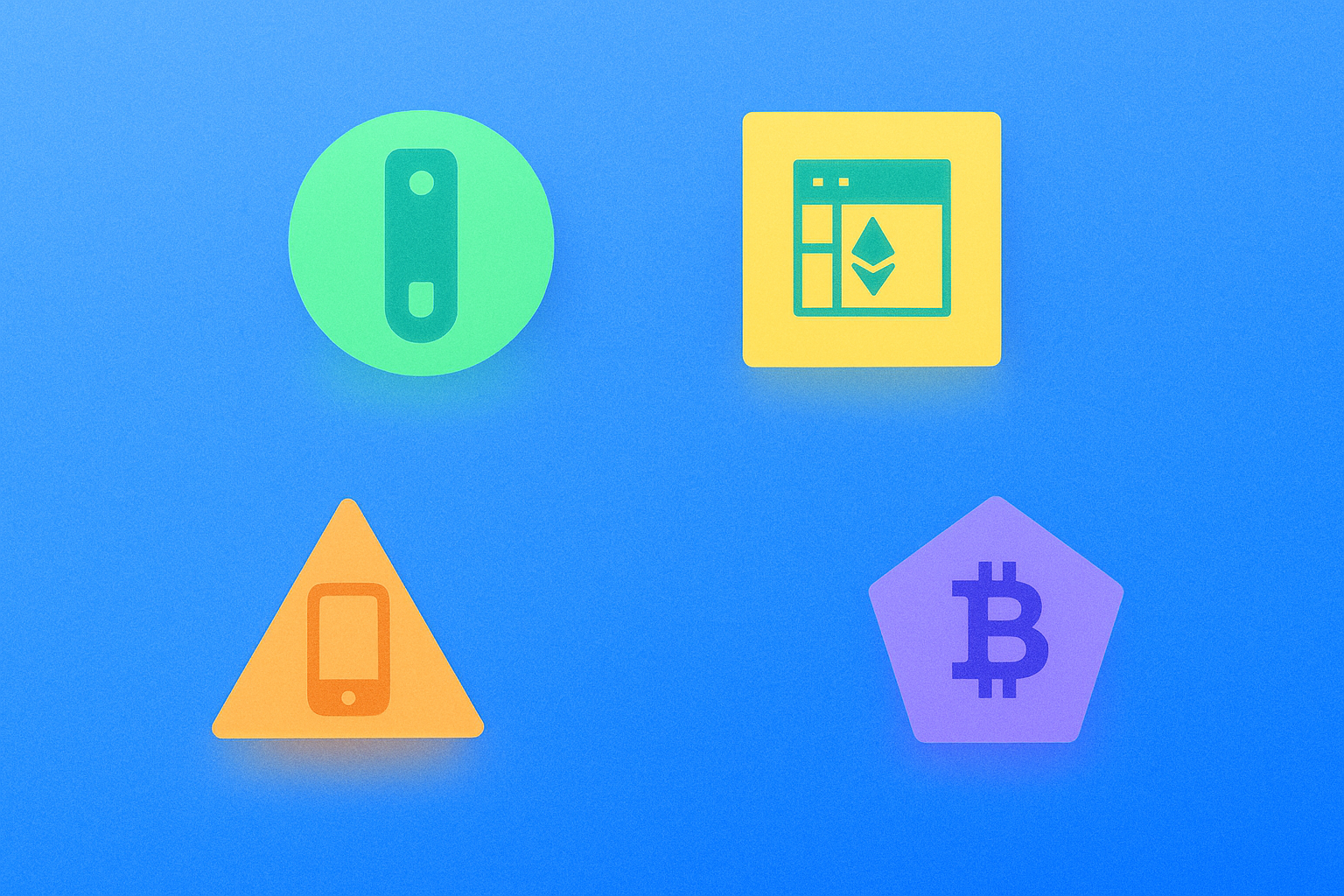
The 5 Types of Crypto Wallets and Their Characteristics
Determining the optimal crypto wallet depends on numerous factors, including your specific requirements, preferences, and intended use cases. The ideal wallet varies based on which cryptocurrencies you plan to hold and utilize. For example, a Bitcoin-optimized wallet may differ substantially from one designed for Ethereum-based assets. Furthermore, certain wallets lack compatibility with specific blockchain networks, making them unsuitable for your particular needs.
1. Hardware Wallets
Hardware wallets are specialized electronic devices that employ random number generators (RNG) to generate public and private key pairs, with the keys stored directly on the physical device itself. As cold wallets, hardware wallets operate offline and maintain no internet connection during cryptocurrency storage and transaction signing processes.
This offline isolation significantly enhances security by protecting private keys from online threats, including hacking attempts and malware infections. By keeping private keys completely disconnected from networked systems, hardware wallets provide superior protection for digital assets, making them the preferred solution for users prioritizing maximum security.
While hardware wallets offer exceptional protection against online attacks, improper firmware implementation can introduce vulnerabilities. Additionally, hardware wallets typically present less user-friendly interfaces than web-based alternatives, and accessing funds may require more complex procedures compared to internet-connected hot wallets.
Hardware wallets are ideal for long-term asset holding or managing substantial cryptocurrency quantities. Most modern hardware wallets incorporate PIN code protection and recovery phrase backups, enabling account restoration if you forget your PIN or lose your device.
Reputable hardware wallet examples include Ledger, Trezor, Tangem, and SafePal.
2. Web Wallets
Web wallets enable blockchain access through browser interfaces without requiring software downloads or installation. This category includes both cryptocurrency exchange wallets and alternative browser-based wallet providers.
When utilizing cryptocurrency exchanges, you receive a custodial wallet managed by the exchange operator. While exchange wallets offer convenience for inexperienced users, you entrust the service provider with your keys and assets. Consequently, selecting trustworthy and secure providers is paramount. When using crypto exchanges, consider enabling protective features including multi-factor authentication, anti-phishing codes, and withdrawal address management.
For those preferring complete asset control, non-custodial alternatives such as MetaMask and Trust Wallet provide full key management without third-party intermediaries.
3. Desktop Wallets
Desktop wallets are software applications downloaded and executed locally on personal computers. Unlike some web-based variants, desktop wallets provide comprehensive control over keys and funds.
When creating a desktop wallet, a file called "wallet.dat" is generated and stored locally on your computer, containing encrypted private key information required to access cryptocurrency addresses. Access typically requires entering your personal password each time you launch the software to decrypt the wallet.dat file.
Loss of this file or password generally results in permanent loss of access to associated funds. Therefore, maintaining secure backups of your wallet.dat file in separate locations is essential. Alternatively, you can export and backup your private keys or wallet seed phrase, enabling fund recovery on other devices if your primary computer becomes inaccessible.
Reputable desktop wallets are generally considered secure, though it is crucial to ensure your computer remains free from viruses and malware before establishing and using a desktop wallet. Electrum represents a popular and respected example of desktop crypto wallet software.
4. Mobile Wallets
Mobile wallets operate similarly to web and desktop versions but are purpose-built as smartphone applications. Their convenience factor is substantial, allowing cryptocurrency usage while mobile and enabling fund transfers via QR code scanning.
Mobile wallets excel at facilitating everyday transactions and payments, making them practical for real-world cryptocurrency spending. MetaMask, Trust Wallet, and Phantom exemplify popular mobile wallet applications.
However, like computers, mobile devices face vulnerability to malicious applications and malware. Encrypting your mobile wallet with a strong password is advisable, and backing up your seed phrase or private keys is essential protection against phone loss or damage.
5. Paper Wallets
A paper wallet consists of a physical piece of paper with a cryptocurrency address and corresponding private key printed on it. These wallets offer excellent resistance to online hacking and may serve as cold storage alternatives. However, they demand meticulous handling and secure storage to prevent loss or physical damage.
Paper wallets were relatively prevalent in the early years of cryptocurrency but are now discouraged due to inherent risks. Paper wallets are vulnerable to damage or destruction from environmental factors, physical mishandling, or accidents. Security concerns also arise from potential data remnants stored on computers and printers used during paper wallet generation.
Additional dangers stem from misunderstanding regarding partial withdrawals from paper wallets. For example, if you send 4 of 10 BTC from your paper wallet, the remaining 6 BTC automatically transfers to a change address distinct from your original paper wallet address. In most cases, users lose access to these remaining funds because the change address is not under their control.
Getting Started With a Crypto Wallet
Establishing a crypto wallet requires following a systematic approach:
Research and Choose a Wallet
Begin by researching available wallet types and evaluating factors including security features, blockchain compatibility, user experience, custody arrangements, and community reputation. Identify reputable wallet providers by reading user reviews and expert assessments.
Once you have selected a wallet, visit the provider's official website, verifying the URL to ensure legitimacy, as fraudulent websites often closely resemble legitimate ones. For hardware wallets, confirm the device arrives sealed with intact packaging, and preferably purchase directly from manufacturers to minimize risks.
Install the Wallet
For software wallets, locate the download section and select the version matching your operating system. Follow the provided installation instructions carefully. For hardware wallets, follow manufacturer setup instructions, which typically involve connecting the device to your computer or smartphone via cable or Bluetooth, installing requisite software, and updating firmware.
Set Up the Wallet and Security Measures
When launching the wallet software initially, you can typically create a new wallet or import an existing one. For new wallets, follow instructions to generate a wallet address and private key. For existing wallets, select import and provide recovery phrase or private key details.
Prioritize backing up your wallet at this stage, following the provider's instructions to securely store your recovery phrase or backup file in a separate location. Establish strong passwords and enable additional security features such as biometric authentication or two-factor authentication (2FA).
Familiarize Yourself with the Wallet Interface
Invest time exploring the wallet interface and available features. Learn to send and receive funds, review transaction history, and access wallet settings and additional functionality.
Fund the Wallet
To begin using your wallet, transfer cryptocurrency to cover transaction fees and gas costs, denominated in the network's native currency. For example, using a Solana wallet for NFT trading requires SOL holdings for purchases and transaction fees.
Transfer crypto from your exchange account:
-
Navigate to your exchange withdrawal page and select the currency to transfer.
-
Locate your new wallet's public address (typically displayed with a QR code), copy the destination address, and paste it into the exchange's address field.
-
Select the correct blockchain network—Bitcoin for BTC, BNB Smart Chain for BNB and BEP20 tokens, Ethereum for ETH and ERC20 tokens, Solana for SOL and SPL tokens, and so forth.
Preventing incorrect network transfers is critical, as this can result in irreversible losses. When uncertain, conduct thorough research and initiate transfers with small amounts to verify correct procedures before moving larger quantities.
- Upon fund arrival, your crypto wallet is operational and ready for use.
How Do I Choose a Crypto Wallet?
Optimal wallet selection depends on your specific usage patterns and risk tolerance. Frequent traders benefit from mobile or web wallets providing rapid fund access and convenient trading functionality. Assuming your device is virus-free and your account utilizes 2FA security, your assets generally remain adequately protected.
Conversely, if you hold substantial cryptocurrency quantities intended for long-term retention without immediate sale expectations, cold wallets represent superior alternatives. Cold wallets demonstrate greater resistance to hacking attempts, phishing attacks, and scams, making them ideal for long-term asset preservation.
Conclusion
Crypto wallets represent indispensable infrastructure for securely managing digital assets in the modern blockchain ecosystem. Understanding the 5 types of cryptocurrency wallets and their characteristics—hardware wallets, web wallets, desktop wallets, mobile wallets, and paper wallets—empowers you to make informed decisions about your digital asset management. Whether engaging in active trading, long-term holding, or exploring decentralized applications, selecting an appropriate wallet is a significant decision impacting both security and functionality. Prioritize security by vigilantly protecting your seed phrases and private keys from unauthorized disclosure. When utilizing custodial services, ensure selection of trusted and reputable providers with demonstrated security track records. By understanding wallet types, security mechanisms, and your personal requirements, you can select a wallet solution optimally aligned with your cryptocurrency goals and risk management preferences.
FAQ
What are the different types of crypto wallets?
Crypto wallets include hot wallets (software-based, internet-connected) and cold wallets (hardware or paper, offline). Hot wallets offer convenience for frequent trading. Cold wallets provide enhanced security for long-term storage.
What is the safest crypto wallet?
The safest crypto wallet is one using multi-party computation technology like Zengo, which eliminates private key vulnerabilities. Hardware wallets offering cold storage also provide strong security for long-term asset protection.
Share
Content
How to Buy Cryptocurrency


Trending Cryptocurrencies



Where to Buy Labubu in Japan: Top Stores and Online Shops 2025
What Is a Phantom Wallet: A Guide for Solana Users in 2025

Best Crypto Wallets 2025: How to Choose and Secure Your Digital Assets
How Web 3.0 is changing the way we use crypto assets: from Wallet to DAO

Web3 Wallet Guide: The Ultimate Strategy for Secure Digital Asset Management

How to choose the most suitable Web3 wallet? Expert insights and comparisons

What is ARCHAI: Revolutionizing AI Architecture Search and Automated Machine Learning
What is MVRK: A Comprehensive Guide to Market Value Risk Metrics and Their Application in Modern Finance

What is ATR: A Comprehensive Guide to Average True Range in Trading

What is HEU: Understanding Highly Enriched Uranium and Its Global Impact
How Much Should You Invest in Bitcoin and Cryptocurrencies?