What are forks, soft forks, and hard forks in cryptocurrency
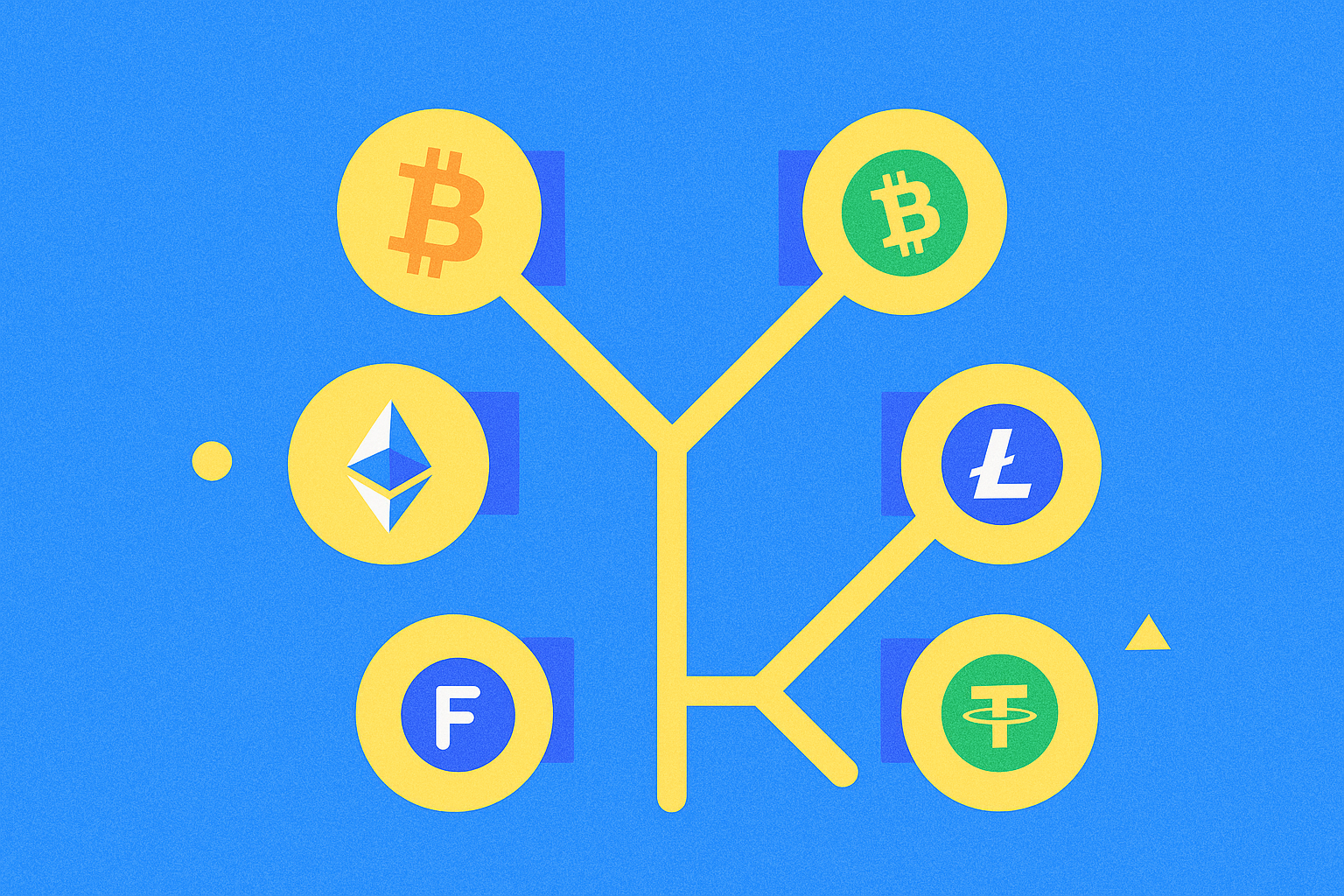
Forks: An Introduction
In the cryptocurrency industry, a "fork" refers to a protocol change in a blockchain, which can impact the entire network in significant ways. Since cryptocurrencies operate in decentralized environments, it's vital that all participants follow the same set of rules and collaborate to maintain the integrity of the blockchain's history.
When consensus breaks down, the blockchain splits, resulting in two parallel chains operating in different parts of the network—an event called chain branching. Forks can occur for various reasons, ranging from technical disagreements to deep ideological divides among developers and users.
Understanding forks is crucial for anyone in the crypto market, as these events can dramatically affect asset prices and project trajectories.
Hard Fork Execution Methods
Forks come in several types, each with distinct characteristics and effects on the blockchain network.
Accidental forks are temporary incidents that happen during routine network operations. They occur when multiple miners nearly simultaneously find a valid block, creating two competing blockchain branches. These forks are short-lived and resolve automatically as new blocks are added. Per consensus rules, the longer chain is accepted as valid, and blocks from the shorter chain are discarded as stale. This self-healing mechanism ensures the blockchain remains intact without human intervention.
Planned forks take place when developers or the community can't agree on the protocol's direction. In these cases, network rules are intentionally changed, leading to the creation of a new cryptocurrency. The success of this new asset depends on community backing and market demand.
If the new coin fails to attract sufficient interest, its value may drop to zero and miners may abandon it. If enough supporters remain, both chains can continue as separate projects, each with its own community, developers, and ecosystem.
Planned forks fall into two main categories: soft forks and hard forks, each with distinct technical features and network impacts.
Soft Fork: Incremental Protocol Upgrade
Soft forks are relatively minor protocol changes that preserve backward compatibility with previous versions. Older block validation rules aren't fully removed—they're supplemented or tightened with new requirements.
The defining trait of soft forks is their optional nature for network participants. Users aren't required to upgrade their software, as nodes running older versions can still recognize and validate new blocks. However, outdated nodes may not support all new features or limitations.
As more participants transition to the updated protocol, the network shifts smoothly to new rules without splitting the blockchain. This keeps the chain unified and stable, preventing community fragmentation.
A notable soft fork example is the rollout of Segregated Witness (SegWit) on Bitcoin, which improved scalability without spawning a separate cryptocurrency.
Hard Fork: Major Protocol Overhaul
Hard forks represent fundamental protocol changes that aren't compatible with prior software versions. These changes are permanent and irreversible, requiring all participants to upgrade to the latest version to continue on the main chain.
If some users or miners refuse to upgrade and stick with the old rules, the chain splits, producing two independent, incompatible blockchains. At this critical juncture, two outcomes are possible: both chains may coexist and evolve independently, each forming its own ecosystem, or one chain may dominate, attracting most miners and users while the other gradually loses support.
Some hard forks are coordinated, with consensus among all key network participants to accept new rules. These transitions are smoother and minimize the risk of community division. Uncoordinated hard forks, however, can trigger serious disputes and lasting splits.
Major Hard Forks in Cryptocurrency History
Case Study: Bitcoin Cash and the Scaling Debate
One of the most prominent hard forks was the birth of Bitcoin Cash in August 2017. This split occurred at block 478,558 of the Bitcoin blockchain, following years of community dispute over scaling strategies.
Prior to the split, Bitcoin and Bitcoin Cash shared an identical transaction history. The division stemmed from fundamental disagreements about the true nature of cryptocurrency as envisioned by creator Satoshi Nakamoto, with the main issue being block size and the adoption of Segregated Witness (SegWit).
Bitcoin Cash advocates pushed for increasing block size to 8 MB (later 32 MB), viewing this as a straightforward fix for scalability. They argued it would allow more transactions and lower fees. Meanwhile, core Bitcoin supporters favored SegWit and second-layer solutions like Lightning Network. To this day, Bitcoin Cash continues as an independent cryptocurrency with its own community and ecosystem.
Case Study: Ethereum and The DAO
Ethereum Classic is the original Ethereum blockchain branch, created after one of crypto's most controversial incidents. In 2016, the Decentralized Autonomous Organization (The DAO) was hacked, leading to the theft of roughly $50 million in ether (ETH).
The Ethereum community faced a dilemma: whether to alter blockchain history to restore stolen funds or uphold the principle of ledger immutability. After heated debate, the majority opted for a hard fork at block 1,920,000, reversing the hack transactions and returning funds to rightful owners.
Some community members opposed this intervention, arguing it violated blockchain’s immutability principle. These individuals maintained the original chain, now called Ethereum Classic. Thus, this hard fork produced two independent cryptocurrencies: Ethereum (ETH) and Ethereum Classic (ETC), each with its own philosophy and user base.
Cloning: Launching New Blockchains from Existing Code
Cloning is often mistaken for forking, but they're fundamentally different. A clone is a direct or modified copy of an existing cryptocurrency's source code, launched on a new distributed ledger with a fresh transaction history.
Platforms like GitHub promote cloning by allowing developers to copy existing code, modify it as needed, and launch wholly new blockchain projects. Unlike a fork, a clone doesn't inherit the original transaction history and starts from block zero.
Cloning drives innovation across the crypto space. Developers can take a proven codebase—like Bitcoin's—adjust key settings such as consensus algorithms, block times, or coin supply, and create a new cryptocurrency with unique features. This method is behind the creation of most altcoins currently on the market.
Case Study: Litecoin’s Creation
In 2011, former Google engineer Charlie Lee demonstrated the potential of cloning by launching Litecoin. He started with Bitcoin’s code, then changed several critical parameters, including switching the proof-of-work algorithm from SHA-256 to Scrypt and reducing block times from 10 minutes to 2.5 minutes.
These adjustments significantly sped up transaction processing and improved scalability, resulting in a cryptocurrency better suited for small, everyday payments. Often dubbed "silver to Bitcoin’s gold," Litecoin remains one of the most successful clones, proving the viability of this innovation model.
The Future of Forks in Crypto Development
Forks have a profound and multifaceted effect on the crypto ecosystem, with both positive and negative outcomes. On the positive side, forks drive technological evolution, enabling new features, bug fixes, and adaptation to shifting market demands.
They give communities a democratic way to challenge a project’s direction and build alternatives that reflect diverse visions for crypto’s future—fueling healthy competition in ideas and technology.
On the downside, forks can trigger major crises and conflict, dividing communities and pitting supporters of rival protocols against each other. Such splits dilute network effects, confuse users and investors, and can destabilize asset prices.
As the crypto industry attracts newcomers with varied goals and perspectives, forks will play an even greater role in managing and evolving decentralized networks. The community will likely develop better mechanisms for consensus and conflict resolution, making future forks more predictable and less disruptive to the ecosystem.
FAQ
What is a cryptocurrency fork and why do they happen?
A fork is a change to blockchain code that creates a new chain. Forks occur to update protocols, fix bugs, or introduce new features.
What’s the difference between a Soft Fork and a Hard Fork?
A hard fork introduces incompatible new rules and may split the network into two chains; a soft fork stays compatible with older versions and does not split the chain. Hard forks are riskier and require all nodes to upgrade to remain part of the network.
How does a hard fork affect my crypto assets?
After a hard fork, you automatically receive an equivalent amount of the new coins. Your private key controls both versions. New tokens may require a separate wallet for management and transactions.
What happens to my assets after a crypto split? Will I get new coins?
With a hard fork, your assets are duplicated across two chains. You receive an equal number of new coins. Make sure your wallet supports the new currency.
Which major forks have occurred in Bitcoin and Ethereum history?
Bitcoin underwent a hard fork in 2017, resulting in Bitcoin Cash (BCH). Ethereum split in 2016 into Ethereum and Ethereum Classic (ETC) after the DAO incident. These forks were driven by community disagreements over technical and governance issues.
How can I tell if a fork is safe and worth joining?
Evaluate developer technical support, community adoption, and market prospects. Check team activity and user feedback. A successful fork needs widespread support from network nodes and participants.
Share
Content
How to Buy Cryptocurrency


Trending Cryptocurrencies



XZXX: A Comprehensive Guide to the BRC-20 Meme Token in 2025

Survey Note: Detailed Analysis of the Best AI in 2025

Detailed Analysis of the Best 10 GameFi Projects to Play and Earn in 2025

Kaspa’s Journey: From BlockDAG Innovation to Market Buzz

Best Crypto Wallets 2025: How to Choose and Secure Your Digital Assets

Popular GameFi Games in 2025

Is MagicCraft (MCRT) a good investment?: A comprehensive analysis of tokenomics, market potential, and risk factors for 2024

Is ZKWASM (ZKWASM) a good investment?: A Comprehensive Analysis of Technology, Market Potential, and Risk Factors for 2024
Top 3 Platforms for Free Cryptocurrency Registration Bonuses
LIORA vs XLM: A Comprehensive Comparison of Cross-Lingual Language Models and Their Performance Across Multilingual Tasks
OOE vs IMX: A Comprehensive Comparison of Two Leading Image Processing Technologies