What is ANLOG: A Comprehensive Guide to Analog Signal Processing and Its Modern Applications
Analog's Positioning and Significance
In 2025, the Analog team launched Analog (ANLOG), aiming to address liquidity fragmentation and inefficient cross-chain operations in the blockchain ecosystem.
As the Universal Liquidity Hub for Autonomous Chains, Analog plays a critical role in DeFi, cross-chain interoperability, and omnichain tokenization.
As of 2026, Analog has established itself as an emerging infrastructure solution in the multi-chain landscape, with an active development community focused on AI-driven liquidity execution and trustless General Message Passing (GMP) transfers.
This article will provide an in-depth analysis of its technical architecture, market performance, and future potential.
Origin and Development History
Genesis Background
Analog was created in 2025, designed to solve liquidity fragmentation and the complexities of cross-chain asset transfers without relying on traditional bridges.
It emerged during the expansion of multi-chain ecosystems, with the goal of enabling seamless integration across EVM-compatible chains, Solana, Polkadot, TON, and RWAs through trustless infrastructure.
Analog's launch brought new possibilities for DeFi protocols, cross-chain applications, and tokenization platforms.
Key Milestones
- January 2025: Mainnet launch, enabling cross-chain liquidity aggregation powered by Timechain technology.
- February 2025: ANLOG token listed on Gate.com with an initial offering price of $0.055.
With support from its development team and community, Analog continues to refine its technology, security features, and real-world applications.
How Does Analog Work?
Decentralized Architecture
Analog operates on a decentralized network of nodes distributed globally, removing reliance on centralized intermediaries.
These nodes collaborate to validate transactions and ensure system transparency and resilience, empowering users with greater autonomy while enhancing network security.
Blockchain Foundation
Analog's blockchain serves as a transparent and immutable digital ledger that records all transactions.
Transactions are grouped into blocks and cryptographically linked to form a secure chain.
Anyone can view the records, establishing trust without intermediaries.
Timechain technology further enhances performance by enabling efficient cross-chain messaging and liquidity execution.
Consensus Mechanism
Analog utilizes Mainnet consensus protocols to validate transactions and prevent fraudulent activities such as double-spending.
Network participants maintain system security through node operation and validation activities, earning ANLOG rewards.
Its innovation includes AI-driven liquidity optimization and trustless General Message Passing (GMP) across diverse Layer 1 and Layer 2 ecosystems.
Secure Transactions
Analog employs public-private key cryptography to protect transactions:
- Private keys (similar to secret passwords) are used to sign transactions
- Public keys (similar to account numbers) are used to verify ownership
This mechanism ensures fund security while maintaining pseudonymous transaction privacy.
Additional security features include cross-chain verification protocols and cryptographic proofs for trustless interoperability.
Analog's Market Performance
Circulation Overview
As of February 07, 2026, Analog's circulating supply stands at 1,494,770,562 ANLOG tokens, with a total supply of 9,057,971,000 tokens. The token follows a fixed supply model with no inflationary mechanisms.
The current circulation represents approximately 16.5% of the total supply, indicating a controlled token release strategy that may influence supply-demand dynamics over time.
Price Fluctuations
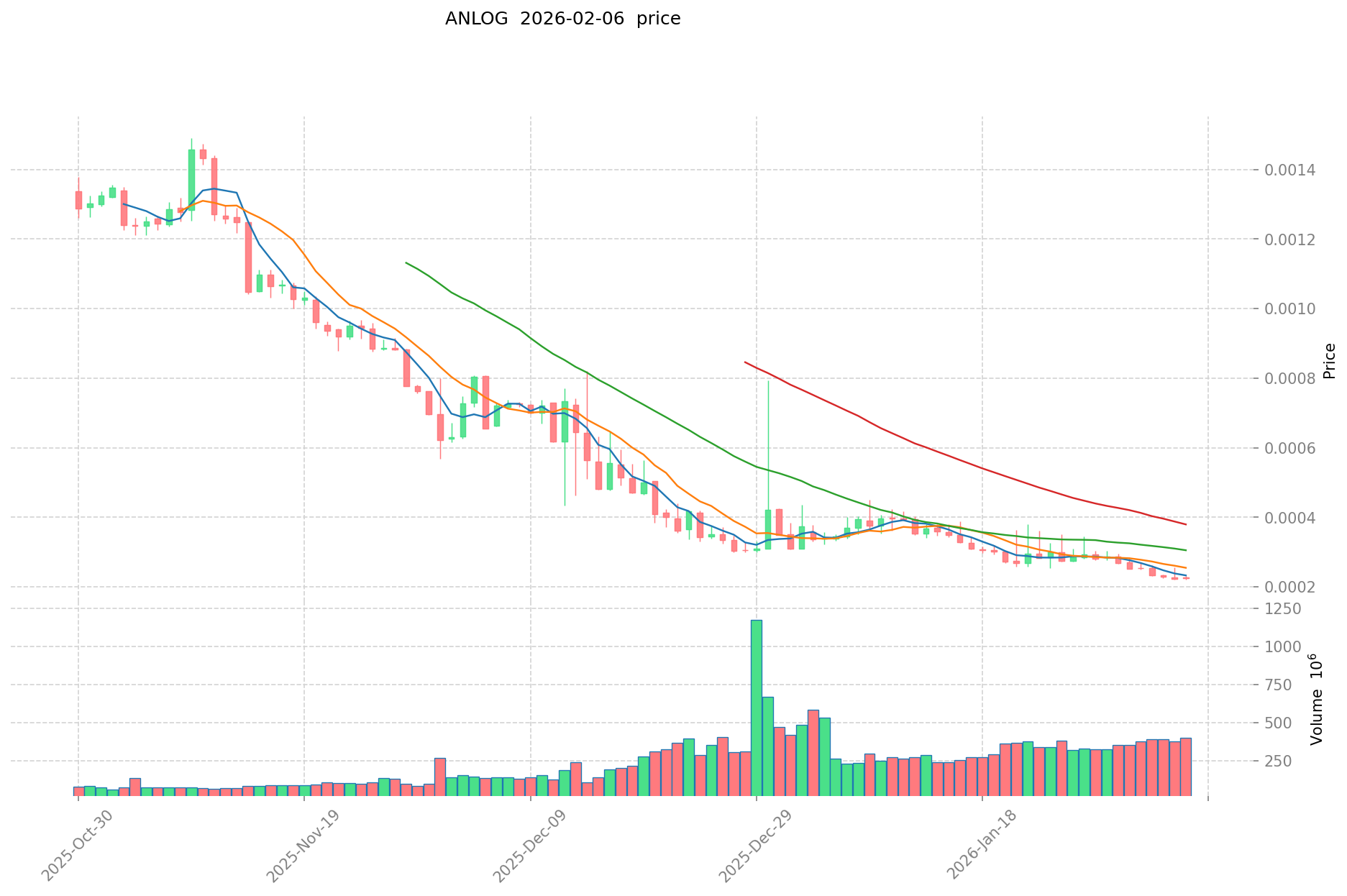
Analog reached an all-time high of $0.0171 on February 10, 2025, during its early trading phase following market launch.
The token recorded its lowest price of $0.0002208 on February 05, 2026, reflecting broader market dynamics and trading patterns.
Recent price movements show mixed trends: a 0.64% increase over 1 hour and 3.8% gain over 24 hours, while experiencing declines of -14.16% over 7 days and -39.71% over 30 days. The one-year performance shows a -92.28% change from initial levels, illustrating the volatility characteristic of emerging crypto assets.
Click to view current ANLOG market price
On-Chain Metrics
The 24-hour trading volume for Analog stands at $89,642, reflecting current market activity levels. The market capitalization is approximately $349,477, with a fully diluted valuation of $2,117,754, indicating the theoretical market value if all tokens were in circulation.
Analog operates on its own Mainnet infrastructure, supporting its vision as a Universal Liquidity Hub for cross-chain integration.
Analog Ecosystem Applications and Partners
Core Use Cases
Analog's ecosystem supports multiple applications:
- Cross-Chain Liquidity: By leveraging its Universal Liquidity Hub architecture, Analog enables seamless asset transfers across EVM-compatible chains, Solana, Polkadot, TON, and RWAs without requiring traditional bridges.
- AI-Driven Execution: The platform facilitates AI-powered liquidity execution and optimization, enhancing efficiency in decentralized finance operations.
- Omnichain Tokenization: Analog supports cross-chain asset tokenization, enabling trustless GMP (General Message Passing) transfers across diverse L1 and L2 ecosystems.
Strategic Partnerships
Analog focuses on building technological capabilities to integrate multiple blockchain ecosystems including EVM-compatible chains, Solana, Polkadot, and TON networks. These integrations provide a solid foundation for Analog's ecosystem expansion and interoperability vision.
Controversies and Challenges
Analog faces the following challenges:
- Technical Complexity: Achieving seamless integration across diverse blockchain architectures while maintaining security and performance standards.
- Market Competition: Operating in a highly competitive cross-chain infrastructure space with established protocols.
- Adoption Hurdles: Building developer and user adoption for a relatively new protocol launched in January 2025.
These issues have sparked discussions within the community and market, while also driving Analog's continuous innovation efforts.
Analog Community and Social Media Atmosphere
Community Engagement
Analog's community shows growing interest, with the token trading on 2 exchanges since its launch. On X platform, discussions around Analog and its Universal Liquidity Hub concept generate attention among cross-chain technology enthusiasts. The platform's innovative approach to eliminating liquidity fragmentation has attracted interest from developers and DeFi users.
Social Media Sentiment
Sentiment on X shows mixed perspectives:
- Supporters praise Analog's bridge-free architecture and AI-driven liquidity execution capabilities, viewing it as a potential solution to cross-chain fragmentation issues.
- Critics note concerns about significant price volatility, with the token down over 92% from its launch price, and the challenges of competing in the crowded cross-chain infrastructure market.
Recent trends indicate cautious interest tempered by market volatility concerns.
Hot Topics
X users actively discuss Analog's technological differentiation through Timechain, competitive positioning against existing cross-chain solutions, and price performance since launch, reflecting both the innovative potential and the challenges of gaining traction in an established market.
More Information Sources on Analog
- Official Website: Visit Analog Official Site for features, use cases, and latest developments.
- White Paper: Analog Timepaper details its technical architecture, objectives, and vision.
- X Updates: On X platform, Analog maintains an active presence using @OneAnalog, posts cover technological updates, cross-chain integration announcements, and ecosystem developments.
- Explorer: Track network activity through Analog Explorer.
Analog Future Roadmap
- Ongoing Development: Continue enhancing Timechain technology and cross-chain integration capabilities, improving transaction efficiency and security.
- Ecosystem Goals: Expand support for additional blockchain networks and increase adoption of AI-driven liquidity solutions.
- Long-Term Vision: Become the standard infrastructure for cross-chain liquidity and autonomous chain interoperability.
How to Participate in Analog?
- Purchase Channels: Buy ANLOG on Gate.com and other supporting exchanges.
- Storage Solutions: Use compatible wallets that support the Analog mainnet for secure storage.
- Ecosystem Building: Visit developer documentation to explore integration opportunities and contribute to the cross-chain infrastructure.
- Stay Informed: Follow official channels for updates on technological developments and ecosystem growth.
Summary
Analog aims to redefine cross-chain liquidity through blockchain technology, offering bridge-free interoperability, AI-driven execution, and seamless asset transfers across multiple ecosystems. Its innovative Timechain architecture and Universal Liquidity Hub concept position it as a noteworthy infrastructure project in the cross-chain space. Despite facing market volatility, adoption challenges, and intense competition, Analog's technological approach and clear focus on eliminating liquidity fragmentation give it potential significance in the future of decentralized technology. Whether you're a newcomer or experienced participant, Analog's cross-chain innovation merits attention and exploration.
FAQ
What is ANLOG and how does it work in the cryptocurrency ecosystem?
ANLOG is the native cryptocurrency of the Analog network, serving as both a utility and governance token. Users can stake ANLOG to participate in network decisions and enhance network functionality within the cryptocurrency ecosystem.
What are the main use cases and benefits of ANLOG crypto?
ANLOG enables seamless interoperability between blockchain networks, facilitating efficient cross-chain transactions. Key benefits include improved transaction efficiency, reduced complexity in managing multiple blockchains, and enhanced ecosystem connectivity across different chains.
How can I buy, store, and trade ANLOG tokens?
Set up a compatible wallet for Analog Network, purchase ANLOG tokens through supported platforms, and store them securely in your wallet for trading and holding.
What is the difference between ANLOG and other similar cryptocurrencies or projects?
ANLOG is a decentralized protocol operated transparently on blockchain without central authority control. It distinguishes itself through advanced privacy and security features, prioritizing user protection over traditional cryptocurrency management models.
What are the risks and security considerations when investing in ANLOG?
ANLOG investments face market volatility risks and potential loss of capital. Security considerations include smart contract vulnerabilities, wallet security, and counterparty risks. Users should conduct thorough due diligence and implement proper security practices.
Share
Content
Analog's Positioning and Significance
Origin and Development History
How Does Analog Work?
Analog's Market Performance
Analog Ecosystem Applications and Partners
Controversies and Challenges
Analog Community and Social Media Atmosphere
More Information Sources on Analog
Analog Future Roadmap
How to Participate in Analog?
Summary
FAQ
How to Buy Cryptocurrency


Trending Cryptocurrencies



XZXX: A Comprehensive Guide to the BRC-20 Meme Token in 2025

Survey Note: Detailed Analysis of the Best AI in 2025

Detailed Analysis of the Best 10 GameFi Projects to Play and Earn in 2025
Kaspa’s Journey: From BlockDAG Innovation to Market Buzz

Best Crypto Wallets 2025: How to Choose and Secure Your Digital Assets

Popular GameFi Games in 2025
Can quantum computers break Bitcoin?
What is MEPAD: A Comprehensive Guide to Mobile Electronic Personal Assistant Devices
What is FRAG: A Comprehensive Guide to Fragment Shaders and Real-Time Graphics Rendering
What is CRE: A Comprehensive Guide to Commercial Real Estate Investment and Market Analysis

What is CATGPT: A Comprehensive Guide to AI-Powered Conversational Technology