What is MOBI: A Comprehensive Guide to Amazon's E-Book File Format and Its Uses

Mobius's Positioning and Significance
In 2018, the Mobius team, composed of members from Stanford University and Harvard University, launched Mobius (MOBI), aiming to address the complexity of integrating blockchain ecosystems into mainstream applications. As a protocol built on the Stellar network that simplifies blockchain integration through APIs and a decentralized application store, Mobius plays a key role in enabling developers to build blockchain modules and connect applications, devices, or data streams to the blockchain ecosystem.
As of 2026, Mobius continues to maintain its presence in the blockchain infrastructure space, with an active development community focused on advancing blockchain adoption among mainstream users. This article will provide an in-depth analysis of its technical architecture, market performance, and future potential.
Origin and Development History
Birth Background
Mobius was created by a team of developers from Stanford and Harvard in 2018, aiming to solve the technical barriers preventing ordinary developers from building on blockchain and the challenge of bringing decentralized applications to mainstream adoption. It emerged during the period of growing interest in blockchain technology and decentralized applications, with the goal of lowering the complexity of blockchain integration through APIs and enabling real-time connections between applications, devices, data streams, and blockchain ecosystems. The launch of Mobius brought new possibilities for developers seeking to create blockchain-enabled applications without deep blockchain expertise.
Important Milestones
- 2018: Launched on the Stellar network, providing API-based tools for blockchain integration and a decentralized application store.
- The project has continued to develop its infrastructure for connecting applications and devices to blockchain ecosystems, supported by its team and community.
Under the support of its development team and community, Mobius continues to optimize its technology and expand its real-world applications.
How Does Mobius Work?
No Central Control
Mobius operates on the Stellar network, a decentralized network of computers (nodes) distributed globally, eliminating control by banks or governments. These nodes collaborate to validate transactions, ensuring system transparency and attack resistance, granting users greater autonomy and enhancing network resilience.
Blockchain Foundation
Mobius leverages the Stellar blockchain, a public, immutable digital ledger that records every transaction. Transactions are grouped into blocks and linked through cryptographic hashes to form a secure chain. Anyone can view the records, establishing trust without intermediaries. The Stellar network's design provides efficient transaction processing and low-cost operations.
Ensuring Fairness
Mobius operates on the Stellar network, which uses Stellar Consensus Protocol (SCP), a federated Byzantine agreement mechanism, to validate transactions and prevent fraud such as double-spending. Validators maintain network security through running nodes and participating in consensus, ensuring network integrity. The protocol's innovation includes energy efficiency and fast transaction finality.
Secure Transactions
Mobius utilizes public-private key cryptography to protect transactions:
- Private keys (similar to secret passwords) are used to sign transactions
- Public keys (similar to account numbers) are used to verify ownership
This mechanism ensures fund security while maintaining pseudonymous transactions. The Stellar network's built-in features provide additional security through its consensus mechanism and network structure.
Mobius's Market Performance
Circulation Overview
As of February 04, 2026, Mobius has a circulating supply of 513,996,636 MOBI tokens, with a total supply of 887,990,859 tokens. The maximum supply is unlimited, indicating an inflationary token model.
New tokens enter the market through ongoing issuance mechanisms, which influence supply and demand dynamics.
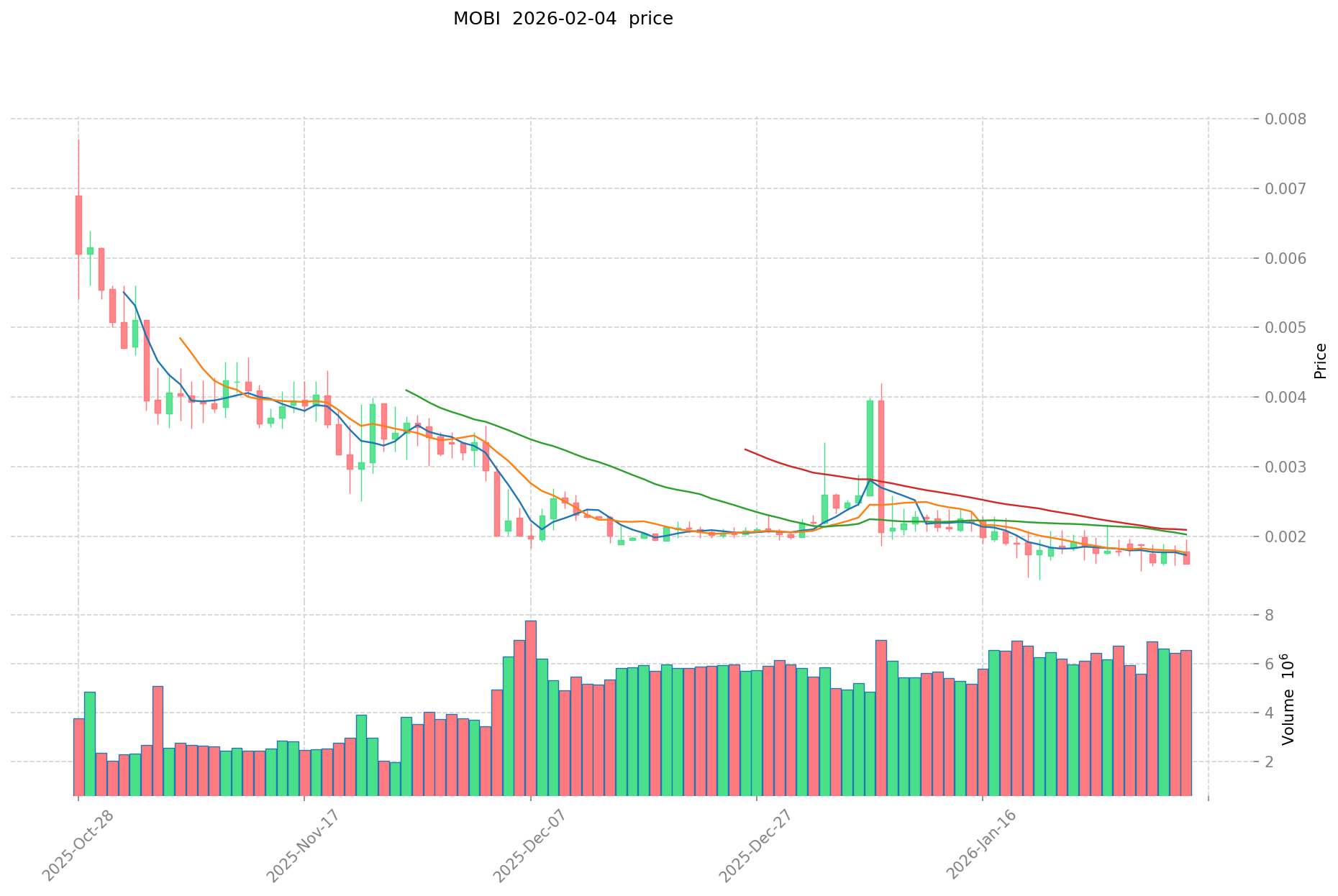
Price Fluctuation
Mobius reached a notable price level of $0.356026 on December 21, 2021, driven by broader market momentum during that period.
Its lowest recorded price was $0.00067546 on March 20, 2020, coinciding with challenging market conditions.
These fluctuations reflect market sentiment, adoption trends, and external factors affecting the cryptocurrency ecosystem.
Click to view the current MOBI market price
On-Chain Metrics
Detailed on-chain metrics such as daily transaction volume, active address count, and staking rate are not available in the provided materials for Mobius at this time.
Mobius Ecosystem Applications and Partners
Core Use Cases
Mobius's ecosystem supports various applications:
- Blockchain Integration: DApp Store (decentralized application store), providing seamless connection between applications, devices, and blockchain ecosystems.
- Developer Tools: Public API infrastructure, enabling simplified blockchain integration for developers.
Strategic Collaborations
Mobius is built on the Stellar network, leveraging Stellar's infrastructure to enhance its technical capabilities and market reach. These partnerships provide a solid foundation for Mobius's ecosystem expansion.
Controversies and Challenges
Mobius faces the following challenges:
- Technical obstacles: Integration complexity and adoption barriers for mainstream applications
- Competitive pressure: Competition from other blockchain platforms and application integration solutions
These issues have sparked discussions within the community and market, while also driving Mobius's continuous innovation.
Mobius Community and Social Media Atmosphere
Community Engagement
Mobius's community shows varied activity levels, with the project maintaining presence across multiple social media platforms.
On X platform, related posts and hashtags (such as #Mobius or #MOBI) appear periodically.
New feature releases and platform updates generate community interest.
Social Media Sentiment
Sentiment on X presents mixed perspectives:
- Supporters praise Mobius's API-based simplification approach and integration with Stellar, viewing it as a bridge between traditional applications and blockchain technology.
- Critics focus on adoption challenges and market competition.
Recent trends reflect the project's development stage and market conditions.
Hot Topics
X users discuss Mobius's application integration capabilities, developer adoption, and ecosystem growth, showcasing both its potential for innovation and the obstacles toward mainstream adoption.
More Information Sources for Mobius
- Official Website: Visit Mobius Official Website for features, use cases, and latest updates.
- X Updates: On X platform, Mobius maintains @mobius_network, with posts covering technical updates, community activities, and partnership news.
Mobius Future Roadmap
- Ecosystem Goals: Expand DApp Store adoption and increase developer participation
- Long-term Vision: Become a standard solution for blockchain application integration
How to Participate in Mobius?
- Purchase Channels: Acquire MOBI on Gate.com
- Storage Solutions: Use compatible Stellar wallets for secure storage
- Build Ecosystem: Visit developer resources to explore integration possibilities
Summary
Mobius aims to redefine blockchain application integration through its DApp Store and API infrastructure, offering simplified development experience and seamless blockchain connectivity. Its partnership with Stellar and focus on developer tools position it within the decentralized technology landscape. Despite facing adoption challenges and market competition, Mobius's API-driven approach and ecosystem vision make it a project worth monitoring. Whether you are a newcomer or experienced participant, Mobius presents opportunities for exploration and engagement.
FAQ
What is MOBI cryptocurrency and what problem does it solve?
MOBI is a cryptocurrency facilitating seamless payments within mobility and transportation ecosystems, solving inefficiencies in traditional payment systems within these sectors.
How can I buy and store MOBI tokens?
Purchase MOBI on a centralized exchange by creating an account and transferring funds. Once bought, transfer your MOBI to a secure wallet for storage and full control of your assets.
What is the total supply and tokenomics of MOBI?
MOBI has a total supply of 887.99 million tokens. The project raised $142.08 million during its token sale, demonstrating strong community support and funding for ecosystem development.
What are the main use cases and features of the MOBI network?
The MOBI network enhances automotive supply chain through blockchain technology, enabling secure data sharing, improved traceability, and fraud reduction. It supports procurement, logistics, production, and finance operations with decentralized ledger solutions.
What are the potential risks and considerations when investing in MOBI?
MOBI investments carry market volatility and liquidity risks. Consider your risk tolerance, market conditions, and investment horizon before participating. Crypto assets are speculative and prices fluctuate significantly.
Share
Content
Mobius's Positioning and Significance
Origin and Development History
How Does Mobius Work?
Mobius's Market Performance
Mobius Ecosystem Applications and Partners
Controversies and Challenges
Mobius Community and Social Media Atmosphere
More Information Sources for Mobius
Mobius Future Roadmap
How to Participate in Mobius?
Summary
FAQ
How to Buy Cryptocurrency


Trending Cryptocurrencies



XZXX: A Comprehensive Guide to the BRC-20 Meme Token in 2025

Survey Note: Detailed Analysis of the Best AI in 2025

Detailed Analysis of the Best 10 GameFi Projects to Play and Earn in 2025

Kaspa’s Journey: From BlockDAG Innovation to Market Buzz
Best Crypto Wallets 2025: How to Choose and Secure Your Digital Assets
Popular GameFi Games in 2025
Bitcoin Dominance and Market Analysis: A Comprehensive Guide

Comprehensive Guide to Crypto Branding
Top-Ranked Cryptocurrencies with Growth Potential and Key Indicators for Identification
What is ALMANAK: A Comprehensive Guide to Digital Calendar and Event Management Systems
Proof of Work vs Proof of Stake: Which Is Superior?