SaaSGo is a code-free DeFi Dapp marketplace builder launched in 2024 to democratize decentralized application deployment and eliminate technical barriers in DeFi infrastructure development. This comprehensive guide explores SaaSGo's decentralized architecture, blockchain-based consensus mechanisms, and innovative no-code platform that enables users to create customized decentralized exchanges with configurable farming, staking, and governance protocols without coding knowledge. The article covers its market performance including current token metrics, price volatility, and on-chain data, alongside ecosystem applications, community engagement on Gate.com and X, and practical participation methods. Whether you're an aspiring DeFi developer or organization seeking accessible blockchain solutions, SaaSGo offers an innovative entry point into community-driven decentralized finance infrastructure.
SaaSGo's Positioning and Significance
In 2024, the SaaSGo team launched SaaSGo (SAAS), aiming to address the complexity and technical barriers in deploying decentralized applications and DeFi marketplaces.
As a code-free DeFi Dapp marketplace builder, SaaSGo plays a key role in democratizing DeFi infrastructure development.
As of 2026, SaaSGo has established itself as an emerging solution in the DeFi builder space, with 30 holders and an active community focused on simplifying decentralized exchange creation.
This article will provide an in-depth analysis of its technical architecture, market performance, and future potential.
Origin and Development History
Birth Background
SaaSGo was created by its development team in 2024, aiming to solve the technical barriers and high costs associated with building custom DeFi marketplaces.
It emerged during the maturation phase of blockchain technology, with the goal of enabling individuals and organizations to deploy peer-to-peer Dapp marketplaces without coding knowledge and changing the landscape of DeFi infrastructure.
The launch of SaaSGo brought new possibilities for community-driven projects and organizations seeking customized DeFi solutions.
Important Milestones
- December 2024: Token launch on Gate.com, establishing initial market presence.
- December 2024: Price reached $0.1182, reflecting early market interest in the platform.
- 2025: Community expansion and platform development continued throughout the year.
- February 2026: Trading volume reached $17,704, demonstrating ongoing market activity.
Under community and platform support, SaaSGo continues to optimize its technology, security, and real-world applications.
How Does SaaSGo Work?
No Central Control
SaaSGo operates on a decentralized network of computers (nodes) distributed globally, free from bank or government control.
These nodes collaborate to validate transactions, ensuring system transparency and attack resistance, granting users greater autonomy and improving network resilience.
Blockchain Core
SaaSGo's blockchain is a public, immutable digital ledger that records every transaction.
Transactions are grouped into blocks and linked through cryptographic hashing to form a secure chain.
Anyone can view the records, establishing trust without intermediaries.
The platform enables users to create customized DEX marketplaces with farming and staking capabilities, further enhancing DeFi accessibility.
Ensuring Fairness
SaaSGo utilizes blockchain consensus mechanisms to validate transactions and prevent fraud such as double-spending.
Network participants maintain security through validation activities and receive incentives.
Its innovation includes empowering non-technical users to deploy sophisticated DeFi platforms with customizable parameters.
Secure Transactions
SaaSGo uses public-private key cryptography to protect transactions:
- Private keys (similar to secret passwords) are used to sign transactions
- Public keys (similar to account numbers) are used to verify ownership
This mechanism ensures fund security while transactions maintain pseudonymous characteristics.
The platform's DeFi Dex Builder allows users to adjust transaction fees, stake-pool interest, referral rewards, and governance protocols, providing flexibility in building community-driven ecosystems.
Circulating Supply Overview
As of February 04, 2026, SaaSGo's circulating supply stands at 800,000,000 tokens, with a total supply of 1,000,000,000 tokens. The circulating supply represents 80% of the total supply, indicating a significant portion of tokens is already in market circulation. The maximum supply is capped at 1,000,000,000 tokens, establishing a fixed supply model that may influence long-term scarcity dynamics.
Price Volatility
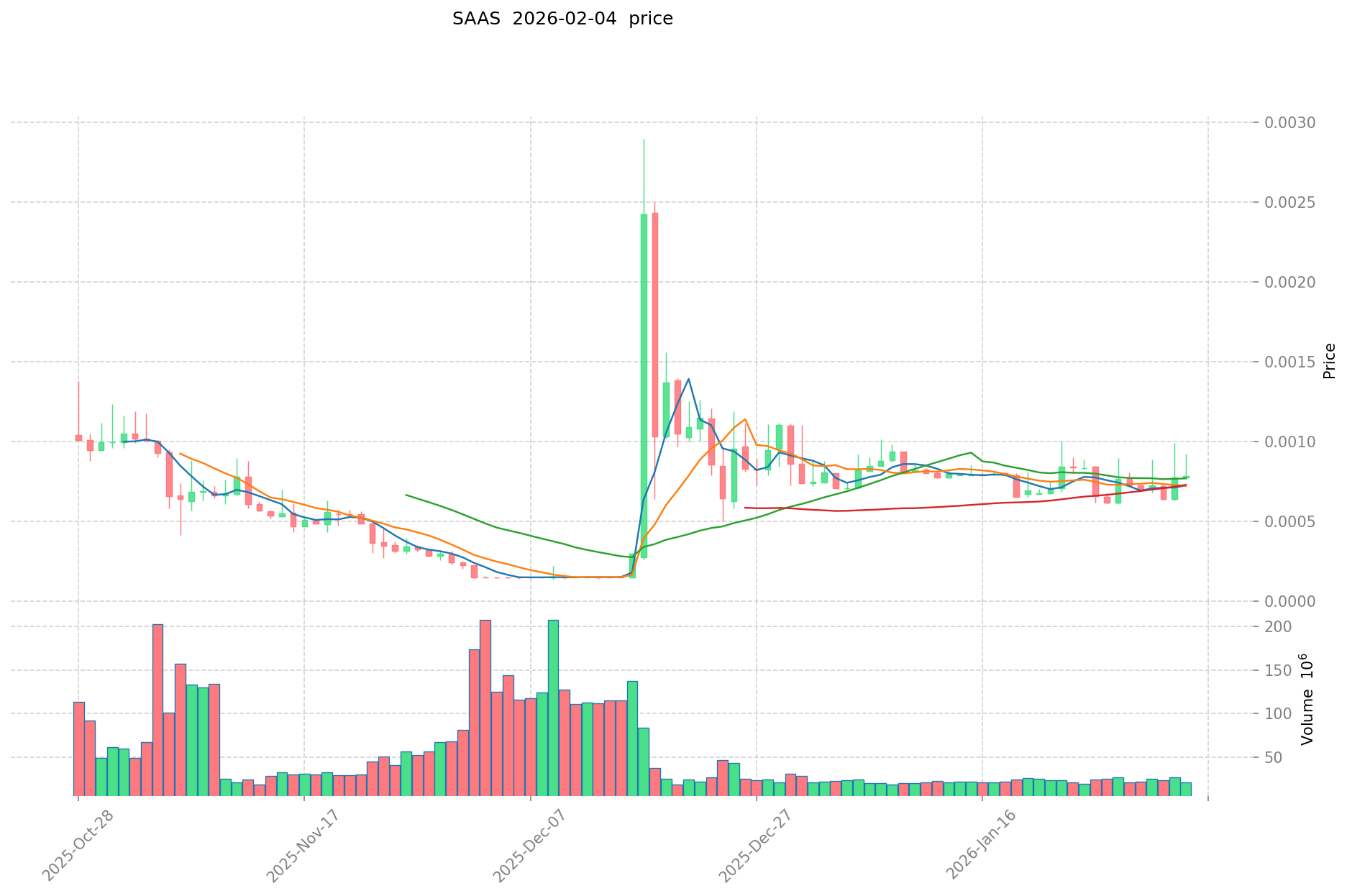
SaaSGo reached a notable price level of $0.1182 on December 20, 2024, reflecting strong market interest during its early trading period. The token's lowest price was recorded at $0.000134 on December 09, 2025, representing a significant correction from previous levels. As of the latest data, the token trades at $0.000834, showing recent short-term fluctuations with a 1.6% increase over the past hour and a 2.4% increase over 24 hours. However, the 7-day performance shows a slight decline of 0.13%, while the 30-day period reflects a 1.88% decrease. These price movements illustrate the dynamic nature of the DeFi marketplace sector and varying market sentiment.
Click to view current SAAS market price
On-Chain Metrics
- Market Capitalization: The current market cap stands at $667,200, with a fully diluted valuation of $834,000
- 24-Hour Trading Volume: $17,704.22, indicating moderate trading activity
- Token Holders: Approximately 30 addresses hold SAAS tokens, reflecting the project's early-stage community development
- Market Dominance: 0.000031% of the total cryptocurrency market cap
SaaSGo Ecosystem Applications and Partners
Core Use Cases
SaaSGo's ecosystem supports multiple applications:
- DeFi Infrastructure: The SaaSGo DeFi Dex Builder enables code-free deployment of decentralized marketplaces, allowing individuals and organizations to create peer-to-peer trading platforms with customizable farming and staking features.
- Community Governance: Projects built on SaaSGo can establish custom governance protocols, adjusting transaction fees, stake-pool interest rates, and referral rewards to align with their community's unique needs.
Strategic Partnerships
Based on available information, specific partnership details for SaaSGo are not currently documented in the provided materials.
Challenges and Controversies
SaaSGo faces several challenges in the competitive DeFi landscape:
- Market Competition: Operating in a crowded decentralized exchange builder space with established platforms offering similar functionalities
- Price Volatility: The token has experienced significant price fluctuations, with current trading levels substantially below earlier periods
- Adoption Barriers: Building awareness and user adoption for no-code DeFi solutions in a rapidly evolving market
These factors continue to shape the project's development trajectory and community engagement strategies.
SaaSGo maintains an active presence on social media, with approximately 30 token holders as of February 2026. The community engages primarily through X (formerly Twitter) at @SaaSGoOfficial, where discussions focus on the platform's no-code DeFi marketplace capabilities and ecosystem developments.
Sentiment on X demonstrates diverse perspectives:
- Supporters highlight SaaSGo's innovative approach to democratizing DeFi creation, praising its ability to enable anyone to launch customized decentralized exchanges without coding knowledge.
- Critics raise concerns about market performance and price trends, noting the token's volatility and current trading levels.
Recent discussions reflect interest in the platform's technical capabilities while acknowledging market challenges.
Popular Topics
X users frequently discuss SaaSGo's no-code deployment features, customizable governance mechanisms, and the potential for community-driven DeFi innovation, illustrating both the platform's transformative possibilities and the hurdles it faces in achieving mainstream adoption.
- Official Website: Visit SaaSGo Official Site for features, use cases, and latest updates.
- Whitepaper: SaaSGo Whitepaper provides detailed information about the platform's technical architecture, objectives, and vision.
- X Updates: On X platform, SaaSGo uses @SaaSGoOfficial to share updates covering technical developments, community activities, and platform features, generating engagement from the DeFi builder community.
SaaSGo Future Roadmap
Based on available documentation, specific roadmap details with dated milestones are not currently provided in the reference materials. The platform continues to focus on enabling code-free DeFi marketplace creation and empowering communities with customizable governance tools.
How to Participate in SaaSGo?
- Purchase Options: SAAS tokens are available on Gate.com and can be traded on supported platforms
- Storage Solutions: Securely store SAAS tokens using compatible wallets such as MetaMask or hardware wallets that support ERC-20 tokens on Ethereum and BSC networks
- Build on the Platform: Visit the official documentation to explore how to deploy your own DeFi marketplace using SaaSGo's no-code builder
- Community Engagement: Follow official channels to stay updated on platform developments and participate in ecosystem discussions
Summary
SaaSGo reimagines DeFi accessibility through blockchain technology, offering code-free marketplace deployment, customizable governance structures, and community-centric trading platforms. The platform's innovative approach to democratizing DeFi creation enables individuals and organizations to establish their own decentralized exchanges with tailored incentive mechanisms. While facing market volatility and competitive pressures, SaaSGo's vision of empowering communities to build and govern their own DeFi ecosystems positions it as a noteworthy project in the decentralized finance space. Whether you're exploring DeFi development opportunities or interested in community-driven marketplace solutions, SaaSGo presents an accessible entry point into blockchain-based financial infrastructure.
FAQ
What is Crypto SaaS? How does it differ from traditional SaaS?
Crypto SaaS integrates blockchain technology into cloud software services, enabling decentralized data management and enhanced security. Unlike traditional SaaS, it offers greater transparency, user data ownership, and immutable record-keeping through cryptographic protocols.
What services and features does Crypto SaaS typically provide?
Crypto SaaS typically provides plug-and-play trading platforms, API interfaces, user management systems, and data analytics tools. These services enable users to quickly launch and manage cryptocurrency trading operations with minimal technical complexity.
Crypto SaaS tools typically operate on subscription-based pricing with monthly or annual payment options. Fees vary by features and usage levels. Common models include tiered pricing based on transaction volume, API calls, or storage capacity. Enterprise solutions offer custom pricing. Most platforms provide transparent fee structures with no hidden charges.
Crypto SaaS platforms employ private key encryption, two-factor authentication, and biometric security to protect user assets. Users should maintain strong passwords, enable multi-factor authentication, and backup private keys securely to ensure comprehensive asset protection.
What are the common use cases for Crypto SaaS?
Common Crypto SaaS applications include DeFi lending platforms, decentralized exchanges, smart contract development tools, wallet management systems, and blockchain analytics platforms. These solutions automate financial services and provide infrastructure for cryptocurrency ecosystem development.
Crypto SaaS versus self-built cryptocurrency infrastructure, what are the advantages?
Crypto SaaS provides greater scalability, lower deployment costs, and faster time-to-market compared to self-built infrastructure. It offers ready-made solutions, reduces technical barriers, and enables rapid innovation and market adaptation.
* The information is not intended to be and does not constitute financial advice or any other recommendation of any sort offered or endorsed by Gate.