


Gold vs Bitcoin in 2026: 12-Year Analysis Reveals Which to Buy Now
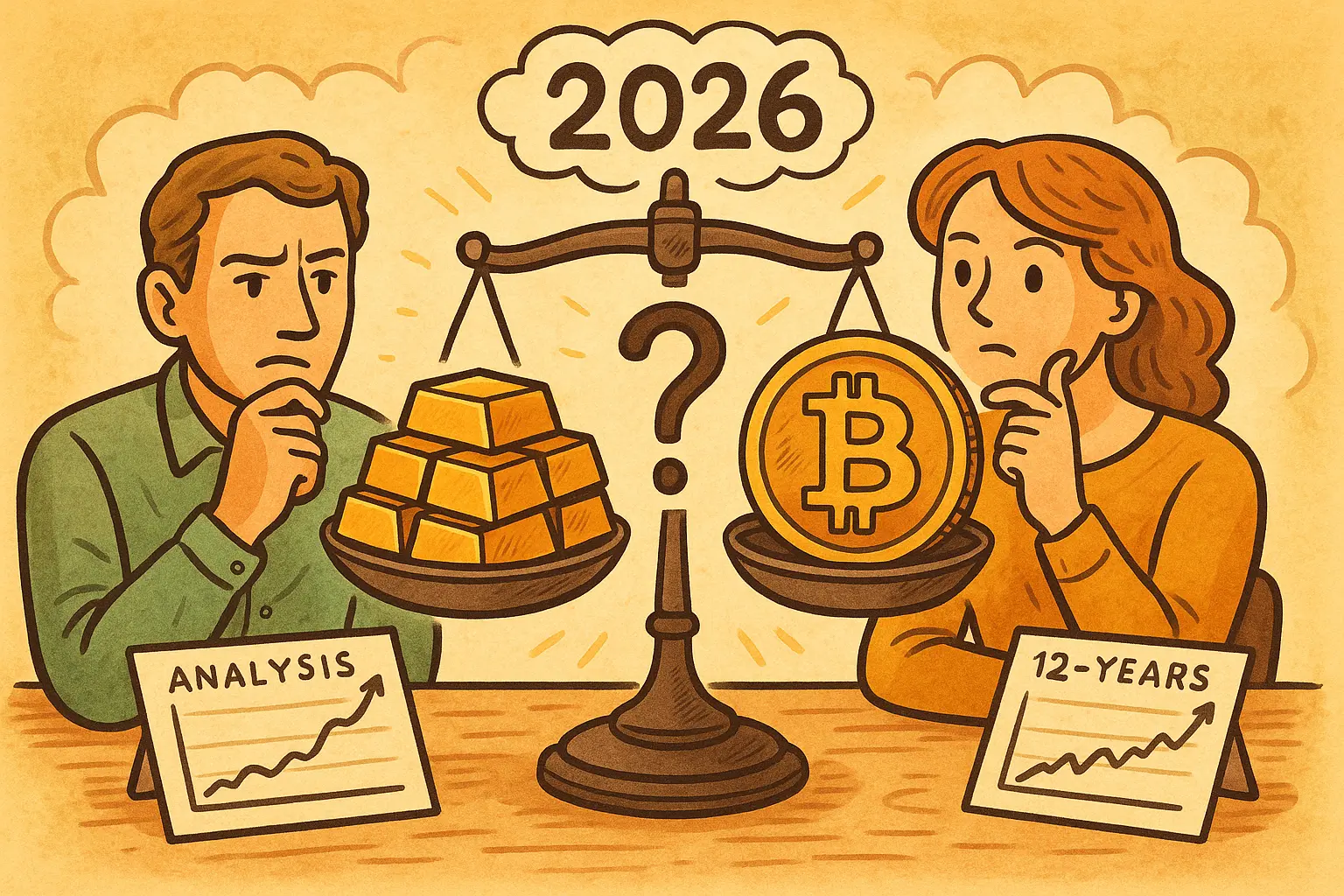
Gold vs Bitcoin diverged in 2026: gold hit $5,600 then crashed 3%, while Bitcoin opened at $87,508 down 7.3% from 2025. Short-term favors gold, but 12-year data shows Bitcoin delivered 213X returns versus gold’s 3.3X. Central banks bought 1,000+ tons gold annually while Bitcoin’s 0.8 tech stock correlation positions it as growth asset, not safe-haven.
Gold Hits $5,600 Then Crashes: What Happened?
On January 29, 2026, gold plummeted 3% in single day, marking its largest recent decline. Just days earlier, gold broke through $5,600 per ounce hitting new highs, and silver also rose, with 2026’s start far exceeding JPMorgan’s mid-December expectations. This volatility demonstrates that even traditional safe-haven assets experience sharp corrections after parabolic rallies.
In contrast, Bitcoin remains within weak consolidation range after pullback, with traditional precious metals and Bitcoin market performance continuing to distance themselves. Although known as “digital gold,” Bitcoin does not seem stable yet. The more periods feature inflation and war—traditional favorable conditions for gold and silver—the more Bitcoin behaves like risk asset, fluctuating with risk appetite rather than providing safe-haven protection.
Gold vs Bitcoin divergence in 2025-2026 challenges the “digital gold” narrative that dominated previous crypto bull markets. Understanding Bitcoin’s actual role in current market structure is essential for reasonable asset allocation decisions. Without this clarity, investors risk misallocating capital based on outdated narratives rather than current market realities.
The 12-Year Showdown: Gold vs Bitcoin Returns Analysis
If examined from long-term perspective, Bitcoin remains one of highest-returning assets despite recent underperformance. Long-term data spanning 12+ years shows Bitcoin delivered approximately 213X returns since 2013, while gold returned approximately 3.3X over same period. This represents 65X higher returns for Bitcoin over the full cycle.
However, past year’s performance tells different story, with Bitcoin showing slight decline while precious metals entered phase known as “supercycle.” Gold vs Bitcoin comparison across key cycles reveals distinct patterns:
Historical Performance Comparison
2017 Bull Market: Bitcoin surged 1,359% while gold rose only 7%
2018 Bear Market: Bitcoin plummeted 63% while gold fell just 5%
2020 Pandemic: Both rallied during liquidity flood, Bitcoin up 300%+, gold up 25%
2022 Bear Market: Bitcoin fell 57% while gold rose slightly by 1%
2025-2026: Gold outperforms with new highs while Bitcoin consolidates weakly
This trend divergence is not new. As early as March 2020, gold and silver rose rapidly due to risk aversion, while Bitcoin plummeted over 30% initially before starting rebound. The price linkage between Bitcoin and gold is unstable—Bitcoin operates at junction of traditional finance and new finance, creating ambiguous positioning during market stress periods.
The correlation between gold and Bitcoin has been volatile long-term and unstable overall. Especially after 2020, although prices sometimes rose simultaneously, correlation did not increase significantly and often appeared negative. Monthly yield correlation between the two has ranged from near zero to moderately positive, never establishing stable relationship suggesting true safe-haven linkage.
Why Gold and Silver Outperformed Bitcoin Recently
Behind frequent new highs of gold and silver and lagging Bitcoin narrative lies deep divergence of asset attributes, market cognition, and macro logic. Gold vs Bitcoin performance gap in 2025-2026 can be understood through four perspectives:
Central Banks Lead Gold Buying Spree
In era of strong currency depreciation expectations, who continues buying determines long-term asset trends. From 2022 to 2024, central banks worldwide heavily increased gold holdings for three consecutive years, with average annual net purchases exceeding 1,000 tons. Whether emerging markets like China and Poland or resource-rich countries like Kazakhstan and Brazil, gold serves as core reserve asset hedging against dollar risk.
Critically, the higher the price, the more central banks buy—this “buy more when expensive” behavior pattern reflects central bank’s firm belief in gold as ultimate reserve asset. Bitcoin struggles gaining central bank approval, which is structural problem: gold represents 5,000-year consensus not relying on any national credit, while Bitcoin requires electricity, network, and private keys that central banks dare not deploy at scale.
Physical Asset Priority During Geopolitical Uncertainty
As global geopolitical conflicts escalate and financial sanctions multiply, asset security becomes question of physical deliverability. After new US administration took office in 2025, high tariffs and export restrictions disrupted global market order, making gold the only ultimate asset not relying on other countries’ credit.
Simultaneously, silver’s industrial value began releasing. Expansion of industries like new energy, AI data centers, and photovoltaic manufacturing drove industrial silver demand surge. Behind this lies real supply-demand mismatch. In this case, silver speculation and fundamentals resonate, creating gains stronger than gold.
Bitcoin’s Structural Dilemma: Leveraged Tech Stock, Not Safe-Haven
In past, Bitcoin was seen as tool combating central bank currency abuse. But with ETF approval and institutional entry, funding structure fundamentally changed. Wall Street institutions include Bitcoin in portfolios typically as “highly elastic risk asset.” Data from second half 2025 shows Bitcoin’s correlation with US technology stocks reached 0.8—unprecedented high correlation meaning Bitcoin increasingly behaves like leveraged technology stock.
When market faces risk-off periods, institutions prefer selling Bitcoin for cash first rather than buying it like gold. More representatively, in October 10, 2025 liquidation plunge, $190 billion in leveraged positions were liquidated instantly. Bitcoin did not show safe-haven attributes but crashed due to high-leverage structure.
Three Additional Reasons for Bitcoin’s Recent Weakness
Crypto Ecosystem Lagging: Innovation stuck on memes while AI track frantically attracts capital; no killer apps or real use cases
Quantum Computing Shadow: Google’s Willow chip demonstrated quantum advantages, creating narrative discouraging some institutions despite quantum cracking being years away
OG Holders Exiting: Early Bitcoin holders feel asset “lost its soul” transforming from decentralized idealistic currency to Wall Street speculative tool
Historical Gold vs Bitcoin Correlation Analysis
Looking back at historical correlation between gold and Bitcoin shows price correlation in major economic events is quite limited, with performance often diverging. The reason “digital gold” term gets repeatedly mentioned may not be because Bitcoin truly resembles gold, but because market needs familiar reference point.
The connection between gold and Bitcoin was never safe-haven resonance from beginning. In 2013 Cyprus banking crisis, gold fell sharply about 15% from high while Bitcoin surged over $1,000. This was interpreted as capital flight into Bitcoin, but retrospectively, 2013 Bitcoin surge was more driven by speculation and early sentiment rather than safe-haven recognition. Monthly yield correlation that year was only 0.08—essentially zero.
The period of real synchronization only occurred during liquidity flood stage. After 2020 pandemic, central banks released unprecedented stimulus, with investors concerned about fiat currency overissuance and inflation expectations. Gold and Bitcoin both strengthened simultaneously. In August 2020, gold hit record high exceeding $2,000, while Bitcoin exceeded $20,000 by year-end then accelerated above $60,000 in 2021.
Many believed during this period Bitcoin began embodying “anti-inflation” digital gold attributes, benefiting from loose monetary policies like gold. However, it was inherently accommodative environment giving both common upside soil, with Bitcoin being much more volatile than gold—72% versus 16% annualized volatility. This volatility difference reveals fundamental distinction in asset characteristics.
The Essence of Bitcoin: Digital Liquidity, Not Digital Gold
What role should Bitcoin actually play? Does it really exist to be “digital gold”? First, Bitcoin’s underlying properties determine it is naturally different from gold. Gold is physically scarce, doesn’t require internet, doesn’t rely on systems—it’s true doomsday asset. In geopolitical crisis, gold can be physically delivered anytime, making it ultimate hedging edge. Bitcoin is built on electricity, network, and computing power, with ownership relying on private keys and transactions requiring network connections.
Second, Bitcoin’s market performance increasingly resembles highly elastic technology asset. When liquidity is loose and risk appetite rising, Bitcoin often leads rallies. However, against backdrop of rising interest rates and risk aversion, institutions reduce Bitcoin exposure. Current market tends to believe Bitcoin has not truly transformed from “risk asset” to “safe-haven asset.” It has both risky side of high growth and volatility, and potential safe-haven side of resisting uncertainty.
This “risk-haven” ambiguity may only be verified through more cycles and crises. Until then, market still tends viewing Bitcoin as high-risk, high-reward speculative asset, correlating its performance with technology stocks. Perhaps only when Bitcoin demonstrates stable value preservation ability similar to gold can this perception truly reverse.
Gold vs Bitcoin Asset Positioning
Gold: Anti-inflation safe-haven asset with low volatility (16%) and small maximum drawdown (-18%), serving as portfolio “ballast stone”
Bitcoin: Growth asset with strong income attributes, annualized return up to 60.6%, but high volatility (72%) and maximum drawdown of -76%
This is not either/or choice but combination of asset allocation. Gold suits preserving value during economic uncertainty periods. Bitcoin suits allocation when liquidity is abundant and risk appetite rises. Optimal strategy combines both assets addressing different macro scenarios and risk profiles.
Expert Analysis: Diverging Opinions on Gold vs Bitcoin
In this round of macro repricing, gold and Bitcoin play different roles. Gold functions more like “shield” resisting external shocks such as war, inflation, and sovereign risks. Bitcoin acts like “spear,” seizing value-added opportunities of technological change.
KOL quoted Polymarket prediction data forecasting Bitcoin will outperform gold and S&P 500 in 2026, believing value realization will come. Another analyst provides interesting technical perspective: Bitcoin’s RSI relative to gold has fallen below 30 again—this signal historically indicates Bitcoin bull market is coming.
Well-known trader started from short-term capital sentiment perspective, believing that after gold and silver led soaring, market is eager to find next “dollar alternative asset,” prompting small BTC position betting on FOMO sentiment from capital rotation in coming weeks.
One analyst proposes more ambitious narrative path, believing traditional hard assets like gold and silver should first absorb credit impact caused by currency depreciation, and only after they complete roles will it be Bitcoin’s turn to enter market. This “tradition first, then digital” path may be story current market is interpreting.
Three Investment Suggestions for Navigating Gold vs Bitcoin Choice
Faced with difference in gains between Bitcoin and gold, most common question for retail investors is: “Which one should I invest in?” There is no standard answer, but here are practical suggestions:
1st: Understand Asset Positioning and Clarify Allocation Purpose
Gold and silver performance in macro uncertainty retains strong “risk aversion” attributes, making them suitable for defensive allocation. Bitcoin currently suits increasing positions when risk appetite heats up and technological growth logic dominates. If you want to fight inflation and avoid risks → buy gold. If you want long-term high yields → buy Bitcoin (but withstand -70% pullbacks).
2nd: Don’t Assume Bitcoin Always Outperforms Everything
Bitcoin’s growth comes from technical narratives, capital consensus, and institutional breakthroughs, not linear return models. It won’t outperform gold, Nasdaq, and oil every year, but its decentralized asset attributes remain valuable long-run. Don’t deny it completely during short-term retracements, and don’t blindly go all-in when it skyrockets.
3rd: Build Multi-Asset Portfolio Accepting Different Cycles
If you have weak perception of global liquidity and limited risk tolerance, consider gold ETFs combined with small BTC amount to handle different macro scenarios. If stronger risk appetite, combine emerging assets like ETH, AI track, and RWA to build higher volatility portfolio.
Long-term, gold is asset favored by central banks worldwide, and silver is superimposed with industrial attributes—both retain allocation value in turbulent cycles. Short-term, they’ve risen significantly with technical pullback pressure, exemplified by gold’s 3% single-day plunge January 29. Consider waiting for pullbacks: gold below $5,000 and silver below $100 for gradual deployment. Although Bitcoin performed poorly recently, if subsequent liquidity expectations improve, it may present low layout window.
The Verdict: Different Assets for Different Market Conditions
Gold has risen, yet no one questions Bitcoin’s long-term value. Bitcoin has fallen, yet it cannot be said gold is only answer. In this era reshaping value anchors, no asset meets all needs simultaneously. In 2024-2025, gold and silver led performance. But stretching time to 12 years, Bitcoin proves with 213X returns: it may not be “digital gold,” but it is greatest asymmetric investment opportunity of this era.
Last night’s sharp gold drop may be end of short-term correction or beginning of larger pullback. For ordinary traders, what’s really important is understanding role behind different assets and establishing own investment logic to survive through cycles. Gold vs Bitcoin is not binary choice but strategic allocation question based on timeframe, risk tolerance, and macro outlook.
The 2026 opening prices—gold near record highs and Bitcoin at $87,508 after correction—represent divergence point testing investor convictions. Those anchored to short-term performance will favor gold. Those focused on long-term asymmetric upside will accumulate Bitcoin during weakness. Sophisticated investors will hold both, recognizing different roles each plays across varying market regimes.
FAQ
Which performed better in 2025-2026: Gold or Bitcoin?
Gold outperformed in 2025-2026, hitting $5,600 new highs while Bitcoin declined 7.3% from $94,419 (New Year 2025) to $87,508 (New Year 2026). Short-term (1-2 years), gold vs Bitcoin favors gold during risk-off periods.
What are the 12-year returns: Gold vs Bitcoin?
Bitcoin delivered approximately 213X returns over 12 years (2013-2025) versus gold’s 3.3X, representing 65X higher returns for Bitcoin. However, Bitcoin experienced 70%+ drawdowns multiple times, while gold’s maximum drawdown was just -18%.
Why do central banks buy gold instead of Bitcoin?
Central banks purchased 1,000+ tons of gold annually 2022-2024 because gold represents 5,000-year consensus not relying on any national credit and is physically deliverable during crises. Bitcoin requires electricity, network, and private keys that central banks consider too risky for large-scale deployment.
Is Bitcoin a safe-haven asset like gold?
No, current data shows Bitcoin’s 0.8 correlation with US tech stocks positions it as leveraged growth asset rather than safe-haven. During October 10, 2025 liquidation, $190 billion in Bitcoin positions were liquidated, demonstrating risk-on behavior rather than safe-haven attributes.
Should I buy gold or Bitcoin in 2026?
Depends on timeframe. Gold suits defensive allocation during economic uncertainty with low 16% volatility. Bitcoin suits long-term growth allocation accepting 72% volatility and -76% maximum drawdowns. Optimal strategy combines both for different macro scenarios.
Can gold continue rallying after hitting $5,600?
Exercise caution after parabolic rally. Gold’s 3% single-day plunge January 29 suggests technical pullback pressure. Consider waiting for retracement below $5,000 for gradual accumulation rather than chasing current highs.
Related Articles
Bitcoin Ransom Wallet Springs to Life: New Transaction Detected in Nancy Guthrie Kidnapping Case
What to do after the crypto market crashes? Tom Lee provides a "new buying logic" for Bitcoin and Ethereum
UK Bitcoin Treasury Company increases holdings by 15 Bitcoins, bringing total holdings to 2,689 Bitcoins
Bitcoin Slides to 15-Month Low — Is This Key Support Setting Up a Rebound?