


XRP Price Crashes to $1.35: Will CME Gap at $1.74 Trigger the Next Rally?
XRP price extended its downtrend to $1.35 as Bitcoin weakness and whale transfers totaling 291 million XRP fueled selling pressure. Yet a CME gap sits 27% above current prices at $1.74, historically a magnet for price recovery. With a pivotal Senate vote on the Clarity Act scheduled and extreme fear gripping the market, we analyze whether XRP fills the gap or breaks lower first.
XRP at a Crossroads: Price Collapse, Whale Dumping, and a $1.74 Magnet
The selling pressure across digital assets shows no sign of relenting. On February 11, 2026, XRP dropped to $1.35, marking a 3.16% decline in 24 hours and extending its year-to-date losses to nearly 26%. Bitcoin, the broader market’s compass, fell 2.50% to hover near $67,000, dragging the total crypto market capitalization down 2.50% to $2.34 trillion.
Beneath the surface-level price action, several forces are converging. Whale Alert tracked three large XRP transactions totaling 291 million tokens—worth approximately $413 million at current values—moving between unknown wallets and the Bybit exchange. Such high-volume exchange inflows during downtrends typically suggest distribution, not accumulation.
Yet in the midst of this carnage, a peculiar technical phenomenon has captured the attention of analysts and retail traders alike. XRP now has an open CME gap at $1.74, a price level representing a 27% upside from current values. Historically, CME gaps act as gravitational wells; price tends to move toward them, whether immediately or over extended timeframes. The question is no longer whether XRP** **can fill the gap, but whether it fills it now—or much later, after further pain.
Why the ‘Extreme Greed’ to ‘Extreme Fear’ Flip Matters
The Crypto Fear & Greed Index has printed a score of 10 for multiple consecutive days. This places market sentiment firmly in “Extreme Fear” territory, a psychological state where capitulation often overlaps with long-term opportunity.
To understand the significance, one must look at where this index sat just four months ago. In October 2025, as the global crypto market cap peaked at $4.27 trillion, the index flirted with “Greed” and “Extreme Greed” readings above 70. Euphoria dominated. Late buyers entered positions near local tops. Now, those same participants are sitting on substantial unrealized losses, and on-chain data suggests many are capitulating.
The relationship between sentiment and price is rarely linear, but historically, sustained Extreme Fear readings have preceded trend reversals—not immediately, but within a window that rewards patient capital. The current reading of 10 ties levels seen during the June 2022 local bottom and the November 2022 FTX collapse aftermath. In both instances, XRP traded significantly higher 12 months later.
Whale Alert: 291 Million XRP in Motion—Distribution or Rehypothecation?
On February 10 and 11, blockchain tracking service Whale Alert flagged three distinct transactions that moved substantial XRP supply.
Transaction 1: 125 million XRP (approx. $177 million) between unknown wallets.
Transaction 2: 116.6 million XRP (approx. $165.9 million) between unknown wallets.
Transaction 3: 50 million XRP (approx. $70.3 million) from an unknown wallet to Bybit exchange.
The cumulative movement of 291 million XRP represents approximately 0.5% of XRP’s total circulating supply. The transfer to CEX is particularly notable. Exchange inflows during bearish price action often precede selling, as holders move tokens to liquid markets.
However, an alternative interpretation exists. Institutional players and over-the-counter desks frequently move large sums between custodial wallets for operational purposes, not immediate liquidation. Without on-chain forensic analysis linking these wallets to specific entities, labeling this distribution versus rehypothecation remains speculative.
What is not speculative: large holders are actively repositioning. In a market starved for conviction, such movements amplify uncertainty and suppress buyer appetite.
Technical Analysis: Broken Averages and a Critical Support Retest
XRP’s daily and weekly charts tell a story of structural bearishness that began in August 2025, when the token first broke below its 200-day moving average near $1.83. Since then, the 200-day MA has acted as overhead resistance on multiple relief rallies.
Key Technical Developments:
- 50-day moving average crossed below 200-day moving average (death cross) in late 2025.
- Lower highs established at $2.25-$2.30 during September, November, and January bounces.
- Price currently trading below all major exponential moving averages (20, 50, 100, 200).
- Volume spikes on down days; volume contraction on up days.
Analyst CRYPTOWZRD noted that XRP’s daily close remains indecisive, with the $1.38 to $1.46 zone serving as the immediate battleground. A reclaim of $1.53 on the daily close would be necessary for any short-term long setup. Below $1.38, the next major support sits near $1.00, a level identified by multiple technicians including Crypto Seth.
The TD Sequential indicator, flagged by analyst Ali, flashed a buy signal on the 12-hour chart. However, such signals in strong downtrends often resolve as consolidation before continuation, not immediate reversal.
CME Gap Theory: Why $1.74 Is More Than Just a Number
For traders unfamiliar with CME futures mechanics, the concept of a “gap” requires explanation.
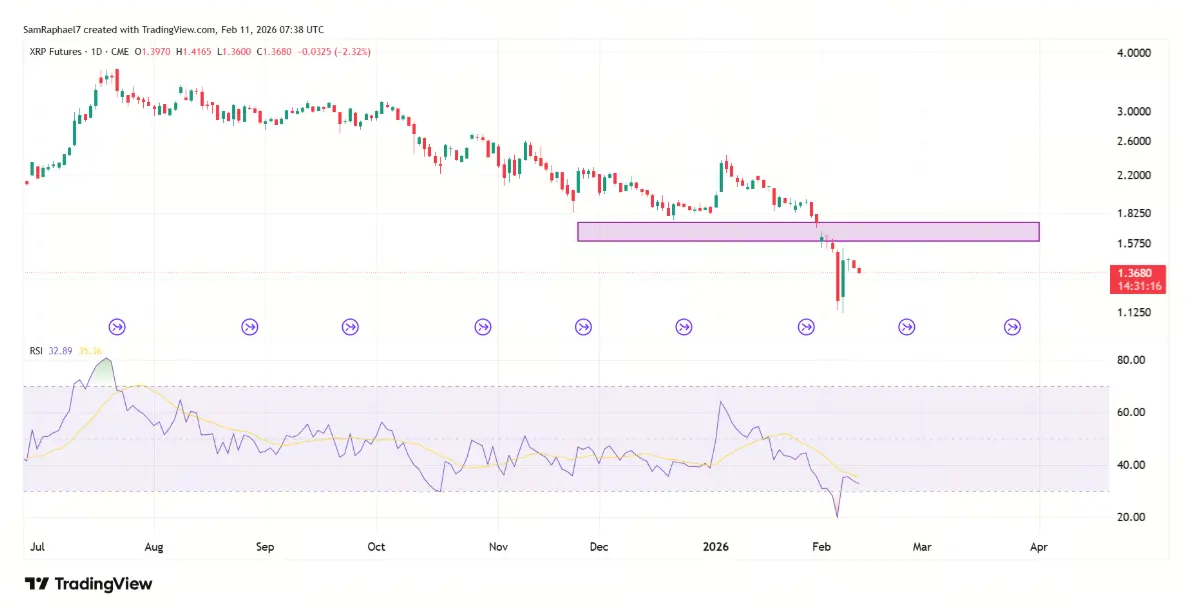
(Source: TradingView)
What Is a CME Gap?
CME Bitcoin and Ethereum futures trade nearly 24/5, closing on Friday afternoons and reopening on Sunday evenings. When the underlying spot market moves significantly while CME is closed, the futures contract opens at a price substantially different from the previous close. This price difference creates a “gap” on the chart.
Market participants have observed for years that price tends to return to these gap levels, “filling” the vacuum. This is not a law of physics, but it is a statistical tendency.
XRP’s CME gap formed between January 30 and February 2, 2026. CME XRP futures closed Friday, January 30 at $1.7480. When trading resumed Monday, February 2, the contract opened at $1.5965—an 8.6% decline. The gap between $1.7480 and $1.5965 remains unfilled.
As of February 11, XRP trades at $1.35, meaning the gap now sits 27% above current price. Bitcoin has a parallel gap at $84,105, representing 25% upside from current levels near $67,000.
Zach Rector, a prominent XRP community voice, argues these gaps will eventually be filled. He acknowledges the possibility of new lows first, but maintains the gap acts as a gravitational target.
Critical Caveat: Not all gaps fill quickly. Bitcoin’s March 2023 gap near $20,000 remains unfilled nearly three years later. Some gaps persist indefinitely. The presence of a gap does not guarantee immediate—or eventual—price action in either direction.
The Clarity Act: A Potential Game Changer for XRP’s Regulatory Status
While technicals dominate short-term trader discourse, institutional investors are watching Washington.
On February 10, 2026, the U.S. Senate convened to discuss the Clarity Act, a bill designed to establish a unified federal regulatory framework for digital assets. Treasury Secretary Scott Bessent has publicly emphasized the bill’s importance, framing it as essential for maintaining U.S. competitiveness in blockchain innovation.
For XRP specifically, the Clarity Act carries existential weight. Since December 2020, Ripple Labs has been entangled in litigation with the SEC over whether XRP constitutes a security. While a 2023 ruling provided partial clarity—finding programmatic sales to retail not securities—the asset’s regulatory status remains contested in certain contexts.
The Clarity Act, if passed, would supersede much of this ambiguity by defining clear jurisdictional boundaries between the SEC and CFTC, and establishing objective criteria for when a digital asset transitions from security to commodity.
A senior executive at Coinbase, speaking on condition of anonymity, stated to reporters that the bill is “expected to pass soon.” If enacted, the regulatory overhang that has suppressed institutional XRP demand since 2020 could meaningfully recede.
Timeline Implications: The Senate meeting occurred February 10. Markets often price legislative outcomes in advance. If investors anticipate the bill’s passage, XRP may begin to decouple from broader market weakness as regulatory risk premium compresses.
Strategic Outlook: Three Scenarios for XRP Price in the Coming Weeks
Synthesizing the technical, on-chain, and fundamental inputs, three distinct pathways emerge.
Scenario A: Gap Fill Rally (Probability: Moderate)
XRP holds the $1.38 support zone, stages a low-volume recovery, and grinds toward $1.74 over several weeks. The CME gap acts as psychological resistance; price may fill the gap but stall immediately after. This scenario requires Bitcoin stabilization and no catastrophic regulatory setbacks. Target: $1.74. Risk: Failure at resistance leads to sharp rejection.
Scenario B: Capitulation Washout (Probability: Moderate-High)
XRP breaks below $1.38, accelerates toward $1.10-$1.00, and potentially lower. Extreme Fear readings deepen to single digits. Whales accelerate accumulation at lower levels. A sharp, high-volume reversal follows, eventually filling the CME gap months later as part of a sustained recovery. This pattern repeated in 2015, 2020, and mid-2023.
Scenario C: Legislative Breakout (Probability: Low-Moderate)
The Clarity Act passes with strong bipartisan support. Institutional custody providers and registered exchanges immediately expand XRP offerings. Price gaps upward, fills the CME gap rapidly, and challenges the $2.00 resistance zone. This scenario divorces XRP from Bitcoin correlation in the short term.
What Is the Clarity Act? A Brief Primer
Given the centrality of this legislation to XRP’s long-term trajectory, a clear definition is warranted.
The Clarity Act (formally the “Cryptocurrency Clarity and Innovation Act”) is a proposed federal statute that:
- Establishes a functional test to determine whether a digital asset is a security or commodity at the time of issuance and in secondary market trading.
- Assigns primary regulatory authority to the CFTC for digital assets determined to be commodities.
- Provides a safe harbor period for decentralized blockchain projects to achieve sufficient decentralization before securities laws apply.
- Preempts inconsistent state-level digital asset regulations, creating a single national standard.
If enacted, the Clarity Act would represent the most significant U.S. crypto legislation since the 2023 FIT21 Act. For XRP, it would effectively nullify the core premise of the SEC’s enforcement action: that XRP was and remains a security.
Conclusion: Fear, Gaps, and Legislation Collide
XRP sits at an uncomfortable intersection. Whale distribution, technical breakdown, and macro bearishness dominate the headlines. The Fear & Greed Index screams capitulation. Retail sentiment is as poor as any period since 2022.
Yet within this bleak landscape, two powerful counterforces are developing. The CME gap at $1.74 offers a concrete, historically resonant target for traders to anchor expectations. And the Clarity Act offers a genuine, near-term catalyst for structural revaluation.
The gap will be filled. The question is whether it fills before or after the capitulation low, and whether regulatory clarity accelerates the timeline.
For traders with short-term horizons, risk management remains paramount. The $1.38 support must hold for any immediate long thesis to survive. For investors measuring in quarters and years, the confluence of extreme sentiment, gap dynamics, and legislative progress creates one of the more compelling asymmetric setups XRP has offered since its 2020 legal battle began.
The wallet moved. The Senate met. The gap waits.
Related Articles
Ripple Showcases XRP Strategy Amid Rising ETF Inflows
Spot Bitcoin ETF attracts $167 million in a single day, institutions rebalance holdings in XRP and Solana