


Trump-Linked WLFI Teases World Swap Forex Platform at Consensus — ‘Remittance Fees of 2-10% Are the Target’
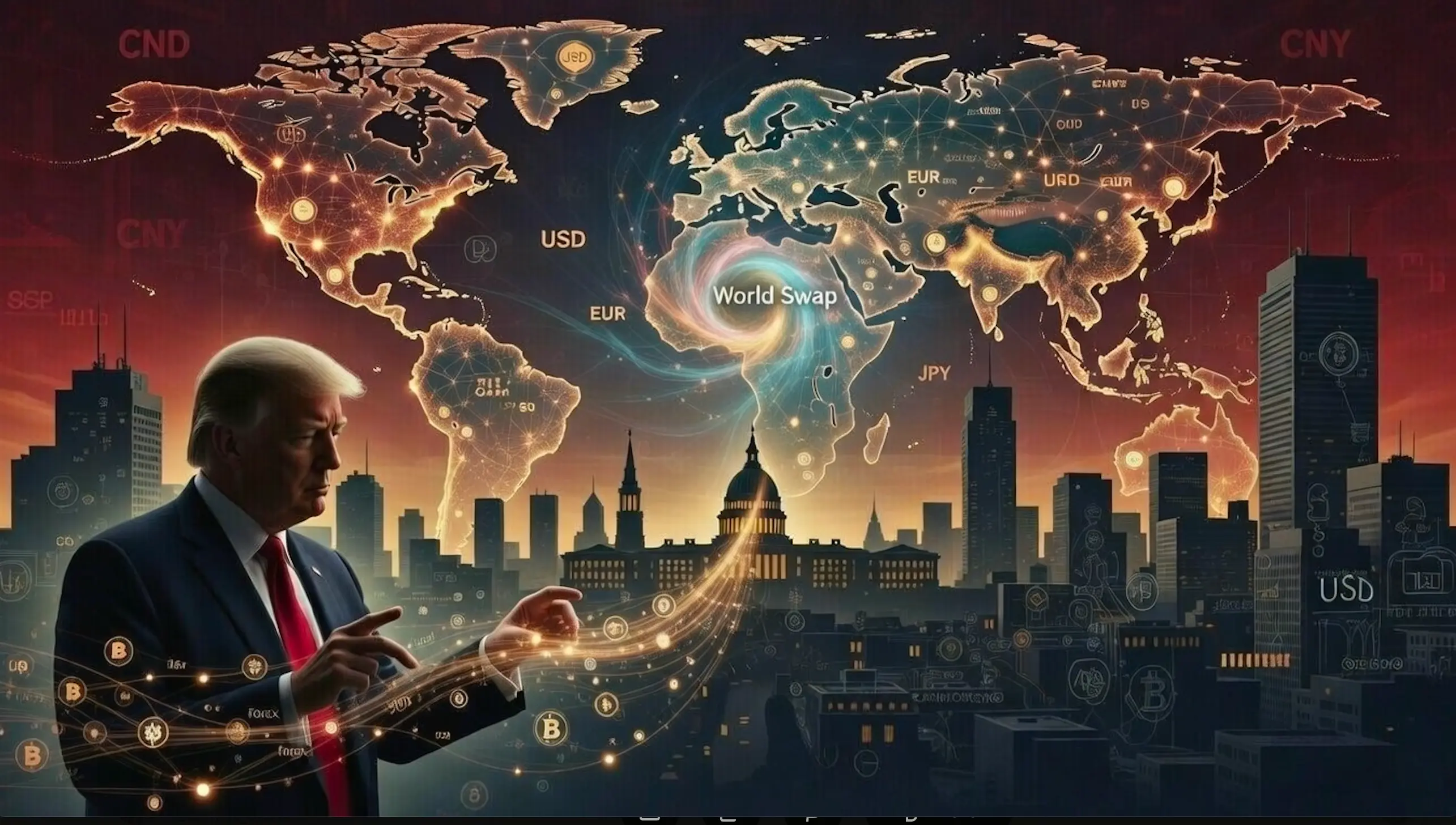
World Liberty Financial, the Trump-family-linked crypto project, just previewed its next move: a foreign exchange platform called World Swap. Co-founder Zak Folkman teased the product at Consensus Hong Kong, positioning it as a direct challenge to traditional remittance fees of 2-10%. Built around the USD1 stablecoin and following the $100M+ lending launch of World Liberty Markets, WLFI is assembling a full‑stack financial ecosystem. More details are promised at Mar-a-Lago.
The Consensus Tease That Turned Heads
On February 12, 2026, Zak Folkman walked onto the stage at Consensus Hong Kong and, with minimal fanfare, changed the trajectory of World Liberty Financial.
The co-founder of the Trump-linked crypto project was there to discuss stablecoins. He left having previewed what could become WLFI’s most ambitious product yet.
World Swap.
The name appeared in Folkman’s remarks as a planned foreign exchange platform, designed to sit atop the project’s USD1 stablecoin and offer cross-border transfers that, in his words, “abstract away the complexity” of wallets, private keys, and blockchain mechanics.
The audience heard a comparison to popular payment apps. They heard a direct attack on the economics of traditional remittance providers. And they heard that more details — including, presumably, a launch timeline — will be revealed at an invitation‑only event at Mar-a-Lago later this month.
For a project that has spent much of its existence navigating the intersection of politics and digital assets, the pivot toward a concrete, use‑case‑driven product is a significant evolution. World Swap is not a meme. It is not a token airdrop. It is an attempt to build financial infrastructure.
The $2 Trillion Target: Why WLFI Is Going After Remittances
Folkman’s framing of World Swap was notably un‑crypto in its marketing. He did not emphasize decentralization, censorship resistance, or self‑custody. He emphasized fees.
“Traditional remittance providers often charge 2% to 10% per transaction,” Folkman said. The implication was clear: World Swap intends to undercut them.
The global remittance market exceeded $2 trillion in annual flows in 2025, according to World Bank data. The average cost of sending $200 across borders remains approximately 6.5%, with corridors like Sub‑Saharan Africa often exceeding 8%. For migrant workers supporting families in their home countries, these fees represent a regressive tax on cross‑border labor.
Crypto has promised to solve this since Bitcoin’s earliest days. Yet adoption has been constrained by volatility, user experience, and regulatory fragmentation.
WLFI’s thesis appears to be that a dollar‑pegged stablecoin — USD1 — combined with an intentionally simplified interface and the distribution advantages of the Trump brand, can achieve what previous efforts have not.
USD1: The Stablecoin at the Center of the Stack
World Swap does not exist in isolation. It is the latest addition to a product ecosystem orbiting** **USD1, WLFI’s dollar‑pegged stablecoin.
Folkman described USD1 as “backed by cash and cash equivalents,” positioning it within the compliance‑first framework established by the GENIUS Act of 2025. The stablecoin is designed to be transferable, programmable, and — critically — usable across WLFI’s growing suite of applications.
Those applications now include:
World Liberty Markets: A lending platform launched in January 2026. Folkman disclosed that it has already attracted “hundreds of millions of dollars” in deposits within weeks of going live. The platform allows users to supply and borrow assets, generating yield and creating demand for USD1 as collateral.
World Swap: The newly teased forex platform. While technical details remain sparse, the product is intended to enable cross‑border transfers using USD1 as the settlement asset. Folkman emphasized ease of use, suggesting that users will not need to understand blockchain infrastructure to send money internationally.
Partnerships with DeFi protocols: Folkman referenced unspecified collaborations with decentralized finance platforms to expand USD1 utility across crypto markets. These partnerships could include integrations with lending protocols, decentralized exchanges, or payment rails.
The strategy is recognizable: build a stablecoin, create demand through proprietary applications, and expand distribution through third‑party integrations. Circle executed this playbook with USDC. PayPal followed with PYUSD. WLFI is now attempting the same, with the addition of political branding and a direct assault on the remittance incumbents.
The Mar-a-Lago Event: What to Expect
Folkman explicitly stated that World Swap details are being reserved for a subsequent event at** **Mar-a-Lago, Donald Trump’s private club and residence.
The venue choice is not incidental. Mar-a-Lago has served as the backdrop for WLFI’s most significant announcements, reinforcing the project’s alignment with the Trump political apparatus. Eric Trump and Donald Trump Jr. have both been publicly associated with WLFI, and the project has positioned itself as a standard‑bearer for “American crypto” — a counterweight to offshore, unregulated platforms.
The Mar-a-Lago event is expected to provide:
- A confirmed launch timeline for World Swap
- Specific corridor and currency pairs
- Fee structure and comparison to traditional providers
- Integration details with USD1 and World Liberty Markets
- Potential partnership announcements with payment processors or financial institutions
For a project that has faced skepticism about its technical depth, the World Swap reveal represents an opportunity to demonstrate execution capability.
AMG Software Solutions and WLFI’s IP Structure
Attentive observers noted that Folkman’s tease was preceded by a quieter but equally significant data point.
In late January, crypto Twitter users identified that AMG Software Solutions LLC, a Puerto Rico‑based entity described as the owner of WLFI’s intellectual property, had filed trademark applications related to “World Swap”.
The filings cover a range of financial services, including currency exchange, digital token transfers, and payment processing. This is standard practice for a project preparing to launch a regulated financial product. It also confirms that World Swap has been in development for months, not weeks.
AMG Software Solutions remains a deliberately opaque entity. Its Puerto Rico domicile offers favorable tax treatment and regulatory flexibility. Its ownership structure has not been publicly disclosed. What is known is that WLFI operates under license from AMG, paying fees or royalties for use of the intellectual property.
This structure insulates the operating company from certain liabilities while centralizing control of the brand and technology. It is neither unusual nor inherently problematic; it is, however, distinctly corporate — a reminder that WLFI is not a grassroots DAO but a professionally structured venture.
The Lending Platform Signal: Hundreds of Millions in Weeks
Folkman’s mention of World Liberty Markets achieving “hundreds of millions of dollars” in deposits within weeks deserves separate attention.
In crypto, deposit figures are often inflated or misrepresented. Yet even if the actual number is closer to $100 million than $500 million, the velocity of adoption is striking. WLFI launched the lending platform in January 2026; by mid‑February, it had already attracted meaningful capital.
This suggests several things:
First, there is genuine demand for USD1‑based yield products. Investors holding the stablecoin for payments or treasury management are willing to deploy it into lending markets for incremental returns.
Second, WLFI has successfully activated its distribution network. The Trump family brand, combined with targeted outreach to crypto‑friendly investors, has translated into user acquisition.
Third, the platform’s risk parameters are perceived as acceptable. Lending protocols are only as trustworthy as their collateral frameworks and smart contract security. WLFI has not disclosed its security audits publicly, but institutional‑scale depositors would not commit capital without some level of assurance.
World Liberty Markets is now the foundation upon which World Swap will be built. Cross‑border payments require liquidity; liquidity requires deposits; deposits require yield. The lending platform generates yield, which attracts deposits, which funds the forex product.
This is circular, but not vicious. It is ecosystem design.
The Competitive Landscape: WLFI vs. Circle, PayPal, and the Banks
World Swap enters a crowded and increasingly competitive market.
Circle has spent years building USDC distribution and recently expanded its cross‑border payment infrastructure through partnerships with Visa and MoneyGram. PayPal has integrated its PYUSD stablecoin into its massive merchant network, enabling instant settlement for millions of businesses. JPMorgan operates Kinexys (formerly Onyx), processing $5 billion daily in blockchain‑based payments for institutional clients.
Each competitor has advantages that WLFI lacks.
Circle has regulatory relationships cultivated over a decade. PayPal has an existing user base of 400 million consumers and merchants. JPMorgan has deep integration with the global banking system.
WLFI’s advantage is different: brand salience and political positioning.
The Trump name carries weight with a substantial segment of the American population. For users who view traditional finance with suspicion and offshore crypto with equal distrust, a “made in America” stablecoin platform endorsed by the former (and potentially future) president offers differentiation that cannot be replicated.
Whether this translates into sustainable competitive advantage depends on execution. World Swap must work. It must be cheaper, faster, and simpler than the alternatives. Brand affinity will drive initial adoption; product quality will determine retention.
What World Swap Must Deliver
Folkman’s tease established the ambition. The Mar-a-Lago event must establish the credibility.
For World Swap to succeed, WLFI needs to answer four questions:
1. What are the fees?
Undercutting 2‑10% is a low bar. Western Union charges 5-7% for many corridors; Wise charges 0.4-1.5%. The relevant benchmark is not the most expensive incumbents, but the cheapest digital alternatives. WLFI must disclose specific pricing.
2. Which corridors are live at launch?
Remittances are not a global market; they are thousands of bilateral corridors with distinct regulatory regimes, liquidity requirements, and payout infrastructures. WLFI cannot launch everywhere at once. It must choose where to start.
3. How does settlement work?
USD1 is the on‑chain asset. But recipients in Mexico, the Philippines, or Nigeria do not want USD1; they want local currency. WLFI must have payout partners in each corridor — banks, mobile money operators, or cash pickup networks.
4. What are** the**** compliance controls?**
Cross‑border payments are the most heavily regulated activity in finance. Anti‑money laundering, sanctions screening, and transaction monitoring are not optional. WLFI must demonstrate that World Swap is built on compliant infrastructure.
What Is World Liberty Financial? A Brief Primer
Founded: 2024** **
Headquarters: Operational presence in the U.S. and Puerto Rico; IP held by AMG Software Solutions LLC** **
Leadership: Co-founders include Zak Folkman; publicly associated with Eric Trump and Donald Trump Jr.** **
Core Product: USD1 stablecoin (dollar‑pegged, cash‑backed)** **
Ecosystem: World Liberty Markets (lending, live Jan 2026, hundreds of millions in deposits), World Swap (forex platform, teased Feb 2026)** **
Regulatory Posture: GENIUS Act compliant; emphasis on “American crypto” and regulated stablecoin issuance** **
Next Event: Mar-a-Lago, late February 2026 — expected World Swap launch details
The Skeptic’s View: Trademarks Are Not Transactions
It is worth acknowledging the limitations of the current information.
WLFI has not published a technical whitepaper for World Swap. It has not disclosed its banking partners, its payout network, or its fee schedule. It has not demonstrated a working product. The deposits into World Liberty Markets, while significant, are unaudited and self‑reported.
Skeptics note that WLFI has generated substantial attention since its founding but has yet to prove its ability to execute at scale. The project’s association with the Trump family invites both loyal adoption and intense scrutiny. Every product claim will be examined, and every failure will be magnified.
These are fair criticisms. WLFI remains, in many respects, an unproven entity.
Yet the direction of travel is clear. The project is not content to be a speculative token or a political curiosity. It is building a regulated stablecoin, a lending market, and now a cross‑border payments platform. The pieces are assembling into a coherent financial stack.
Whether that stack functions as intended — whether the deposits translate into liquidity, whether the forex platform processes real transactions, whether users trust USD1 in moments of stress — will be determined in the coming months.
Conclusion: The Mar-a-Lago Moment
Zak Folkman stood on a stage in Hong Kong and, without apology, positioned World Liberty Financial as a competitor to the global remittance industry.
He did not hedge. He did not gesture vaguely toward “solving problems” or “building community.” He named the target: 2% to 10% transaction fees. He named the weapon: World Swap. He named the venue for the next battle: Mar-a-Lago.
This is not the language of a project content to remain in the margins. It is the language of a project that believes it has the brand, the capital, and the political tailwinds to challenge entrenched incumbents.
The skepticism is warranted. Many have tried to disrupt remittances; few have succeeded. The technical, regulatory, and operational barriers are formidable. WLFI is late to a market where several well‑funded competitors already operate.
Yet the project has something that cannot be easily replicated: the explicit association with a former U.S. president and his political movement. In a country where trust in institutions is fractured and polarization extends to consumer behavior, that association is a genuine asset.
Whether it is sufficient to build a sustainable financial business will become clearer at Mar-a-Lago.
Until then, World Swap remains a teaser — a trademark, a stage mention, and a promise.
But promises, in this industry, are cheap. The remittance giants charge 2% to 10%. WLFI now has to prove it can charge less.