


Canada Spearheads New Trade Alliance to Counter Trump's Influence
Mark Carney, Prime Minister of Canada, is organizing a trade alliance that would bring together the EU and the Comprehensive and Progressive Agreement for Trans-Pacific Partnership (CPTPP) to counter the growing influence of the Trump Administration on trade issues.
Canada Prepares Mega Trade Alliance to Counter Trump’s Aggressive Trade Practices
The Trump Administration’s aggressive trade tactics, which leverage protectionist measures like tariffs, are facing growing opposition from middle powers like Canada.
Mark Carney, Prime Minister of Canada, is reportedly making moves to forge a new trade alliance that would combine the whole EU and the 12 countries of the Comprehensive and Progressive Agreement for Trans-Pacific Partnership, including Australia, Brunei Darussalam, Canada, Chile, Japan, Malaysia, Mexico, New Zealand, Peru, and the U.K.
The alliance seeks to create a common trade zone based on the “rules of origin” principle, allowing goods and parts deemed to have “economic nationality” in the zone to be traded in a low-tariff environment across over 40 countries.
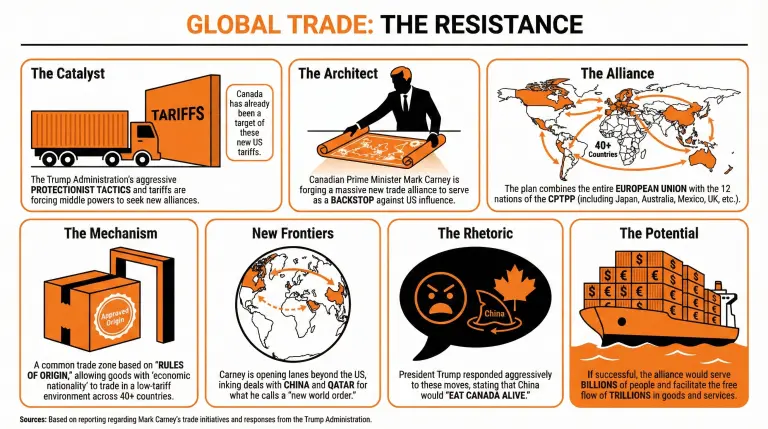
The objective of this new organization would be to serve as a backstop against the growing influence of the Trump Administration’s tariffs in shaping global trade. Canada has already been the target of these measures, with Trump threatening (and applying) tariffs to several goods exported from Canada to the U.S.
Carney has been opening new trade lanes with countries other than the U.S., recently inking deals with China and Qatar in preparation for what Carney himself referred to as a “new world order.” This prompted aggressive rhetoric from President Trump, who stated that China would “eat Canada alive.”
While the development of this alliance is in the initial stages, the initiative has received support from key commerce organizations, including the German Chamber of Commerce and Industry (DIHK) and British Chambers of Commerce. This could prove useful for the final construction of the legal framework to enable this initiative in the future, as these organizations can have huge leverage over lawmakers.
If finally agreed, the alliance would open joint markets serving billions, potentially allowing the free flow of trillions of dollars in goods and services across several continents.
FAQ
- What trade strategies is Canada pursuing in response to the Trump Administration’s policies?
Canada, led by Prime Minister Mark Carney, is seeking to establish a new trade alliance that includes the EU and countries in the Comprehensive and Progressive Agreement for Trans-Pacific Partnership. - What is the main objective of this proposed trade alliance?
The alliance aims to create a low-tariff common trade zone based on the “rules of origin” principle, facilitating trade among over 40 countries while countering U.S. tariffs. - How has Canada been affected by U.S. trade policies under the Trump Administration?
Canada has faced threats and actual tariffs on its goods exported to the U.S., prompting the need for alternative trade partnerships. - What support has this initiative garnered from trade organizations?
The proposed alliance has received backing from influential commerce organizations such as the German Chamber of Commerce and the British Chambers of Commerce, enhancing its potential impact.