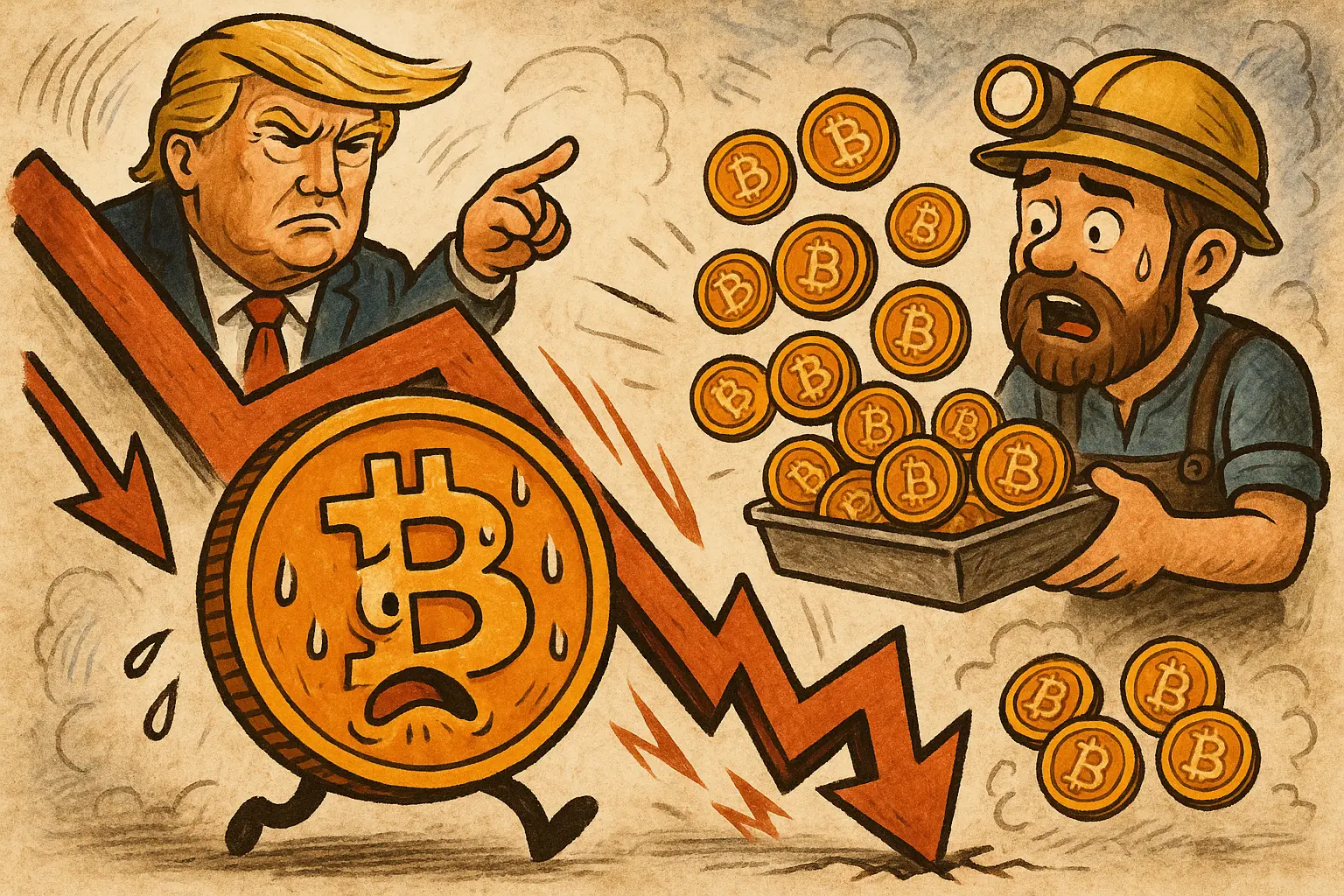
Bitcoin has recently experienced a sharp decline, with the market facing two simultaneous pressures. Major miner Bitdeer has liquidated over 2,000 coins from its reserves within eight weeks, strategically shifting to an immediate sell-off mode; the U.S. Supreme Court ruled that Trump’s reciprocal tariffs are illegal, bringing a new wave of national security tariff issues to the forefront, causing global risk assets to panic sell. On the technical side, the situation has also worsened, with Bitcoin breaking below the triangle support, with short-term focus directly on the critical $64,000 level.
Miners Shift from Holding to Liquidation: A Warning Signal from Bitdeer
(Source: Bitdeer)
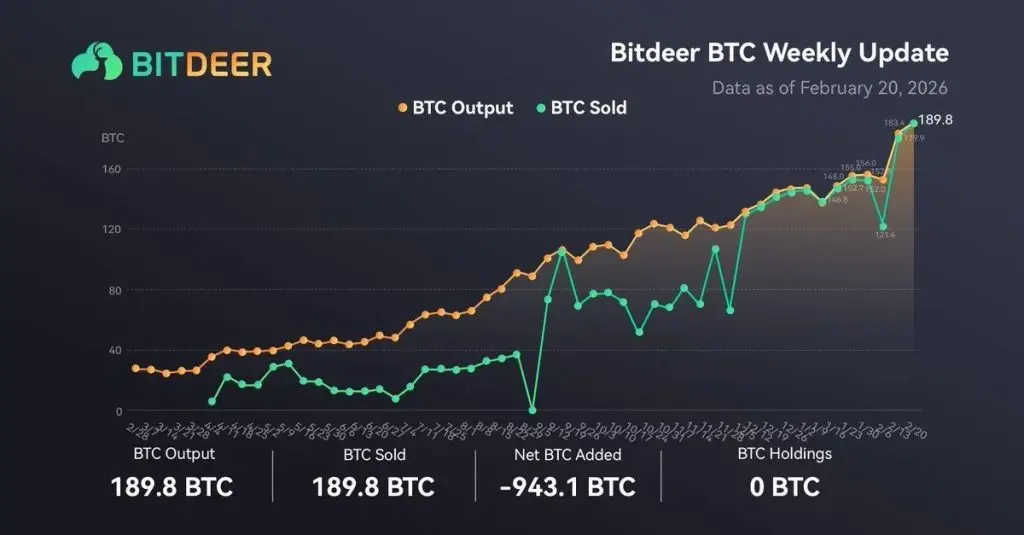
Bitdeer is one of the most noteworthy on-chain indicators during this Bitcoin decline. This large miner has been reducing its holdings since late December last year, depleting its reserves of over 2,000 BTC over eight weeks. More concerning is its strategic shift—In January, Bitdeer mined 668 BTC but sold over 1,100 BTC, far exceeding its monthly production, now entering a full-speed liquidation mode of “mine in the week, sell in the same week.”
Miner behavior has always been a leading market indicator. When long-term holders turn into continuous sellers, it signals not just a one-time impact but the formation of a structural medium-term selling pressure.
Three Core Reasons Behind Bitdeer’s Liquidation
Halving Effect Compresses Profits: After the block reward halving, mining rewards plummeted, increasing the relative cost basis for holding coins.
Urgent Need for Business Transformation Capital: Bitdeer is heavily expanding its AI high-performance computing infrastructure through convertible bonds and equity financing.
Immediate Financial Pressure Relief: With the stock price continuously declining, selling BTC becomes the fastest way to replenish cash flow.
These triple pressures have triggered a coordinated response, and liquidation is no longer a short-term move but an inevitable choice under the business transformation.
Trump Tariff U-turn: Policy Uncertainty Sparks Market Panic
Macroeconomic turbulence has added fuel to Bitcoin’s sharp decline today. The U.S. Supreme Court ruled that Trump’s reciprocal tariff mechanism is illegal, casting a shadow over several ongoing trade agreements. The European Parliament announced delays in approving agreements with the U.S., India has paused its official visit to the U.S., and Japan’s ruling party described the situation as “a tangled mess.”
Trump immediately announced that the U.S. would maintain a 15% baseline tariff globally. According to The Wall Street Journal, the government is also evaluating new national security tariffs on six major industries—including large batteries, industrial chemicals, and power grid equipment—under Section 232 of the Trade Expansion Act.
Goldman Sachs strategists in their latest report pointed out that policy uncertainty is “one of the most destructive channels” impacting market confidence, as it directly suppresses investor decision-making and corporate capital expenditure. While a weaker dollar supports gold, for Bitcoin, risk-averse capital outflows driven by safe-haven sentiment remain the primary short-term bearish force.
Technical Analysis: $64,000 Is the Key Support Level for Bulls and Bears
(Source: TradingView)
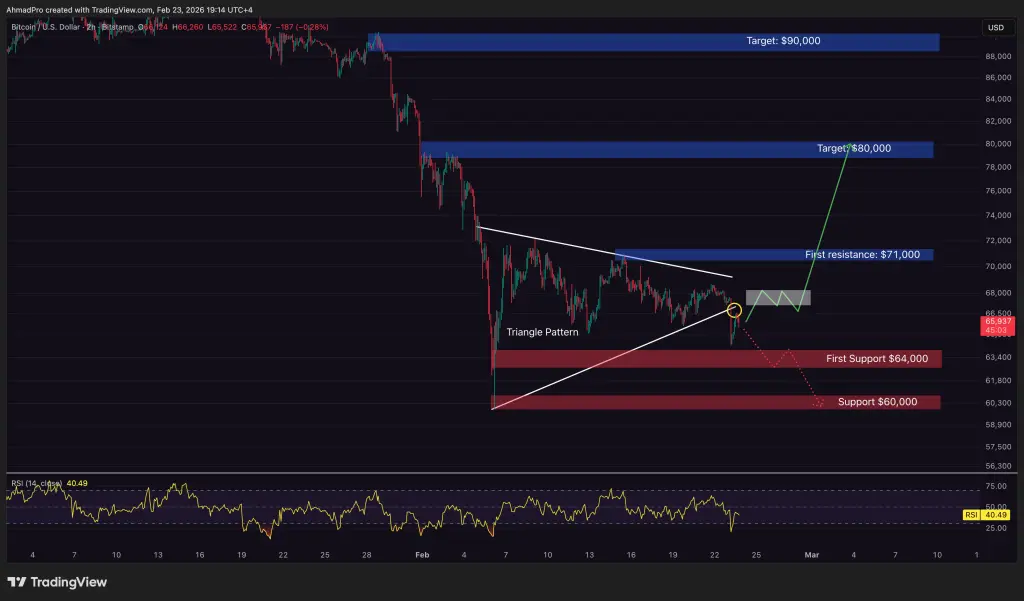
After Bitcoin broke below the contracting triangle’s lower boundary, the previously supportive upward structure was invalidated. Short-term momentum shifted from neutral to clearly bearish, with price consolidating around $65,000. If the $64,000 support fails, the market will face a severe test at the macro bottom of $60,000; breaking this level would cause a fundamental breakdown of the higher timeframe bullish structure.
The reversal conditions are also clear: BTC needs to regain the trendline and break above $71,000 to confirm the bullish momentum recovery. Until then, each rebound should be viewed cautiously and not as a sign of trend reversal.
Disclaimer: The information on this page may come from third parties and does not represent the views or opinions of Gate. The content displayed on this page is for reference only and does not constitute any financial, investment, or legal advice. Gate does not guarantee the accuracy or completeness of the information and shall not be liable for any losses arising from the use of this information. Virtual asset investments carry high risks and are subject to significant price volatility. You may lose all of your invested principal. Please fully understand the relevant risks and make prudent decisions based on your own financial situation and risk tolerance. For details, please refer to
Disclaimer.
Related Articles
When will Bitcoin rebound? Historical data reveals key prices and potential buying opportunities
February 24 News, Bitcoin has recently been on a continuous decline, sparking market attention on the recovery timing. According to Glassnode data, the 90-day realized profit and loss ratio has fallen below 1 for the first time since 2022, indicating that the market has entered an oversold phase. Historical experience shows that this state typically lasts about six months, suggesting that Bitcoin may remain at low levels until the end of the third quarter of this year.
The realized profit and loss ratio reflects the proportion of profits and losses in on-chain transactions. When the ratio is below 1, losses dominate, and investors are mostly capitulating. Past bear market cycles—2015, 2018, and 2022—have all shown this pattern. During these lows, market panic is common, but it also presents potential buying opportunities.
GateNewsBotJust Now
Vitalik Buterin Analyzes Bitcoin Privacy Limitations: Why Decentralization Takes Priority Over Privacy
February 24 News, Ethereum founder Vitalik Buterin stated at an event in Chiang Mai, Thailand, that Bitcoin was designed with a priority on decentralization rather than privacy features, so it cannot effectively support both. He pointed out that Bitcoin, in order to maximize decentralization, has almost sacrificed privacy benefits, resulting in highly transparent transactions and account information on the blockchain.
Buterin explained that early cryptographic technology relied on centralized institutions to protect privacy because achieving full decentralization and privacy simultaneously was nearly impossible at the time. He emphasized that Bitcoin's design trade-offs involve some sacrifices in privacy, but its decentralization advantage provides the foundation for its network security and resistance to censorship.
GateNewsBot3m ago
Will Bitcoin drop to $50,000? Strategy adds $40 million, Citrini AI report triggers market turbulence
February 24 News, Strategy announced an additional $40 million investment in Bitcoin, despite the current market being somewhat pessimistic about Bitcoin price forecasts. The company currently holds Bitcoin worth $55 billion, with an average cost of approximately $76,020. At Bitcoin's current price of $63,000, unrealized losses amount to nearly $10 billion. Executive Chairman Michael Saylor stated that the company employs a dollar-cost averaging strategy and is not concerned about short-term price fluctuations.
Recently, Bitcoin has been affected by geopolitical tensions, economic uncertainties triggered by developments in artificial intelligence, and policy changes by the Trump administration, leading to consecutive price declines. Matt Howells-Barby, Vice President of Growth at CEX, pointed out that Bitcoin could potentially drop to $50,000 in the short term. Data from DefiLlama shows that investors sold over $1 billion worth of Bitcoin ETFs in February, bringing the total ETF decline since November last year to $7 billion. Data from CF Benchmark indicates that major hedge funds reduced their Bitcoin ETF holdings by 28% between the third and fourth quarters.
GateNewsBot6m ago
Analysis: De-globalization and AI reshaping the macro environment, with crypto assets being sold off as high-beta growth assets
The current market is undergoing a structural reshaping driven by de-globalization and artificial intelligence, resulting in slow trading adjustments. Bitcoin and Ethereum prices are struggling to rebound, indicating a lack of market confidence. Capital is flowing into value sectors, technology stocks are underperforming, and crypto assets are being sold off, facing a critical transition ahead.
GateNewsBot14m ago
Nakamoto spends $107 million to acquire BTC Inc. and UTXO, accelerating the integration of Bitcoin media and asset management landscape
February 24 News, Bitcoin asset management firm Nakamoto announced the completion of its acquisition of BTC Inc. and UTXO Management through a fully stock-based transaction valued at approximately $107.3 million. This move is seen as a significant step in reshaping the Bitcoin media ecosystem and asset management landscape. According to the company's disclosure, after the completion of the transaction, relevant shareholders will hold 363,589,816 shares on a fully diluted basis, further strengthening its capital structure and business synergy.
The acquisition includes BTC Inc., which operates Bitcoin Magazine and the Bitcoin Conference, as well as UTXO Management, which focuses on Bitcoin asset management. Founder David Bailey stated that the deal aligns with their long-term strategy of building a diversified business matrix around Bitcoin, aiming to create a closed-loop ecosystem encompassing media, asset management, and consulting services to enhance stable revenue streams and industry influence.
GateNewsBot20m ago
Capital withdrawal accelerates! US Bitcoin and Ethereum ETFs see over $250 million in net outflows in a single day, with institutional sentiment clearly weakening.
February 24 News, there is a clear redemption wave in US spot Bitcoin and spot Ethereum ETFs. Data shows that on that day, the net outflow from the spot Bitcoin ETF was approximately $204 million, while the spot Ethereum ETF also saw an outflow of $49.48 million, with a total daily capital outflow of $253 million. This large-scale capital withdrawal occurred after Bitcoin's price briefly fell below the critical $65,000 level, combined with macroeconomic uncertainties caused by expectations of US tariff policies, leading to a significant decline in risk appetite in the crypto market.
GateNewsBot26m ago


