


XRP and XLM Explained: Origin Story, Use Cases, and Key Differences
XRP and XLM share roots but follow different paths. Read more on their origins, use cases, milestones, and what separates the two networks.
XRP and XLM are among the most popular crypto assets. They share a common genesis, but their goals for global finance diverge widely.
Developed by Ripple Labs (Opencoin at start) in 2012, XRP is the native currency of the XRP Ledger. Serving the same role for Stellar Network is XLM (Lumen), which launched two years later in 2014.
Both cryptocurrencies are designed to broadly serve the same purpose (cross-border payments and accessibility to finance). Yet they have fairly different technologies, governance, tokenomics and ecosystems.
Here’s how both networks evolved from a shared origin into distinct systems while still maintaining several points of intersection.
The Origin Story That Connects XRP and XLM
The story of XRP and XLM begins with one shared name, Jed McCaleb. In 2012, McCaleb co-founded the XRP Ledger alongside David Schwartz and Arthur Britto.
Shortly after, the three brought in Chris Larsen and founded the company now known as Ripple. Their goal was straightforward: build a faster and more energy-efficient alternative to Bitcoin for global payment settlement.
McCaleb departed from Ripple in 2013 following disagreements over the company’s strategic direction. Rather than exit the industry, he channeled his experience into a new project.
In 2014, he co-founded the Stellar network with lawyer Joyce Kim. The mission echoed some of Ripple’s goals, but with a wider vision.
The goal was to bring financial access to people who had been left out of the traditional banking system entirely.
McCaleb put it plainly himself in September 2020,
“The whole original design of Stellar is that you can have fiat currencies and other kinds of forms of value run in parallel with each other and with crypto assets.”
That philosophy set Stellar apart from Ripple’s more institutional focus. And really, the shared origin is where the connection between XRP and XLM ends. From 2014 onwards, both projects went their own ways, building out different technologies, priorities, and communities.
XRP’s History: Milestones, Developments
The XRP Ledger has evolved over time since its launch. A combination of constant development and numerous legal proceedings has played a significant role in its evolution.
As of this writing, the XRP Ledger has closed over 70 million ledgers – a significant accomplishment after being operational for over ten years with a consistent and reliable record.
Furthermore, the XRP Ledger is fast and efficient. It handles over 1,500 transactions per second, settles in three to five seconds, and costs as little as $0.0002 per transaction on average.
In December 2020, the U.S. SEC filed a lawsuit against Ripple Labs, Inc. and two of its officers. It resulted in one of the largest cases in the history of XRP and the crypto industry.
The SEC claimed that Ripple sold more than $1.3 billion in XRP in an unregistered securities offering. Ripple defended itself in court rather than settling the matter like most other companies facing similar litigation did.
After nearly five years in court, the SEC and Ripple finally put the case to rest in 2025. It wasn’t a clean win for either side. More of a draw with fine print.
XRP traded on public exchanges was ruled not to be a security. Sold directly to institutional investors, it was. The same token, treated differently depending on who’s buying and how.
Ripple paid $50 million, well below the $125 million the SEC originally sought, and the SEC also dropped its injunction as part of the resolution.
Ripple continues to develop RippleNet, the world’s largest payment network that uses XRP, as a bridge currency for institutional transactions.
Additionally, the XRP Ledger has included native tokenization capabilities and a built-in decentralised exchange, allowing the XRP Ledger to support more than just sending or receiving money, but also DeFi applications and asset creation.
Trader JD recently captured the current market sentiment around XRP price,
“XRP /BTC — If weekly RSI close above 1-year trendline while above MA I expect Hidden Bullish Divergence to play out & possibly breakout out from 7-YEAR trendline! This would be the BIGGEST breakout in XRP history, & MAJORITY will still be EXIT LIQUIDITY in the end REKT!”
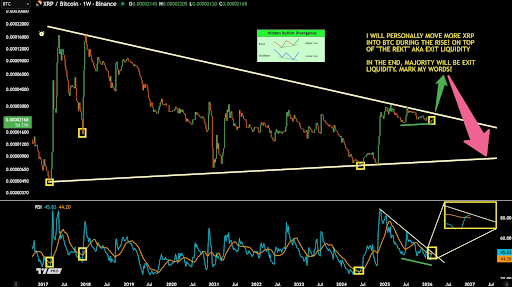
Expert expects XRP Hidden Bullish Divergence to play out, Source| X/ Trader JD
The commentary reflects cautious optimism among technical analysts while warning retail investors about exit liquidity risks.
Notable Milestones in XLM’s History
Since its launch in 2014, Stellar has steadily grown its presence in global finance.
The network has built out its infrastructure over time. It has formed partnerships with major institutions, including some of the world’s largest banks. This consistent development has strengthened Stellar’s position as a bridge for traditional finance and blockchain-based systems.
One of its most notable innovations was the creation of the Anchor Network. This system can convert fiat currencies into digital assets across a network of over 450,000 locations in 180+ countries. It is relatively simple for users to exchange fiat for digital assets.
By eliminating the need to transfer funds across multiple locations, this structure simplifies the transfer process (i.e., reducing friction). Very few blockchains at scale have implemented a complete, global on-and-off-ramp infrastructure integrated into a single platform.
In 2024, Stellar released Protocol 20, providing for the first time, robust smart contract functionality via Soroban, utilizing Rust and Wasm (WebAssembly).
As a result of this upgrade, Stellar’s capacity has been expanded. It includes decentralized finance solutions that offer access to decentralized exchanges, lending protocols, and asset tokenization.
Perhaps most importantly, these new features were added without sacrificing either of Stellar’s primary advantages (i.e., fast settlement times or low transaction costs).
A pivotal institutional milestone occurred with Franklin Templeton’s release of BENJI (the first U.S.-registered money market fund on a public blockchain) on the Stellar network.
The launch of BENJI represents a meaningful advancement in integrating traditional financial products regulated by law into blockchain infrastructures.
In addition to Franklin Templeton, Stellar has partnered with companies such as MoneyGram International, WisdomTree, PayPal, and the United Nations High Commissioner for Refugees (UNHCR), thereby extending the Stellar network’s payment rails to support real-world use cases across financial services and humanitarian efforts.
As of recent market activity, XLM trades at $0.16. Market analyst Token Talk noted:
“XLM Strong reaction from major weekly demand zone. History shows explosive moves from this level, and momentum is building again.”
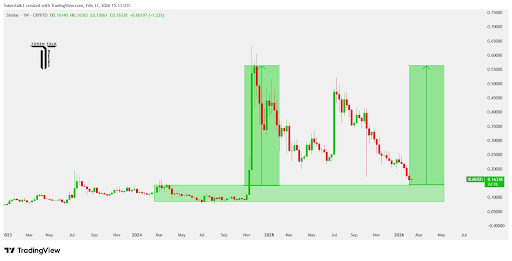
XLM shows a strong reaction from a major weekly demand zone, Source| X/Token Talk
The observation points to historical price behavior at key support zones, suggesting continued market interest in the asset.
How XRP and XLM Are Similar
XRP and XLM aim to fix one of global finance’s biggest problems: slow and expensive cross-border payments.
Traditional systems like SWIFT can take days and include unclear, high fees. XRP and XLM? They settle transactions in seconds at a fraction of the cost. This makes international transfers far more efficient and accessible.
While XRP and XLM both serve as bridge currencies between fiat currencies, the way each performs this function is slightly different.
For example, when an institutional customer uses the XRP Ledger to transfer funds, they first convert the value of their fiat currency into XRP.
However, when transferring funds using the Stellar Network/Ethereum, XLM is used to convert the value of the sending fiat currency to the destination currency (i.e., XLM to fiat) and vice versa.
Unlike Bitcoin, XRP and XLM do not utilize energy-intensive Proof of Work mining. Instead, both networks utilize more efficient consensus protocols. Federated Consensus for XRP, while the Stellar Consensus Protocol (SCP) for XLM.
Although their designs differ, both systems deliver fast transaction finality. Besides, they significantly lower energy consumption, using a fraction of the power required by Bitcoin’s PoW network.
Both ecosystems have also expanded into asset tokenization and decentralized finance. The XRP Ledger has native tokenization and DEX capabilities built into the protocol.
Stellar added smart contract functionality through Soroban in 2024. These parallel expansions signal that both networks are evolving beyond simple payment rails into broader financial infrastructure platforms.
Transaction speed and cost also remain comparable across the two. XRP settles in three to five seconds at $0.0002 per transaction.
Stellar confirms transactions in under six seconds at 0.00001 XLM, effectively fractions of a penny. Both are among the most cost-efficient blockchains available for payments at scale.
Where XRP and XLM Fundamentally Differ
While their similarities are real, the differences between XRP and XLM are more defining. The two networks diverge in governance, target audience, tokenomics, security model, and institutional strategy.
XRP was built primarily for institutional use.
Ripple promotes the XRP Ledger to banks and other financial institutions looking for liquidity options for high-volume international transactions.
Ripple’s primary customers are enterprises and corporations using the network, rather than individuals or retail consumers.
Stellar’s design implements inclusive finance as its priority. The Stellar Network targets low-income consumers living in areas with limited access to traditional banks.
The Stellar Anchor Network assists users in transitioning from areas without bank access to the global financial system via its 450,000 cash points in 180 countries.
In addition, the Stellar Development Foundation is a non-profit organization dedicated to the long-term success of the Stellar Network.
It does not provide financial incentives for validators and governs with a community-first model.
Ripple is a for-profit company. It holds a significant amount of XRP in escrow and operates with commercial interests tied to the asset’s performance.
XRP and XLM differ notably in their tokenomics. XRP has a fixed total supply of 100 billion tokens, with roughly 55 billion held in escrow and the rest released gradually over time.
This structure gives the network predictability in circulation and liquidity management. XLM’s supply, however, is governed by the Stellar Development Foundation and is adjusted to support network growth and ecosystem needs.
As a result, XLM primarily functions as a utility token, rather than a speculative or reserve asset like XRP.
Their approaches to consensus also diverge. The XRP Ledger relies on designated “validators” that operate within a trusted network.
Each validator confirms transactions independently. Yet a consensus is reached across the network. Stellar, in contrast, uses a federated Byzantine agreement model.
Here, each node chooses its own trusted validators, forming overlapping trust relationships. Security comes not from ownership or computational power, but from the reputation and reliability of these trusted parties.
Security design also separates the two. Stellar’s Soroban smart contract platform uses Rust’s memory safety guarantees, a no-reentrancy design, and an authorization-required framework.
These features reduce attack surfaces at the code level. The XRP Ledger’s security comes from its validator structure and protocol rules rather than smart contract design, as its DeFi features are built natively into the ledger itself.
Two Networks, One Common Challenge
One challenge for XRP and XLM is to gain a large user base before they can have the kind of widespread use that will ultimately lead to success in their respective locations.
While XRP faced a legal case against the SEC that limited its ability to gain traction in the U.S., Stellar has, as of yet, not encountered any major regulatory difficulties. However, it faces a saturated market of potential customers and struggles to gain institutional support.
Their strategic focus is different from one another. Ripple focuses on partnering with enterprises through its trade and marketing partnerships.
They create a basis for the adoption of the XRP token. Besides, they engage with regulators to help provide legitimate support and legitimacy for their products and services.
Stellar focuses on the development of smart contract technology and building the infrastructure needed to integrate physical assets into the digital world.
Both assets have delivered consistently for more than a decade. Their performance records, transaction volumes, and institutional partnerships demonstrate staying power in a volatile industry.
For any investor or developer evaluating the two, the distinction is not simply technical; it is strategic. XRP targets the corridors of institutional finance. XLM aims to reach the edges of the global economy where traditional finance has not yet arrived.
Related Articles
XRP Ledger Devnet Reboot Scheduled for March 3 as Devs Prepare for Update - U.Today
Ripple CTO Emeritus Clarifies Only Way 'Valid' XRP Transaction Can Be Blocked - U.Today