


Revolut selected for FCA stablecoin sandbox, GBP token plan may be announced before July

The UK Financial Conduct Authority (FCA) announced on February 25, 2026, that it has selected four organizations—Revolut, Monee Financial Technologies, ReStabilise, and VVTX—from nearly 20 applicants to participate in a stablecoin regulatory sandbox pilot, which is scheduled to officially launch in the first quarter of 2026.
FCA Stablecoin Sandbox: Controlled Environment for Issuance Benchmark Testing
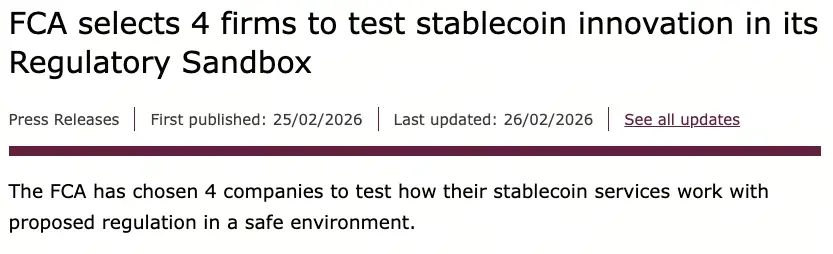 (Source: UK Financial Conduct Authority)
Matthew Long, Director of Payments and Digital Assets at FCA, stated that the regulator will fully support UK stablecoin issuers to ensure that issued assets are highly credible in the payments, settlement, and trading industries. The core focus of this sandbox testing includes stablecoin issuance mechanisms, as well as diverse application scenarios such as payment systems, wholesale financial settlement, and cryptocurrency trading infrastructure.
FCA noted that participating organizations will operate within a supervised, controlled environment, allowing regulators to closely observe issuance processes, operational challenges, and compliance risks before final rules are established. The data collected will inform the final stablecoin regulatory framework expected to be released later in 2026.
Revolut’s GBP Token Ambitions: A Contrast to Traditional Banks’ Silence
Among the four selected organizations, London-based fintech unicorn Revolut’s moves are the most closely watched by the market. Revolut obtained a conditional UK banking license in 2024 and is currently awaiting full license approval. Sources reveal that the sandbox testing will focus on issuing GBP-pegged stablecoins, although the company has not made an official statement. Market prediction data from Myriad Markets shows that users estimate about a 34% chance that Revolut will announce a token launch before July.
In contrast, traditional large UK banks remain cautious. Currently, the European stablecoin market (including euro, pound, and Swiss franc tokens) accounts for less than 0.2% of the global market share, with dominance still held by dollar-pegged entities like Tether. Bank of England Governor Andrew Bailey has explicitly indicated a focus on “tokenized deposits,” and requires banks issuing stablecoins to use entirely independent brands. This stance objectively limits traditional banks’ motivation to enter the stablecoin market.
UK Stablecoin Regulatory Roadmap Overview
Q1 2026: FCA stablecoin sandbox officially launches, with four organizations beginning pilot testing
Summer 2026: FCA is expected to release a policy statement summary covering token issuance, custody requirements, and market abuse prevention
September 2026: FCA opens formal application process for cryptocurrency companies (“Crypto Gateway”)
October 2027: New crypto regulation comes into effect, requiring all regulated crypto service providers to obtain FCA authorization under the Financial Services and Markets Act
Notably, Coinbase CEO Brian Armstrong recently criticized the Bank of England’s proposed “stablecoin holding limit” policy (personal £5,000 to £20,000, corporate £1 million to £10 million), arguing that it would weaken the UK’s digital financial competitiveness. Over 81,000 people have signed a petition initiated by Stand With Crypto UK urging Parliament to reconsider these restrictions.
Frequently Asked Questions
What is the FCA stablecoin regulatory sandbox, and why is it important?
A regulatory sandbox allows companies to test innovative products in a controlled environment. FCA’s initiative enables the collection of real-world data on stablecoin issuance before final regulations are enacted. This marks a shift from observation to proactive engagement by the UK and provides policy clarity ahead of comprehensive regulation in 2026–2027.
Why is Revolut focusing on GBP stablecoins as the main testing direction?
GBP stablecoins hold strategic significance for Revolut: the company’s primary market is the UK, and it is applying for a full banking license. Issuing GBP stablecoins helps solidify its position in the UK fintech scene and explores advantages in cross-border payments and wholesale settlement scenarios.
How does the Bank of England’s stance on “tokenized deposits” impact the UK stablecoin market?
Bank of England Governor Andrew Bailey favors “tokenized deposits” over independent stablecoins and requires banks to use independent brands for stablecoin issuance. This creates a barrier for traditional banks to enter the market. Meanwhile, fintech firms like Revolut are less restricted and are positioned to take a more flexible, early-mover advantage in the GBP stablecoin space.
Related Articles
MARA stock price surged 18% after hours, teaming up with Starwood Capital to develop AI data centers—more than just mining transformation
Flare and Xaman Enable One-Click DeFi Access for Over 2 Billion Idle XRP
Solana Payments launches real-time stablecoin settlement, with Visa and PayPal integrated
Aave Hits $1 Trillion Lending Volume: Price Implications for 2026?
POWER (Power Protocol) increased by 70.03% in the past 24 hours