


Wikipedia Co-Founder: Bitcoin May Fall Below $10,000 by 2050

Wikipedia co-founder Jimmy Wales recently publicly stated his harsh assessment of Bitcoin’s long-term prospects. He believes that Bitcoin’s network protocol is sufficiently robust and unlikely to go to zero, but its role as a currency or store of value has fundamental limitations. He warns that by 2050, Bitcoin’s price could completely fall to “hobbyist levels,” dropping below the current $10,000.
Wales’s Core Argument: Technology Survives, Function Fails
(Source: Trading View)
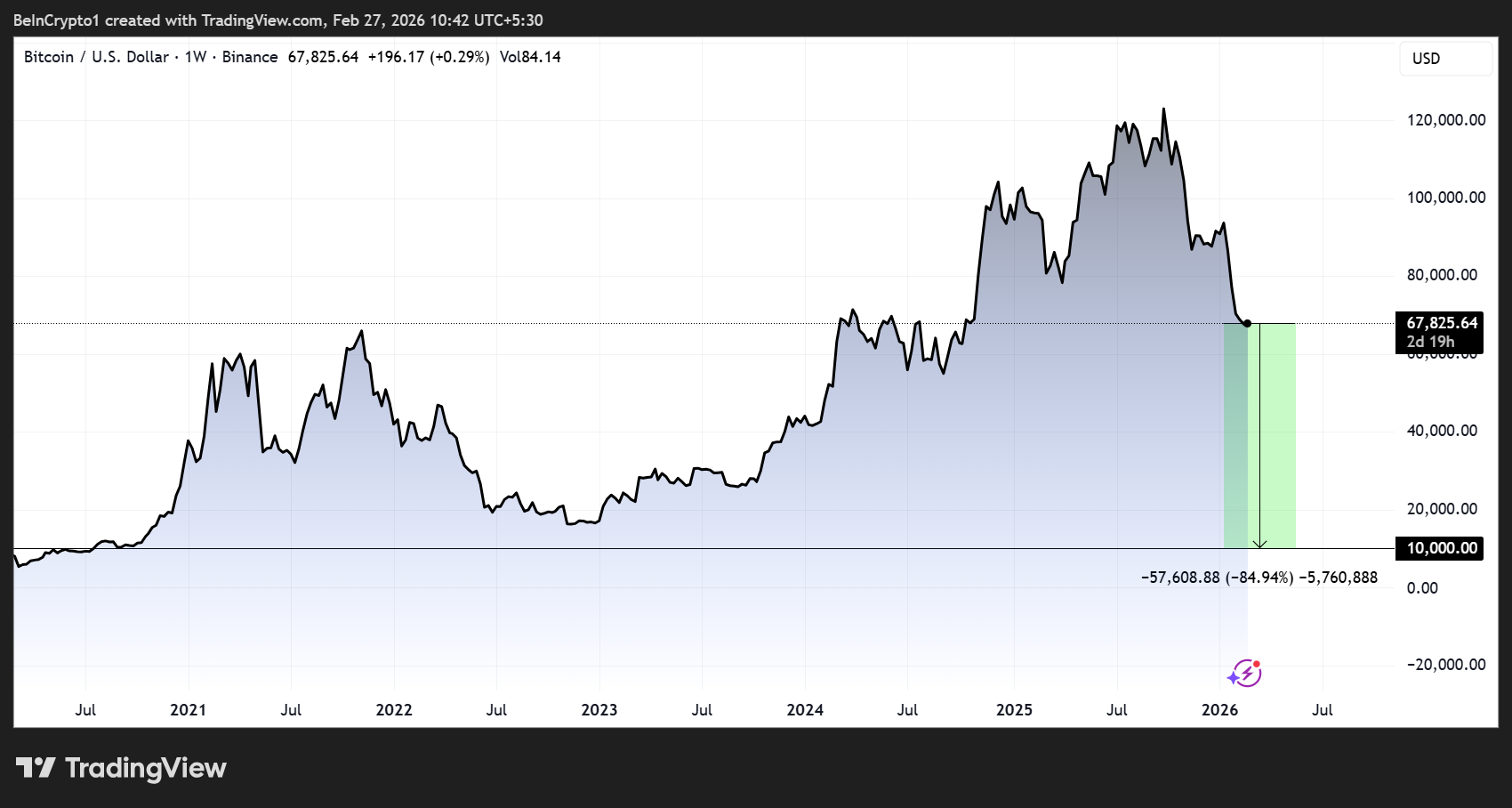
In Wales’s evaluation framework, there is a fundamental separation between Bitcoin’s technical resilience and its market role.
Wales states that those who believe Bitcoin will go to zero “are very likely wrong”—unless cryptographic vulnerabilities or 51% attacks emerge that are currently unforeseen, Bitcoin’s existence as a network is almost permanent. Even if threatened, fork mechanisms can keep it running.
However, he immediately points out the limitations of this technical survivalism: “Its price could completely fall to the level of hobbyists’ casual modifications.” He further describes Bitcoin as “at best speculative” and refutes three mainstream claims about its application:
- High difficulty of use: Operating barriers remain far higher than mainstream financial tools
- Excessive volatility: Cannot provide stable pricing as a currency
- Lack of acceptance: Rarely accepted as daily currency in most places worldwide
Wales clearly states that gold, silver, jewelry, real estate, and art will continue to serve as primary safe-haven assets. Bitcoin is at a fundamental disadvantage in this competition. He also dismisses the idea that institutional ETF inflows or AI adoption can ensure long-term price stability, considering both scenarios “highly unlikely.”
Controversy Focus: Bitcoin’s “Mission Drift” and Market Divisions
Wales’s critique touches on a long-standing core debate within the Bitcoin community: whether the ongoing evolution of Bitcoin’s definition reflects a failed trajectory.
Some critics point out that Bitcoin initially aimed to be “peer-to-peer electronic cash.” After failing to fully achieve this, it transformed into a solution relying on the Lightning Network; after the Lightning Network’s adoption was hindered, it rebranded as a “digital gold” store of value. Now, this narrative is also being questioned, as Bitcoin seeks new storytelling justifications. Jacob Kinge of SwanDesk also warns that Bitcoin’s bubble phase may have already ended.
However, not all market observers share this pessimistic view. Chartered financial analyst Rajat Soni counters: “Seeing volatility and immediately thinking Bitcoin has failed… these people are just tourists.” He believes defining Bitcoin’s long-term fate based on short-term price swings is a fundamental misreading of its underlying logic.
Frequently Asked Questions
Q: What is the relationship between Jimmy Wales and Wikipedia?
Jimmy Wales is the co-founder of Wikipedia, the world’s largest free online encyclopedia, with over 1.5 billion monthly active users. Wales has broad influence and credibility in the tech industry. Although he is mainly known for Wikipedia, in recent years he has also publicly commented on topics like technology, artificial intelligence, and cryptocurrencies.
Q: Why has Wales’s comment on Bitcoin attracted widespread attention?
Wales’s remarks are valued partly because of his prominence and reputation in the tech startup scene, and partly because of the unique structure of his argument—he does not predict Bitcoin will go to zero (which is an extreme view), but suggests a middle scenario where Bitcoin “survives but becomes marginalized,” existing technically forever but becoming a niche hobby asset. This relatively novel framework has sparked broader discussion.
Q: How credible is Wales’s prediction that Bitcoin will fall below $10,000 by 2050?
Wales’s forecast is a personal long-term view, not based on specific quantitative models or market data. Supporters argue that Bitcoin’s fixed supply (21 million coins), increasing global adoption, and ETF trends reducing volatility support a positive outlook. Critics point out that Bitcoin lacks real-world use cases, regulatory risks persist, and quantum computing threats remain unaddressed. The long-term sustainability of widespread adoption remains uncertain. Market analysts have vastly divergent predictions for Bitcoin’s price in 2050, ranging from a few thousand dollars to several million.
Related Articles
Bitcoin ETF and Treasury companies heavily buy $60,000 protective put options
Bitcoin holds the $66,000 support level, ETF funds are flowing back to assist, can it once again challenge $70,000?
Bitwise CIO: Bitcoin dropping to $63,000 is due to long-term holders cashing out, not market manipulation
A Surprising On-Chain Signal Is Flashing for Bitcoin
Wikipedia Co-Founder Predicts Bitcoin Price Could Drop Below $10K by 2050