


A Surprising On-Chain Signal Is Flashing for Bitcoin

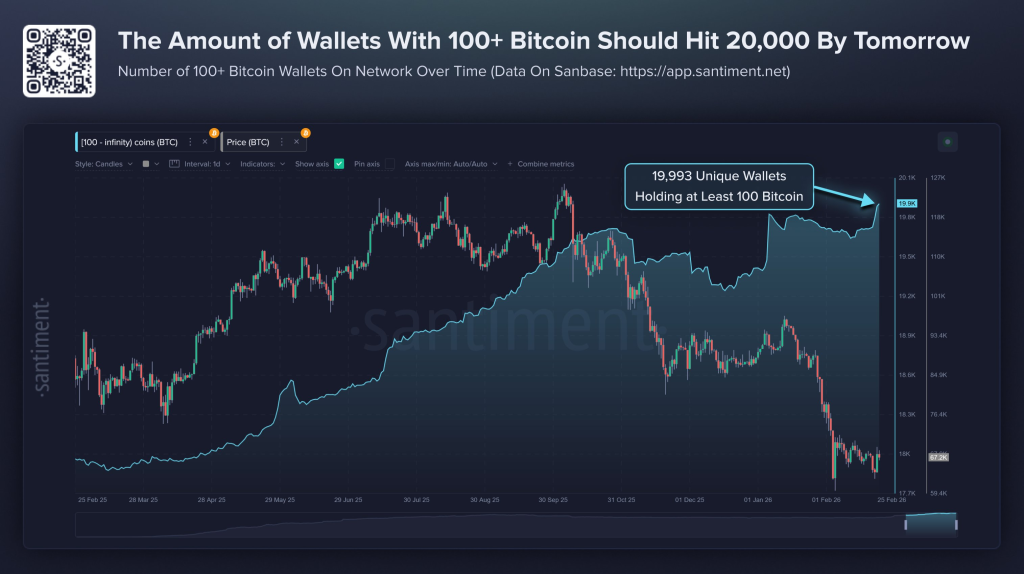
The Bitcoin price has been under pressure in recent weeks, with price drifting lower toward mid-60s range and sentiment turning bearish over and over again. Yet beneath the surface, a key on-chain metric is moving in the opposite direction. Blockchain analytics firm Santiment showed that the number of wallets holding at least 100 BTC is about to surpass a major milestone: 20,000 addresses.
Historically, changes in large wallet behavior have often preceded major trend changes. The question now is whether this latest surge in “whale” wallets marks the early stages of accumulation, or something more complex.
Whale Wallets Rising During BTC Price Weakness
Santiment’s chart shows the steady rise in wallets holding 100 or more BTC, even as Bitcoin’s price has been pulling back. At current levels, 100 BTC represents roughly $6–7 million, meaning these wallets are typically controlled by high-net-worth individuals, funds, long-term holders, or institutions.
The key detail is timing. The wallet count has been climbing during or shortly after price declines. Historically, that pattern has appeared during accumulation phases. When large entities increase exposure while price is weak, it often shows confidence in long-term value rather than short-term speculation.
Source: X/@santimentfeed
However, Santiment also points out an important nuance: while the number of 100+ BTC wallets is increasing, the overall percentage of supply held by top stakeholders has not surged dramatically. In other words, this is not simply a few mega-entities absorbing everything. Instead, it appears that more separate entities are reaching “whale” status.
That distinction is important. It implies distribution across a broader set of large holders rather than extreme consolidation at the very top.
Accumulation, But Not Decentralization
There is a dual narrative in this data. On one hand, the growth in 100+ BTC wallets indicates accumulation. Retail participants tend to sell into fear or during choppy markets, and historically those coins often flow toward stronger hands. Rising whale counts during downturns have frequently aligned with longer-term recovery phases.
On the other hand, this does not necessarily signal decentralization at the smallest levels. If wealth is migrating from smaller wallets to larger ones, concentration is still occurring, just in a slightly more distributed manner among whales.
Santiment frames this as a structural shift rather than an immediate price trigger. For this signal to become more powerful, growth in the number of large wallets would ideally be matched by a clear rise in total supply held by them. That would confirm deeper conviction rather than incremental redistribution.
For now, the takeaway is straightforward: despite recent volatility, large Bitcoin holders are not disappearing. They are growing in number. And historically, when that trend persists during price weakness, it has often laid the groundwork for the next recovery phase.
Will this turns into a major bullish catalyst? Well, it depends on what happens next, but the on-chain data is flashing a signal worth watching.
Read also: TAO vs. Other AI Cryptos: Why Bittensor Is Different (And Why It Could Be the Bitcoin of AI)
Related Articles
'Not Your Market Price': Nick Szabo Questions Who Controls Bitcoin ETF Pricing After Jane Street Allegations - U.Today
Bitcoin and Ethereum options worth $8.7 billion will expire today.
Cryptocurrency markets retreat during pre-market hours in the US stock market, with the largest long whale holdings of BTC and ETH both falling below their average prices.
How Engie Is Turning Brazil Solar Surplus Into Bitcoin Mining Revenue?