


U.S. economic data releases are coming thick and fast, and this Friday's reports will determine Bitcoin's direction.
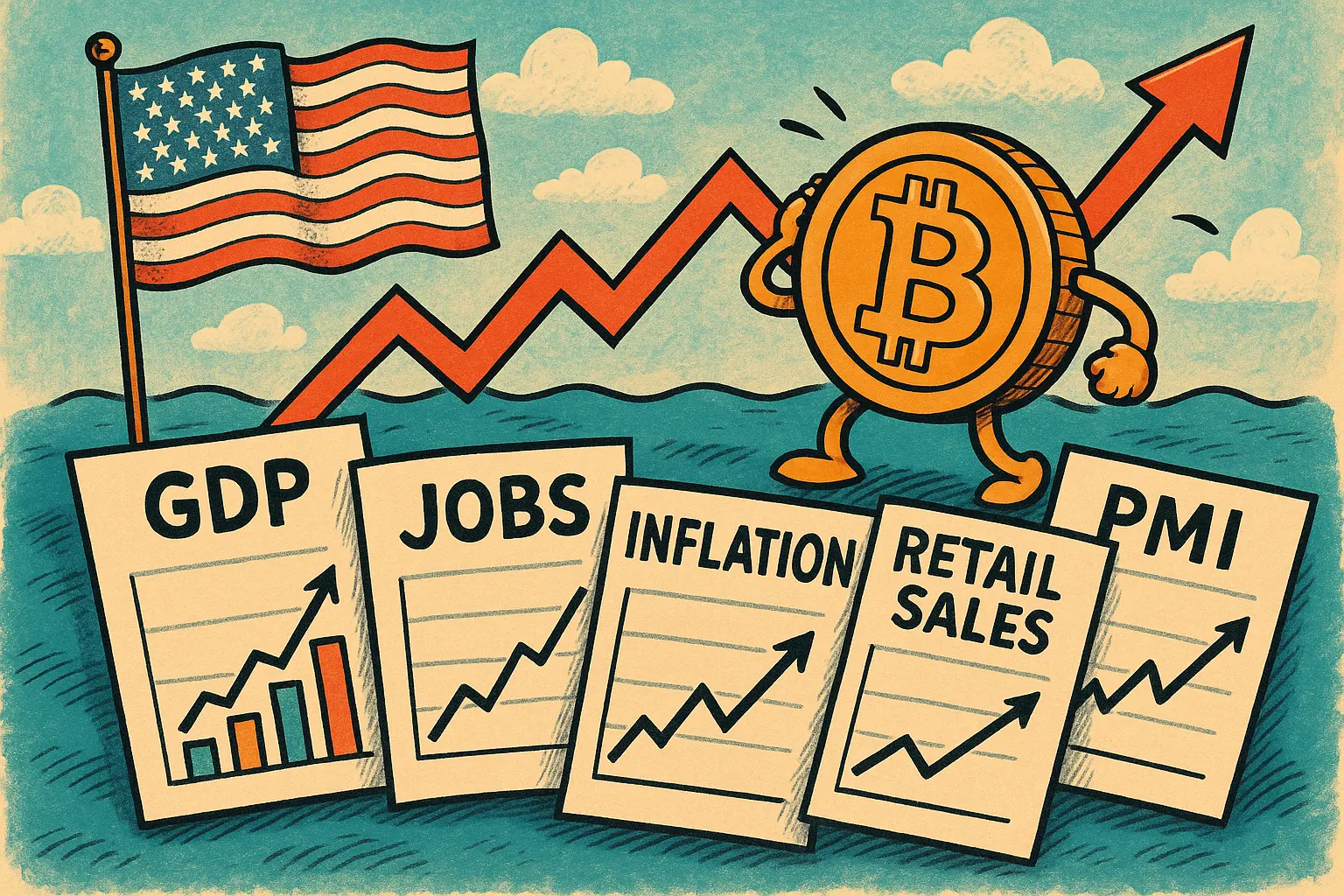
Bitcoin (BTC) is currently hovering around $66,000. This week, the United States will release five key macroeconomic reports, including the Manufacturing Purchasing Managers’ Index (PMI), private employment data, services PMI, unemployment claims, and most importantly, the Non-Farm Payrolls (NFP) report. Analysts generally believe these data will quickly reshape market expectations regarding the Federal Reserve’s rate cut trajectory and will directly influence Bitcoin’s market trend in March.
This Week’s Five Major Reports: Schedule and Market Impact Framework
Bitcoin’s movement is highly sensitive to U.S. interest rate expectations—strong economic data typically pushes yields and the dollar higher, exerting pressure on non-yielding Bitcoin; weak data may reignite rate cut expectations, supporting risk assets. Below is a detailed analysis of each key report this week:
Overview of This Week’s Five Major Reports
March 2 (Monday): Manufacturing PMI (S&P Global + ISM): Expect ISM around 52.0-52.3, with January unexpectedly rising to 52.6 (the strongest since 2022); readings above 52.5 reinforce the “economic resilience” narrative, delaying rate cut expectations; readings near 50 suggest contraction risk, potentially pricing in rate cuts earlier.
March 4 (Wednesday): ADP Private Sector Employment Data: Expect about 50,000 new jobs (January only 22,000, showing moderate performance); strong readings (>60,000–75,000) support the stance of “maintaining high interest rates longer”; weak readings (<40,000) revive easing expectations.
March 4 (Wednesday evening): Services PMI (S&P Global + ISM): Expect 52.3-53.5, with January ISM Services Index at 53.8; services account for over 60% of U.S. economic activity, exerting greater influence than manufacturing; simultaneous weak ADP and services data may push Bitcoin toward the $70,000 psychological level.
March 5 (Thursday): Initial Jobless Claims: Expect about 215,000 (previous 212,000); lower claims reinforce hawkish stance; a surprising spike supports the “cooling labor market” narrative, setting the tone for Friday’s non-farm data.
March 6 (Friday): Non-Farm Payrolls (NFP): The most influential catalyst of the week, detailed in the next section.
Non-Farm Payrolls: This Week’s Key Market Turning Point
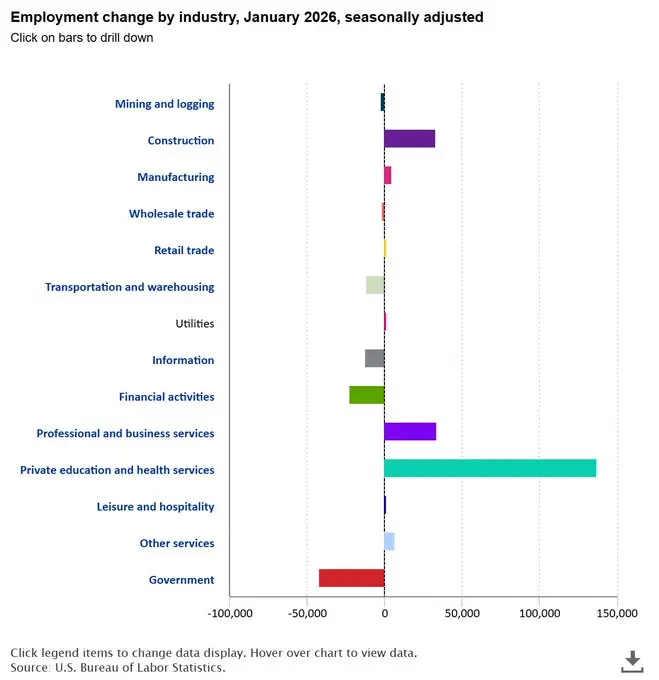
(Source: U.S. Bureau of Labor Statistics)
The February NFP report will be released Friday at 8:30 a.m. Eastern Time. Market consensus expects about 54,000 new jobs, significantly below the strong 130,000 in January; the expected unemployment rate is 4.3%, with a 0.3% monthly increase in wages.
Regarding Bitcoin’s dual risk scenarios: if data is strong (more than 80,000 new jobs, steady wages), markets may see no need for recent rate cuts by the Fed, leading to rising yields and a stronger dollar, testing Bitcoin support at $62,000 to $59,000; if data is weak (fewer than 40,000 new jobs or rising unemployment), rate cut expectations may be priced in earlier, potentially triggering a liquidity-driven rally. Currently, markets have priced in about 2-3 rate cuts by 2026, and even minor surprises could quickly adjust expectations.
It’s important to note that Bitcoin is currently trading below the key resistance zone of $72,000 to $75,000. The outcome of this week’s data could determine the overall trend for March.
Frequently Asked Questions
Why does U.S. Manufacturing PMI data affect Bitcoin?
Manufacturing PMI is a leading indicator of industrial expansion or contraction. Readings above 50 indicate expansion, often interpreted as a sign of “economic resilience,” reducing the urgency for the Fed to cut rates, which in turn pushes U.S. bond yields and the dollar higher. As a non-interest-bearing risk asset, Bitcoin faces higher holding costs in a high-rate environment. Therefore, manufacturing data indirectly influence Bitcoin’s market valuation through interest rate expectations.
Why is services PMI more closely watched than manufacturing PMI?
Services account for over 60% of U.S. GDP, while manufacturing makes up only about 10-12%. Services data more comprehensively reflect consumer confidence, labor market resilience, and overall business activity health, making it more valuable for Fed policy decisions. Unexpected deviations in services PMI often trigger larger market reactions.
What’s the difference between ADP employment data and non-farm employment data?
ADP employment data, released by ADP Research Institute based on private sector payrolls, is usually published on Wednesday; the non-farm payroll report (NFP), released by the U.S. Bureau of Labor Statistics (BLS), covers both government and private employment and is published on Friday. ADP data is often seen as an early indicator for NFP, but when there are significant discrepancies, the predictive value of ADP diminishes.
Related Articles
Analysis: The bears are not enough to quickly "break 6 and see 5" for BTC. The $64,500 support will be reaffirmed after the US stock market opens.
Saudi Arabia Shuts Ras Tanura Refinery After Iran Drone Strike
The stock market soars, while crypto heats up slowly? Koreans' all-in bets have never cooled down
The escalation of Middle East conflicts has triggered capital transfers, with XRP inflows to trading platforms exceeding $650 million in one week. Short-term selling pressure may intensify.