The off-chain snapshot vote for the Aave proposal “Aave Will Win” funding concluded on Sunday, passing narrowly with 52.58%. The results were 622,300 votes in favor and 497,100 votes against. However, Aave founder Marc Zeller raised concerns almost immediately after the vote ended, alleging that approximately 233,000 tokens’ voting behavior was linked to Aave Labs.
Core Allegations and Financial Background of the Voting Controversy
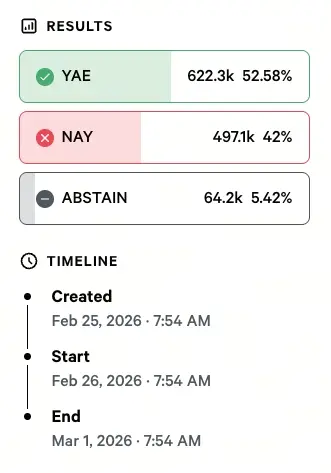 (Source: Snapshot)
Zeller’s concerns are not unfounded. Just prior to this vote, on February 25, he published an audit report examining Aave Labs’ historical fund usage, questioning the approximately $86 million in investment returns from multiple funding rounds.
The main findings of the audit include:
- 2017 ICO: Raised $16.2 million
- Venture Capital Rounds: Raised $32.5 million
- Direct DAO Payments: $31.93 million
- Aave “Approved” Swap Fees: About $5,000
Disputed attribution of technical contributions: Zeller states that revenue directly generated by V3.0 was only $3.33 million, while subsequent upgrades carried out by DAO service providers generated up to $179 million.
On the same day, Aave Labs released a rebuttal report emphasizing their historical contributions to core innovations such as the liquidity pool model, flash loans, security modules, and V3 efficiency mode. They pointed out that these technologies were developed before the DAO service provider structure was established.
Proposal Details and the Logic of Centralizing Token Governance
The “Aave Will Win” proposal requests token holders to approve a funding plan based on a two-way exchange:
-
Aave Labs’ Commitment: All revenue from their products—including aave.com token swaps, upcoming mobile app, Aave Card, Aave Pro, enterprise Aave Kit, and fees from the Aave Horizon RWA marketplace—will be fully directed into the DAO treasury.
-
DAO’s Offer: Up to $42.5 million in stablecoins and 75,000 AAVE tokens to cover operational costs previously paid by Aave Labs through product revenue.
After the proposal was approved, Stani Kulechov posted on X: “The provisional review of the Aave Will Win proposal has been approved. This brings Aave Labs closer to a fully token-centric model, with 100% of product revenue going to $AAVE tokens.”
However, Zeller immediately pointed out that the 75,000 AAVE tokens provided by the DAO to Aave Labs would grant additional protocol governance rights to Aave Labs, further fueling concerns over centralization of power.
Broader Context of Governance Crisis: BGD Labs Declares Departure
This governance controversy is not an isolated incident. On February 20, BGD Labs, a key technical contributor to Aave for four years, officially announced they will not renew their contract with AaveDAO after April 1, 2026. BGD Labs played a critical role in building and maintaining Aave V3.
In their departure statement, BGD Labs cited several reasons: fundamental disagreements with Aave Labs’ centralized management approach, unresolved organizational structural issues, and dissatisfaction with Aave Labs’ promotion of V4—arguing that V4’s marketing exaggerated the supposed flaws of V3, ignoring V3’s dominant market position and strong performance record.
To address the structural issue of Aave Labs holding exclusive legal ownership of the Aave brand and trademarks, the “Aave Will Win” proposal framework also mentions establishing a foundation to hold the Aave trademarks and intellectual property on behalf of the DAO. Specific governance structures and trademark transfer details will be discussed in a separate proposal.
Frequently Asked Questions
What is the basis for Marc Zeller’s doubts about the legality of the vote?
Zeller points out that three address clusters associated with Aave Labs contributed about 233,000 tokens in favor, including 111,000 tokens entrusted by Aave co-founder Stani Kulechov. His argument is that these votes are linked to the direct beneficiaries (Aave Labs). Excluding these, the proposal would have failed with 387,000 votes in favor versus 497,100 against. However, the Aave governance protocol does not prohibit such delegated voting, so the controversy is essentially an ethical issue in governance design, not a violation of rules.
What are the next steps for the “Aave Will Win” proposal?
Currently, the proposal is in the ARFC (Aave Final Community Feedback) stage, where community members can suggest amendments and further discuss the proposal. Final approval requires an on-chain vote, which has higher legal binding and may differ from off-chain snapshot results.
What is the actual impact of BGD Labs leaving on Aave’s technical development?
BGD Labs is a core builder of Aave V3. Their departure means AaveDAO must find or cultivate new technical providers. In the short term, this raises concerns about ongoing maintenance and security audits; long-term, the departure of a major technical contributor due to governance disagreements signals potential issues with DAO governance health, possibly affecting community confidence in the protocol’s future development.
Disclaimer: The information on this page may come from third parties and does not represent the views or opinions of Gate. The content displayed on this page is for reference only and does not constitute any financial, investment, or legal advice. Gate does not guarantee the accuracy or completeness of the information and shall not be liable for any losses arising from the use of this information. Virtual asset investments carry high risks and are subject to significant price volatility. You may lose all of your invested principal. Please fully understand the relevant risks and make prudent decisions based on your own financial situation and risk tolerance. For details, please refer to
Disclaimer.
Related Articles
Polkadot to Reset Tokenomics on March 12 With Major DOT Supply and Staking Changes
Polkadot will introduce a new monetary framework on March 12 that sets DOT’s supply cap at 2.1 billion and lowers emissions by 53.6%.
The overhaul will also create a Dynamic Allocation Pool and shorten the DOT unbonding period from 28 days to 24–48 hours.
On March 12, Polkadot will reset
CryptoNewsFlash3h ago
Builders Are Walking Away From Aave – What Does It Mean for AAVE Price?
Aave (AAVE) is dealing with two very different headlines at the same time. On one side, the protocol faced a $24 million exploit linked to address poisoning, once again reminding users that security risks still exist across DeFi.
Despite that incident, the market reaction has been somewhat
CaptainAltcoin5h ago
Western Union Launches USDPT Stablecoin on Solana Network
_Western Union is launching USDPT, a new stablecoin on Solana, backed by 360,000 cash locations across 200+ countries worldwide._
Western Union is making a bold move into the stablecoin space. The global payments giant has announced USDPT, a new U.S. dollar-denominated stablecoin built on Solana
LiveBTCNews7h ago
Japanese Yen Stablecoin: Can Japan Shake Up the $40 Trillion On-Chain Arbitrage Market Worldwide?
Japan is actively promoting the Japanese Yen stablecoin to reshape its position in the global financial market, aiming to strengthen the core role of the Yen through on-chain arbitrage trading. Despite challenges such as liquidity, regulation, and retail participation, its success will bring an important non-USD asset base to on-chain finance.
PANews7h ago
Aave Labs proposes launching the V4 dedicated bug bounty program
Aave Labs proposes to launch the Aave V4 bug bounty program on the Sherlock platform, aiming to establish a security reporting channel with tiered handling to prioritize high-risk vulnerabilities and improve processing efficiency. Sherlock has previously collaborated with Aave on security work.
GateNews7h ago
Self-Custody Startup Bron Adds Inheritance Flow Built Around Guardians and MPC - Unchained
Bron has launched a "Digital Inheritance" feature for its self-custody wallets, allowing heirs access after the owner's death, with a six-month delay and pre-selected guardians for verification. This aims to prevent funded loss due to missing keys or phrases.
UnchainedCrypto8h ago


