


VVV Token surges 100% in one week, driven by OpenClaw partnership and tightening supply

Venice Token (VVV) has gained over 100% in the past week, becoming a rare strong asset amid the overall weakness in the cryptocurrency market. VVV is currently trading between $7 and $8, with a market cap of approximately $330 million. The core drivers behind this rally stem from Venice becoming a recommended model provider for OpenClaw and the protocol actively tightening token supply, creating a dual effect.
Core Driver 1: Becoming a Recommended AI Model Provider for OpenClaw
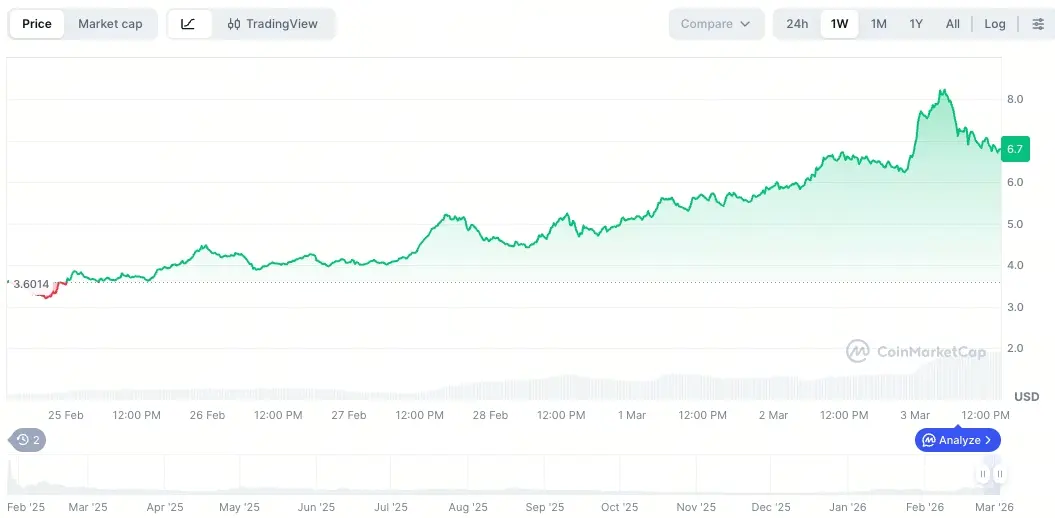 (Source: CMC)
Venice is a decentralized privacy-focused AI protocol founded by Erik Voorhees. Its main goal is to enable users to utilize large language models without revealing their data. The immediate catalyst for this rally was the announcement of Venice’s partnership with OpenClaw — an open-source autonomous agent framework recently acquired by OpenAI.
Voorhees confirmed in a post on X platform on March 2 that Venice is now a recommended model provider for OpenClaw, advising users to abandon the “outdated” Llama 3.3 model in favor of the more powerful GLM 4.6 (model name: zai-org-glm-4.6).
Following the announcement, VVV’s price surged to $8.30, and the protocol’s fully diluted valuation (FDV) surpassed $600 million. This partnership has increased Venice’s visibility within the AI agent ecosystem and created tangible demand expectations for its underlying VVV tokens.
Core Driver 2: Active Token Supply Tightening and Ecosystem Expansion
The strong performance of VVV is not solely dependent on the OpenClaw announcement but is supported by solid technical fundamentals and developments beforehand:
Supply Tightening: Venice decided to reduce its annual VVV token issuance by 25% around February 10, 2026, directly decreasing new token issuance pressure and increasing the token’s relative scarcity.
DeFi Ecosystem Integration: Venice continues to expand its real-world application scenarios, having integrated with platforms like Aerodrome, Morpho, and Plena.
Model Upgrades: Earlier this year, GLM 4.7 was set as the default model for Venice’s web application. In scenarios requiring complex reasoning and high-intensity programming tasks, Venice is positioned as a top choice for high-productivity AI workflows.
Frequently Asked Questions
What is Venice, and what is the use of VVV tokens?
Venice is a decentralized AI protocol centered on privacy protection, allowing users to invoke large language models without sending data to centralized servers. VVV tokens are the native asset of the protocol; holders can stake VVV to gain priority access to the protocol’s computing power, and VVV also functions as a governance token for protocol decision-making.
What does the partnership between Venice and OpenClaw specifically mean?
According to Voorhees, Venice is now a “recommended model provider” for the OpenClaw framework, meaning developers building AI agents with OpenClaw will be guided to prioritize Venice’s model services. Given OpenClaw’s recent acquisition by OpenAI and its broad influence within the global AI agent developer community, this partnership provides significant endorsement potential for Venice in terms of demand.
Is the 100% increase in VVV sustainable?
Short-term sharp gains often imply that some market signals have been priced in early. Long-term fundamentals supporting VVV include: scarcity from supply tightening, genuine demand for privacy-focused computing resources in the AI agent market, and ongoing DeFi ecosystem integrations. However, sustainability ultimately depends on whether the OpenClaw partnership can lead to measurable actual usage growth and how the overall macro environment of the crypto market evolves.
Related Articles
Legalization of Cryptocurrency Perpetual Contracts? CFTC Chairman: Policy to be Announced Within a Month
Did Brazil Just Confirm XRP’s Biggest Adoption Signal?
XRP Ledger Developer Spotlights Biggest RLUSD Liquidity Pool Incentive - U.Today
Trump Brothers' American Bitcoin Boosts Mining Capacity Following Q4 Loss
UNI Rallies as Federal Court Ends Investor Case Against Uniswap Labs
Federal Ruling Raises Risk for Polymarket, Kalshi in Nevada
