


Surged by 346% vs decreased by 20.8%, CoinGecko: DEX perpetual contracts are taking market share away from CEXs
Author: CoinGecko
Compiled by: Deep Tide TechFlow
Introduction: The core data from CoinGecko’s annual report clearly shows the trend: DEX perpetual contracts saw a 346% increase in total trading volume year-over-year, while CEX holdings decreased by 20.8%. Funds are systematically shifting from centralized to decentralized infrastructure.
This article isn’t just about numbers; it explains why this migration is happening, how Hyperliquid is surpassing Coinbase International, and what these platforms are becoming after HIP-3.
Full Text:
By 2025, perpetual contract exchanges—especially decentralized platforms—are experiencing explosive growth, with total trading volume reaching $92.9 trillion (up 64.6% YoY), fundamentally shifting the crypto market from spot trading to a derivatives-driven price discovery mechanism.
Key Points:
- DEX perpetuals grew 346%, reaching $6.7 trillion; meanwhile, CEX holdings declined 20.8%. This indicates a large-scale capital migration driven by platforms like Hyperliquid (ranked seventh globally, with $2.9 trillion in volume) from centralized to decentralized infrastructure.
- Capital efficiency drives adoption: Perpetuals allow traders to leverage less capital for greater exposure, enabling two-way profits (crucial during Q4 2025 downturns), and avoiding the friction of physical settlement.
- HIP-3 enables permissionless listing of any asset with a price source, transforming platforms like Hyperliquid from “crypto exchanges” into 24/7 global financial infrastructure capable of trading everything from commodities to pre-IPO equities.
Why Perpetuals Outpace Spot Trading
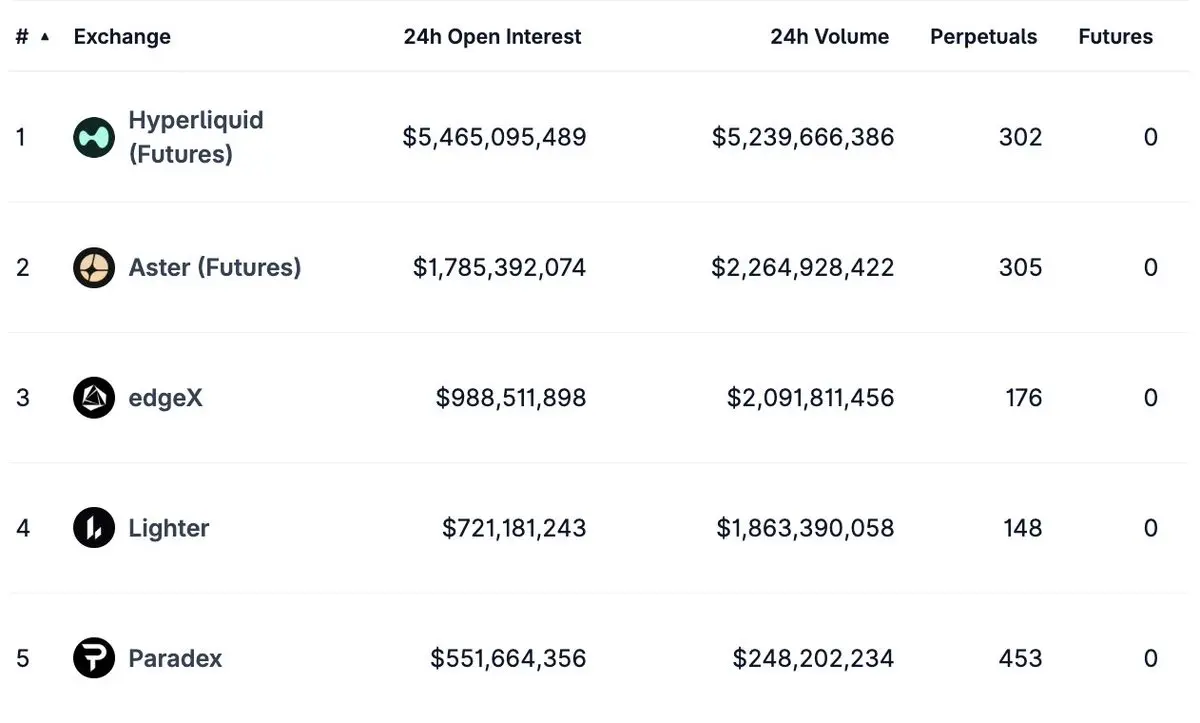
Image: As of March 2, 2026, top 5 decentralized perpetual contract exchanges by 24-hour trading volume on CoinGecko
Capital Efficiency: Doing More with Less
The fundamental advantage of perpetual contracts is capital efficiency. In spot markets, buying $10,000 worth of Bitcoin requires locking in $10,000 of capital. In perpetual markets, leverage allows traders to control the same exposure with a fraction of the capital, freeing up liquidity for other positions or strategies.
Beyond speculation, perpetuals enable market participants to:
- Hedge existing positions without selling the underlying asset (avoiding tax events);
- Arbitrage price differences across venues;
- Express directional views without physical settlement friction;
- Deploy capital across multiple opportunities.
Every dollar in a perpetual market can generate more value than in spot. For traders, funds, and institutions seeking optimized returns, the balance is tipping toward perpetuals.
Market Maturity: Following Traditional Finance
The explosive growth of crypto derivatives mirrors patterns seen in mature financial markets. In traditional finance, derivatives often outsize the underlying spot markets by 10 to 50 times. For example, the notional value of interest rate swaps exceeds $400 trillion, while the global bond market is about $130 trillion.
Crypto markets are just catching up. As markets mature and more experienced participants enter, the ratio of derivatives to spot trading volume continues to widen. The top ten exchanges alone generated $92.9 trillion in perpetual contract volume—far surpassing the combined spot volume across all crypto exchanges.
Hedging in Downturns: Staying Resilient
Perhaps the most convincing evidence of perpetuals’ value proposition appears during Q4 2025 downturns. While spot markets contracted and investor sentiment worsened, the top ten perpetual exchanges saw a 64.6% YoY increase in volume.
Why? Because perpetuals enable two-way profits. When prices fall, short positions profit significantly, increasing hedging activity. The ability to express bearish views keeps capital active and trading volumes high—even when spot buying dries up.
In traditional spot markets, falling prices mean less activity. This is evident in CEX spot volumes dropping from $2.21 trillion in January 2025 to a low of $950 billion in December.
But in perpetual markets, any price movement presents opportunity. Data from 2025 shows this dynamic has fundamentally changed crypto market structure.
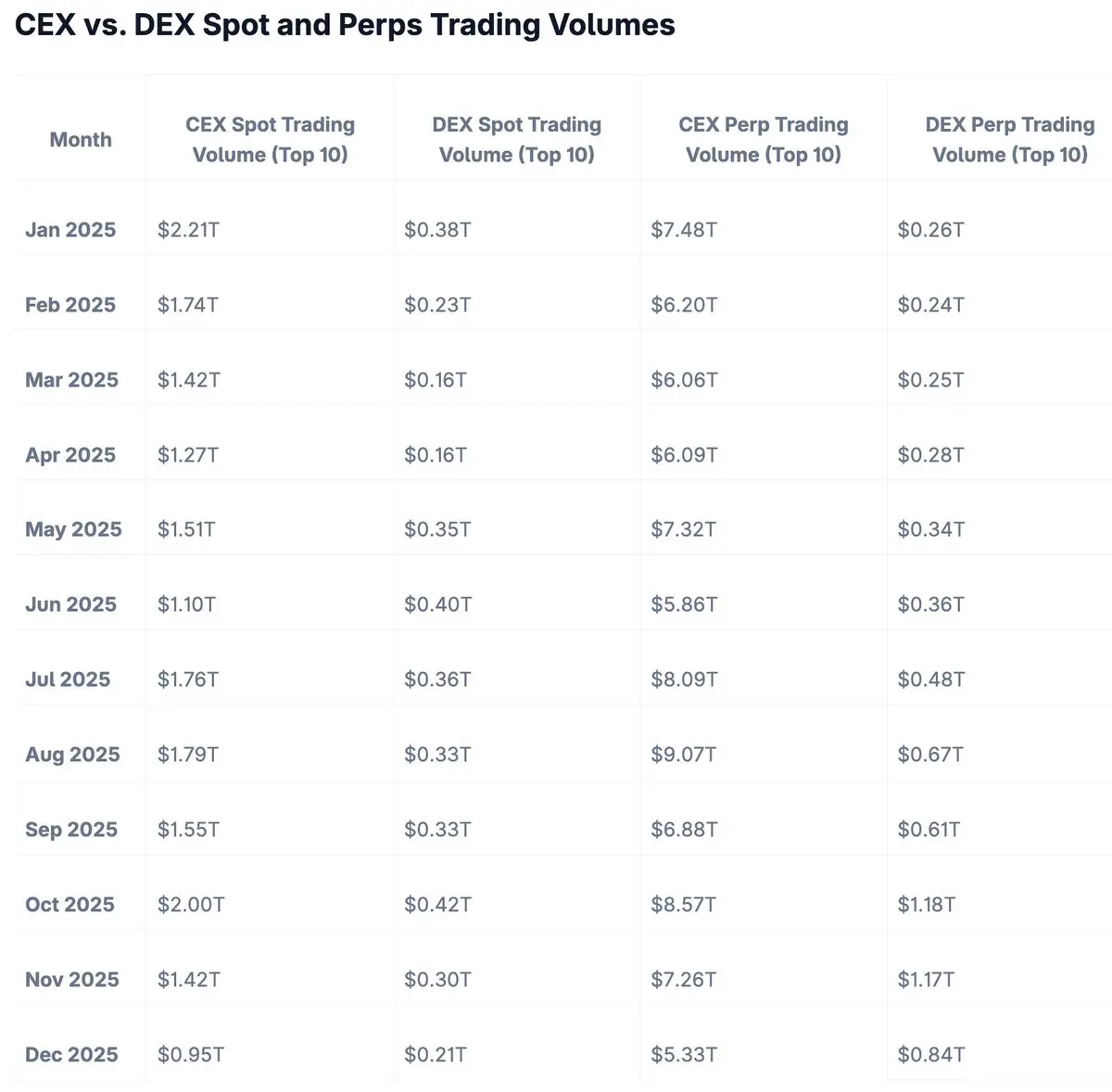
Image: Comparison of spot and perpetual trading volumes on CEX and DEX
The Great Shift: DEX vs CEX
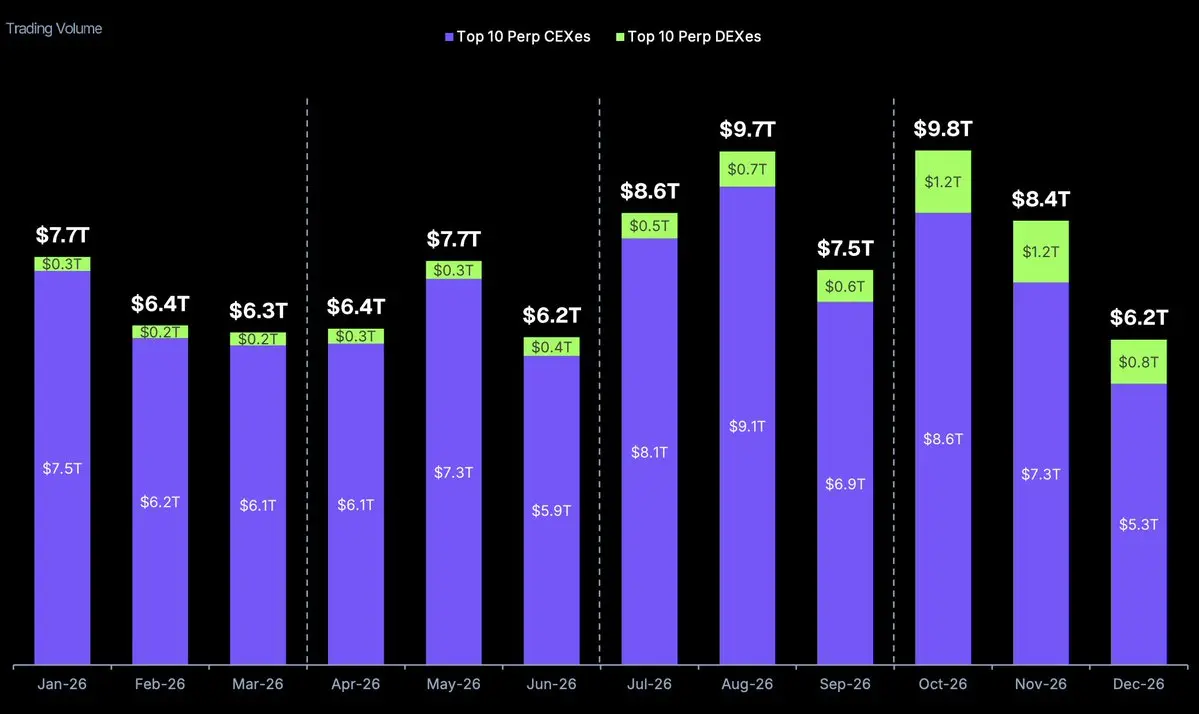
Image: Top 10 Perp CEX and Perp DEX trading volumes
Source: CoinGecko 2025 Crypto Industry Report
While centralized exchanges still dominate in absolute size, the real story of 2025 is the rapid rise of decentralized perpetual exchanges. Perp DEX volumes surged 346%, reaching a record $6.7 trillion for the year.
To visualize this leap: in October 2025 alone, Perp DEX handled $1.18 trillion in volume—more than four times January’s total.
Breaking Through for DEX
By 2025, Perp DEX has addressed the fundamental usability issues that kept users on centralized platforms:
- User Experience Parity: The notion that “DEXs are clunky” ended in 2025. Platforms like Hyperliquid and Lighter offer interfaces nearly indistinguishable from Binance or Coinbase. Order book depth is sufficient, execution is near-instant, and average traders no longer feel they are using decentralized platforms.
- Competitive Fee Structures: Early DEXs charged a premium for decentralization. By 2025, competition and technological advances have driven Perp DEX fees down to match or even undercut CEXs. Hyperliquid, for example, offers up to 90% taker rebates, rivaling the most competitive CEX fee structures.
- Scalable Performance: Early blockchain-based DEXs couldn’t handle the volume required for serious derivatives trading. The advent of dedicated Layer 1 chains and optimized rollups solved this. Hyperliquid’s custom L1, for instance, processes thousands of transactions per second with confirmation times under one second—performance comparable to centralized infrastructure.
Positioning of Open Interest
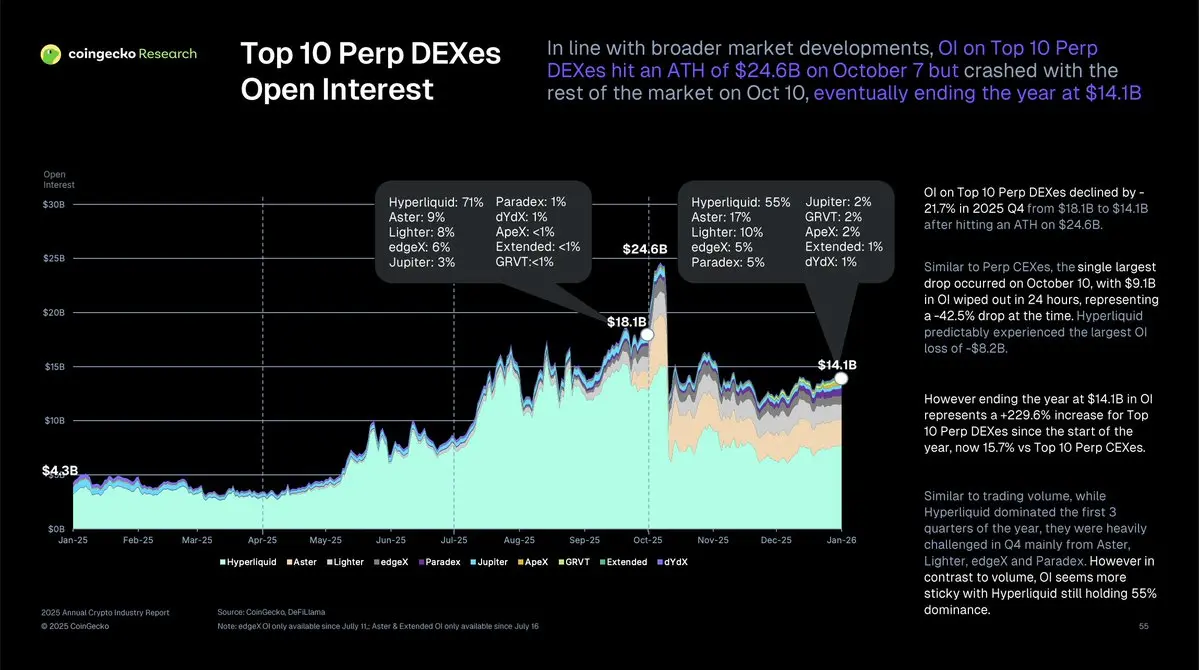
According to CoinGecko’s 2025 Crypto Industry Annual Report, CEX open interest declined 20.8%, while DEX open interest skyrocketed 229.6%.
Open interest—the total value of open derivatives contracts—represents committed capital and confidence. This divergence indicates traders aren’t just “testing” DEXs for quick trades; they are building substantial long-term positions on-chain.
This shift signals a reallocation of funds from centralized to decentralized infrastructure. Once this migration begins, network effects accelerate: more liquidity attracts more traders, which attracts more market makers, deepening liquidity further.
Rise of Hyperliquid and Lighter

The 2025 perpetual exchange rankings reveal a major structural shift. Two decentralized platforms entered the top ten, replacing traditional centralized players:
- @HyperliquidX: ranked seventh globally, with $2.9 trillion in annual volume;
- @Lighter_xyz: ranked tenth, with $1.3 trillion.
In 2025, Hyperliquid’s volume surpassed Coinbase International. This decentralized platform, less than two years old, outperformed a listed exchange backed by billions in capital and years of operation.
Coinbase International processed about $1.4 trillion in 2025. Hyperliquid reached $2.9 trillion—more than double.
Infrastructure Wins
Hyperliquid’s success isn’t due to clever marketing or token incentives but infrastructure. The platform built its own Layer 1 blockchain optimized for perpetual trading—HyperCore.
This architecture ends the “slow DEX” narrative. By controlling the entire tech stack—from consensus to matching engine—Hyperliquid achieves: transaction confirmation under one second; zero gas fees for market makers; throughput of over 20,000 orders per second; and 100% uptime throughout 2025.
In contrast, Ethereum-based DEXs suffer from network congestion and variable gas costs, while other Layer 2 solutions rely on external infrastructure. Hyperliquid’s vertical integration delivers a user experience comparable to centralized exchanges while maintaining full decentralized security.
Lighter follows a similar path, though with different technical implementations. The clear conclusion: to compete with centralized exchanges, DEXs must control their own infrastructure.
Hyperliquid’s HIP-3 Revolution
By the end of 2025, Hyperliquid implemented HIP-3 (Hyperliquid Improvement Proposal 3), fundamentally transforming its market structure.
Permissionless Listing
Previously, launching a new perpetual market required validator approval—a semi-centralized process. HIP-3 introduces permissionless deployment of perpetual markets.
Any builder can now create a perpetual market for any asset with a reliable price source. No tokens, no permission, no listing fees.
The immediate impact was explosive. Within weeks, markets for assets never traded on-chain appeared on the platform.
Bridging to Traditional Finance
By February 2026, HIP-3’s influence was clear. Platforms like Hyperliquid are no longer just “crypto derivatives exchanges” but are becoming foundational infrastructure for global finance.
Current perpetual markets on Hyperliquid include:
- Commodities: Gold and silver perpetuals tracking COMEX futures; crude oil and natural gas; agricultural products (wheat, corn, soy);
- Equities: Pre-IPO companies like SpaceX and OpenAI; synthetic exposure to major tech stocks; stock indices (S&P 500, Nasdaq 100);
- Alternative assets: Prediction markets (elections, economic indicators); sports betting derivatives; weather derivatives.
This expansion means Perp DEXs are becoming 24/7 global price discovery infrastructure.
Markets That Never Close
Traditional markets close—NYSE at 4 p.m. ET, CME futures at night—causing friction, information gaps, and opportunity costs.
Blockchain-based perpetual markets never close. When traditional markets are offline, on-chain markets continue to operate, incorporating new information in real time.
Imagine: major news breaks on a Sunday night—geopolitical crises, corporate bankruptcies, unexpected central bank moves. Traditional markets can only price these when they reopen Monday morning, risking gaps and dislocations.
Perpetual contracts on platforms like Hyperliquid instantly price in this information. As liquidity deepens, they may influence opening prices in traditional markets—24/7 on-chain prices becoming a reference point for Monday’s open.
Conclusion: The New Frontier of Perpetuals
The data from 2025 tells a clear story: perpetual contracts have become the dominant force in crypto trading, with decentralized platforms rapidly closing the gap with their centralized counterparts.
Numbers speak for themselves: the top ten perpetual exchanges processed $92.9 trillion; DEX perpetual volumes grew 346%; DEX holdings surged 229.6%; leading DEXs now surpass major CEXs in rankings.
With permissionless market creation enabled, blockchain infrastructure achieving performance parity with centralized systems, the line between “crypto exchanges” and “global financial markets” is disappearing. These platforms are evolving into “on-chain financial markets”—assets with reliable price sources can be traded 24/7, fully self-custodied, with transparent settlement.
Spot trading—buy-and-hold with physical settlement—will persist. But in price discovery, hedging, and capital-efficient speculation, perpetual contracts will dominate.