


XRP News Today: Ripple Expands Payments Platform as XRP Consolidates Near $1.33 Support
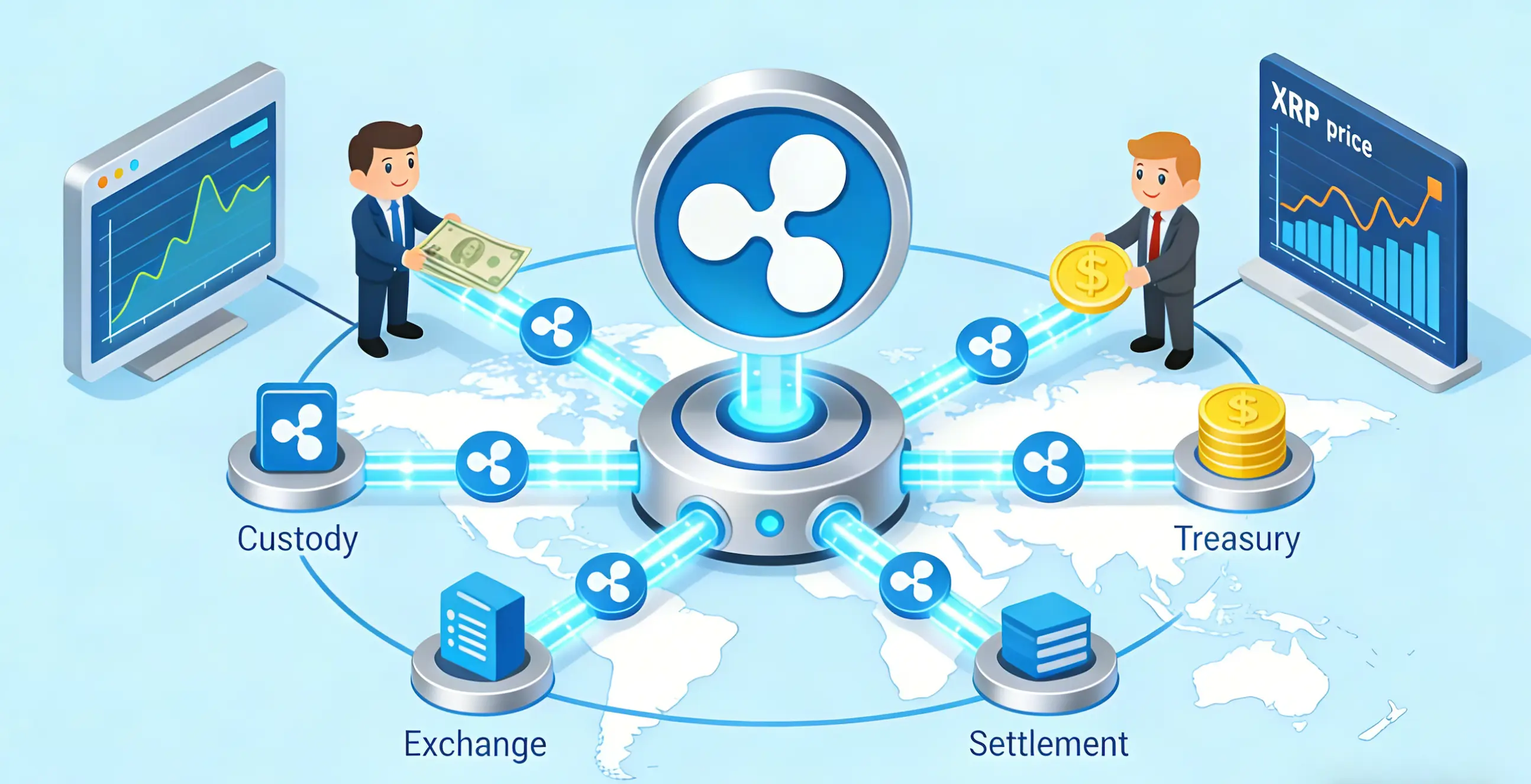
Ripple announced on March 4, 2026, a major expansion of its Ripple Payments platform, transforming it into a full-stack infrastructure layer enabling businesses to collect, hold, exchange, and pay out in both fiat currencies and stablecoins through a single integrated provider.
The new capabilities, powered by recent acquisitions Palisade and Rail, consolidate custody, treasury automation, virtual accounts, conversion, and settlement across 60 markets, with the platform having now processed more than $100 billion in total volume amid accelerating global stablecoin adoption. Meanwhile, XRP price has entered a consolidation phase near the $1.3320 support level after failing to sustain levels above $1.40, with technical indicators suggesting potential for either a fresh increase or further downside depending on hold of key support.
Ripple Payments Expands to Full-Stack Stablecoin Infrastructure
Ripple is no longer solely focused on cross-border payments but now positions itself as a comprehensive infrastructure provider for digital asset money movement. The expanded Ripple Payments platform allows businesses to avoid stitching together separate vendors for custody, collections, conversion, and settlement, instead accessing all capabilities through a single integration.
Two recent acquisitions power the new functionality. Palisade, which handles custody and treasury automation, enables the managed custody layer that lets businesses provision wallets at scale and sweep funds into operational accounts. Rail, a virtual accounts and collections platform, enables businesses to accept fiat and stablecoin pay-ins through named virtual accounts with automated conversion and settlement.
The result consolidates what previously required multiple providers—custody, foreign exchange, stablecoin liquidity, and local payout rails—into one platform with a single integration. This positions Ripple to serve fintechs and financial institutions seeking infrastructure that treats digital assets with the same operational rigor as traditional finance.
$100 Billion Volume Milestone and Market Context
Ripple reported that the platform has now processed more than $100 billion in total volume, a milestone achieved against a backdrop of accelerating stablecoin adoption across the global financial system. Annual stablecoin transaction volumes reached $33 trillion in 2025, with stablecoins now accounting for approximately 30 percent of all onchain transaction volume.
The expansion comes at a time when XRP price has been under pressure, down approximately 5 percent over the past week amid broader market sell-offs driven by U.S.-Iran conflict. However, Ripple’s payments business operates largely independently of XRP’s spot price, and the institutional adoption trajectory suggests enterprise strategy is gaining traction regardless of token market performance.
President Monica Long stated that for the global financial system to evolve, fintechs and financial institutions need infrastructure that treats digital assets with the same rigor as traditional finance. Ripple has built the blueprint for blockchain-based enterprise solutions designed to operate at global scale for regulated finance.
XRP Price Technical Analysis: Consolidation Near Critical Support
XRP failed to sustain levels above $1.40 and has entered a downside correction, currently trading below $1.3750 and the 100-hourly Simple Moving Average. A new bearish trend line has formed with resistance at $1.3880 on the hourly chart.
The price dipped below the 50 percent Fibonacci retracement level of the upward move from the $1.2702 swing low to the $1.4330 high. Bulls remain active above the $1.3320 zone, which represents the 61.8 percent Fibonacci retracement level and serves as critical near-term support.
If XRP can hold above $1.3320, a fresh upward move may attempt to clear resistance near $1.370, with major resistance at $1.3880 and $1.40. A clear move above $1.40 could send the price toward $1.4320 and potentially $1.45, with the next major hurdle near $1.50.
However, failure to clear the $1.3880 resistance zone could trigger a fresh decline. Initial downside support sits at $1.3320, followed by $1.3085. A downside break and close below $1.3085 could open the path toward $1.2880, with next major support at $1.2650 and $1.250.
Technical indicators show the hourly MACD losing pace in the bullish zone, while the hourly RSI remains below the 50 level, suggesting neutral to slightly bearish momentum in the near term.
FAQ: Ripple Platform Expansion and XRP Price
What new capabilities has Ripple added to its payments platform?
Ripple has expanded Ripple Payments into a full-stack infrastructure platform that lets businesses collect, hold, exchange, and pay out in both fiat currencies and stablecoins through a single provider. The new capabilities, powered by acquisitions Palisade and Rail, consolidate custody, treasury automation, virtual accounts, conversion, and settlement into one integrated system for cross-border payments across 60 markets.
What are the key support and resistance levels for XRP price?
Critical support sits at $1.3320 (61.8 percent Fibonacci retracement), followed by $1.3085 and $1.2880. Major resistance levels are at $1.3880 (trend line), $1.40, $1.4320, and $1.45. A clear move above $1.40 could target $1.4320 and potentially $1.50, while a break below $1.3085 could open the path toward $1.2650.
How does Ripple’s payments business relate to XRP price performance?
Ripple’s payments platform operates largely independently of XRP’s spot price. The platform has processed over $100 billion in volume amid accelerating stablecoin adoption, demonstrating institutional traction regardless of XRP’s market performance. While XRP has been under pressure due to broader market sell-offs, Ripple’s enterprise strategy continues advancing through infrastructure expansion and strategic acquisitions.
Related Articles
Ripple payment volume exceeds 100 billion USD, XRP Binance liquidity hits new low
XRP Today's News: Cardano Founder Reiterates "Securities" Regulation Sparks Community Controversy
U.S. XRP spot ETF had a total net inflow of $7,525,500 in a single day
ETF Launch Fails to Stem Tide As XRP Sinks to $1.81, Lowest Since April