


Institutions Return to Ethereum as Staking Hits Record Highs
Financial markets are experiencing turbulence following attacks on oil and gas infrastructure in the Persian Gulf, but institutional investors are showing early signs of returning to crypto
DailyCoin reported yesterday about renewed capital interest in Ethereum (ETH) and Bitcoin (BTC) ETFs, which have recorded fresh net inflows since Monday.
But the new data also points to a growing trend of large investors returning to Ethereum’s validator ecosystem. Instead of selling into the market, major holders are increasingly staking their ETH, signaling a strategic shift toward steady yield generation and long-term positioning.
According to recent data from ValidatorQueue, roughly 3.35 million ETH is currently waiting in the validator entry queue, which one of the largest staking backlogs in recent history.
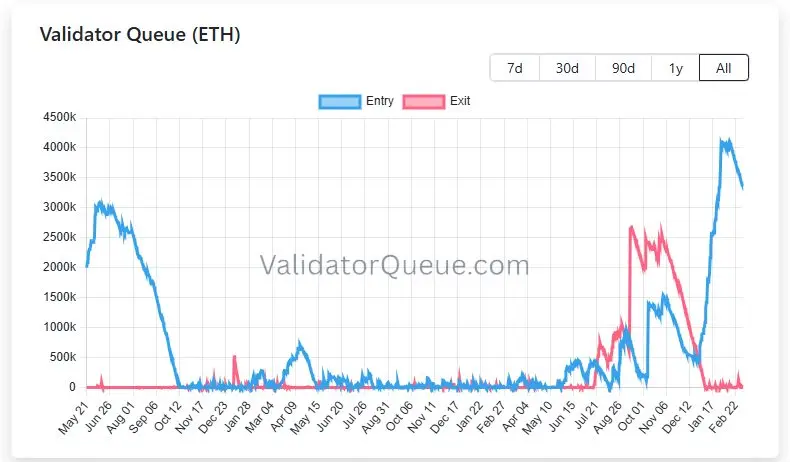 Source: ValidatorQueueThis represents a sharp rise from approximately 904,000 ETH in early January 2026, highlighting accelerating demand to lock tokens into Ethereum’s proof-of-stake network
Under Ethereum’s staking model, validators must deposit 32 ETH to participate and earn rewards, and new validators can only join at a fixed rate, creating a queue that can last weeks or months.
Staking allows corporates and exchanges to earn returns while maintaining full exposure to ETH’s price movements. This approach mirrors traditional capital markets, where yield-bearing assets often take priority over speculative trading, reflecting a more income-focused allocation strategy.
Ethereum Network Activity
Ethereum was trading for $2,004 at the time of writing after climbing nearly 0.5% over the past 24 hours, as bulls and bears test the key level, where liquidity, stop orders, and leverage have recently clustered.
The second-largest crypto asset has now gained nearly 10% since Saturday, following a sudden surge on Sunday and Monday morning.
On-chain metrics indicate steady network growth, with over 837,000 active addresses per day, according to Santiment, underscoring steady participation from both new and existing users.
Why This Matters
A long ETH validator queue shows that more investors are locking up their tokens, which typically boosts network security. It also limits available supply, which could help support the asset price.
Dig into DailyCoin’s hottest crypto scoops right now:
1.6T SHIB Coins Left Exchanges: What’s Cracking Here?
XRP Analyst Ties ETF Demand and Metal Selloff to Next Leg Higher
People Also Ask:
What is Ethereum staking? Staking is the process of locking up ETH in Ethereum’s proof-of-stake network to support security and validate transactions in exchange for rewards.
How does staking affect the ETH price? By locking ETH in validators, staking reduces the circulating supply, which can support price stability if demand remains strong.
How does network activity relate to Ethereum’s health? Metrics like active addresses and new address creation indicate user engagement, adoption trends, and the overall vitality of the Ethereum network.
DailyCoin’s Vibe Check: Which way are you leaning towards after reading this article?
Bullish Bearish Neutral
Market Sentiment
0% Neutral
Related Articles
Data: If ETH drops below $1,975, the total long liquidation strength on major CEXs will reach $932 million.
A major ETH bearish whale was liquidated in a series of liquidations and has exited the market, nearly clearing a $31 million position.
Bitmine buys the dip again! Tom Lee is optimistic about Ethereum with "three major bullish factors" supporting it
Gate's annual trading volume increased by $3.9 trillion, a 204% year-over-year growth.