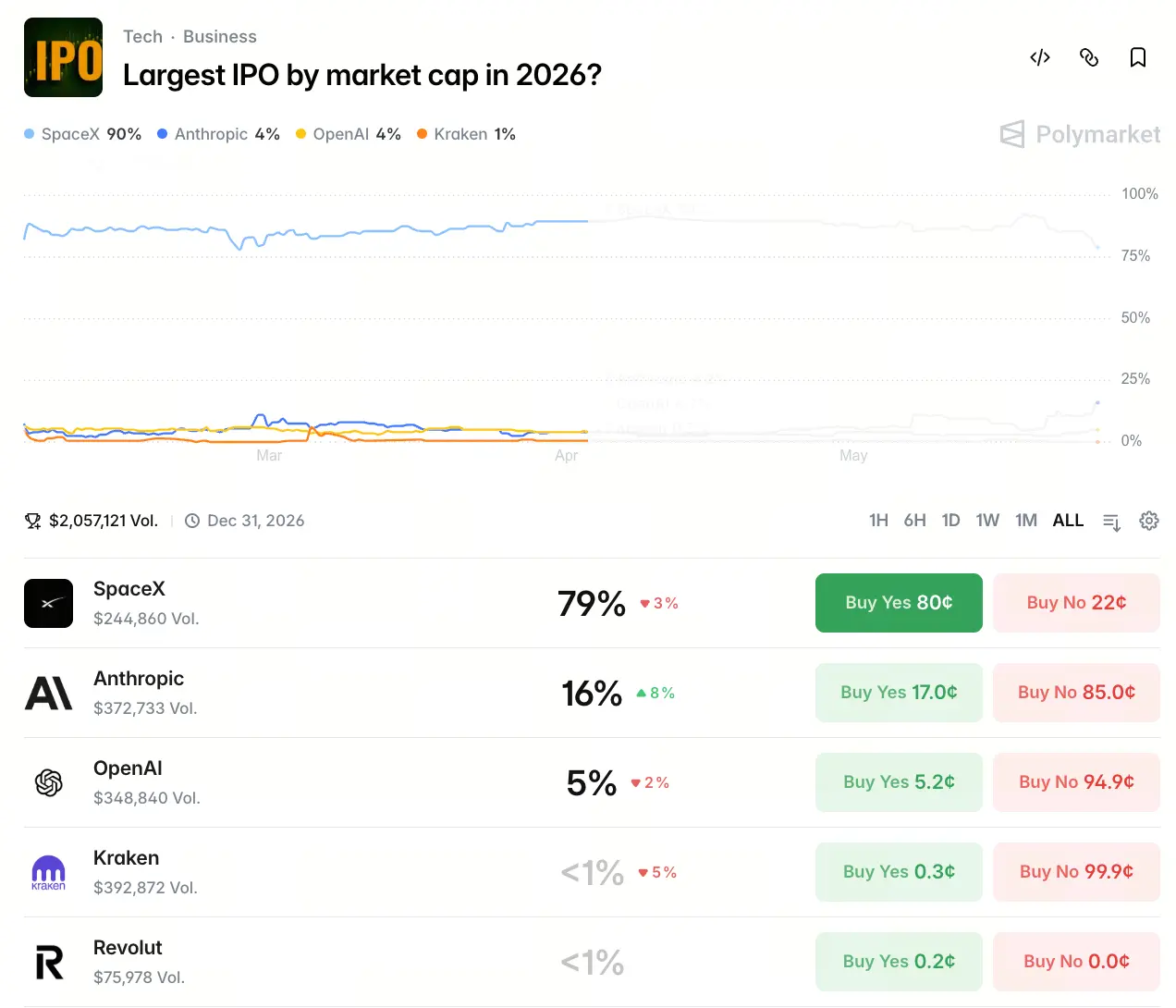
The global IPO market in 2026 is undergoing a rare wave of concentrated listings of “super unicorns.” In Polymarket’s prediction market on the question of “which company will have the largest IPO market cap in 2026,” wagers totaling more than $2 million have already been placed. Data shows the probability of SpaceX winning is 79%, Anthropic is 16%, OpenAI is 5%, while options including Kraken, Shein, and Revolut are all below 1%. What this betting mix reflects goes far beyond speculation about the listing prospects of a few technology giants—it represents a deep repricing of the next generation of tech-industry capitalization logic.
Behind the 79% betting probability, what valuation advantage does SpaceX have?
Polymarket’s 79% betting probability is not generated out of thin air. SpaceX plans to list on Nasdaq on June 12, 2026, targeting a valuation range as high as $1.75 trillion to $2 trillion, with a planned capital raise of about $75 billion. This would be the largest IPO case in global financial history, with the amount raised more than 2.5 times the scale of Saudi Aramco’s 2019 IPO.
In terms of valuation scale, if SpaceX succeeds in listing at $2 trillion, its market cap would directly stand alongside the world’s top-tier technology companies. However, such an enormous valuation also triggers a core discussion: what business foundation actually supports a trillion-dollar valuation?
Starlink profitability and massive AI losses coexist—how should we understand SpaceX’s financial contradictions?
SpaceX’s financial condition shows a typical polarized pattern. According to its publicly filed prospectus, the company’s 2025 full-year revenue was about $18.7 billion, up 33% year over year, but net losses in the same period were as high as $4.94 billion. Entering the first quarter of 2026, the losses worsened further, with single-quarter net losses surging to $4.28 billion.
Behind this data is a structural imbalance across business segments: its Starlink communications business contributes the vast majority of income and positive adjusted EBITDA, while after the completion of its acquisition of xAI in February 2026, the massive compute investment for its AI business has been steadily consuming cash flow. In 2025, xAI’s full-year operating loss was about $6.4 billion, accounting for the overwhelming majority of the company’s overall losses.
In short, SpaceX’s trillion-dollar valuation rests on the technology moat of its commercial space business and Starlink’s profit potential. But whether xAI’s ongoing cash-burning model will affect IPO pricing has become the core point of divergence in the market.
Anthropic follows with 16% bets—what differentiating competitive strength is reflected in its profitability?
In Polymarket’s distribution of bets, Anthropic ranks second with a 16% probability. This new AI player is completing a Pre-IPO financing round, with an expected valuation that could exceed $90 billion. That figure has already overtaken OpenAI’s valuation of $85.2 billion, making Anthropic the AI startup with the highest valuation globally.
More importantly, Anthropic has disclosed its quarterly profit forecast, making it one of the first companies in the large model track to achieve profitability. As Claude Code’s annualized operating revenue exceeds $2.5 billion, enterprise code assistants have become the product form with the highest monetization efficiency in the current AI industry. If Anthropic can sustain its path to profit and complete a listing, its valuation narrative will have a core element that SpaceX and OpenAI still lack—positive cash-flow validation.
OpenAI has only a 5% probability—how do legal barriers and internal governance affect its listing timeline?
OpenAI has only a 5% probability of winning on Polymarket. This low expectation is directly related to the complex governance environment it faces. OpenAI has recently completed a commitment financing round totaling $122 billion, with a post-investment valuation of $85.2 billion, and it aims to complete an IPO in September 2026 with a target valuation exceeding $100 billion. However, the ongoing legal controversy stemming from its transition from a nonprofit organization to a for-profit public-benefit company continues to ferment. Although a lawsuit filed by Musk against OpenAI has been dismissed by a California jury, the long-term impact on corporate governance and public trust is still unfolding.
In addition, there are internal disagreements about the IPO timetable. OpenAI’s CFO believes the company is not yet ready to list by the end of 2026 in terms of organizational structure and compliance systems. With the combination of these internal and external variables, the uncertainty of its path to listing is significantly higher than the general expectations in the market earlier.
IPO coldness in the crypto industry—why are options like Kraken below 1%?
In Polymarket’s options, the probabilities for crypto-related companies such as Kraken are all below 1%, a figure that directly mirrors the split in 2026 capital market preferences. Kraken previously secretly submitted an S-1 to the SEC; its valuation once reached $20 billion. But then, due to volatility in market conditions and weak overall trading volumes in the crypto industry, its IPO plan was shelved in March 2026. The Deutsche Börse Group recently acquired a 1.5% equity stake in Kraken for about $200 million. Based on this, the implied latest valuation has fallen to about $13.3 billion.
Against the backdrop of AI narratives absorbing market liquidity, crypto-industry companies face dual pressure in the short term: decreased capital-market attention and reduced valuation support. This means that for crypto-native companies to restart their IPOs, they may need to wait for clearer industry recovery signals and a more definitive regulatory framework.
The gap between valuation narratives and financial statement reality—what tension drives the biggest IPO race in 2026?
The current distribution of bets on Polymarket reflects a deeper phenomenon: the market’s judgment of the final market-cap outcome is, at its core, a bet on the interplay between “narrative realization ability” and “ability to withstand financial constraints.” On one side, SpaceX’s technological barriers, Starlink’s scale effects, and Musk’s personal influence form a strong vision-driven logic. On the other side, the reality of $4.94 billion in losses for all of 2025 and the massive capital expenditures for the xAI business also serves as a discount factor that cannot be ignored in its valuation.
In this sense, the race for the biggest IPO in 2026 is not merely a comparison of market caps among a handful of companies, but an industry-level pressure test on how “high-growth tracks” can break through the capital market’s threshold for financial validation.
Capital flows are being reshaped by this super IPO showdown?
This contest over who wins the right to the biggest IPO is changing how global capital is allocated. Data shows that in Q1 2026, AI-related companies are receiving record-high valuation premiums, while crypto IPOs are being forced to wait for more suitable timing. AI and commercial space are becoming priority directions for institutional capital, while crypto firms face dual pressures of IPO delays and valuation pullbacks. If this divergence in capital preferences continues, it will further strengthen the weight of “narrative clarity” and “cash-flow predictability” within IPO pricing frameworks, pushing more growth-stage tech companies to start building paths to profitability and optimizing financial metrics earlier before going public.
How should we understand the reference value and limitations of these bet data?
The data from prediction markets like Polymarket is essentially an immediate mapping of traders’ collective judgment. Behind it lies a fusion of multiple types of information, including listing rumors, financial disclosures, industry landscape, and macro policy. A 79% probability for SpaceX implies a high consensus in the market around the valuation narrative of a “dual-engine” of commercial space plus Starlink. Meanwhile, OpenAI’s mere 5% probability reflects a cautious stance by the market toward its legal risks and governance uncertainties.
However, probability distributions in prediction markets are always changing dynamically. As IPO progress for each company moves forward in practice, more financial data is disclosed, and the macro environment and economic cycles evolve, the current betting structure still has significant room for adjustment.
From super unicorn IPOs to structural reshaping of the industry
Polymarket’s betting data offers a unique lens into the 2026 capital market landscape. SpaceX’s trillion-dollar valuation anchors the ceiling for the commercial space sector; Anthropic’s profitability validates the possibility of an AI commercialization path; and OpenAI’s governance dilemma reveals the institutional challenges that high-growth companies must face during capitalization. No matter which company ultimately becomes the company with the highest annual IPO market cap, this 2026 wave of super unicorn listings has already been set to become an important turning point for global capital markets shifting from “story-driven” to “profitability validation.”
FAQ
Q1: What does SpaceX’s 79% probability in Polymarket’s prediction represent?
The 79% probability in Polymarket represents the collective judgment of traders betting on the outcome that “SpaceX will become the company with the largest IPO market cap in 2026.” It reflects a high level of market consensus about SpaceX’s valuation scale and listing certainty, but this is not an absolute guaranteed prediction. The probability itself will adjust dynamically as new information emerges.
Q2: Why is SpaceX’s planned capital raise so large?
SpaceX’s planned IPO capital raise is about $70 billion to $75 billion, corresponding to a valuation range as high as $1.75 trillion to $2 trillion. This scale far exceeds Saudi Aramco’s 2019 IPO record of about $29.4 billion. The amount raised is more than 2.5 times the latter, mainly to support Starlink’s continued expansion and the compute investment for the xAI business.
Q3: Why can Anthropic’s valuation overtake OpenAI’s?
Anthropic is recently completing a large-scale financing round at an estimated valuation of about $90 billion, slightly higher than OpenAI’s $85.2 billion. At the same time, Anthropic has disclosed its quarterly profit forecast first, providing stronger financial validation at a stage when profitability is not yet broadly achieved in the AI industry, increasing the capital market’s trust in its valuation narrative.
Q4: Why has the crypto industry’s IPO market been cold in 2026?
In a capital market environment dominated by AI narratives, institutional capital is highly concentrated in commercial space and large-model tracks. The crypto industry is affected by declining trading activity and valuation pullbacks. Kraken shelved its IPO due to market environment volatility; its valuation has fallen from a peak of $20 billion to about $13.3 billion. For crypto firms to reactivate an IPO window, they need to wait for clearer industry recovery signals and regulatory frameworks.


