Financial markets are experiencing turbulence following attacks on oil and gas infrastructure in the Persian Gulf, but institutional investors are showing early signs of returning to crypto
DailyCoin reported yesterday about renewed capital interest in Ethereum (ETH) and Bitcoin (BTC) ETFs, which have recorded fresh net inflows since Monday.
But the new data also points to a growing trend of large investors returning to Ethereum’s validator ecosystem. Instead of selling into the market, major holders are increasingly staking their ETH, signaling a strategic shift toward steady yield generation and long-term positioning.
According to recent data from ValidatorQueue, roughly 3.35 million ETH is currently waiting in the validator entry queue, which one of the largest staking backlogs in recent history.
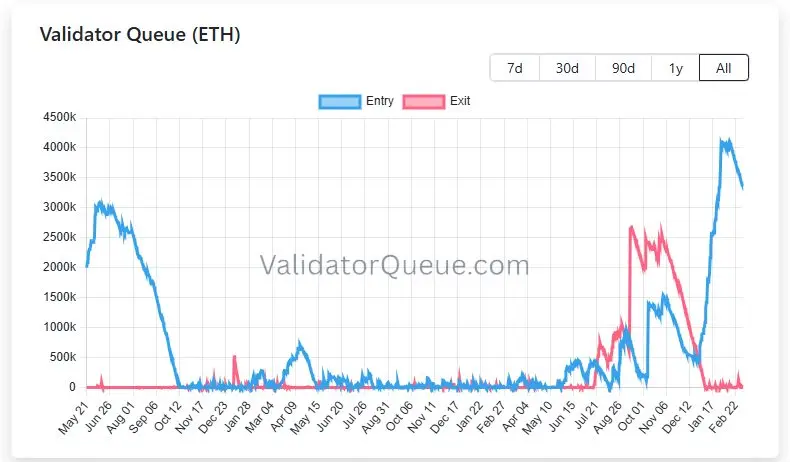 Source: ValidatorQueueThis represents a sharp rise from approximately 904,000 ETH in early January 2026, highlighting accelerating demand to lock tokens into Ethereum’s proof-of-stake network
Under Ethereum’s staking model, validators must deposit 32 ETH to participate and earn rewards, and new validators can only join at a fixed rate, creating a queue that can last weeks or months.
Staking allows corporates and exchanges to earn returns while maintaining full exposure to ETH’s price movements. This approach mirrors traditional capital markets, where yield-bearing assets often take priority over speculative trading, reflecting a more income-focused allocation strategy.
Ethereum Network Activity
Ethereum was trading for $2,004 at the time of writing after climbing nearly 0.5% over the past 24 hours, as bulls and bears test the key level, where liquidity, stop orders, and leverage have recently clustered.
The second-largest crypto asset has now gained nearly 10% since Saturday, following a sudden surge on Sunday and Monday morning.
On-chain metrics indicate steady network growth, with over 837,000 active addresses per day, according to Santiment, underscoring steady participation from both new and existing users.
Why This Matters
A long ETH validator queue shows that more investors are locking up their tokens, which typically boosts network security. It also limits available supply, which could help support the asset price.
Dig into DailyCoin’s hottest crypto scoops right now:
1.6T SHIB Coins Left Exchanges: What’s Cracking Here?
XRP Analyst Ties ETF Demand and Metal Selloff to Next Leg Higher
People Also Ask:
What is Ethereum staking? Staking is the process of locking up ETH in Ethereum’s proof-of-stake network to support security and validate transactions in exchange for rewards.
How does staking affect the ETH price? By locking ETH in validators, staking reduces the circulating supply, which can support price stability if demand remains strong.
How does network activity relate to Ethereum’s health? Metrics like active addresses and new address creation indicate user engagement, adoption trends, and the overall vitality of the Ethereum network.
DailyCoin’s Vibe Check: Which way are you leaning towards after reading this article?
Bullish
Bearish
Neutral
Market Sentiment
0% Neutral
Disclaimer: The information on this page may come from third parties and does not represent the views or opinions of Gate. The content displayed on this page is for reference only and does not constitute any financial, investment, or legal advice. Gate does not guarantee the accuracy or completeness of the information and shall not be liable for any losses arising from the use of this information. Virtual asset investments carry high risks and are subject to significant price volatility. You may lose all of your invested principal. Please fully understand the relevant risks and make prudent decisions based on your own financial situation and risk tolerance. For details, please refer to
Disclaimer.
Related Articles
Sharplink Posts $28 Million Revenue as Ethereum Holdings Hit 868,699
Sharplink has released its 2025 financial results, highlighting a major shift into an institutional-grade ethereum treasury model. Despite reporting a large accounting loss tied to market volatility, the firm significantly expanded its ETH holdings and staking operations.
Ethereum Treasury
Coinpedia16m ago
Mainstream CEX and DEX funding rates indicate the market remains broadly bearish, with BTC and ETH both showing negative rates.
Bitcoin's recent volatility has narrowed, and the overall market funding rate is negative, indicating a bearish sentiment. The funding rate is a mechanism to maintain the balance between contract prices and asset prices; a rate below 0.005% suggests a bearish market.
GateNews43m ago
Tokenized RWA grows 309% annually, with Ethereum holding a 57% share dominating the institutional market
The tokenization of real-world assets (RWA) market reached $26.7 billion in March this year, a 309% increase compared to last year. Despite the overall downturn in the crypto market, institutional demand for tokenized assets continues to grow, with Ethereum dominating over 57% of the market share, making it the preferred choice for institutions. Although alternative chains like Solana are developing rapidly, Ethereum's security and ecosystem make its position difficult to challenge. Market growth is mainly driven by improved regulatory environments and the demonstration effect from financial institutions.
MarketWhisper2h ago
BitMine is sweeping up 60,000 ETH! Tom Lee confidently states: "The mini crypto winter" is coming to an end.
Bitmine Immersion Technologies recently purchased 60,976 Ethereum, totaling approximately $120 million, to support the crypto market. Despite facing $7.8 billion in unrealized losses, Chairman Tom Lee remains actively buying, believing the market is close to the bottom. The company plans to stake all its Ethereum, with an estimated annualized return of $259 million, urging investors to seize the bottoming opportunity.
区块客3h ago
Ethereum spot ETF had a net inflow of $57.012 million yesterday, with none of the nine ETFs experiencing net outflows.
As of March 12, Ethereum spot ETFs recorded a total net inflow of $57.012 million on March 11, 2023, in Eastern Time, with all nine ETFs experiencing no net outflows. Among them, the Fidelity ETF had the highest net inflow at $19.1332 million, with a total net inflow of $2.333 billion. Grayscale Ethereum Mini Trust ETF followed, with a single-day net inflow of $19.0788 million and a total net inflow of $1.842 billion. Currently, the total net asset value of Ethereum spot ETFs is $11.85 billion, with a net asset ratio of 4.75%.
GateNews3h ago


