# TradingStrategiesInChoppyMarkets

5.59K
#TradingStrategiesInChoppyMarkets
Trading Strategies in Choppy Markets: The Safe Harbor Plan for Defense, Survival, and Psychological Mastery
The cryptocurrency market is widely known for its volatility, but what truly tests a trader is not always sharp trends—it is the slow, frustrating, sideways movement where price oscillates within a range and creates the illusion of opportunity without delivering real direction. These choppy conditions often trap traders into overtrading, emotional decisions, and unnecessary losses. This comprehensive guide merges practical strategy with psychological di
ATR-1.73%
HighAmbition
#TradingStrategiesInChoppyMarkets
Trading Strategies in Choppy Markets: The Safe Harbor Plan for Defense, Survival, and Psychological Mastery
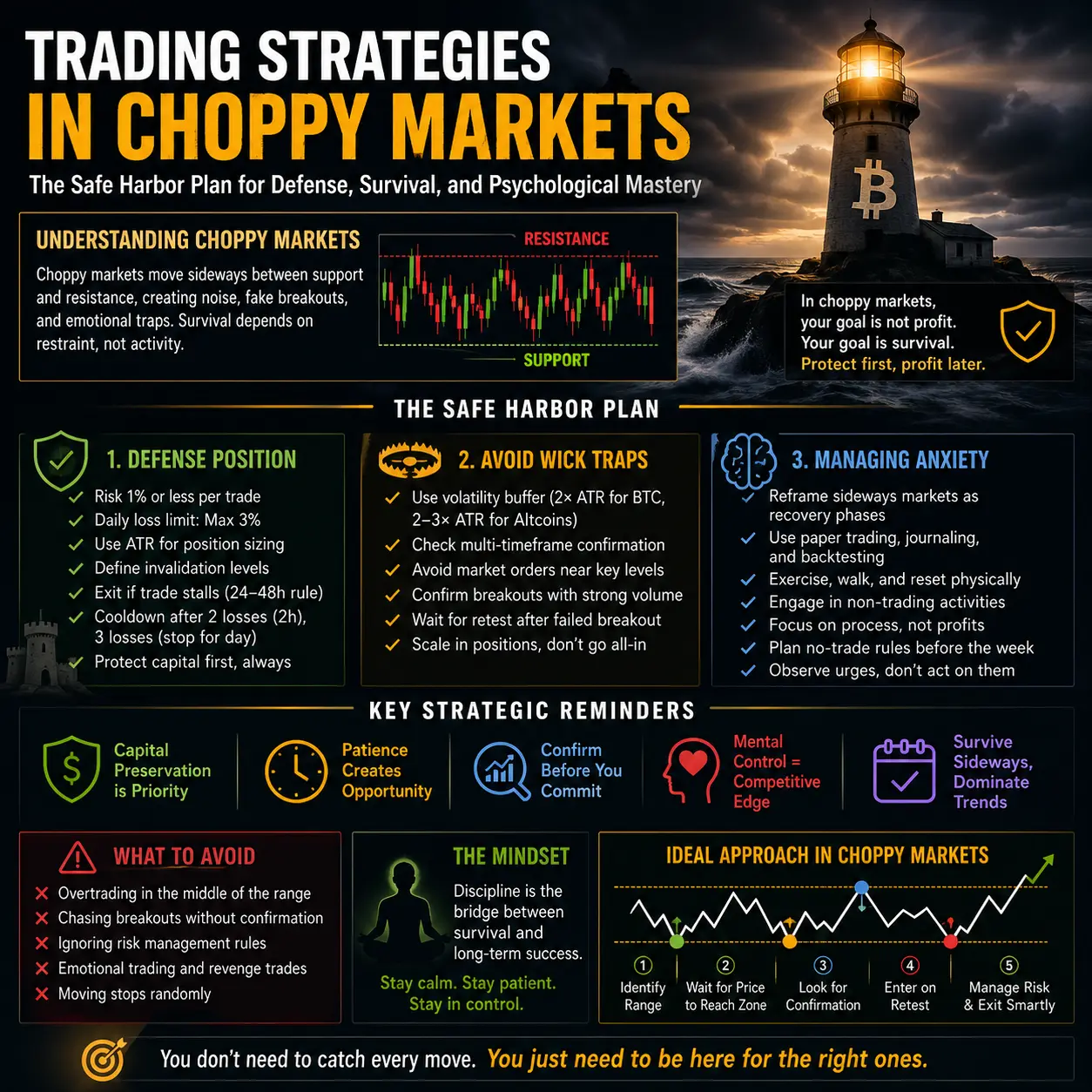
The cryptocurrency market is widely known for its volatility, but what truly tests a trader is not always sharp trends—it is the slow, frustrating, sideways movement where price oscillates within a range and creates the illusion of opportunity without delivering real direction. These choppy conditions often trap traders into overtrading, emotional decisions, and unnecessary losses. This comprehensive guide merges practical strategy with psychological discipline to help you not just survive, but operate intelligently in such markets
Understanding the Nature of Sideways Markets
Sideways markets occur when price moves between clearly defined support and resistance levels without forming a sustained trend. Price action becomes noisy, unpredictable, and filled with fake breakouts. What makes this phase dangerous is not the lack of movement, but the deceptive nature of small moves that appear meaningful but quickly reverse. Many traders misinterpret these minor fluctuations as trend beginnings, leading to repeated losses.
The key realization is simple: survival in these conditions depends less on activity and more on restraint. The best traders are not the most active—they are the most selective.
The Safe Harbor Plan: A Framework for Stability
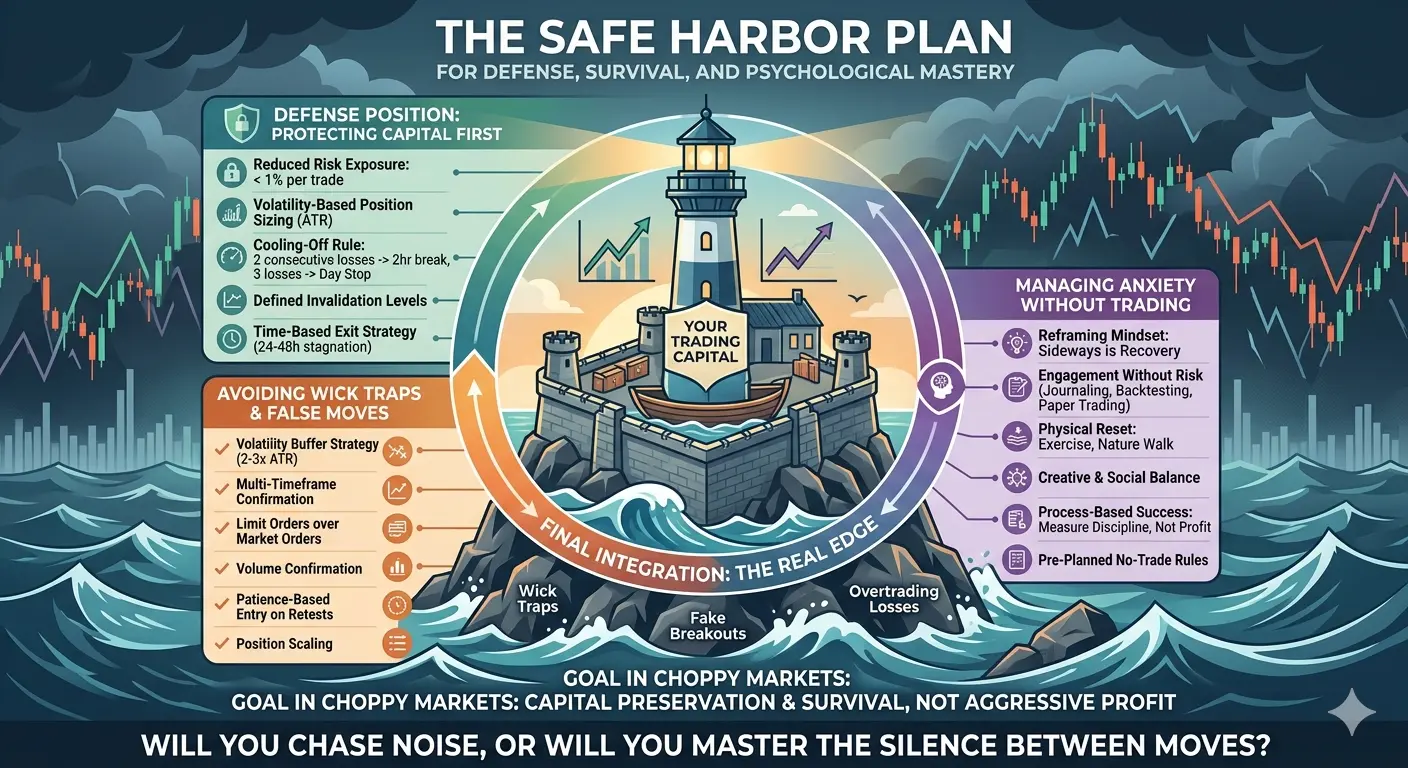
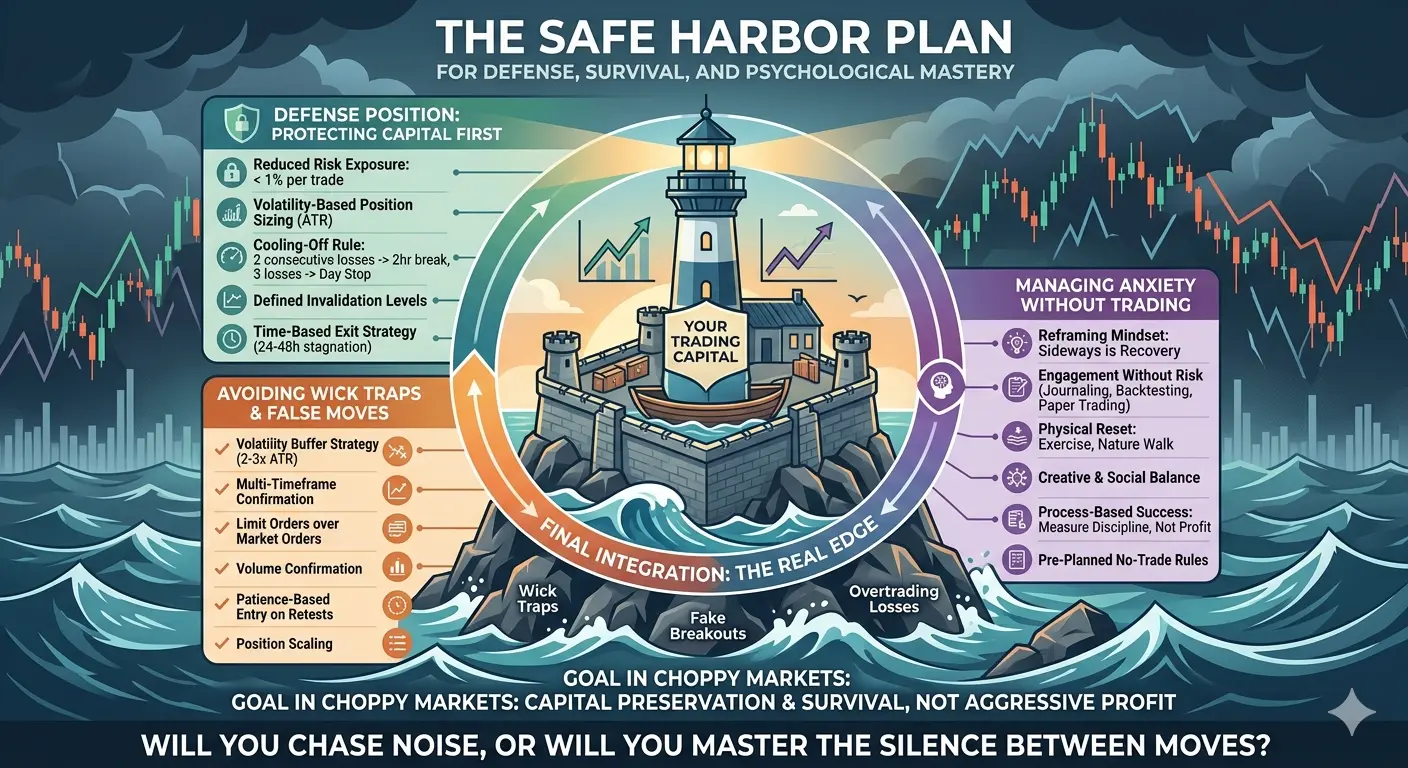
The Safe Harbor Plan is built on one principle: capital preservation comes before profit. In choppy markets, your goal shifts from aggressive growth to controlled survival. This requires a structured defense system built on risk management, precision, and emotional control.
1. Defense Position: Protecting Capital First
Your defense level is your most important tool. It defines how much you are willing to lose and when you step away.
Reduced Risk Exposure:
In trending markets, risking 2–3% per trade might be acceptable. In sideways markets, this should drop to 1% or less, with total daily exposure capped around 3%. This ensures that a series of losses does not damage your account significantly.
Volatility-Based Position Sizing:
Using ATR (Average True Range), position sizes should adjust dynamically. Higher volatility means smaller positions. Lower volatility signals caution, as breakouts may be approaching.
Cooling-Off Rule:
After two consecutive losses, step away for at least two hours. After three losses, stop trading for the day. This rule alone prevents most emotional damage.
Technical Defense Levels:
Always define invalidation points before entering a trade. In range conditions, these should align with confirmed breaks of support or resistance—not random price levels.
Time-Based Exit Strategy:
If a trade does not move within 24–48 hours, exit. Sideways markets punish patience in stagnant positions.
Psychological Defense:
Know when to step away mentally. If frustration builds, your edge disappears. Walking away is not weakness—it is strategy.
2. Avoiding Wick Traps and False Moves
Wick traps are one of the biggest threats in choppy markets. These sudden spikes trigger stop losses before reversing direction.
Volatility Buffer Strategy:
Instead of placing stop losses exactly at support or resistance, use a buffer:
Bitcoin: ~2× ATR
Altcoins: ~2–3× ATR
This allows natural movement without premature stop-outs.
Multi-Timeframe Confirmation:
Always check higher, entry, and lower timeframes. A setup that looks valid on a small timeframe may be noise on a larger one.
Avoid Market Orders Near Key Levels:
Liquidity hunts are common. Use limit orders within the range instead of chasing breakouts.
Volume Confirmation:
Real breakouts come with strong volume. Weak volume often signals a fake move.
Patience-Based Entry:
Wait for breakout attempts to fail, then enter on retests. This reduces risk and increases probability.
Position Scaling:
Enter trades in parts rather than full size. This reduces exposure and improves flexibility.
3. Managing Anxiety Without Trading
The hardest part of sideways markets is doing nothing. The urge to trade becomes psychological pressure.
Reframing Mindset:
View sideways markets as recovery phases, not missed opportunities.
Engagement Without Risk:
Use paper trading, journaling, and backtesting instead of real trades.
Physical Reset:
Exercise, walking, and movement reduce stress and improve clarity.
Creative and Social Balance:
Engage in non-trading activities and connect with others to reduce isolation.
Process-Based Success:
Measure discipline, not profits. Winning in choppy markets means losing less.
Pre-Planned No-Trade Rules:
Define conditions where you will not trade before the week begins.
Urge Control:
Observe the impulse to trade without acting on it—it fades faster than you think.
Final Integration: The Real Edge
Defense, execution, and psychology must work together. Smaller risk allows wider stops, reducing unnecessary losses. Better mindset improves decision-making. Strong discipline ensures consistency.
The goal in choppy markets is not profit—it is survival.
Traders who protect capital during uncertain phases are the ones who capitalize when strong trends return. Markets constantly shift between trending and sideways conditions. Mastering both is what separates consistent traders from emotional ones.
Conclusion: The Safe Harbor Mindset
Choppy markets are not a barrier—they are a training ground. They expose weaknesses in discipline, patience, and emotional control. But they also offer an opportunity to refine your system and strengthen your mindset.
The Safe Harbor Plan teaches you when to act and when to stay still. It reminds you that not trading is a valid and often powerful decision. It transforms you from a reactive trader into a strategic one
In the end, success in trading is not about catching every move—it is about surviving every phase. Those who learn to navigate uncertainty with control and patience build the foundation for long-term profitability.
repost-content-media
  • Reward
  • Comment
  • Repost
  • Share
#TradingStrategiesInChoppyMarkets
Trading Strategies in Choppy Markets: The Safe Harbor Plan for Defense, Survival, and Psychological Mastery
The cryptocurrency market is widely known for its volatility, but what truly tests a trader is not always sharp trends—it is the slow, frustrating, sideways movement where price oscillates within a range and creates the illusion of opportunity without delivering real direction. These choppy conditions often trap traders into overtrading, emotional decisions, and unnecessary losses. This comprehensive guide merges practical strategy with psychological di
ATR-1.73%
post-image
  • Reward
  • Comment
  • Repost
  • Share
#TradingStrategiesInChoppyMarkets
In cryptocurrency trading, everyone loves strong trends. Bull runs create excitement, bear markets create urgency, and both offer clear opportunities for profit. But the real challenge often appears in the quiet phases—the choppy, sideways markets where price moves without clear direction. These are the moments where traders lose not because of bad analysis, but because of impatience, overtrading, and emotional mistakes.
A choppy market is a range-bound environment where price continuously moves between support and resistance without creating a strong trend.
ATR-1.73%
post-image
post-image
  • Reward
  • 5
  • Repost
  • Share
MasterChuTheOldDemonMasterChu:
Steadfast HODL💎
View More
#TradingStrategiesInChoppyMarkets
Trading Strategies in Choppy Markets: The Safe Harbor Plan for Defense, Survival, and Psychological Mastery
The cryptocurrency market is widely known for its volatility, but what truly tests a trader is not always sharp trends—it is the slow, frustrating, sideways movement where price oscillates within a range and creates the illusion of opportunity without delivering real direction. These choppy conditions often trap traders into overtrading, emotional decisions, and unnecessary losses. This comprehensive guide merges practical strategy with psychological di
BTC-0.17%
HighAmbition
#TradingStrategiesInChoppyMarkets
Trading Strategies in Choppy Markets: The Safe Harbor Plan for Defense, Survival, and Psychological Mastery
The cryptocurrency market is widely known for its volatility, but what truly tests a trader is not always sharp trends—it is the slow, frustrating, sideways movement where price oscillates within a range and creates the illusion of opportunity without delivering real direction. These choppy conditions often trap traders into overtrading, emotional decisions, and unnecessary losses. This comprehensive guide merges practical strategy with psychological discipline to help you not just survive, but operate intelligently in such markets
Understanding the Nature of Sideways Markets
Sideways markets occur when price moves between clearly defined support and resistance levels without forming a sustained trend. Price action becomes noisy, unpredictable, and filled with fake breakouts. What makes this phase dangerous is not the lack of movement, but the deceptive nature of small moves that appear meaningful but quickly reverse. Many traders misinterpret these minor fluctuations as trend beginnings, leading to repeated losses.
The key realization is simple: survival in these conditions depends less on activity and more on restraint. The best traders are not the most active—they are the most selective.
The Safe Harbor Plan: A Framework for Stability
The Safe Harbor Plan is built on one principle: capital preservation comes before profit. In choppy markets, your goal shifts from aggressive growth to controlled survival. This requires a structured defense system built on risk management, precision, and emotional control.
1. Defense Position: Protecting Capital First
Your defense level is your most important tool. It defines how much you are willing to lose and when you step away.
Reduced Risk Exposure:
In trending markets, risking 2–3% per trade might be acceptable. In sideways markets, this should drop to 1% or less, with total daily exposure capped around 3%. This ensures that a series of losses does not damage your account significantly.
Volatility-Based Position Sizing:
Using ATR (Average True Range), position sizes should adjust dynamically. Higher volatility means smaller positions. Lower volatility signals caution, as breakouts may be approaching.
Cooling-Off Rule:
After two consecutive losses, step away for at least two hours. After three losses, stop trading for the day. This rule alone prevents most emotional damage.
Technical Defense Levels:
Always define invalidation points before entering a trade. In range conditions, these should align with confirmed breaks of support or resistance—not random price levels.
Time-Based Exit Strategy:
If a trade does not move within 24–48 hours, exit. Sideways markets punish patience in stagnant positions.
Psychological Defense:
Know when to step away mentally. If frustration builds, your edge disappears. Walking away is not weakness—it is strategy.
2. Avoiding Wick Traps and False Moves
Wick traps are one of the biggest threats in choppy markets. These sudden spikes trigger stop losses before reversing direction.
Volatility Buffer Strategy:
Instead of placing stop losses exactly at support or resistance, use a buffer:
Bitcoin: ~2× ATR
Altcoins: ~2–3× ATR
This allows natural movement without premature stop-outs.
Multi-Timeframe Confirmation:
Always check higher, entry, and lower timeframes. A setup that looks valid on a small timeframe may be noise on a larger one.
Avoid Market Orders Near Key Levels:
Liquidity hunts are common. Use limit orders within the range instead of chasing breakouts.
Volume Confirmation:
Real breakouts come with strong volume. Weak volume often signals a fake move.
Patience-Based Entry:
Wait for breakout attempts to fail, then enter on retests. This reduces risk and increases probability.
Position Scaling:
Enter trades in parts rather than full size. This reduces exposure and improves flexibility.
3. Managing Anxiety Without Trading
The hardest part of sideways markets is doing nothing. The urge to trade becomes psychological pressure.
Reframing Mindset:
View sideways markets as recovery phases, not missed opportunities.
Engagement Without Risk:
Use paper trading, journaling, and backtesting instead of real trades.
Physical Reset:
Exercise, walking, and movement reduce stress and improve clarity.
Creative and Social Balance:
Engage in non-trading activities and connect with others to reduce isolation.
Process-Based Success:
Measure discipline, not profits. Winning in choppy markets means losing less.
Pre-Planned No-Trade Rules:
Define conditions where you will not trade before the week begins.
Urge Control:
Observe the impulse to trade without acting on it—it fades faster than you think.
Final Integration: The Real Edge
Defense, execution, and psychology must work together. Smaller risk allows wider stops, reducing unnecessary losses. Better mindset improves decision-making. Strong discipline ensures consistency.
The goal in choppy markets is not profit—it is survival.
Traders who protect capital during uncertain phases are the ones who capitalize when strong trends return. Markets constantly shift between trending and sideways conditions. Mastering both is what separates consistent traders from emotional ones.
Conclusion: The Safe Harbor Mindset
Choppy markets are not a barrier—they are a training ground. They expose weaknesses in discipline, patience, and emotional control. But they also offer an opportunity to refine your system and strengthen your mindset.
The Safe Harbor Plan teaches you when to act and when to stay still. It reminds you that not trading is a valid and often powerful decision. It transforms you from a reactive trader into a strategic one
In the end, success in trading is not about catching every move—it is about surviving every phase. Those who learn to navigate uncertainty with control and patience build the foundation for long-term profitability.
repost-content-media
  • Reward
  • 5
  • Repost
  • Share
BlockRider:
2026 GOGOGO 👊
View More
Trading Strategies in Volatile Markets: 5 Quantitative Frameworks for 2026 Crypto Regimes
Volatility is not a "bug" in 2026, it's the main product of the market. Derivatives make up 73% of the total crypto volume, and this volume collapses during macro shocks and swells during calm periods. Therefore, making money in a volatile market is less about predicting direction and more about reading the regime and shaping your position accordingly. cbd4
The following 5 strategies are my personal framework, tested during the 2022-2025 bear-bull cycle and applied to perpetual and spot pairs traded on Ga
BTC-0.17%
ETH-0.09%
post-image
  • Reward
  • 12
  • Repost
  • Share
Z谋谋nxcrypto:
2026 GOGOGO 👊
View More
#TradingStrategiesInChoppyMarkets
Trading Strategies in Choppy Markets: The Safe Harbor Plan for Defense, Survival, and Psychological Mastery
The cryptocurrency market is widely known for its volatility, but what truly tests a trader is not always sharp trends—it is the slow, frustrating, sideways movement where price oscillates within a range and creates the illusion of opportunity without delivering real direction. These choppy conditions often trap traders into overtrading, emotional decisions, and unnecessary losses. This comprehensive guide merges practical strategy with psychological di
BTC-0.17%
ATR-1.73%
post-image
post-image
post-image
post-image
  • Reward
  • 18
  • Repost
  • Share
ChuDevil:
Just charge forward 👊
View More
🌊 #TradingStrategiesInChoppyMarkets | Weekend Defense Mode Activated
Not every market is meant to be traded.
Sometimes, the real edge is knowing when to sit still.
🧠 Sideways Market Truth: Profit isn’t the goal — discipline is.
Choppy conditions reward patience, not activity.
⚖️ Reduce Trading Anxiety • Stop chasing every move
• Let setups come to you
• Treat inactivity as a strategic position
🛡️ Defense Level Strategy • Define support zones (7–30 day lows)
• Tight stop-loss just below support
• Smaller positions, controlled exposure
• Max 2–3x leverage — survival > speed
🔄 Range-Based Exe
BTC-0.17%
ETH-0.09%
SOL-0.55%
DOGE-0.03%
post-image
  • Reward
  • 4
  • Repost
  • Share
CryptoDiscovery:
To The Moon 🌕
View More
#TradingStrategiesInChoppyMarkets
Reducing Anxiety in Sideways Markets
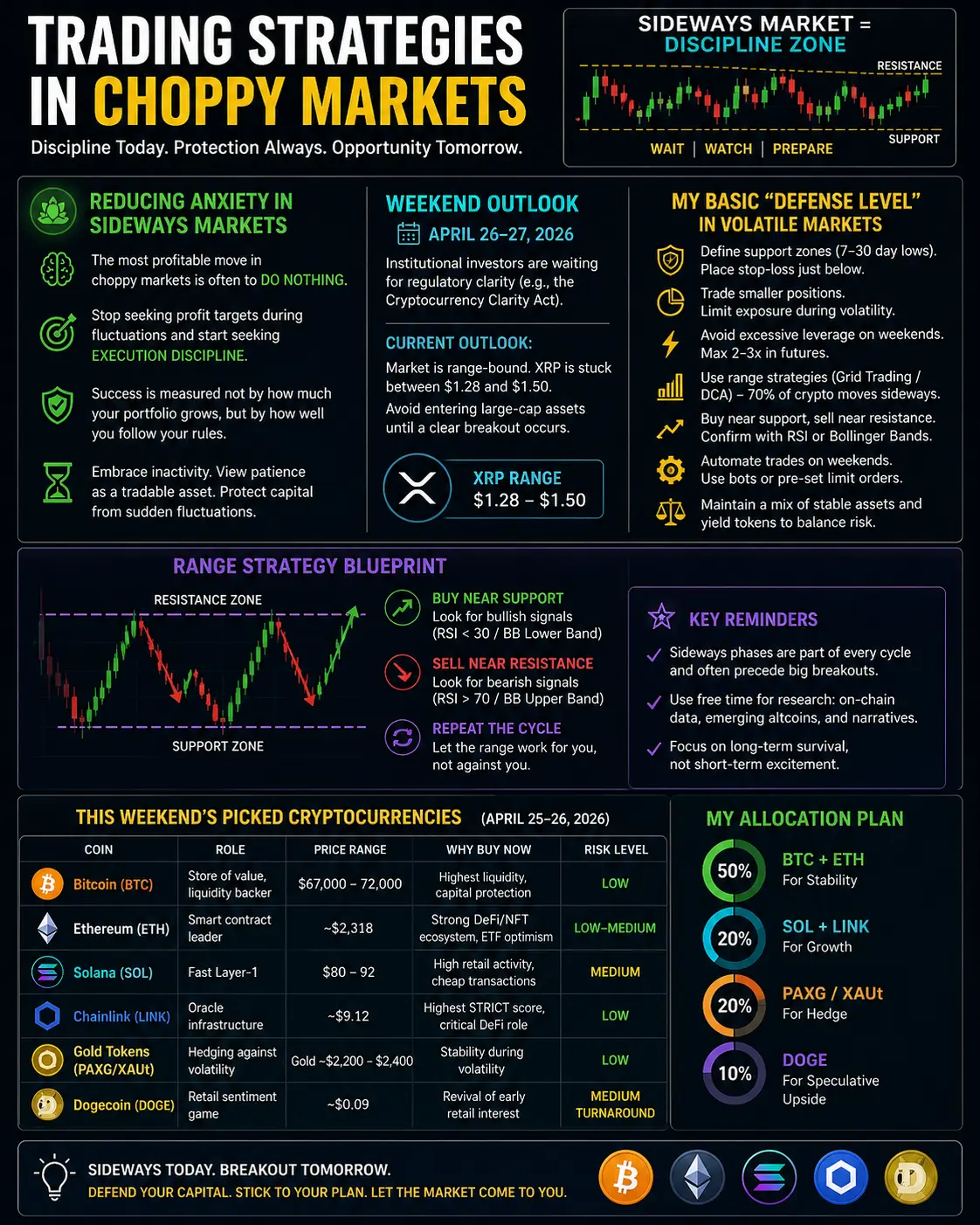
Sideways markets are a major cause of "excessive trading fatigue." When the market is sideways, the most profitable course of action is often to do nothing.
Stop seeking profit targets during market fluctuations and start seeking "execution discipline." Success in a sideways market is measured not by how much your portfolio grows, but by how well you adhere to your rules.
Embrace Inactivity: View patience as a tradable asset. By not trading, you protect your capital from the "sudden fluctuations" that can wipe out accoun
ybaser
#TradingStrategiesInChoppyMarkets
Reducing Anxiety in Sideways Markets
Sideways markets are a major cause of "excessive trading fatigue." When the market is sideways, the most profitable course of action is often to do nothing.
Stop seeking profit targets during market fluctuations and start seeking "execution discipline." Success in a sideways market is measured not by how much your portfolio grows, but by how well you adhere to your rules.
Embrace Inactivity: View patience as a tradable asset. By not trading, you protect your capital from the "sudden fluctuations" that can wipe out accounts during sideways consolidation.
Weekend Crypto Plan (April 26-27, 2026)
In the current environment, a "wait and see" approach is most appropriate this weekend, given that large institutional investors are awaiting regulatory clarity (e.g., the Cryptocurrency Clarity Act).
Current Outlook: The market is currently fluctuating as institutional investors await concrete legal progress. Especially since XRP is stuck between $1.28 and $1.50 due to regulatory delays, avoid entering large-cap assets until a clear breakout occurs.
My Weekend Volatile
Market Trading Strategies and My Basic "Defense Level" in a Volatile Market
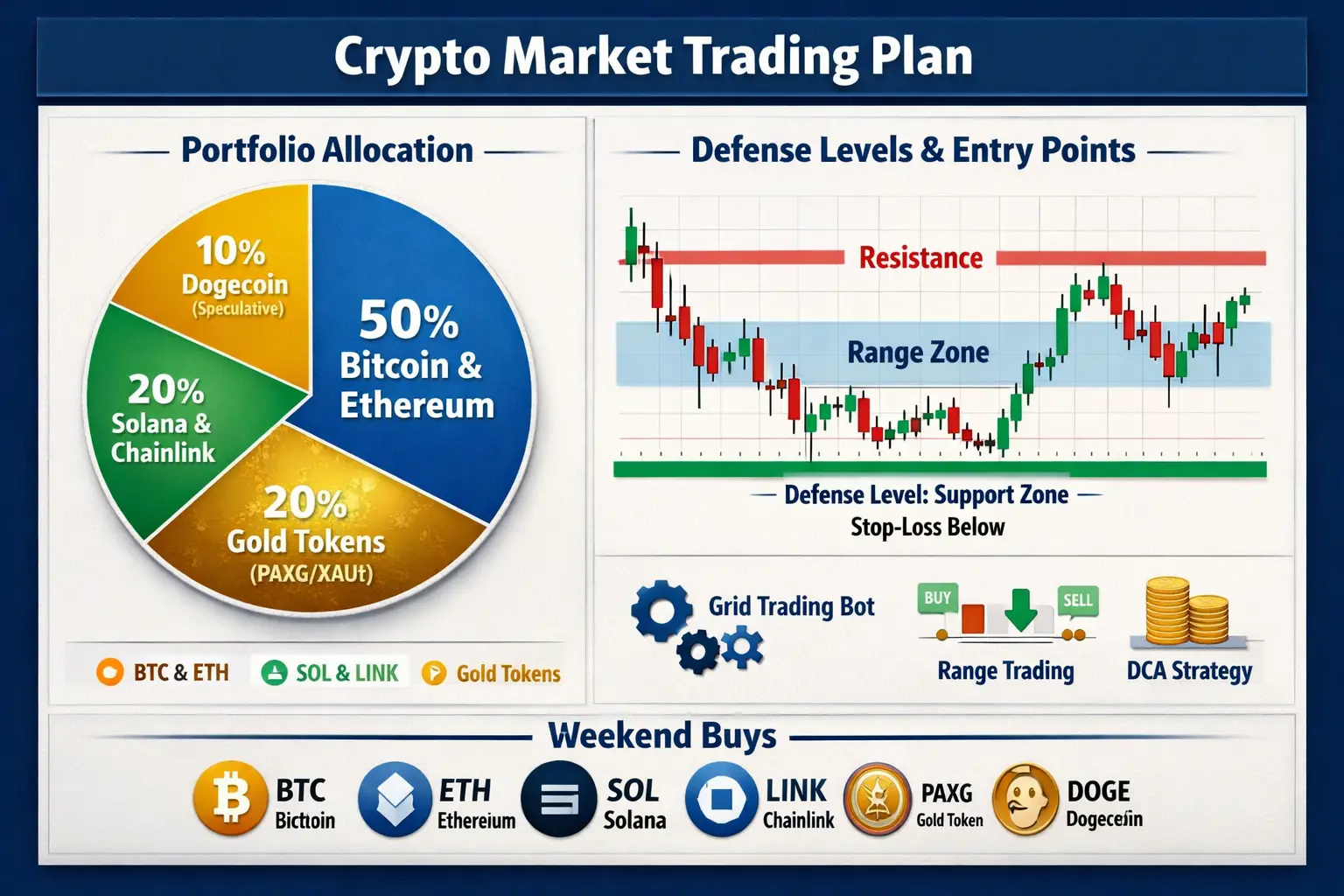
In volatile crypto markets, I define my "defense level" by identifying clear support zones and using tight stop-losses; I also employ range-limited strategies like grid trading or dollar cost averaging to avoid wick traps. This weekend, the strongest buys were in Bitcoin (BTC), Solana (SOL), Ethereum (ETH), and Chainlink (LINK); I consider gold-backed tokens (PAXG/XAUt) as a hedge.
Defense Level in Volatile Markets
I Define Support Zones: I use the lowest levels of the last 7-30 days as my "defense level." I place stop-losses just below these levels to avoid deep wick traps.
I trade smaller positions, limiting exposure during price fluctuations.
I Avoid Excessive Leverage on Weekends: I use a maximum of 2-3x leverage in futures; higher leverage increases the risk of liquidation.
To avoid dips and wick traps, I automate buy-low/sell-high trades within a defined range, as this works best in sideways markets where 70% of crypto price movements occur.
I buy near support and sell near resistance. I confirm entries using RSI or Bollinger Bands.
Instead of chasing every move, I gradually accumulate strong assets.
I acknowledge that sideways phases are part of every cycle and often precede breakouts.
I focus on research: I use my free time to study on-chain data and emerging altcoins.
Automating trades on weekends: Bots or pre-set limit orders reduce emotional decision-making.
I try to maintain a mix of stable assets (BTC, ETH) and yield-providing tokens to balance risk.
This Weekend's Picked Cryptocurrencies to Buy (April 25-26, 2026)
Coin Current Role Price Range Why Buy Now Risk Level
Bitcoin (BTC) Store of value, liquidity backer $67,000-72,000 Highest liquidity, capital protection Low
Ethereum (ETH) Smart contract leader ~$2,318 Strong DeFi/NFT ecosystem, ETF optimism Low-Medium
Solana (SOL) Fast Layer-1 $80-92 High retail activity, cheap transactions Medium
Chainlink (LINK) Oracle infrastructure ~$9.12 Highest STRICT score, critical DeFi role Low
Gold-backed tokens (PAXG/XAUt) Hedging against volatility Gold ~$2,200-2,400 Stability during volatility Low
Dogecoin (DOGE) Retail sentiment game ~$0.09 Revival of early retail interest Medium Turnaround
BTC: Stable but slower growth potential compared to altcoins.
ETH/SOL: Strong ecosystems but vulnerable to macroeconomic shocks.
LINK: Risk of token launch (29% supply not yet released).
DOGE: Sentiment-driven rather than fundamental factors.
Gold Tokens: Limited upside potential, more of a safe haven.
I plan to allocate 50% BTC/ETH for stability.
I'm considering adding 20% ​​SOL/LINK for growth potential.
I will hold a 20% hedge in gold-backed tokens.
I may add 10% DOGE for speculative upside.
$SOL $DOGE $PAXG
repost-content-media
  • Reward
  • 7
  • Repost
  • Share
MrFlower_XingChen:
To The Moon 🌕
View More
#TopCopyTradingScout
#TradingStrategiesInChoppyMarkets
Trading Strategies in Choppy Markets: The Art of Defensive Precision, Liquidity Awareness, and Psychological Control
The cryptocurrency market is often celebrated for its explosive trends and high-volatility opportunities, yet some of the most defining moments for a trader occur not during expansion—but during stagnation. Choppy and sideways markets represent a hidden battlefield where capital is not grown, but tested; where discipline outweighs aggression; and where survival becomes the ultimate strategy
post-image
  • Reward
  • 3
  • Repost
  • Share
MasterChuTheOldDemonMasterChu:
Chong Chong GT 🚀
View More
✨ Surviving in Volatile Markets: Strategy is the Game Itself
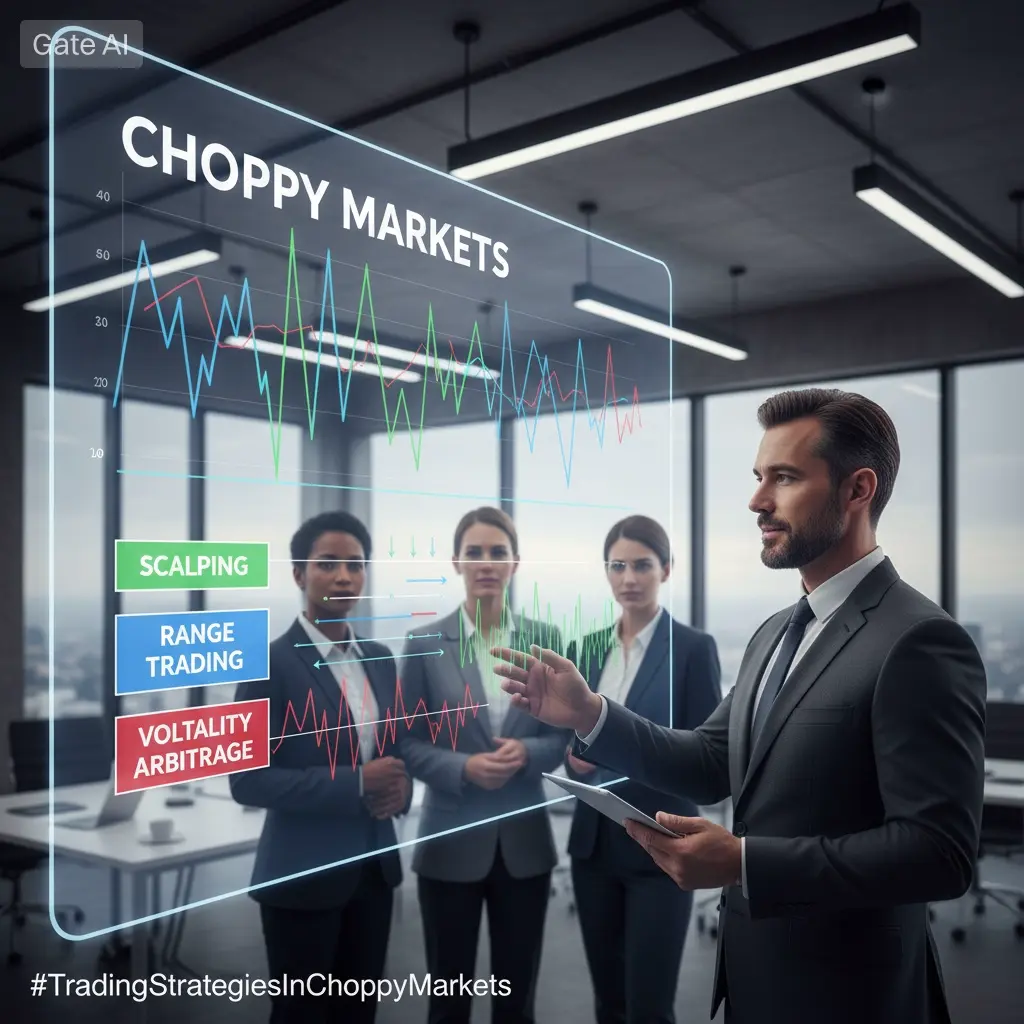
✨ Periods when the market is directionless and sharp up-and-down movements become frequent are the most challenging testing grounds for traders. #VolatileMarketTradingStrategy and #TradingStrategiesInChoppyMarkets require understanding these kinds of environments correctly.
✨ In these "choppy" markets, classic trend following is often misleading. Instead, shorter-term, disciplined, and reaction-based strategies come to the forefront.
✨ The main assets I follow
🔹Bitcoin
🔹Ethereum
🔹XRP
🔹Solana
🔹Chainlink
🔹GT
exhibit different b
BTC-0.17%
ETH-0.09%
XRP-0.42%
SOL-0.55%
User_any
✨ Surviving in Volatile Markets: Strategy is the Game Itself
✨ Periods when the market is directionless and sharp up-and-down movements become frequent are the most challenging testing grounds for traders. #VolatileMarketTradingStrategy and #TradingStrategiesInChoppyMarkets require understanding these kinds of environments correctly.
✨ In these "choppy" markets, classic trend following is often misleading. Instead, shorter-term, disciplined, and reaction-based strategies come to the forefront.
✨ The main assets I follow
🔹Bitcoin
🔹Ethereum
🔹XRP
🔹Solana
🔹Chainlink
🔹GT
exhibit different behavioral patterns in these markets.
✨ For example, BTC and ETH are generally direction-setting, while assets like SOL and LINK tend to amplify volatility. XRP, on the other hand, can often show sudden and independent movements based on news flow.
✨ The fundamental approach that can be applied in this environment is: range trading. Clear support and resistance levels are determined, and the buy-sell cycle is repeated as long as the price remains within this range.
✨ Another critical strategy: position reduction and leverage control. In volatile markets, smaller, more flexible entries instead of large positions are crucial for protecting capital.
✨ Monitoring liquidity flow is also important. Sudden increases in volume often produce fake breakouts. Therefore, taking aggressive positions without confirmation of a breakout is risky.
✨ Alternatively, portfolio diversification provides balance. Gold-based assets like PAX Gold and silver-based XAG/USDT pairs can stand out as hedging tools during risky periods.
✨ These types of assets can reduce portfolio volatility by behaving more stably against crypto volatility.
✨ The most critical point is psychology: In choppy markets, the biggest losses come from overtrading and impatience. Not every move needs to be traded.
✨ For a disciplined trader, these markets are an opportunity, not chaos — but only with proper risk management.
✨ In conclusion: In environments where the trend is unclear, the winners are not those who predict direction, but those who manage risk.
#Gate广场 #创作者狂欢 #内容挖矿
repost-content-media
  • Reward
  • 25
  • Repost
  • Share
strong_man:
LFG 🔥
View More
Load More