What is DPR: A Comprehensive Guide to Dense Passage Retrieval in Information Retrieval Systems

Deeper Network's Positioning and Significance
In 2018, Deeper Network Inc. launched Deeper Network (DPR), aiming to address internet privacy vulnerabilities, centralized control, and unfair access. As a decentralized distributed blockchain network for building truly private, secure and fair internet infrastructure, Deeper Network plays a key role in Web 3.0 infrastructure, network security, and decentralized connectivity.
As of 2026, Deeper Network has established itself within the crypto ecosystem with 9,674 holders and an active development community focused on privacy-preserving internet solutions. This article will provide an in-depth analysis of its technical architecture, market performance and future potential.
Origin and Development History
Birth Background
Deeper Network was created by Deeper Network Inc. in 2018, aiming to address internet privacy concerns, centralized network control, and barriers to fair internet access. It emerged during the blockchain technology boom and growing awareness of data privacy issues, with the goal of empowering internet users with true privacy, security and fair access through blockchain technology. The launch of Deeper Network brought new possibilities for individual internet users and households seeking decentralized network solutions.
Important Milestones
- 2018: Company establishment and project initiation, laying the foundation for decentralized internet infrastructure.
- 2021: Token listing on Gate.com in April, with initial trading activity establishing market presence.
- 2026: Continued ecosystem development with focus on Web 3.0 infrastructure and accessible gateway solutions for households.
With support from the Deeper Network community and development team, the project continues to optimize its technology, security features and real-world applications.
How Deeper Network Operates?
No Central Control
Deeper Network operates on a decentralized distributed blockchain network spanning globally, eliminating reliance on centralized internet service providers or government control. These nodes collaborate to create private, secure internet connections, ensuring the system remains transparent and resistant to attacks, granting users greater autonomy and enhancing network resilience.
Blockchain Core
Deeper Network's blockchain serves as a public, immutable digital ledger supporting its decentralized internet infrastructure. Transactions and network activities are grouped into blocks, linked through cryptographic hashing to form a secure chain. Anyone can verify the integrity of the network without intermediaries, establishing trust through transparency. The infrastructure provides households with accessible gateways to the decentralized Web 3.0 ecosystem.
Ensuring Fairness
Deeper Network employs blockchain consensus mechanisms to validate network activities and prevent malicious behavior. Network participants contribute to maintaining network security and infrastructure, receiving DPR token rewards as economic incentives. The token serves as the primary value currency for economic incentives and payment of various services within the ecosystem.
Secure Transactions
Deeper Network utilizes public-private key cryptography to protect transactions:
- Private keys (similar to secret passwords) are used to authorize transactions
- Public keys (similar to account numbers) are used to verify ownership
This mechanism ensures fund security while transactions maintain appropriate privacy levels within the decentralized network infrastructure. The DPR token facilitates secure payments for network services and incentivizes ecosystem participation.
Deeper Network (DPR) Market Performance
Circulation Overview
As of February 5, 2026, Deeper Network has a circulating supply of 3,293,928,004.66 DPR tokens, with a total supply of 10,000,000,000 tokens and a maximum supply cap of 10,000,000,000 tokens, indicating a fixed supply model.
The current circulation ratio stands at approximately 32.94%, with new tokens potentially entering the market through network rewards and economic incentives that support the ecosystem's growth and user participation.
Price Volatility
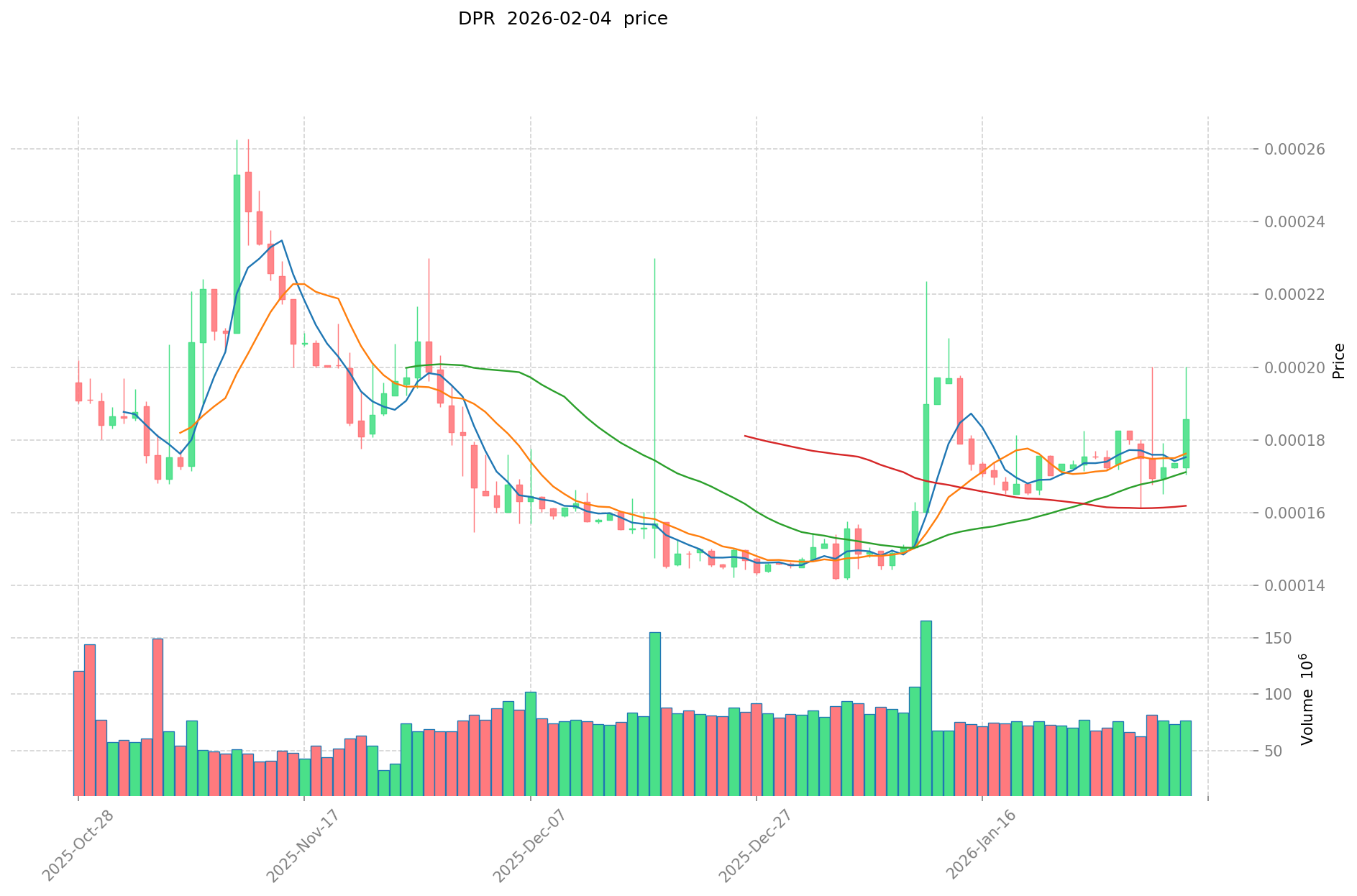
Deeper Network reached its all-time high price of $0.334751 on April 12, 2021, during a period of heightened market activity in the cryptocurrency sector.
The token recorded its lowest price of $0.0001416 on January 4, 2026, reflecting broader market dynamics and sector-specific developments.
These price movements demonstrate the influence of market sentiment, adoption patterns, and various external factors on the token's valuation.
Click to view current DPR market price
On-Chain Metrics
- Token Holders: 9,674 addresses (indicating the distribution of token ownership across the network)
- 24-Hour Trading Volume: $15,823.04 (reflecting recent market activity and liquidity)
- Market Capitalization: $647,586.25 (representing the current network valuation based on circulating supply)
Deeper Network Ecosystem Applications and Partners
Core Use Cases
Deeper Network's ecosystem supports multiple applications:
- Web 3.0 Infrastructure: Deeper Connect devices provide decentralized gateway access for households, enabling private and secure internet connectivity.
- Privacy & Security Solutions: The network facilitates encrypted communications and decentralized VPN services, protecting users from surveillance and data breaches.
Strategic Partnerships
Deeper Network continues to expand its technical capabilities and market presence through collaborations within the blockchain and cybersecurity sectors. These partnerships provide a solid foundation for Deeper Network's ecosystem expansion.
Controversies and Challenges
Deeper Network faces the following challenges:
- Market Competition: Competition from other privacy-focused blockchain networks and decentralized VPN providers
- Adoption Barriers: User education and awareness regarding Web 3.0 technologies and decentralized infrastructure
- Token Performance: Price volatility affecting network incentive mechanisms and user participation
These issues have sparked discussions within the community and market, while also driving Deeper Network's continuous innovation.
Deeper Network Community and Social Media Atmosphere
Fan Enthusiasm
Deeper Network's community demonstrates notable activity, with approximately 9,674 token holders actively participating in the ecosystem.
On X platform, related posts and hashtags (such as #DeeperNetwork) generate consistent engagement.
Factors such as network upgrades and device releases have energized community participation.
Social Media Sentiment
Sentiment on X shows diverse perspectives:
- Supporters praise Deeper Network's decentralization features and privacy protection capabilities, viewing it as essential infrastructure for a truly private internet.
- Critics focus on price fluctuations and market cap challenges.
Recent trends reflect varying sentiment levels corresponding to broader market conditions.
Hot Topics
X users actively discuss Deeper Network's privacy technology, Web 3.0 development potential, and tokenomics, showcasing both its transformative potential and the obstacles toward mainstream adoption.
Deeper Network Additional Information Sources
- Official Website: Visit Deeper Network Official Site for features, use cases, and latest updates.
- X Activity: Deeper Network maintains an active presence on X platform at @deeper_network, with posts covering technical updates, community events, and ecosystem developments, generating substantial engagement.
Deeper Network Future Roadmap
- Ecosystem Goals: Expand decentralized gateway network coverage and enhance user privacy protection features
- Long-term Vision: Establish itself as foundational infrastructure for Web 3.0 and decentralized internet access
How to Participate in Deeper Network?
- Purchase Channels: Acquire DPR on Gate.com and other supported exchanges
- Storage Solutions: Securely store DPR using compatible wallets such as MetaMask or hardware wallets
- Network Participation: Deploy Deeper Connect devices to earn DPR rewards through bandwidth sharing
- Ecosystem Building: Visit developer documentation to explore integration opportunities and contribute to network development
Summary
Deeper Network redefines internet privacy through blockchain technology, providing decentralized infrastructure, enhanced security, and true privacy protection. Its engaged community, comprehensive resources, and innovative approach position it distinctively in the cryptocurrency space. Despite facing market volatility and adoption challenges, Deeper Network's commitment to privacy innovation and its clear development trajectory secure its important role in the future of decentralized technology. Whether you're a newcomer or experienced participant, Deeper Network merits attention and involvement.
FAQ
What does DPR stand for in cryptocurrency?
DPR stands for Diamond Protocol Reserve, a digital asset designed for secure transactions and enabling smart contract functionality within blockchain networks.
How is Daily Percentage Return (DPR) calculated in crypto trading?
Daily Percentage Return (DPR) is calculated by dividing the Annual Percentage Rate (APR) by 365. For example, a 10% APR equals approximately 0.0274% daily return.
What is the difference between DPR and APR in crypto investments?
APR does not include compounding interest, representing simple annual returns. DPR (DeFi Performance Rate) typically accounts for compounding effects, providing more accurate yield projections for crypto investments with regular interest reinvestment.
How can I use DPR to evaluate crypto investment performance?
Analyze DPR's historical price trends, transaction volume, and market demand. Monitor its development progress in the decentralized VPN ecosystem. Track adoption rates and compare performance against market benchmarks to assess investment potential.
What are the risks and limitations of relying on DPR for crypto portfolio management?
DPR carries risks including high volatility, limited regulatory oversight, and market manipulation susceptibility. Lack of mainstream adoption and uncertain long-term viability present additional limitations for portfolio reliance.
Share
Content
Deeper Network's Positioning and Significance
Origin and Development History
How Deeper Network Operates?
Deeper Network (DPR) Market Performance
Deeper Network Ecosystem Applications and Partners
Controversies and Challenges
Deeper Network Community and Social Media Atmosphere
Deeper Network Additional Information Sources
Deeper Network Future Roadmap
How to Participate in Deeper Network?
Summary
FAQ
How to Buy Cryptocurrency


Trending Cryptocurrencies



XZXX: A Comprehensive Guide to the BRC-20 Meme Token in 2025

What Is a Phantom Wallet: A Guide for Solana Users in 2025

Ethereum 2.0 in 2025: Staking, Scalability, and Environmental Impact

2025 Layer-2 Solution: Ethereum Scalability and Web3 Performance Optimization Guide

What is BOOP: Understanding the Web3 Token in 2025

Altcoin Season Index 2025: How to Use and Invest in Web3
ANI vs SNX: Which AI-Powered Oracle Network Offers Better Value for 2024?
SCF vs DOGE: A Comprehensive Comparison of Two Leading Meme Cryptocurrencies
SHM vs LTC: Understanding the Key Differences Between Simple Harmonic Motion and Lithium-Ion Battery Technology
What are Satoshis, and why is Bitcoin broken down into smaller units?

GAIN vs APT: A Comprehensive Comparison of Advanced Persistent Threat Groups and Their Impact on Cybersecurity