AKI vs BAT: A Comprehensive Comparison of Acute Kidney Injury and Bioartificial Kidney Technologies in Modern Clinical Practice

Introduction: AKI vs BAT Investment Comparison
In the cryptocurrency market, the comparison between AKI vs BAT has consistently been a topic investors cannot overlook. Both demonstrate significant differences in market cap ranking, application scenarios, and price performance, representing distinct positioning within the crypto asset landscape. AKI (AKI): Launched in 2021, it has gained market recognition through its positioning as a data-driven influencer network utilizing the Proof of Promotion methodology to track on-chain promotional contributions. BAT (BAT): Since its inception in 2017, it has been positioned as a digital advertising solution integrated with the Brave browser, addressing advertisement display and user incentive challenges through blockchain technology. This article will comprehensively analyze the investment value comparison between AKI vs BAT across historical price trends, supply mechanisms, institutional adoption, technological ecosystems, and future predictions, attempting to answer the question investors care about most:
"Which is the better buy right now?"
I. Historical Price Comparison and Current Market Status
AKI and BAT Historical Price Trends
-
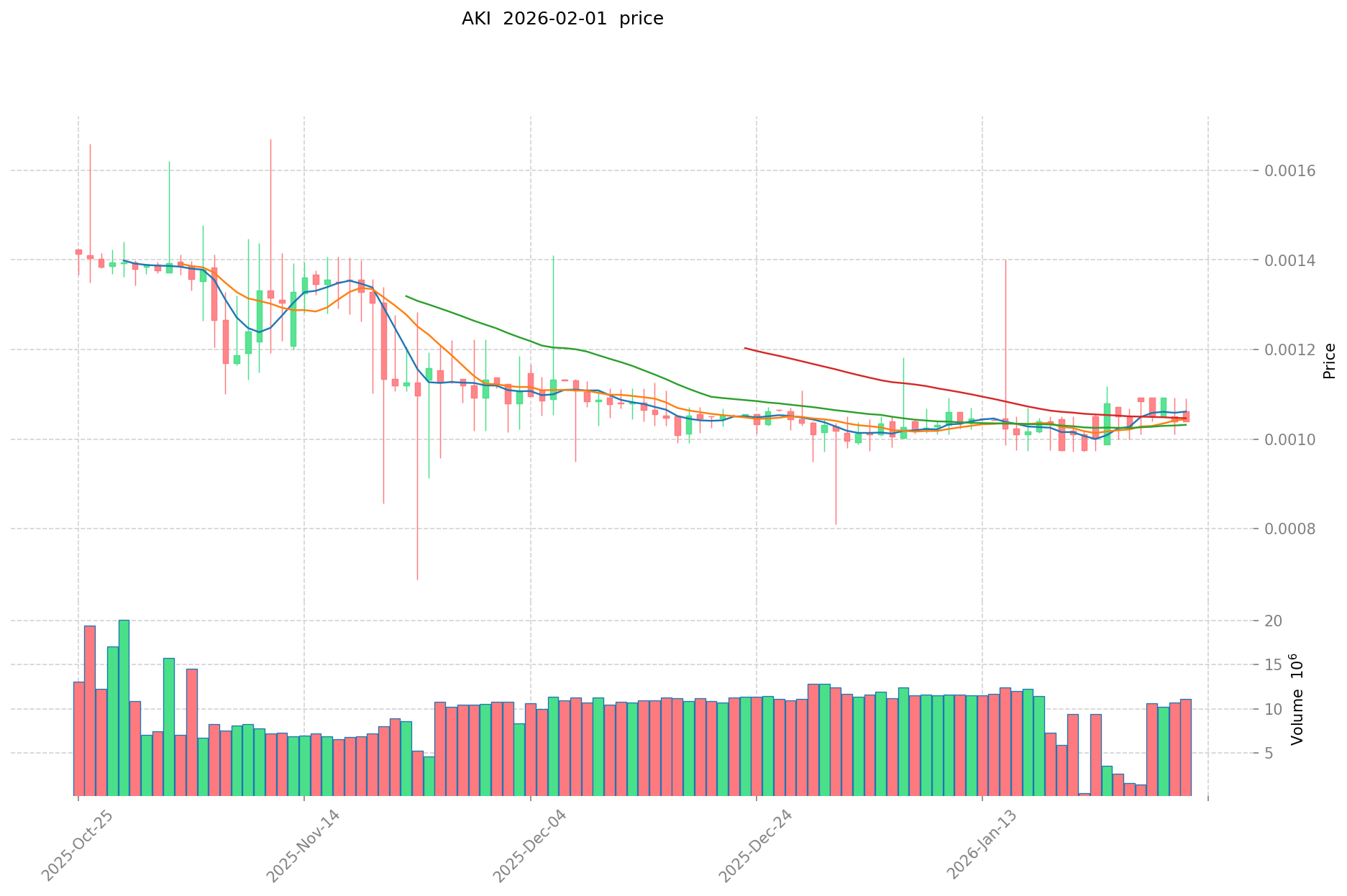
2023: AKI experienced a notable price movement during December 2023, when it recorded its all-time high of $0.0825. However, this peak was followed by a substantial decline in subsequent periods.
-
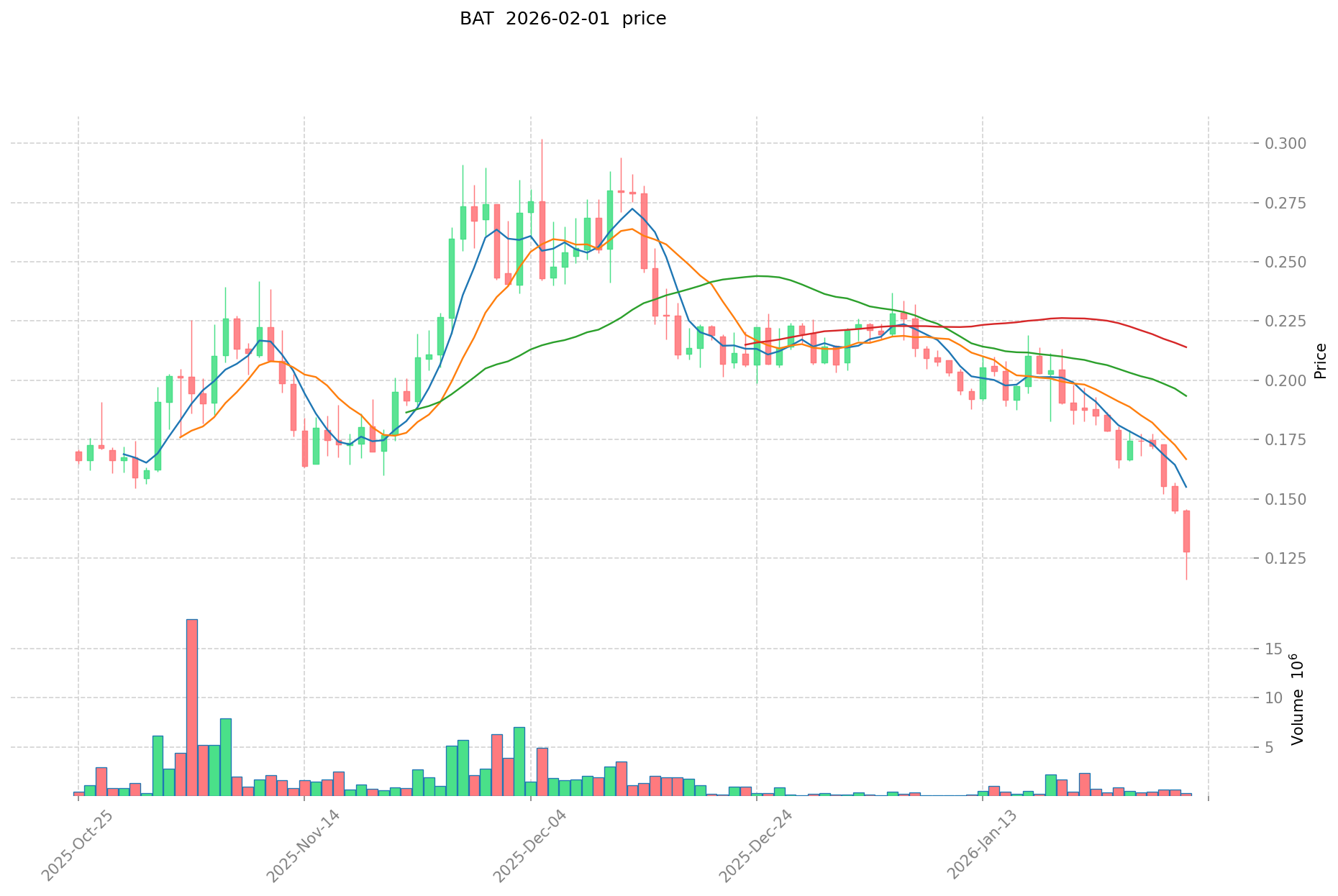
2017-2021: BAT launched in May 2017 with an initial offering price of approximately $0.036. The token reached its all-time high of $1.9 in November 2021, driven by increased adoption of the Brave browser and growing interest in privacy-focused digital advertising solutions.
-
Comparative Analysis: During the recent market cycle, AKI declined from its peak of $0.0825 to a low of $0.000627 in September 2025, representing a significant downturn. Meanwhile, BAT experienced a decline from its peak of $1.9 to a low of $0.072394 in July 2017, though it has shown relatively more stability in recent periods compared to AKI's recent volatility.
Current Market Status (2026-02-01)
- AKI Current Price: $0.0010631
- BAT Current Price: $0.1288
- 24-Hour Trading Volume: AKI $11,608.88 vs BAT $39,976.21
- Market Sentiment Index (Fear & Greed Index): 14 (Extreme Fear)
Check real-time prices:
- View AKI Current Price Market Price
- View BAT Current Price Market Price
II. Core Factors Influencing AKI vs BAT Investment Value
Supply Mechanism Comparison (Tokenomics)
The supply structure of crypto assets directly impacts their long-term price dynamics and investment appeal. Understanding the fundamental tokenomics of each asset provides insight into scarcity mechanisms and potential value trajectories.
-
AKI: Specific supply mechanism details were not available in the provided materials. General market analysis suggests that token supply structures—whether fixed, inflationary, or deflationary—play a crucial role in determining price stability and investor perception.
-
BAT: Supply mechanism specifics were not detailed in the reference materials. However, established tokens typically feature defined maximum supplies or emission schedules that influence market behavior over time.
-
📌 Historical Pattern: Supply-driven dynamics have historically shaped crypto price cycles. Assets with capped supplies or deflationary features tend to experience amplified volatility during bull markets, while inflationary models may offer more stable but potentially limited upside.
Institutional Adoption and Market Application
Institutional engagement and real-world utility significantly affect the investment profile of crypto assets. Factors include institutional holdings, enterprise integration, and regulatory positioning.
-
Institutional Holdings: The reference materials did not provide comparative data on institutional preference between AKI and BAT. Generally, tokens with established track records, regulatory clarity, and integration into financial infrastructure attract greater institutional interest.
-
Enterprise Adoption: Information on cross-border payment applications, settlement usage, or portfolio integration for AKI and BAT was not available in the provided sources. Real-world use cases in payments, remittances, and enterprise solutions typically enhance long-term value propositions.
-
National Policy Stance: Regulatory attitudes toward different crypto assets vary globally. The materials did not specify jurisdictional treatment of AKI or BAT. However, assets with clearer compliance frameworks and regulatory engagement often demonstrate more sustainable growth patterns.
Technology Development and Ecosystem Building
Technological innovation and ecosystem maturity are critical determinants of long-term viability and competitive positioning.
-
AKI Technology Upgrades: Specific technical development roadmaps or upgrade initiatives were not detailed in the reference materials. Technology enhancements such as scalability improvements, security upgrades, or feature expansions typically influence investor confidence and network adoption.
-
BAT Technology Development: The provided sources did not contain information on BAT's technical evolution. Tokens that demonstrate active development, protocol improvements, and adaptation to emerging blockchain standards tend to maintain competitive relevance.
-
Ecosystem Comparison: Details on DeFi integration, NFT applications, payment infrastructure, and smart contract deployment for AKI and BAT were not available in the materials. Assets with diversified, active ecosystems generally exhibit stronger network effects and resilience during market downturns.
Macroeconomic Environment and Market Cycles
Broader economic conditions and global financial trends exert substantial influence on crypto asset performance.
-
Performance in Inflationary Environments: The reference materials did not provide comparative analysis of AKI and BAT behavior during inflationary periods. Historically, crypto assets with strong scarcity narratives or store-of-value characteristics have attracted interest during high-inflation environments, though actual performance varies significantly.
-
Macroeconomic Monetary Policy: Interest rate movements and U.S. dollar index fluctuations affect liquidity conditions for risk assets, including cryptocurrencies. The materials did not specify differential impacts on AKI versus BAT. Generally, tightening monetary policy tends to pressure crypto valuations, while accommodative conditions support risk-on behavior.
-
Geopolitical Factors: Cross-border transaction demand and international political developments can influence crypto adoption patterns. Specific geopolitical considerations for AKI and BAT were not addressed in the provided sources. Assets facilitating international transfers or operating in regions with currency instability may experience demand shifts during geopolitical turbulence.
III. 2026-2031 Price Forecast: AKI vs BAT
Short-term Forecast (2026)
- AKI: Conservative $0.000864 - $0.001067 | Optimistic $0.001067 - $0.001472
- BAT: Conservative $0.107 - $0.128 | Optimistic $0.128 - $0.167
Medium-term Forecast (2028-2029)
- AKI may enter a gradual growth phase, with projected price range of $0.000850 - $0.001987 (2028) and $0.001562 - $0.001881 (2029)
- BAT may enter a consolidation phase, with projected price range of $0.086 - $0.184 (2028) and $0.103 - $0.247 (2029)
- Key drivers: institutional capital inflows, ETF developments, ecosystem expansion
Long-term Forecast (2030-2031)
- AKI: Baseline scenario $0.001655 - $0.001780 (2030) | Optimistic scenario $0.001559 - $0.003076 (2031)
- BAT: Baseline scenario $0.199 - $0.211 (2030) | Optimistic scenario $0.203 - $0.296 (2031)
Disclaimer
AKI:
| Year | Predicted High Price | Predicted Average Price | Predicted Low Price | Price Change |
|---|---|---|---|---|
| 2026 | 0.001471908 | 0.0010666 | 0.000863946 | 0 |
| 2027 | 0.00147233464 | 0.001269254 | 0.00096463304 | 19 |
| 2028 | 0.001987651764 | 0.00137079432 | 0.0008498924784 | 28 |
| 2029 | 0.00188072980704 | 0.001679223042 | 0.00156167742906 | 57 |
| 2030 | 0.002491966994328 | 0.00177997642452 | 0.001655378074803 | 67 |
| 2031 | 0.00307579926157 | 0.002135971709424 | 0.001559259347879 | 100 |
BAT:
| Year | Predicted High Price | Predicted Average Price | Predicted Low Price | Price Change |
|---|---|---|---|---|
| 2026 | 0.16692 | 0.1284 | 0.106572 | 0 |
| 2027 | 0.184575 | 0.14766 | 0.088596 | 14 |
| 2028 | 0.184390425 | 0.1661175 | 0.0863811 | 28 |
| 2029 | 0.247108087125 | 0.1752539625 | 0.103399837875 | 36 |
| 2030 | 0.251305419526875 | 0.2111810248125 | 0.19851016332375 | 63 |
| 2031 | 0.2959913243772 | 0.231243222169687 | 0.203494035509325 | 79 |
IV. Investment Strategy Comparison: AKI vs BAT
Long-term vs Short-term Investment Strategies
-
AKI: May appeal to investors seeking exposure to emerging influencer marketing networks and data-driven promotional tracking mechanisms. The asset's early-stage positioning suggests potential for growth-oriented strategies, though accompanied by substantial volatility considerations.
-
BAT: May suit investors interested in established digital advertising solutions with browser integration. The token's longer operational history and connection to privacy-focused browsing infrastructure positions it within the utility token category.
Risk Management and Asset Allocation
-
Conservative Investors: A cautious allocation approach might consider limiting exposure to higher-volatility assets. A potential framework could involve AKI: 20-30% vs BAT: 70-80% within a crypto portfolio subset, recognizing BAT's relatively longer track record.
-
Aggressive Investors: Growth-focused portfolios accepting elevated risk profiles might explore AKI: 60-70% vs BAT: 30-40%, capitalizing on potential upside in earlier-stage projects while maintaining diversification.
-
Hedging Instruments: Risk mitigation strategies include stablecoin allocations for liquidity management, options contracts for downside protection where available, and cross-asset combinations to reduce correlation risk.
V. Potential Risk Comparison
Market Risk
-
AKI: The token has demonstrated significant price volatility, declining substantially from its December 2023 peak of $0.0825 to $0.000627 by September 2025. Current trading volumes of $11,608.88 suggest relatively limited liquidity, which may amplify price swings during market stress.
-
BAT: While BAT experienced a decline from its November 2021 peak of $1.9, it has shown comparatively more established trading patterns. Current 24-hour volume of $39,976.21 indicates moderately higher liquidity than AKI, though still subject to broader crypto market dynamics.
Technology Risk
-
AKI: Specific technical infrastructure details were not extensively documented in available materials. Emerging projects may face scalability challenges and network stability considerations as user bases expand.
-
BAT: Technical evolution specifics were not detailed in reference sources. Established tokens typically confront ongoing requirements for protocol updates, security maintenance, and adaptation to evolving blockchain standards.
Regulatory Risk
- Global regulatory frameworks continue evolving regarding crypto assets. Tokens with utility functions, advertising applications, or data-related operations may encounter varying jurisdictional treatment. Assets with longer operational histories and clearer compliance engagement may experience different regulatory trajectories compared to newer entrants. Specific regulatory positioning for AKI and BAT was not addressed in provided materials.
VI. Conclusion: Which Is the Better Buy?
📌 Investment Value Summary:
-
AKI Advantages: Represents exposure to the emerging influencer marketing and promotional tracking sector within crypto infrastructure. The token's positioning in data-driven networks may offer growth potential for investors willing to accept early-stage project risks.
-
BAT Advantages: Benefits from integration with an established browser platform and a longer operational track record since 2017. The token's connection to privacy-focused digital advertising provides a defined use case within the crypto ecosystem.
✅ Investment Considerations:
-
New Investors: Consider beginning with assets demonstrating established track records, clearer utility functions, and higher liquidity levels. Prioritize educational resources and gradual position building while maintaining strict risk management protocols.
-
Experienced Investors: May evaluate portfolio diversification across different crypto sectors, balancing established tokens with selective exposure to emerging projects. Technical analysis, on-chain metrics, and ecosystem development tracking can inform position sizing decisions.
-
Institutional Investors: Typically emphasize regulatory clarity, custody solutions, liquidity depth, and integration with traditional financial infrastructure. Assets with transparent governance, compliance frameworks, and institutional-grade custody options generally align with institutional risk parameters.
⚠️ Risk Disclaimer: Cryptocurrency markets exhibit extreme volatility. This analysis does not constitute investment advice. Investors should conduct independent research, assess personal risk tolerance, and consult qualified financial advisors before making investment decisions.
VII. FAQ
Q1: What is the current price difference between AKI and BAT?
As of February 1, 2026, AKI is trading at $0.0010631 while BAT is priced at $0.1288, representing a substantial price differential of approximately 121x. This significant gap reflects their divergent market capitalizations, trading volumes, and adoption levels. BAT's higher price point correlates with its longer operational history since 2017 and established integration with the Brave browser ecosystem. AKI's lower price reflects its positioning as an emerging project launched in 2021, though it should be noted that absolute price per token does not directly indicate investment value without considering total supply, market cap, and utility factors.
Q2: Which asset demonstrates better liquidity for trading purposes?
BAT exhibits superior liquidity characteristics with 24-hour trading volume of $39,976.21 compared to AKI's $11,608.88. This approximately 3.4x volume advantage suggests BAT offers easier entry and exit positions with potentially lower slippage during transactions. Higher liquidity generally reduces execution risk and provides more stable price discovery mechanisms. For investors prioritizing the ability to adjust positions quickly or execute larger trades without significant market impact, BAT's liquidity profile presents a more favorable trading environment. However, both assets display relatively modest trading volumes compared to major cryptocurrencies, indicating careful position sizing remains essential.
Q3: What are the primary use cases differentiating AKI from BAT?
AKI positions itself as a data-driven influencer network utilizing Proof of Promotion methodology to track on-chain promotional contributions, targeting the creator economy and marketing verification sector. BAT functions as a digital advertising solution integrated with the Brave browser, addressing advertisement display and user incentive challenges through blockchain technology. These distinct use cases place them in different crypto market segments—AKI in emerging influencer marketing infrastructure and BAT in established privacy-focused digital advertising. The differentiation suggests they serve complementary rather than directly competing functions within the broader crypto ecosystem, potentially offering portfolio diversification benefits across different utility categories.
Q4: How have AKI and BAT performed relative to their all-time highs?
AKI has declined approximately 98.7% from its December 2023 all-time high of $0.0825 to its current price of $0.0010631, representing substantial downside from peak levels. BAT has fallen approximately 93.2% from its November 2021 all-time high of $1.9 to the current $0.1288. While both assets have experienced significant corrections from peak valuations, BAT has shown comparatively more price resilience during the recent market cycle. These drawdowns reflect broader crypto market dynamics, with newer projects like AKI typically exhibiting higher volatility amplitudes. Investors evaluating entry points should consider whether current price levels represent accumulation opportunities or reflect fundamental valuation adjustments.
Q5: What price ranges are forecasted for 2026-2031?
Short-term 2026 forecasts project AKI between $0.000864-$0.001472 (conservative to optimistic scenarios) and BAT between $0.107-$0.167. Medium-term 2028-2029 estimates suggest AKI may range from $0.000850-$0.001987, while BAT could trade between $0.086-$0.247. Long-term 2030-2031 projections indicate AKI potentially reaching $0.001559-$0.003076 and BAT between $0.199-$0.296 under optimistic conditions. These forecasts incorporate baseline and growth scenarios considering institutional adoption, ecosystem expansion, and market cycle dynamics. However, cryptocurrency price predictions carry substantial uncertainty, and actual outcomes may differ materially based on technological developments, regulatory changes, competitive positioning, and macroeconomic conditions that cannot be fully anticipated.
Q6: Which asset suits conservative versus aggressive investment strategies?
Conservative investors might consider a portfolio weighting favoring BAT at 70-80% versus AKI at 20-30% within their crypto allocation, reflecting BAT's longer operational track record, established browser integration, and relatively higher liquidity. This approach prioritizes assets with clearer utility functions and more mature market positioning. Aggressive investors accepting elevated risk profiles for potential higher returns might explore reversed allocations of AKI at 60-70% versus BAT at 30-40%, capitalizing on early-stage growth potential in the influencer marketing infrastructure sector. Both strategies should incorporate strict risk management protocols including position sizing limits, stablecoin liquidity reserves, and diversification across multiple crypto sectors beyond just these two assets.
Q7: What are the primary risks differentiating AKI from BAT investments?
AKI's primary risk factors include extreme price volatility evidenced by its 98.7% decline from peak levels, limited liquidity with modest daily trading volumes, and execution risks associated with early-stage project development. As an emerging protocol, AKI faces heightened technology implementation challenges, network adoption uncertainties, and competitive positioning risks within the influencer marketing sector. BAT's risks, while still substantial, differ in character—regulatory evolution affecting browser-integrated advertising models, competitive pressure from alternative privacy-focused solutions, and dependence on continued Brave browser adoption growth. Both assets face broader crypto market risks including macroeconomic monetary policy shifts, regulatory framework changes, and sector-wide sentiment swings, though AKI's earlier development stage amplifies these systemic risk factors.
Q8: How does the current market sentiment affect AKI versus BAT?
The current Fear & Greed Index reading of 14 (Extreme Fear) indicates highly pessimistic market sentiment across the cryptocurrency sector. This environment typically pressures all risk assets, though impacts vary by project maturity and liquidity characteristics. Extreme fear conditions often create accumulation opportunities for long-term investors but require careful risk assessment given potential for further downside. AKI, with its lower liquidity and earlier-stage positioning, may experience amplified volatility during fearful market phases, while BAT's relatively established profile might demonstrate somewhat more price stability. Historical market cycles suggest extreme fear readings can precede recovery phases, though timing remains unpredictable. Investors should evaluate whether current sentiment levels align with their risk tolerance and investment timeframes rather than treating sentiment extremes as definitive entry or exit signals.
Share
Content
Introduction: AKI vs BAT Investment Comparison
I. Historical Price Comparison and Current Market Status
II. Core Factors Influencing AKI vs BAT Investment Value
III. 2026-2031 Price Forecast: AKI vs BAT
IV. Investment Strategy Comparison: AKI vs BAT
V. Potential Risk Comparison
VI. Conclusion: Which Is the Better Buy?
VII. FAQ
How to Buy Cryptocurrency


Trending Cryptocurrencies



Bitcoin Fear and Greed Index: Market Sentiment Analysis for 2025

Newbie Must Read: How to Formulate Investment Strategies When Nasdaq Turns Positive in 2025

Bitcoin Market Cap in 2025: Analysis and Trends for Investors

How to Mine Ethereum in 2025: A Complete Guide for Beginners
Best Crypto Wallets 2025: How to Choose and Secure Your Digital Assets
TapSwap Listing Date: What Investors Need to Know in 2025

UNIBOT vs DYDX: Which DEX Trading Bot Offers Superior Performance and Lower Fees?

SCF vs THETA: A Comprehensive Comparison of Two Leading Decentralized Computing Platforms

DBC vs OP: Comprehensive Comparison of Database Connection Pooling and Object-Oriented Programming Paradigms

BSW vs UNI: A Comprehensive Comparison of Two Leading Decentralized Exchange Platforms

What Is QM Pattern (Quasimodo Pattern) and How to Trade With It