This comprehensive investment analysis compares HEU and BAT, two distinct cryptocurrency assets with different market positioning. HEU (Heurist), launched in 2024, operates as a decentralized AI-as-a-Service platform aggregating GPU computing resources for serverless AI services. BAT (Basic Attention Token), established since 2017, focuses on digital advertising and attention economy within the Brave browser ecosystem. The article examines historical price trends, current market status, supply mechanisms, institutional adoption, and technological developments for both tokens. Price forecasts through 2031 project different growth trajectories based on market cycles and sector dynamics. Investment strategies vary by risk profile: conservative investors typically favor BAT's established presence with 70-80% allocation, while aggressive investors may increase HEU exposure to 50-60% for emerging technology growth potential. The analysis addresses key risk factors including market volatility, technical infrastructu
Introduction: HEU vs BAT Investment Comparison
In the cryptocurrency market, the comparison between HEU and BAT has become a topic of interest for investors. The two tokens differ significantly in market cap ranking, application scenarios, and price performance, representing distinct positioning within the crypto asset landscape.
HEU (Heurist): Launched in 2024, it has gained recognition through its positioning as a decentralized AI-as-a-Service cloud platform, aggregating GPU computing resources to provide serverless AI services for developers.
BAT (Basic Attention Token): Since its launch in 2017, BAT has been known for its focus on digital advertising and user attention economy, operating within the Brave browser ecosystem to create a decentralized advertising model.
This article will comprehensively analyze the investment value comparison between HEU and BAT, covering historical price trends, supply mechanisms, institutional adoption, technical ecosystems, and future projections, attempting to address the question investors care about most:
"Which is the better buy right now?"
I. Historical Price Comparison and Current Market Status
Price History of HEU (Coin A) and BAT (Coin B)
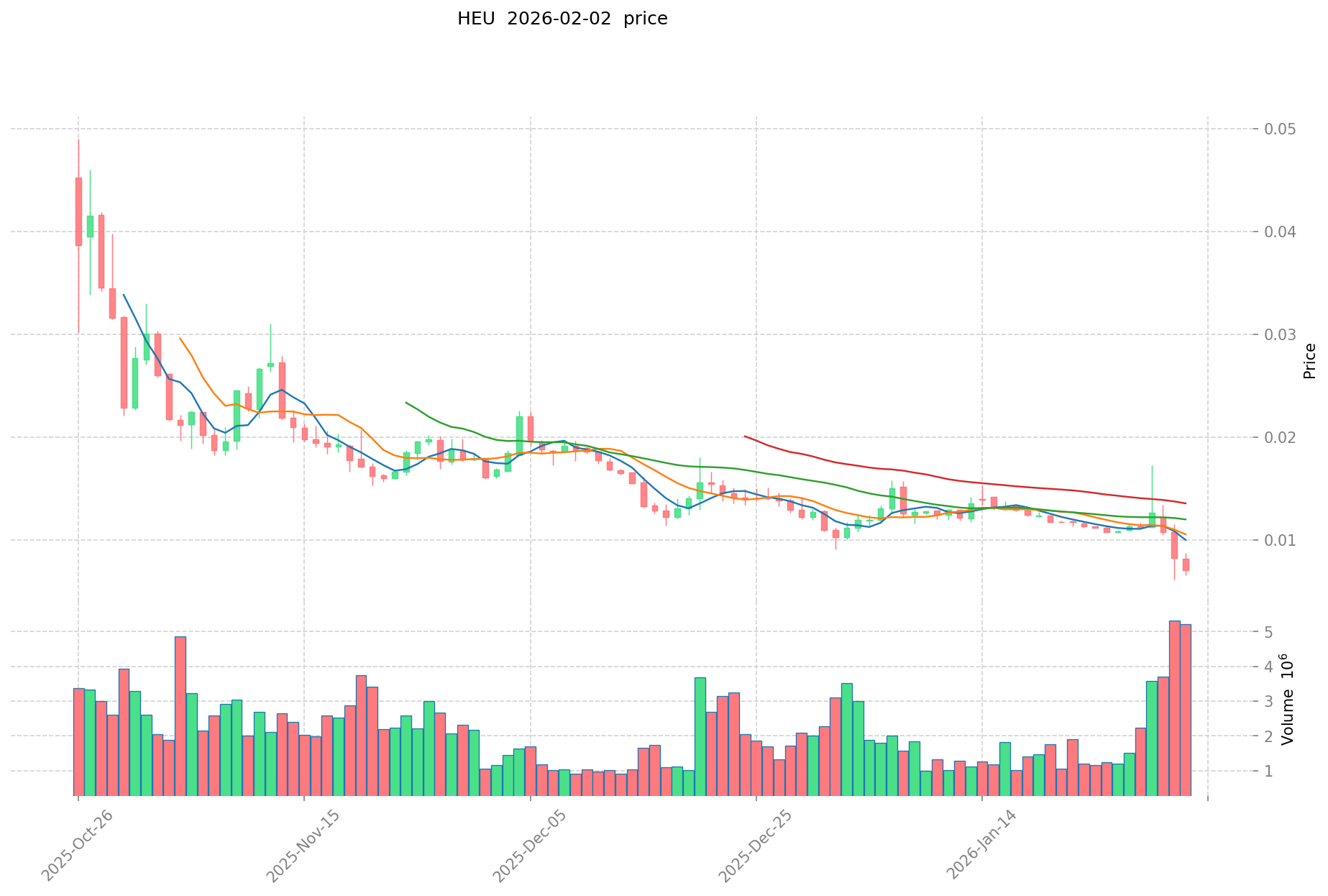
- 2024: HEU reached an all-time high of $0.462 on December 28, 2024, following its launch in the decentralized AI-as-a-Service sector.
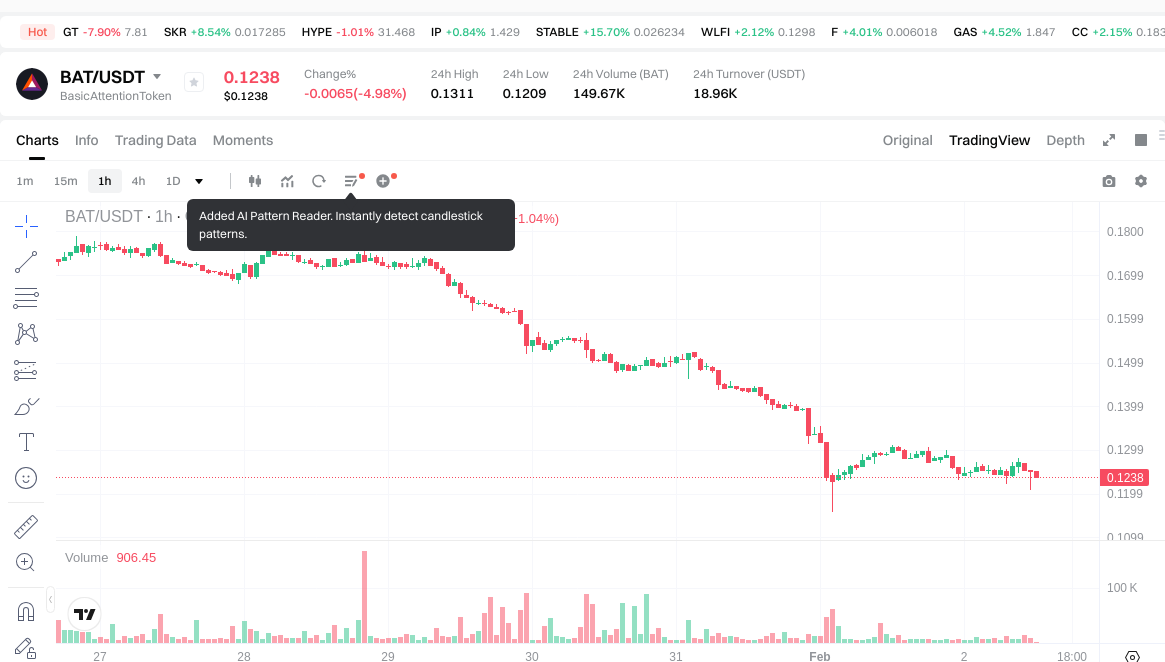
- 2021: BAT experienced notable price movements, reaching its all-time high of $1.90 on November 28, 2021, driven by increased adoption of the Brave browser ecosystem.
- Comparative Analysis: During recent market cycles, HEU declined from its peak of $0.462 to a low of $0.00613 on January 31, 2026, while BAT dropped from $1.90 to $0.072394 during its historical period, demonstrating different volatility patterns in their respective market segments.
Current Market Status (2026-02-02)
- HEU Current Price: $0.00744
- BAT Current Price: $0.1244
- 24-Hour Trading Volume: HEU $41,490.58 vs BAT $19,154.73
- Market Sentiment Index (Fear & Greed Index): 14 (Extreme Fear)
View real-time prices:
II. Core Factors Influencing HEU vs BAT Investment Value
Supply Mechanism Comparison (Tokenomics)
- HEU: The supply mechanism details are not available in the provided materials, and specific tokenomics information cannot be determined without additional data sources.
- BAT: Supply mechanism specifications are not available in the reference materials, and concrete tokenomics parameters cannot be established without further information.
- 📌 Historical Pattern: Supply mechanisms may influence price cycle dynamics through scarcity effects and emission schedules, though specific historical correlations require additional market data.
Institutional Adoption and Market Application
- Institutional Holdings: Comparative institutional preference data between HEU and BAT is not available in the provided materials.
- Enterprise Adoption: Application scenarios in cross-border payments, settlement systems, and investment portfolios for both assets require additional research beyond the available references.
- National Policies: Regulatory approaches across different jurisdictions toward these assets are not documented in the provided materials.
Technological Development and Ecosystem Building
- HEU Technology Upgrades: Specific technological advancement information is not available in the reference materials.
- BAT Technology Development: Details regarding technical evolution and infrastructure improvements are not provided in the available sources.
- Ecosystem Comparison: Comparative analysis of DeFi integration, NFT applications, payment implementations, and smart contract deployment requires additional data beyond the provided references.
Macroeconomic Environment and Market Cycles
- Performance in Inflationary Environment: Comparative anti-inflation characteristics between HEU and BAT cannot be determined from the available materials.
- Macroeconomic Monetary Policy: The relationship between interest rate movements, dollar index fluctuations, and the performance of these assets requires additional economic data.
- Geopolitical Factors: Cross-border transaction demand and international situation impacts on both assets are not documented in the provided references.
III. 2026-2031 Price Forecast: HEU vs BAT
Short-term Forecast (2026)
- HEU: Conservative scenario projects a range of $0.0047 to $0.0072, with optimistic projections reaching up to $0.0087
- BAT: Conservative scenario estimates a range of $0.1127 to $0.1238, with optimistic estimates potentially reaching $0.1758
Medium-term Forecast (2028-2029)
- HEU may enter a gradual accumulation phase, with projected price ranges between $0.0065 and $0.0124 by 2028-2029
- BAT may enter a consolidation and growth phase, with projected price ranges between $0.0975 and $0.2392 by 2028-2029
- Key drivers: institutional capital flows, ETF developments, ecosystem expansion
Long-term Forecast (2030-2031)
- HEU: Baseline scenario suggests a range of $0.0074 to $0.0127 | Optimistic scenario projects potential range of $0.0124 to $0.0189
- BAT: Baseline scenario estimates a range of $0.1091 to $0.2021 | Optimistic scenario projects potential range of $0.1857 to $0.3169
View detailed price predictions for HEU and BAT
Disclaimer: Price predictions are based on historical data analysis and market modeling. Actual prices may vary significantly due to market volatility, regulatory changes, technological developments, and macroeconomic factors. These projections should not be considered as investment advice.
HEU:
| Year |
Predicted High Price |
Predicted Average Price |
Predicted Low Price |
Price Change |
| 2026 |
0.0087483 |
0.00723 |
0.0046995 |
-2 |
| 2027 |
0.010066329 |
0.00798915 |
0.004473924 |
7 |
| 2028 |
0.012368003115 |
0.0090277395 |
0.00649997244 |
21 |
| 2029 |
0.014656083691275 |
0.0106978713075 |
0.00834433961985 |
43 |
| 2030 |
0.01800130804913 |
0.012676977499387 |
0.007352646949644 |
70 |
| 2031 |
0.018867145612338 |
0.015339142774258 |
0.012424705647149 |
106 |
BAT:
| Year |
Predicted High Price |
Predicted Average Price |
Predicted Low Price |
Price Change |
| 2026 |
0.175796 |
0.1238 |
0.112658 |
0 |
| 2027 |
0.17526366 |
0.149798 |
0.0898788 |
20 |
| 2028 |
0.1674067549 |
0.16253083 |
0.097518498 |
30 |
| 2029 |
0.2392047490525 |
0.16496879245 |
0.1435228494315 |
32 |
| 2030 |
0.293025817589312 |
0.20208677075125 |
0.109126856205675 |
62 |
| 2031 |
0.31687205653796 |
0.247556294170281 |
0.18566722062771 |
99 |
IV. Investment Strategy Comparison: HEU vs BAT
Long-term vs Short-term Investment Strategies
- HEU: May suit investors interested in emerging decentralized AI infrastructure and early-stage technology adoption, with focus on ecosystem development potential
- BAT: May suit investors focused on established digital advertising models and attention economy applications within the Brave browser ecosystem
Risk Management and Asset Allocation
- Conservative Investors: HEU 20-30% vs BAT 70-80% allocation approach may emphasize established market presence
- Aggressive Investors: HEU 50-60% vs BAT 40-50% allocation approach may emphasize growth potential in emerging sectors
- Hedging Tools: stablecoin allocation, options strategies, cross-asset portfolio diversification
V. Potential Risk Comparison
Market Risk
- HEU: Price volatility associated with early-stage market positioning, with historical price movements from $0.462 to $0.00613 demonstrating significant fluctuation patterns
- BAT: Market cycles influenced by browser adoption rates and digital advertising sector dynamics, with historical price movements from $1.90 to lower levels reflecting sector-specific trends
Technical Risk
- HEU: scalability considerations, network stability factors in decentralized AI service infrastructure
- BAT: computing power distribution patterns, security architecture considerations
Regulatory Risk
- Global regulatory frameworks may impact both assets differently based on their respective application domains, with AI services and digital advertising facing distinct compliance requirements across jurisdictions
VI. Conclusion: Which Is the Better Buy?
📌 Investment Value Summary:
- HEU Characteristics: positioning in decentralized AI-as-a-Service sector, GPU computing resource aggregation model, serverless AI infrastructure approach
- BAT Characteristics: established presence in digital advertising sector since 2017, integration with Brave browser ecosystem, attention economy focus
✅ Investment Considerations:
- New Investors: consider starting with established assets demonstrating longer market history and clearer regulatory frameworks, emphasizing portfolio diversification and risk management
- Experienced Investors: may evaluate both assets based on technical ecosystem development, adoption metrics, and correlation with broader market cycles
- Institutional Investors: may assess strategic allocation based on sector exposure preferences, regulatory compliance requirements, and portfolio diversification objectives
⚠️ Risk Disclaimer: Cryptocurrency markets exhibit extreme volatility. This content does not constitute investment advice.
VII. FAQ
Q1: What is the main difference between HEU and BAT in terms of their use cases?
HEU focuses on decentralized AI-as-a-Service infrastructure, while BAT specializes in digital advertising and attention economy. HEU, launched in 2024, operates as a cloud platform that aggregates GPU computing resources to provide serverless AI services for developers. In contrast, BAT, established in 2017, functions within the Brave browser ecosystem to create a decentralized advertising model that rewards users for their attention and participation in digital advertising.
Q2: Which cryptocurrency has shown greater price volatility historically?
HEU has demonstrated more extreme volatility in its shorter market history. HEU experienced a decline from its all-time high of $0.462 (December 28, 2024) to $0.00613 (January 31, 2026), representing approximately a 98.7% drop. BAT, while also experiencing significant volatility, declined from its peak of $1.90 (November 28, 2021) to lower levels over a longer period, reflecting different volatility patterns associated with their respective market maturity and sector positioning.
Q3: What are the price projections for HEU and BAT by 2030?
By 2030, baseline projections suggest HEU may range between $0.0074 and $0.0127, while BAT is estimated to range between $0.1091 and $0.2021. In optimistic scenarios, HEU could potentially reach $0.0124 to $0.0189, and BAT might achieve $0.1857 to $0.3169. However, these forecasts are subject to significant uncertainty due to market volatility, regulatory changes, technological developments, and macroeconomic factors, and should not be considered as guaranteed outcomes.
Q4: How should conservative investors approach allocation between HEU and BAT?
Conservative investors may consider a 20-30% HEU allocation versus 70-80% BAT allocation strategy. This approach emphasizes BAT's longer market presence since 2017 and more established ecosystem within the Brave browser, while maintaining limited exposure to HEU's emerging decentralized AI infrastructure sector. Risk management tools such as stablecoin allocation, options strategies, and cross-asset portfolio diversification should be incorporated to mitigate overall portfolio volatility.
Q5: What are the primary regulatory risks facing HEU and BAT?
Both assets face distinct regulatory considerations based on their application domains. HEU, operating in the decentralized AI-as-a-Service sector, may encounter evolving regulations around artificial intelligence services, data privacy, and computing infrastructure across different jurisdictions. BAT, focused on digital advertising, faces compliance requirements related to advertising standards, user privacy protection, and browser-based financial transactions. Global regulatory frameworks continue to develop in both sectors, creating ongoing uncertainty for investors.
Q6: What market conditions currently affect both HEU and BAT?
As of February 2, 2026, the cryptocurrency market exhibits extreme fear sentiment with a Fear & Greed Index of 14. Current prices show HEU at $0.00744 with 24-hour trading volume of $41,490.58, and BAT at $0.1244 with trading volume of $19,154.73. Both assets are influenced by broader market cycles, macroeconomic conditions, and sector-specific developments in their respective domains of decentralized AI services and digital advertising.
Q7: Which cryptocurrency is more suitable for aggressive investors seeking growth potential?
Aggressive investors may consider a 50-60% HEU versus 40-50% BAT allocation strategy to emphasize exposure to emerging technology sectors. HEU's positioning in decentralized AI infrastructure represents early-stage adoption potential, though with correspondingly higher risk profiles. BAT offers more established market presence with integration into the Brave browser ecosystem. This allocation approach requires higher risk tolerance and understanding of both early-stage technology adoption patterns and established digital advertising market dynamics.
Q8: What technological factors should investors monitor for HEU and BAT?
For HEU, investors should monitor scalability developments, network stability metrics, and adoption rates of its decentralized AI service infrastructure, particularly GPU computing resource aggregation and serverless architecture implementation. For BAT, key technological factors include browser adoption trends, computing power distribution patterns within the ecosystem, security architecture updates, and integration developments with the Brave browser platform. Both assets require ongoing assessment of technical ecosystem evolution and competitive positioning within their respective sectors.
* The information is not intended to be and does not constitute financial advice or any other recommendation of any sort offered or endorsed by Gate.