This comprehensive analysis examines whether Credefi (CREDI) represents a viable investment opportunity within the alternative lending and real-world asset financing sector. CREDI serves as a FinTech bridge connecting cryptocurrency lenders with European SME borrowers, with current market capitalization of approximately $990,363 and trading price around $0.001323 as of February 2026. The article evaluates key investment factors including token supply mechanics, market volatility (84.22% decline over one year), and platform infrastructure built on Ethereum's ERC20 standard. Price outlooks through 2031 span conservative to optimistic scenarios, with base estimates ranging from $0.0015 to $0.0030 by year-end 2031. Critical considerations include substantial market risks from limited liquidity ($20,868 daily volume), regulatory complexities, technical dependencies, and the business model's reliance on effective loan origination and real-asset recovery. Investment recommendations vary by experience level, emphasiz
Introduction: Credefi (CREDI) Investment Position and Market Outlook
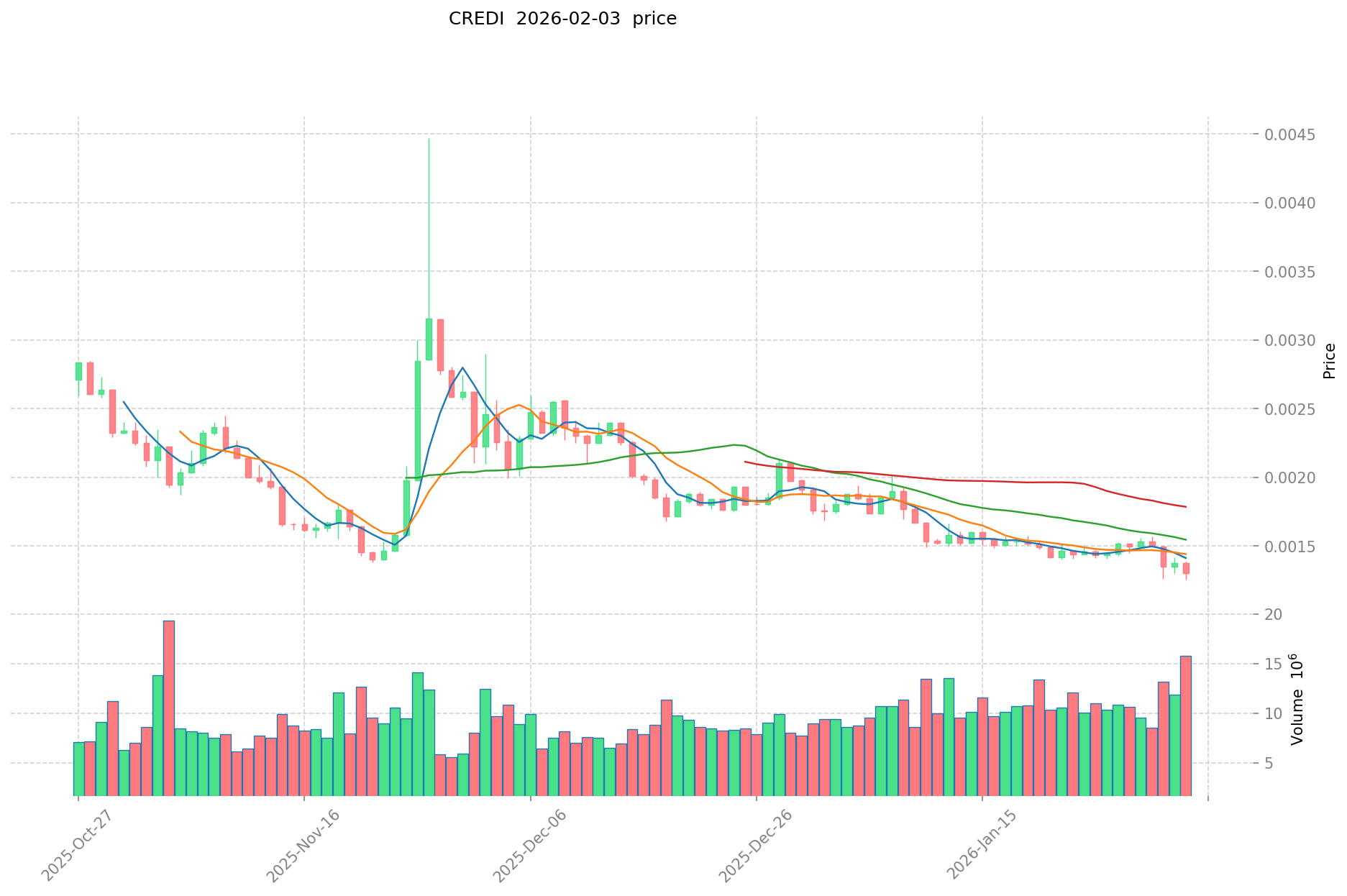
CREDI is an asset in the cryptocurrency field. Launched in December 2021, it has established its presence in the alternative lending and real-world asset (RWA) financing sector. As of February 03, 2026, Credefi holds a market capitalization of approximately $990,363, with a circulating supply of around 748,573,880 tokens, and the current price stands at approximately $0.001323. Positioned as a bridge between Traditional Finance (TradFi) and Decentralized Finance (DeFi), Credefi has become a subject of discussion among investors considering "Is Credefi (CREDI) a good investment?" This article provides a comprehensive analysis of CREDI's investment value, historical trends, future price projections, and associated risks to serve as a reference for investors.
The platform operates as a FinTech solution connecting crypto lenders with small and medium-sized enterprise (SME) borrowers in the real economy, offering loans backed by real-world assets including real estate and future receivables. With 3,647 holders and trading availability on 3 exchanges, CREDI demonstrates a modest but established market presence. The token has experienced notable price fluctuations, with recent performance showing a decline of 1.18% over 24 hours, 9.59% over 7 days, and 29.94% over 30 days. Understanding these market dynamics and the underlying technology is essential for evaluating CREDI's potential in the evolving landscape of blockchain-based lending solutions.
I. CREDI Price History Review and Current Investment Value
- 2024-05-22: CREDI reached a notable price level of $0.03456
- 2026-02-02: Market experienced downward pressure, with CREDI trading at $0.001255
- 2025-2026: Throughout this period, CREDI demonstrated significant volatility, declining from higher levels to current trading ranges
Current CREDI Investment Market Status (February 2026)
- Current CREDI Price: $0.001323
- 24-hour Trading Volume: $20,868.61
- Market Capitalization: $990,363.24
- Circulating Supply: 748,573,880 CREDI
- Market Cap to Fully Diluted Valuation: 74.86%
- Market Dominance: 0.000044%
Click to view real-time CREDI market price
II. Core Factors Influencing Whether CREDI is a Good Investment (Is Credefi(CREDI) a Good Investment)
Supply Mechanism and Scarcity (CREDI Investment Scarcity)
- Supply Structure → Influences price and investment value
- Credefi has a max supply of 1,000,000,000 CREDI tokens, with a current circulating supply of 748,573,880 tokens (74.86% circulation ratio). The controlled token distribution may affect future scarcity dynamics as the remaining supply gradually enters circulation.
- Investment Significance: The relatively high circulation ratio suggests limited future dilution risk, which is a consideration for assessing long-term investment value.
- Price Volatility: CREDI has experienced significant price fluctuations, with a 1-year decline of 84.22% and a 30-day decrease of 29.94%. The token's volatility profile reflects inherent market risks.
- Market Capitalization: With a market cap of $990,363 and ranking #2517, CREDI represents a smaller-cap asset with corresponding liquidity considerations.
- Trading Activity: Daily trading volume of $20,868 indicates modest market participation, which investors should consider when evaluating entry and exit opportunities.
Macroeconomic Environment's Impact on CREDI Investment
- Traditional Finance Integration: Credefi's model bridges Traditional Finance (TradFi) and Decentralized Finance (DeFi) by connecting crypto lenders with SME borrowers in the real economy. This dual positioning may be influenced by broader monetary policy shifts affecting both sectors.
- Real-World Asset Backing: The platform's focus on loans backed by real estate and future receivables provides exposure to physical economic activity, potentially offering some diversification from pure crypto market volatility.
- European SME Financing Gap: Credefi targets the financing needs of European SMEs (which constitute 99% of businesses in Europe), positioning itself within a specific economic niche that may be affected by regional economic conditions and regulatory frameworks.
Technology and Ecosystem Development (Technology & Ecosystem for CREDI Investment)
- Platform Infrastructure: Credefi operates as an alternative lending FinTech solution using ERC20 standard on the Ethereum blockchain, with contract address 0xae6e307c3fe9e922e5674dbd7f830ed49c014c6b.
- Use Case Focus: The platform provides stable and predictable returns from the real economy with stated low correlation to crypto market volatility, targeting a specific lending and borrowing use case.
- Ecosystem Adoption: With 3,647 token holders and availability on 3 exchanges, the current adoption metrics reflect an early-stage ecosystem that may evolve as platform utilization develops.
III. CREDI Future Investment Forecast and Price Outlook (Is Credefi(CREDI) worth investing in 2026-2031)
Short-term Investment Forecast (2026, short-term CREDI investment outlook)
- Conservative forecast: 0.00074424 - 0.001329 USD
- Neutral forecast: 0.001329 - 0.00196692 USD
- Optimistic forecast: 0.00164796 - 0.0020269908 USD
Mid-term Investment Outlook (2027-2029, mid-term Credefi(CREDI) investment forecast)
- Market stage expectation: CREDI may experience gradual price appreciation as the alternative lending sector continues to develop, with potential growth driven by increased adoption of RWA-backed lending solutions and DeFi-TradFi integration initiatives.
- Investment return forecast:
- 2027: 0.0009228576 - 0.0020269908 USD
- 2028: 0.001120859994 - 0.002370343266 USD
- 2029: 0.00143065834644 - 0.00305066853285 USD
- Key catalysts: expansion of SME lending partnerships in European markets, enhancement of real-world asset collateral mechanisms, growth in unutilized crypto liquidity deployment, and regulatory clarity in DeFi lending frameworks.
Long-term Investment Outlook (Is CREDI a good long-term investment?)
- Base scenario: 0.001520600470425 - 0.003015428051522 USD (assuming steady platform growth and sustained demand for alternative financing solutions)
- Optimistic scenario: 0.002796358492223 - 0.003942865474035 USD (assuming accelerated SME adoption, expanded collateral asset types, and favorable regulatory developments)
- Risk scenario: Below 0.001520600470425 USD (in case of reduced market confidence, competitive pressure from traditional lending platforms, or adverse regulatory changes)
Click to view CREDI long-term investment and price forecast: Price Prediction
2026-2031 Long-term Outlook
- Base scenario: 0.001520600470425 - 0.003015428051522 USD (corresponding to steady progress and gradual mainstream application enhancement)
- Optimistic scenario: 0.002796358492223 - 0.003942865474035 USD (corresponding to large-scale adoption and favorable market conditions)
- Transformative scenario: Above 0.003942865474035 USD (if the ecosystem achieves breakthrough developments and mainstream popularization)
- 2031-12-31 forecast high: 0.003942865474035 USD (based on optimistic development assumptions)
Disclaimer: The above forecasts are based on historical data analysis and market trend projections. Cryptocurrency markets are highly volatile and subject to multiple risk factors. These predictions do not constitute investment advice, and actual prices may differ significantly from projections. Investors should conduct independent research and consider their own risk tolerance before making investment decisions.
| Year |
Predicted High Price |
Predicted Average Price |
Predicted Low Price |
Price Change |
| 2026 |
0.00196692 |
0.001329 |
0.00074424 |
0 |
| 2027 |
0.0020269908 |
0.00164796 |
0.0009228576 |
24 |
| 2028 |
0.002370343266 |
0.0018374754 |
0.001120859994 |
38 |
| 2029 |
0.00305066853285 |
0.002103909333 |
0.00143065834644 |
59 |
| 2030 |
0.003015428051522 |
0.002577288932925 |
0.001520600470425 |
94 |
| 2031 |
0.003942865474035 |
0.002796358492223 |
0.001537997170722 |
111 |
IV. CREDI Investment Strategy and Risk Management (How to invest in Alternative Lending Tokens)
Investment Methodology (CREDI investment strategy)
-
Long-term Holding (HODL CREDI): Suitable for conservative investors who believe in the fundamental value proposition of connecting crypto liquidity with real-world SME lending. Given CREDI's focus on real economy integration and asset-backed lending, this approach may appeal to investors seeking exposure to the intersection of traditional and decentralized finance.
-
Active Trading: Relies on technical analysis and swing trading strategies. CREDI has exhibited notable volatility, with price changes ranging from -0.75% (1H) to -84.22% (1Y), presenting potential opportunities for traders who can navigate short-term price movements.
Risk Management (Risk management for CREDI investment)
V. CREDI Investment Risks and Challenges (Risks of investing in Alternative Lending Tokens)
-
Market Risk: CREDI has demonstrated substantial volatility, with a 24-hour trading volume of approximately $20,869 and significant price fluctuations. The token reached a price low of $0.001255 on February 2, 2026, following an 84.22% decline over the past year from historical patterns. The current market capitalization of approximately $990,363 suggests relatively limited liquidity, which may amplify price movements.
-
Regulatory Risk: As a platform bridging traditional finance and DeFi while serving EU SMEs, CREDI operates in a complex regulatory environment. Policy uncertainties across different jurisdictions, particularly regarding alternative lending and crypto-backed financing, may impact operational flexibility and token utility.
-
Technical Risk: The platform's reliance on real-world asset backing and integration between traditional and decentralized systems introduces operational complexities. Potential concerns include smart contract vulnerabilities, oracle dependencies for off-chain asset verification, and challenges in maintaining transparent loan performance data.
-
Business Model Risk: The success of CREDI depends on effective loan origination, credit assessment of SME borrowers, and actual recovery of real-world assets in default scenarios. The gap between fully diluted valuation ($1,243,591) and current market cap suggests significant token supply yet to enter circulation, which may create downward price pressure.
VI. Conclusion: Is Alternative Lending Token a Good Investment?
-
Investment Value Summary: CREDI represents an innovative approach to connecting crypto liquidity with real economy financing needs, addressing a documented gap in SME funding within the EU market. However, the token has experienced considerable price pressure, declining significantly from its historical range. The platform's value proposition relies on successful execution of its lending model and sustained demand from both crypto lenders and SME borrowers.
-
Investor Recommendations:
✅ Beginners: Consider dollar-cost averaging (DCA) if interested in the alternative lending sector, combined with secure wallet storage. Prioritize understanding the platform's lending mechanics and risk factors before committing capital.
✅ Experienced Investors: May explore swing trading opportunities given observed volatility patterns, while maintaining diversified portfolio allocation. Monitor platform metrics such as loan origination volume, default rates, and holder growth (currently 3,647 holders).
✅ Institutional Investors: Should conduct comprehensive due diligence on loan portfolio quality, legal structures for asset backing, and regulatory compliance frameworks before considering strategic allocation.
⚠️ Disclaimer: Cryptocurrency investments carry substantial risk. This analysis is for informational purposes only and does not constitute investment advice. The significant price volatility and relatively small market capitalization of CREDI warrant careful consideration. Investors should conduct independent research and consider their risk tolerance before making investment decisions.
VII. FAQ
Q1: What is Credefi (CREDI) and how does it differ from traditional DeFi lending platforms?
Credefi (CREDI) is a FinTech platform that bridges Traditional Finance (TradFi) and Decentralized Finance (DeFi) by connecting crypto lenders with small and medium-sized enterprise (SME) borrowers in the real economy. Unlike typical DeFi lending platforms that primarily facilitate crypto-to-crypto loans, Credefi focuses on loans backed by real-world assets including real estate and future receivables. This positions it in the alternative lending and RWA (real-world asset) financing sector, targeting the financing gap for European SMEs which constitute 99% of businesses in Europe. The platform operates as an ERC20 token on the Ethereum blockchain.
Q2: Has CREDI demonstrated good historical investment performance?
No, CREDI has experienced substantial price declines from its historical levels. The token reached a notable price of $0.03456 on May 22, 2024, but by February 2, 2026, it had declined to $0.001255, representing an 84.22% decrease over one year. As of February 3, 2026, CREDI trades at approximately $0.001323 with recent performance showing a 1.18% decline over 24 hours, 9.59% over 7 days, and 29.94% over 30 days. The market capitalization stands at approximately $990,363, ranking #2517, indicating a smaller-cap asset with limited liquidity and significant volatility.
Q3: What are the main risks associated with investing in CREDI?
The primary risks include market risk due to substantial volatility and limited liquidity (24-hour trading volume of approximately $20,869); regulatory risk stemming from the complex jurisdictional environment affecting alternative lending and crypto-backed financing; technical risk related to smart contract vulnerabilities and dependencies on oracle systems for off-chain asset verification; and business model risk concerning loan origination effectiveness, credit assessment of SME borrowers, and asset recovery in default scenarios. Additionally, the gap between fully diluted valuation ($1,243,591) and current market cap suggests significant token supply yet to enter circulation, potentially creating downward price pressure.
Q4: What is the price forecast for CREDI in 2026-2031?
Price forecasts vary by timeframe and scenario. For 2026, conservative estimates range from $0.00074424-$0.001329, while optimistic forecasts suggest $0.00164796-$0.0020269908. Mid-term projections for 2027-2029 anticipate gradual appreciation driven by increased adoption of RWA-backed lending solutions, with 2029 estimates ranging from $0.00143065834644-$0.00305066853285. Long-term forecasts through 2031 suggest a base scenario of $0.001520600470425-$0.003015428051522 and an optimistic scenario of $0.002796358492223-$0.003942865474035. However, these projections are highly speculative, and actual prices may differ significantly due to market volatility and multiple risk factors.
Q5: What investment strategy is recommended for CREDI?
Investment strategies depend on risk tolerance and experience level. Conservative investors should consider limiting CREDI exposure to 1-3% of their total crypto portfolio and may explore long-term holding (HODL) if they believe in the platform's value proposition of connecting crypto liquidity with real-world SME lending. Aggressive investors might allocate 5-10% and consider active trading to capitalize on volatility patterns. For beginners, dollar-cost averaging (DCA) combined with secure wallet storage is recommended, while experienced investors may explore swing trading opportunities. All investors should prioritize understanding the platform's lending mechanics, monitor key metrics such as loan origination volume and default rates, and maintain diversified portfolio allocation.
Q6: How secure is storing CREDI tokens, and what are the best practices?
CREDI tokens are ERC-20 standard tokens on the Ethereum blockchain (contract address: 0xae6e307c3fe9e922e5674dbd7f830ed49c014c6b), which can be stored using standard Ethereum-compatible wallets. Best practices include using cold wallets (hardware wallets) for long-term holdings to minimize exposure to online threats, maintaining minimal balances in hot wallets for active trading purposes, and implementing multi-signature solutions where appropriate. Hardware wallets specifically designed for ERC-20 tokens provide enhanced security. Investors should also verify the contract address when interacting with the token to avoid potential scams.
Q7: What factors could drive CREDI's price appreciation in the future?
Potential catalysts for price appreciation include expansion of SME lending partnerships in European markets, enhancement of real-world asset collateral mechanisms, growth in deployment of unutilized crypto liquidity into productive lending activities, regulatory clarity in DeFi lending frameworks, increased platform adoption metrics (currently 3,647 holders), and successful demonstration of stable returns from real economy loans with low correlation to crypto market volatility. Additionally, broader mainstream acceptance of RWA-backed tokens and successful integration between traditional and decentralized finance systems could positively impact CREDI's value proposition.
Q8: Is CREDI suitable for institutional investors?
Institutional investors should approach CREDI with caution and conduct comprehensive due diligence before considering strategic allocation. Critical evaluation areas include loan portfolio quality, legal structures supporting asset backing, regulatory compliance frameworks across relevant jurisdictions, platform track record in loan origination and recovery, and liquidity considerations given the relatively small market capitalization of approximately $990,363. The platform's focus on bridging TradFi and DeFi presents both opportunities and complexities. Institutional investors should assess whether the risk-return profile aligns with their investment mandates and thoroughly review the platform's transparency regarding loan performance data and default rates before making investment decisions.
* The information is not intended to be and does not constitute financial advice or any other recommendation of any sort offered or endorsed by Gate.