This comprehensive analysis evaluates Fly.trade (FLY) as a decentralized finance investment, examining whether this multichain liquidity aggregator represents a viable opportunity. FLY currently trades at $0.01579 with a market capitalization of $206,608.66 on Gate exchange, serving traders, protocols, and agents through optimized cross-chain swap functionality. The article addresses critical investment considerations including token fundamentals with 100,000,000 total supply and only 13.08% in circulation, technical infrastructure on SONIC blockchain, and market potential within the growing DeFi infrastructure sector. Price projections range from $0.0112 to $0.0394 through 2031, depending on adoption scenarios, though the token experienced significant volatility with -97.85% decline over one year. Investment strategies tailored to beginners, experienced traders, and institutional investors are presented alongside comprehensive risk assessment covering market volatility, regulatory uncertainty, and technical
Introduction: Fly.trade (FLY) Investment Position and Market Outlook
Fly.trade (FLY) represents a developing asset in the cryptocurrency landscape, functioning as a multichain liquidity aggregator designed to optimize swap processes for traders, protocols, and agents. As of February 8, 2026, FLY maintains a market capitalization of approximately $206,608.66 with a circulating supply of 13,084,779 tokens, currently trading at around $0.01579. With a total supply of 100,000,000 tokens and a circulating ratio of 13.02%, the token operates within the DeFi infrastructure sector. FLY is listed on 3 exchanges and has attracted 2,468 holders since its market debut. The asset's market share stands at 0.000062%, positioning it at rank 3897 in the broader cryptocurrency market. This article provides a comprehensive analysis of FLY's investment characteristics, historical performance patterns, future price considerations, and associated investment risks to serve as a reference for those evaluating the question "Is Fly.trade (FLY) a good investment?"
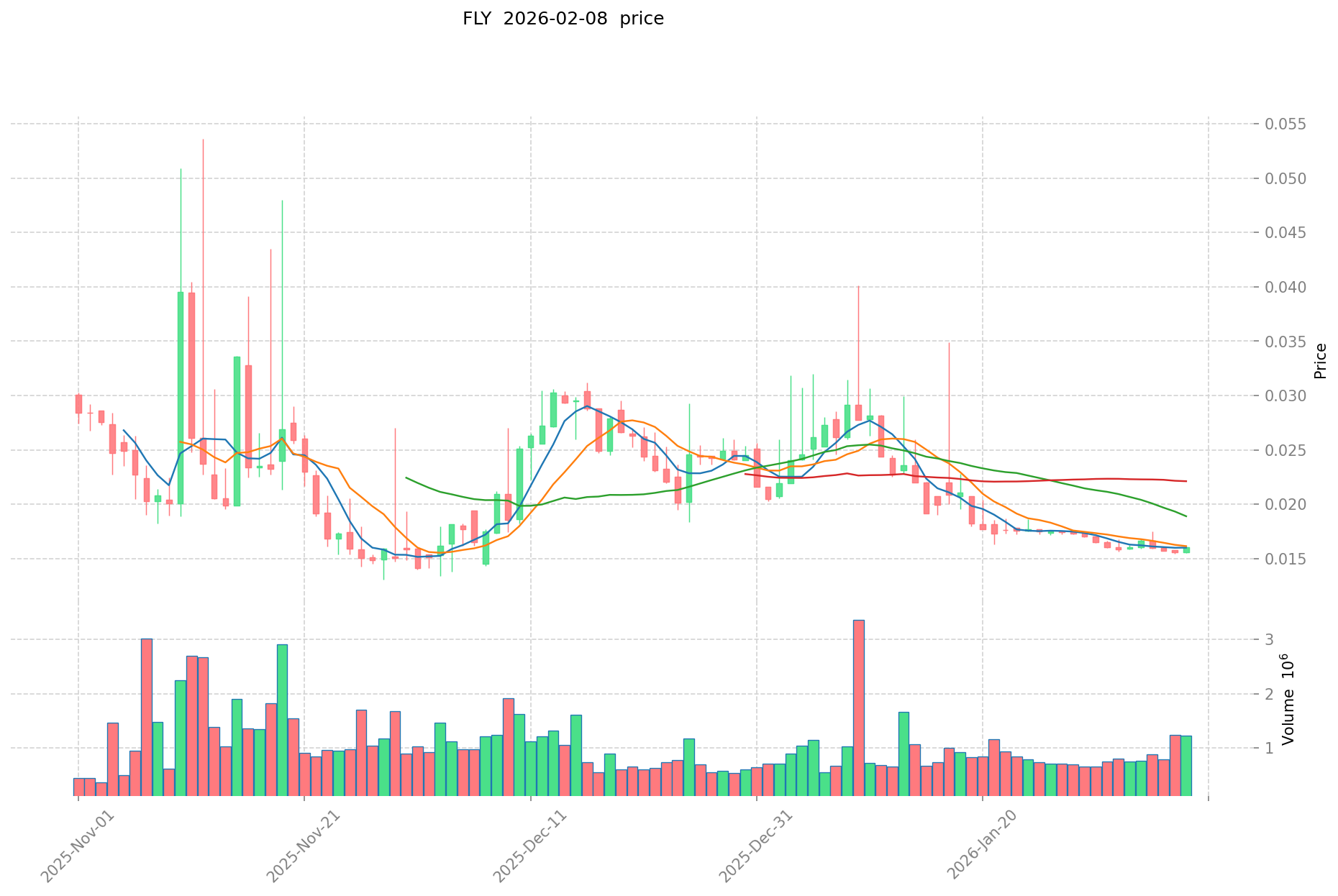
I. FLY Price History Review and Current Investment Value
- 2025: On June 6, the token recorded a notable price level, reflecting early market activity during its initial trading phase.
- 2025: As of late November, FLY experienced significant volatility, with price movements indicating market uncertainty and investor sentiment shifts.
- 2025: Throughout the year, the token showed substantial fluctuations, with prices moving from elevated levels in mid-year to lower ranges by year-end.
Current FLY Investment Market Status (February 2026)
- FLY current price: $0.01579
- 24-hour trading volume: $15,532.14
- Circulating market capitalization: $206,608.66
- Circulation ratio: 13.02% of total supply
Click to view real-time FLY market price
II. Core Factors Affecting Whether FLY is a Good Investment
Supply Mechanism and Scarcity (FLY Investment Scarcity)
- Supply Structure: Fly.trade (FLY) has a maximum supply of 100,000,000 tokens, with a current circulating supply of 13,084,779 tokens, representing approximately 13.02% of the total supply.
- Market Cap Dynamics: The fully diluted valuation stands at $1,579,000, while the current market capitalization is $206,608.66, indicating significant potential supply yet to enter circulation.
- Investment Implication: The relatively low circulating supply ratio suggests potential dilution risk as more tokens enter the market, which investors should monitor when evaluating long-term scarcity dynamics.
Institutional Investment and Mainstream Adoption (Institutional Investment in FLY)
- Holder Distribution: The token currently has 2,468 holders, indicating an emerging user base for this multichain liquidity aggregator.
- Exchange Presence: FLY is listed on 3 exchanges, representing limited but growing accessibility for investors seeking exposure to the asset.
- Market Positioning: As a liquidity aggregator optimizing swaps for traders, protocols, and agents, Fly.trade serves a functional role within the decentralized finance ecosystem, though mainstream institutional adoption data remains limited in available materials.
Technology and Ecosystem Development (Technology & Ecosystem for FLY Investment)
- Technical Infrastructure: FLY operates on the SONIC blockchain, with the primary contract address deployed at 0x6c9b3a74ae4779da5ca999371ee8950e8db3407f on the Sonic network.
- Core Functionality: The platform functions as a multichain liquidity aggregator designed to optimize swap execution for various market participants, potentially supporting broader DeFi ecosystem integration.
- Ecosystem Role: By providing seamless user experience for token swaps across multiple chains, Fly.trade addresses liquidity fragmentation challenges that may influence its utility-driven investment value over time.
III. FLY Future Investment Forecast and Price Outlook (Is Fly.trade (FLY) Worth Investing in 2026-2031)
Short-term Investment Forecast (2026, Short-term FLY Investment Outlook)
- Conservative Estimate: $0.0112 - $0.0158
- Neutral Estimate: $0.0158 - $0.0183
- Optimistic Estimate: $0.0183 - $0.0209
Mid-term Investment Outlook (2027-2029, Mid-term Fly.trade (FLY) Investment Forecast)
-
Market Stage Expectation: During the 2027-2029 period, FLY may experience moderate price fluctuations as the multichain liquidity aggregator sector continues to evolve. Adoption trends and ecosystem developments could influence price behavior.
-
Investment Return Forecast:
- 2027: $0.0094 - $0.0233
- 2028: $0.0183 - $0.0256
- 2029: $0.0197 - $0.0307
-
Key Catalysts: Factors such as protocol integrations, trading volume growth, and broader market sentiment toward decentralized finance (DeFi) solutions may serve as potential catalysts.
Long-term Investment Outlook (Is FLY a Good Long-term Investment?)
- Base Scenario: $0.0171 - $0.0329 (Assumes steady development and moderate ecosystem growth)
- Optimistic Scenario: $0.0329 - $0.0394 (Assumes increased adoption and favorable market conditions)
- Risk Scenario: $0.0094 - $0.0171 (Considers potential market downturns or slower-than-expected adoption)
Click to view FLY long-term investment and price forecast: Price Prediction
2026-02-08 to 2031 Long-term Outlook
- Base Scenario: $0.0171 - $0.0329 (Corresponds to steady progress and gradual mainstream application growth)
- Optimistic Scenario: $0.0269 - $0.0394 (Corresponds to large-scale adoption and favorable market environment)
- Transformative Scenario: Above $0.0394 (If the ecosystem achieves breakthrough developments and mainstream penetration)
- 2031-12-31 Predicted High: $0.0394 (Based on optimistic development assumptions)
Disclaimer: The above forecast is based on historical data and market analysis and does not constitute investment advice. Cryptocurrency markets are highly volatile, and actual prices may differ from predictions.
| Year |
Predicted High Price |
Predicted Average Price |
Predicted Low Price |
Price Change |
| 2026 |
0.0208824 |
0.01582 |
0.0112322 |
0 |
| 2027 |
0.023306024 |
0.0183512 |
0.009359112 |
16 |
| 2028 |
0.02561919276 |
0.020828612 |
0.01832917856 |
31 |
| 2029 |
0.0306555511416 |
0.02322390238 |
0.019740317023 |
47 |
| 2030 |
0.038793206535552 |
0.0269397267608 |
0.026131534957976 |
70 |
| 2031 |
0.039439759977811 |
0.032866466648176 |
0.017090562657051 |
108 |
IV. FLY Investment Strategy and Risk Management (How to invest in FLY)
Investment Methodology (FLY investment strategy)
-
Long-term Holding (HODL FLY): Suitable for conservative investors seeking to benefit from potential long-term value appreciation. This approach requires patience and belief in the project's fundamental value proposition as a multichain liquidity aggregator.
-
Active Trading: Relies on technical analysis and swing trading strategies. Given FLY's price volatility, traders may capitalize on short-term price movements by analyzing chart patterns, support and resistance levels, and market momentum indicators.
Risk Management (Risk management for FLY investment)
V. FLY Investment Risks and Challenges (Risks of investing in FLY)
-
Market Risk: FLY exhibits substantial price volatility with a 30-day change of -48.6%. The relatively low market cap of approximately $206,609 may contribute to increased susceptibility to significant price swings. The limited circulating supply (13.08% of total supply) could also impact liquidity dynamics.
-
Regulatory Risk: As with all digital assets, FLY faces regulatory uncertainty across different jurisdictions. Evolving regulatory frameworks for decentralized finance protocols and liquidity aggregators may impact the token's adoption and trading accessibility.
-
Technical Risk: As a multichain liquidity aggregator, FLY depends on the security and reliability of multiple blockchain networks and smart contract protocols. Potential vulnerabilities in cross-chain bridge technologies, smart contract exploits, or integration failures could pose technical challenges to the platform's operations.
VI. Conclusion: Is FLY a Good Investment?
-
Investment Value Summary: FLY operates in the growing DeFi liquidity aggregation sector, which addresses genuine market needs for optimized swap experiences. However, the token has experienced significant price decline with a 1-year change of -97.85%, indicating substantial market challenges. The project's success depends on continued adoption by traders, protocols, and agents seeking efficient multichain liquidity solutions.
-
Investor Recommendations:
✅ Beginners: Consider dollar-cost averaging (DCA) strategy with small, regular investments rather than lump-sum purchases. Prioritize secure wallet storage and thoroughly research the project fundamentals before investing.
✅ Experienced Investors: Employ swing trading strategies during volatile periods while maintaining a diversified portfolio. Monitor on-chain metrics, trading volume patterns, and protocol development updates for informed decision-making.
✅ Institutional Investors: Evaluate FLY as part of a broader DeFi infrastructure allocation strategy. Conduct comprehensive due diligence on team credentials, tokenomics structure, and competitive positioning within the liquidity aggregation landscape.
⚠️ Disclaimer: Cryptocurrency investments carry substantial risk due to market volatility and regulatory uncertainty. This content is provided for informational purposes only and does not constitute financial, investment, or trading advice. Investors should conduct independent research and consider their risk tolerance before making investment decisions.
VII. FAQ
Q1: What is the current market position of Fly.trade (FLY) and its key metrics?
As of February 8, 2026, FLY is trading at approximately $0.01579 with a market capitalization of $206,608.66 and ranks #3897 in the cryptocurrency market. The token has a total supply of 100,000,000 tokens with only 13.08% (13,084,779 tokens) currently in circulation, creating a fully diluted valuation of $1,579,000. FLY is listed on 3 exchanges with 2,468 holders and maintains a 24-hour trading volume of $15,532.14. The project operates on the SONIC blockchain as a multichain liquidity aggregator designed to optimize swap processes for traders, protocols, and agents within the DeFi ecosystem.
Q2: How has FLY performed historically and what explains its significant price decline?
FLY has experienced substantial price volatility since its market debut, with a 1-year change of -97.85% and a 30-day decline of -48.6%. The token showed elevated price levels during mid-2025 following its initial trading phase, but subsequently experienced significant downward pressure through the end of 2025 and into early 2026. This dramatic price decline can be attributed to several factors including market-wide cryptocurrency corrections, limited exchange listings, relatively low holder count, and potential challenges in achieving widespread adoption for its liquidity aggregation services. The low circulating supply ratio (13.08%) may also contribute to liquidity constraints and amplified price movements.
Q3: What are the projected price ranges for FLY from 2026 to 2031?
Based on market analysis models, FLY's short-term outlook for 2026 ranges from $0.0112 (conservative) to $0.0209 (optimistic). Mid-term forecasts suggest 2027 prices between $0.0094-$0.0233, 2028 at $0.0183-$0.0256, and 2029 reaching $0.0197-$0.0307. Long-term projections for 2030-2031 span from $0.0171-$0.0394 under base and optimistic scenarios, with a predicted high of $0.0394 by December 31, 2031. These forecasts assume various adoption scenarios including steady ecosystem development (base case), increased mainstream adoption (optimistic case), and potential breakthrough integrations (transformative scenario). It's important to note that cryptocurrency markets are highly volatile and actual performance may differ significantly from these projections.
Q4: What investment strategies are recommended for different types of FLY investors?
For beginners, a dollar-cost averaging (DCA) approach is recommended, making small regular purchases rather than lump-sum investments while prioritizing secure wallet storage. Experienced investors should consider swing trading strategies during volatile periods while maintaining portfolio diversification, monitoring on-chain metrics, trading volumes, and protocol development updates. Institutional investors should evaluate FLY as part of a broader DeFi infrastructure allocation strategy with comprehensive due diligence on team credentials, tokenomics, and competitive positioning. Regarding asset allocation, conservative investors should limit FLY to 1-3% of their crypto portfolio, moderate investors to 3-7%, and aggressive investors to 7-15%, always employing risk management tools such as stop-loss orders and diversification across multiple digital assets.
Q5: What are the primary risks associated with investing in FLY?
FLY investment carries three major risk categories. Market risk is substantial given the token's high volatility (-48.6% in 30 days), relatively low market capitalization of approximately $206,609, and limited circulating supply which impacts liquidity. Regulatory risk stems from evolving regulatory frameworks for DeFi protocols and liquidity aggregators across different jurisdictions, potentially affecting adoption and trading accessibility. Technical risk involves the project's dependence on multiple blockchain networks and smart contract protocols, exposing it to potential vulnerabilities in cross-chain bridge technologies, smart contract exploits, or integration failures. Additionally, the limited exchange listings (only 3 exchanges) and small holder base (2,468 holders) represent liquidity and adoption risks that investors should carefully consider.
Q6: What factors could drive FLY's future value appreciation?
FLY's potential value drivers include several ecosystem and market factors. Protocol integrations with established DeFi platforms could expand utility and trading volume, while increased adoption by traders, protocols, and agents seeking efficient multichain liquidity solutions would drive organic demand. The growing DeFi infrastructure sector presents opportunities as liquidity aggregation addresses genuine market needs for optimized cross-chain swap experiences. Additional catalysts include potential listings on major exchanges improving accessibility, increased token circulation from the current 13.08% ratio, successful technical developments addressing cross-chain interoperability challenges, and favorable broader cryptocurrency market conditions. However, these factors remain speculative and investors should evaluate them against the significant historical price decline and current market challenges.
Q7: How does FLY's tokenomics structure impact its long-term investment potential?
FLY's tokenomics present both opportunities and concerns for long-term investors. The maximum supply of 100,000,000 tokens provides a clear scarcity ceiling, but the current circulating supply of only 13.08% means approximately 87 million tokens remain to enter the market, creating substantial dilution risk. The fully diluted valuation of $1,579,000 compared to the current market cap of $206,608.66 represents a 7.6x difference, suggesting significant downward price pressure if additional tokens are released without corresponding demand growth. This supply structure requires investors to monitor token unlock schedules, vesting mechanisms, and team/ecosystem allocation releases. The relatively concentrated supply could support price appreciation if demand increases before significant supply expansion, but represents a structural challenge requiring careful evaluation in any long-term investment thesis.
Q8: What technical infrastructure and ecosystem positioning distinguish FLY in the DeFi landscape?
FLY operates on the SONIC blockchain with its primary contract deployed at address 0x6c9b3a74ae4779da5ca999371ee8950e8db3407f, positioning itself as a multichain liquidity aggregator that optimizes swap execution across different blockchain networks. This infrastructure addresses liquidity fragmentation challenges in the DeFi ecosystem by providing seamless token swap experiences for traders, protocols, and agents. The multichain approach differentiates FLY from single-chain solutions, potentially offering broader utility as blockchain interoperability becomes increasingly important. However, this technical positioning also creates dependencies on multiple networks' security and reliability, cross-chain bridge technologies, and smart contract protocol integrity. The project's success depends on effectively balancing technical complexity with user experience while competing against established liquidity aggregation solutions from larger DeFi protocols.
* The information is not intended to be and does not constitute financial advice or any other recommendation of any sort offered or endorsed by Gate.