Is Think Protocol (THINK) a good investment?: A Comprehensive Analysis of Tokenomics, Use Cases, and Market Potential

Introduction: Think Protocol (THINK)'s Investment Position and Market Outlook
THINK represents an emerging digital asset in the cryptocurrency space, positioning itself as a foundational protocol for AI agent interoperability. As of February 06, 2026, THINK maintains a market capitalization of approximately $356,650, with a circulating supply of 700,000,000 tokens out of a maximum supply of 1,000,000,000 tokens. The current trading price stands at around $0.0005095, reflecting a circulating supply ratio of 70%. With its focus on connecting AI agents to open-source tools, models, and protocols, THINK aims to establish itself within the agent-powered internet infrastructure sector. The token operates on the Ethereum network and is held by approximately 2,173 addresses. This article examines THINK's investment characteristics, historical price movements, potential future trajectories, and associated risks to provide analytical perspective for those evaluating "Is Think Protocol (THINK) a good investment?"
I. THINK Price History Review and Current Investment Value
THINK Historical Price Performance and Investment Returns (Think Protocol (THINK) Investment Performance)
THINK Protocol has experienced notable volatility since its market debut, reflecting the broader dynamics of emerging crypto assets in the AI agent infrastructure sector.
- 2025: Market Launch and Initial Growth → THINK reached a price level of $0.03576 on July 29, 2025, representing an early phase of market interest and adoption
- 2025: Price Correction Period → Following the peak in July, the token entered a downward trend, declining to $0.0005001 by October 2025
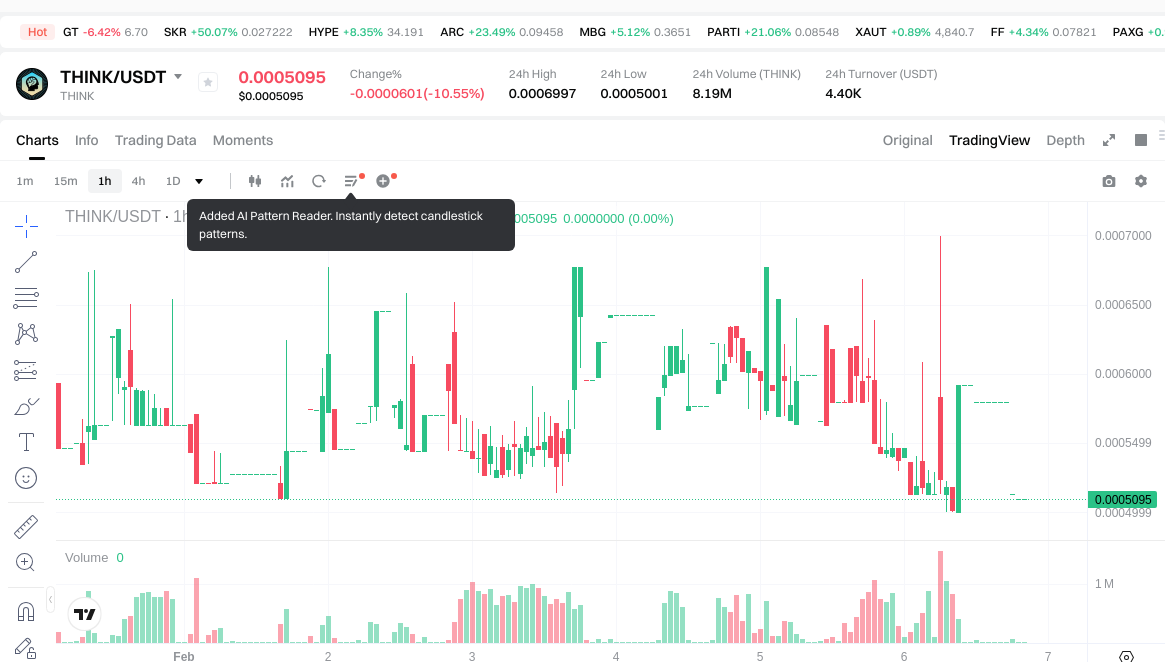
- 2026: Stabilization Phase → As of early February 2026, THINK trades at approximately $0.0005095, showing signs of price stabilization after significant earlier volatility
The token's price movement from its higher levels in mid-2025 to current values represents a decline of approximately 98.6% from earlier price points, illustrating the challenges faced by newly launched crypto assets in establishing sustained market value.
Current THINK Investment Market Status (February 2026)
- THINK Current Price: $0.0005095
- 24-Hour Trading Volume: $4,478.09
- Market Capitalization: $356,650
- Circulating Supply: 700,000,000 THINK (70% of total supply)
- Fully Diluted Market Cap: $509,500
- Holder Count: 2,173 addresses
- Exchange Listings: Available on 2 platforms
The token demonstrates relatively modest trading activity with limited exchange presence. The current market capitalization places THINK outside mainstream crypto asset rankings, with a market share of 0.000021%. Recent price changes show a decline of 7.04% over 24 hours, 14.12% over 7 days, and 78.35% over 30 days, indicating ongoing downward pressure.
Click to view real-time THINK market price
II. Core Factors Affecting Whether THINK is a Good Investment
Supply Mechanism and Scarcity (THINK Investment Scarcity)
- Fixed supply cap of 1,000,000,000 tokens → influences price dynamics and investment value
- Current circulating supply of 700,000,000 tokens represents 70% of maximum supply
- Investment significance: scarcity mechanism may provide support for long-term value consideration
Macro-Economic Environment Impact on THINK Investment
- Market volatility and risk factors → affect investment attractiveness
- Current price trends show significant downward movement: -7.04% (24H), -14.12% (7D), -78.35% (30D), -99.41% (1Y)
- Market capitalization of $356,650 reflects relatively small market presence
- Investment consideration: broader crypto market conditions influence THINK's risk-return profile
Technology and Ecosystem Development (Technology & Ecosystem for THINK Investment)
- AI agent connectivity infrastructure: enables connection to open-source tools, models, and protocols
- Interoperability focus: designed to support composable intelligence across agent-powered systems
- User ownership emphasis: protocol architecture prioritizes user data control
- Developer-oriented design: permissionless innovation framework for builders and creators
- Investment significance: technology foundation and ecosystem adoption may influence long-term value trajectory
III. THINK Future Investment Forecast and Price Outlook (Is Think Protocol(THINK) worth investing in 2026-2031)
Short-term Investment Forecast (2026, short-term THINK investment outlook)
- Conservative forecast: $0.00029 - $0.00043
- Neutral forecast: $0.00043 - $0.00051
- Optimistic forecast: $0.00051 - $0.00064
Based on the current price of $0.0005095 as of February 6, 2026, short-term projections for 2026 suggest limited volatility within the current trading range. The conservative scenario assumes continued market pressure and low trading volume ($4,478 in 24h volume), while the optimistic scenario factors in potential recovery from recent declines.
Mid-term Investment Outlook (2027-2029, mid-term Think Protocol(THINK) investment forecast)
-
Market stage expectation: THINK may experience gradual recovery and ecosystem development during this period, with the protocol working to expand its AI agent connectivity network and enhance interoperability features.
-
Investment return forecast:
- 2027: $0.00044 - $0.00072 (potential 12% annual increase)
- 2028: $0.00043 - $0.00069 (estimated 27% cumulative growth from 2026)
- 2029: $0.00036 - $0.00081 (projected 31% cumulative increase)
-
Key catalysts: Development of the open-source tools ecosystem, expansion of AI agent adoption, platform upgrades enhancing composable intelligence features, and increased developer community engagement.
Long-term Investment Outlook (Is THINK a good long-term investment?)
- Baseline scenario: $0.00053 - $0.00093 (assuming steady ecosystem growth and moderate market conditions through 2030-2031)
- Optimistic scenario: $0.00075 - $0.0012 (based on significant adoption of the protocol's AI agent connectivity features and favorable crypto market conditions)
- Risk scenario: $0.00028 - $0.00050 (under challenging market conditions or slower-than-expected ecosystem development)
Click to view THINK long-term investment and price forecast: Price Prediction
2026-2031 Long-term Outlook
- Base scenario: $0.00053 - $0.00074 (corresponding to steady progress and gradual mainstream application growth)
- Optimistic scenario: $0.00075 - $0.0012 (corresponding to large-scale adoption and favorable market environment)
- Transformative scenario: Above $0.0015 (if ecosystem achieves breakthrough developments and mainstream adoption)
- Predicted high point by December 31, 2031: $0.0012 (based on optimistic development assumptions)
Disclaimer: This analysis is for informational purposes only and should not be considered financial advice. Cryptocurrency investments carry substantial risk, and past performance does not guarantee future results. The projections are based on available data as of February 6, 2026, and actual outcomes may differ materially. Investors should conduct their own research and consider their risk tolerance before making investment decisions.
| Year | Predicted High Price | Predicted Average Price | Predicted Low Price | Price Change |
|---|---|---|---|---|
| 2026 | 0.000636875 | 0.0005095 | 0.00028532 | 0 |
| 2027 | 0.00072221625 | 0.0005731875 | 0.0004356225 | 12 |
| 2028 | 0.00069304100625 | 0.000647701875 | 0.0004274832375 | 27 |
| 2029 | 0.000811149443156 | 0.000670371440625 | 0.000355296863531 | 31 |
| 2030 | 0.000925950552363 | 0.00074076044189 | 0.000533347518161 | 45 |
| 2031 | 0.00118336480592 | 0.000833355497126 | 0.000750019947414 | 63 |
IV. THINK Investment Strategy and Risk Management (How to invest in AI Agent Protocol)
Investment Methodology (THINK investment strategy)
Long-term Holding (HODL THINK)
For conservative investors seeking exposure to the AI agent infrastructure sector, a long-term holding strategy may be considered. This approach involves:
- Accumulating positions during market corrections or consolidation periods
- Focusing on the protocol's fundamental development rather than short-term price movements
- Monitoring ecosystem adoption metrics, including the number of integrated tools, active agents, and developer participation
- Setting predetermined time horizons (e.g., 12-24 months) to evaluate the protocol's progress
Given THINK's relatively early stage and significant price volatility (with a 99.41% decline over the past year), investors should maintain realistic expectations and avoid overexposure.
Active Trading
For traders with technical analysis capabilities, active trading strategies may include:
- Identifying support and resistance levels based on historical price action
- Utilizing momentum indicators to capture short-term price swings
- Implementing stop-loss orders to limit downside exposure
- Monitoring trading volume patterns as confirmation signals
Traders should note that THINK's 24-hour trading volume of approximately $4,478 indicates relatively limited liquidity, which may result in wider bid-ask spreads and increased slippage during execution.
Risk Management (Risk management for THINK investment)
Asset Allocation Ratio
Conservative Investors:
- Allocation: 0.5-1% of total crypto portfolio
- Rationale: Experimental exposure to AI agent infrastructure without significant capital risk
Aggressive Investors:
- Allocation: 2-5% of total crypto portfolio
- Rationale: Higher conviction in the AI agent narrative while maintaining diversification
Professional Investors:
- Allocation: Subject to individual risk tolerance and portfolio construction methodology
- Rationale: May include derivatives and hedging strategies for enhanced risk-adjusted returns
Risk Hedging Solutions
- Multi-asset Portfolio: Combining THINK with established cryptocurrencies (e.g., BTC, ETH) and other AI-focused tokens to reduce unsystematic risk
- Defensive Tools: Utilizing stablecoins as safe-haven assets during market downturns
- Position Sizing: Implementing dollar-cost averaging (DCA) to mitigate timing risk
- Rebalancing: Periodic portfolio adjustments to maintain target allocation ratios
Secure Storage
THINK tokens are deployed on the Ethereum network (contract address: 0xf9ff95468cb9a0cd57b8542bbc4c148e290ff465). Recommended storage solutions include:
Cold Wallets:
- Hardware wallets (e.g., Ledger, Trezor) for long-term holdings
- Paper wallets for offline storage (advanced users only)
Hot Wallets:
- MetaMask or Trust Wallet for active trading and ecosystem interaction
- Exchange wallets for short-term trading positions (with awareness of custodial risks)
Best Practices:
- Never share private keys or seed phrases
- Enable two-factor authentication (2FA) on all accounts
- Verify contract addresses before transactions
- Consider multi-signature wallets for larger holdings
V. THINK Investment Risks and Challenges (Risks of investing in AI Agent Protocol)
Market Risk
High Volatility: THINK has demonstrated substantial price fluctuations, with a 7.04% decline in 24 hours and a 78.35% decrease over 30 days. The token's price ranged from $0.0005001 to $0.0006997 within a single day, indicating significant intraday volatility. The historical high of $0.03576 (recorded on July 29, 2025) compared to the current price of $0.0005095 reflects a decline of approximately 98.6%.
Price Manipulation Risk: With a relatively modest market capitalization of approximately $356,650 and limited trading volume, THINK may be susceptible to price manipulation by large holders or coordinated trading activities. The circulating supply of 700 million tokens (70% of total supply) suggests potential selling pressure if large holders decide to liquidate positions.
Regulatory Risk
Policy Uncertainty Across Jurisdictions:
- Evolving regulations regarding AI-related tokens and decentralized protocols
- Potential classification changes that may affect trading, taxation, or accessibility
- Varying compliance requirements in different countries that could impact global adoption
- Potential restrictions on AI agent protocols interacting with financial services
Technical Risk
Network Security Vulnerabilities:
- Smart contract risks inherent in the Ethereum-based token deployment
- Potential exploits in integrated tools, models, or protocols within the THINK ecosystem
- Dependencies on external protocols and infrastructure that may introduce systemic risks
Upgrade and Development Risks:
- Implementation challenges in expanding the open-source tool network
- Potential technical bottlenecks in achieving interoperability goals
- Competition from established AI infrastructure providers and emerging protocols
- Adoption risks if developer and community participation does not meet expectations
VI. Conclusion: Is AI Agent Protocol a Good Investment?
Investment Value Summary
THINK represents an infrastructure play in the emerging AI agent ecosystem, positioning itself as a protocol layer connecting agents to open-source tools, models, and services. While the project addresses the growing demand for composable AI intelligence and user-owned data frameworks, investors should note the token's substantial price decline and limited liquidity.
The protocol's vision of creating a permissionless, agent-powered internet infrastructure aligns with broader trends in decentralized AI and Web3 convergence. However, the early-stage nature of both the project and the AI agent sector introduces considerable uncertainty regarding adoption timelines and competitive dynamics.
Investor Recommendations
✅ Beginners:
- Consider dollar-cost averaging with minimal position sizes (0.5-1% of portfolio)
- Prioritize secure storage using hardware wallets
- Focus on learning about AI agent infrastructure before significant capital allocation
- Avoid emotional decision-making during volatile price movements
✅ Experienced Investors:
- Implement technical analysis for short-term trading opportunities
- Maintain diversified exposure across multiple AI and infrastructure tokens
- Monitor protocol development updates and ecosystem metrics
- Set clear entry and exit criteria based on risk tolerance
✅ Institutional Investors:
- Evaluate THINK as part of a broader AI infrastructure thesis
- Conduct thorough due diligence on team, technology, and competitive positioning
- Consider strategic allocation within venture or thematic portfolios
- Assess liquidity constraints and position sizing limitations
⚠️ Disclaimer: Cryptocurrency investments carry substantial risk, including potential loss of principal. This content is for informational purposes only and does not constitute investment advice. Investors should conduct independent research and consult with qualified financial advisors before making investment decisions.
VII. FAQ
Q1: What is the current market position of Think Protocol (THINK) as an investment?
As of February 2026, THINK trades at approximately $0.0005095 with a market capitalization of $356,650, positioning it as a micro-cap cryptocurrency asset. The token has experienced significant volatility, declining approximately 98.6% from its July 2025 high of $0.03576. With only 2,173 holder addresses and $4,478 in 24-hour trading volume, THINK represents a highly speculative investment with limited liquidity. The protocol focuses on AI agent interoperability infrastructure, operating on the Ethereum network with 700 million tokens in circulation (70% of total supply).
Q2: What are the primary factors that could influence THINK's investment value?
Three core factors impact THINK's investment outlook: First, its fixed supply mechanism of 1 billion tokens creates a scarcity framework that may support long-term valuation. Second, the protocol's technical development in AI agent connectivity and composable intelligence could drive ecosystem adoption. Third, broader cryptocurrency market conditions significantly affect its risk-return profile, as evidenced by recent declines of 78.35% over 30 days. The protocol's success depends on expanding its open-source tools network, developer community engagement, and achieving meaningful adoption within the AI agent infrastructure sector.
Q3: What are the short-term and long-term price projections for THINK?
For 2026, conservative estimates suggest a range of $0.00029-$0.00043, neutral forecasts indicate $0.00043-$0.00051, and optimistic scenarios project $0.00051-$0.00064. Mid-term projections show potential growth to $0.00044-$0.00072 by 2027 and $0.00036-$0.00081 by 2029, representing possible cumulative increases of 12-31% from current levels. Long-term forecasts through 2031 range from $0.00028-$0.00050 in risk scenarios to $0.00075-$0.0012 in optimistic scenarios, with a transformative scenario exceeding $0.0015 if breakthrough adoption occurs. These projections assume varying degrees of ecosystem development and market conditions.
Q4: What investment strategies are suitable for different types of THINK investors?
Conservative investors should consider allocating 0.5-1% of their crypto portfolio to THINK using dollar-cost averaging during market corrections, focusing on long-term ecosystem fundamentals. Aggressive investors may allocate 2-5% while implementing active trading strategies based on technical analysis, though they should note the limited liquidity of $4,478 in 24-hour volume. Both approaches require secure storage solutions, preferably hardware wallets for long-term holdings. Investors should monitor ecosystem adoption metrics including integrated tools, active agents, and developer participation rather than solely focusing on short-term price movements.
Q5: What are the major risks associated with investing in THINK?
THINK carries substantial market risk with demonstrated volatility of 7.04% decline in 24 hours and 78.35% decrease over 30 days. The modest market capitalization of $356,650 makes it susceptible to price manipulation by large holders. Regulatory uncertainty surrounding AI-related tokens and decentralized protocols poses policy risks across different jurisdictions. Technical risks include smart contract vulnerabilities, dependencies on external protocols, and implementation challenges in achieving interoperability goals. The early-stage nature of both THINK and the AI agent sector introduces considerable adoption uncertainty and competitive pressures from established infrastructure providers.
Q6: How does THINK's supply mechanism affect its investment characteristics?
THINK implements a fixed maximum supply of 1 billion tokens, with 700 million currently in circulation representing 70% of total supply. This scarcity mechanism may provide support for long-term value considerations as demand increases relative to fixed supply. However, the 30% remaining supply introduces potential selling pressure if released to the market. The circulating supply ratio of 70% is relatively high compared to some crypto assets, suggesting that significant supply inflation is less likely in the near term, though investors should monitor any planned token releases or vesting schedules that could impact market dynamics.
Q7: What technical infrastructure and ecosystem features distinguish THINK as an investment?
THINK positions itself as foundational infrastructure for AI agent interoperability, enabling connections to open-source tools, models, and protocols. The protocol emphasizes composable intelligence across agent-powered systems and prioritizes user ownership of data. Its permissionless innovation framework targets developers and creators building within the AI agent ecosystem. The Ethereum-based deployment (contract address: 0xf9ff95468cb9a0cd57b8542bbc4c148e290ff465) provides established network security and compatibility. Investment value depends on the protocol's ability to expand its open-source tool network, attract developer participation, and achieve meaningful adoption in the emerging AI agent infrastructure sector.
Q8: Is THINK suitable for different investor profiles and what are the recommended allocation strategies?
For beginners, THINK represents a high-risk exposure requiring minimal position sizes of 0.5-1% of portfolio with emphasis on secure storage and education about AI agent infrastructure before significant capital allocation. Experienced investors may implement 2-5% allocations using technical analysis for trading opportunities while maintaining diversification across multiple AI infrastructure tokens. Institutional investors should evaluate THINK within broader AI infrastructure theses, conducting thorough due diligence on team, technology, and competitive positioning while assessing liquidity constraints. All investor types should establish clear entry and exit criteria based on individual risk tolerance and avoid overexposure given the token's speculative nature and limited market presence.
Share
Content
Introduction: Think Protocol (THINK)'s Investment Position and Market Outlook
I. THINK Price History Review and Current Investment Value
II. Core Factors Affecting Whether THINK is a Good Investment
III. THINK Future Investment Forecast and Price Outlook (Is Think Protocol(THINK) worth investing in 2026-2031)
IV. THINK Investment Strategy and Risk Management (How to invest in AI Agent Protocol)
V. THINK Investment Risks and Challenges (Risks of investing in AI Agent Protocol)
VI. Conclusion: Is AI Agent Protocol a Good Investment?
VII. FAQ
How to Buy Cryptocurrency


Trending Cryptocurrencies



Survey Note: Detailed Analysis of the Best AI in 2025

What Is the Best AI Crypto in 2025?

What is the Best AI Now?
Why ChatGPT is Likely the Best AI Now?
How Does Solidus Ai Tech's Market Cap Compare to Other AI Cryptocurrencies?

MomoAI: AI-Powered Social Gaming Revolution on Solana

What is HARD: Understanding the Challenges of Achieving Excellence in Modern Work Environments

What is NC: A Comprehensive Guide to Numerical Control Technology in Modern Manufacturing

What is ANLOG: A Comprehensive Guide to Analog Signal Processing and Its Modern Applications
2026 SUDO Price Prediction: Expert Analysis and Market Forecast for the Next Generation of Blockchain Governance Tokens
Who is Satoshi Nakamoto, and who created Bitcoin?