What is GTAI: A Comprehensive Guide to Graph-based Transformer Artificial Intelligence

GT-Protocol's Positioning and Significance
In 2024, the GT-Protocol team launched GT-Protocol (GTAI), aiming to address barriers to sophisticated investment strategies in crypto markets and the complexity of navigating CeFi, DeFi, and NFT ecosystems. As an AI-powered Web3 execution layer, GT-Protocol plays a key role in AI-driven portfolio management, trading automation, and democratizing investment access.
As of 2026, GT-Protocol has established itself within the Web3 AI infrastructure landscape, with deployment on BSC and integration capabilities across Web3 and Web2 platforms. This article will deeply analyze its technical architecture, market performance, and future potential.
Origin and Development History
Birth Background
GT-Protocol was created by its development team in 2024, aiming to solve the accessibility gap in sophisticated investment strategies and the fragmented user experience across CeFi, DeFi, and NFT markets. It emerged during the rapid evolution of AI technology and growing demand for user-friendly Web3 interfaces, with the goal of democratizing investment opportunities through an AI conversational interface that responds to prompts and voice commands. GT-Protocol's launch brought new possibilities for retail investors and users seeking simplified access to complex crypto investment strategies.
Key Milestones
- January 2024: Token launch with an initial offering price of $0.2, establishing the foundation for its AI execution platform.
- March 2024: Token reached a significant price level reflecting early market interest in AI-powered Web3 solutions.
- 2024-2026: Platform development continued with focus on seamless integration with both Web3 and Web2 platforms, working toward the mission of onboarding users to its AI Layer for Web3.
With support from its development community and growing holder base of over 18,000 addresses, GT-Protocol continues to refine its technology and expand its ecosystem applications.
How GT-Protocol Works
Decentralized Infrastructure
GT-Protocol operates on blockchain infrastructure, specifically deployed on BSC (Binance Smart Chain), enabling it to function without central control from traditional financial institutions. This decentralized approach allows the platform to provide AI-powered investment services while maintaining transparency and giving users greater autonomy over their investment decisions.
Blockchain Foundation
GT-Protocol utilizes the BSC blockchain as its underlying infrastructure, leveraging its public and immutable ledger to record transactions. The BEP20 token standard ensures compatibility with the broader BSC ecosystem, allowing seamless interaction with DeFi protocols, wallets, and other Web3 applications. This technical foundation enables GT-Protocol to deliver its AI execution services across multiple market segments including CeFi, DeFi, and NFT markets.
AI Execution Layer
GT-Protocol introduces an innovative AI conversational interface that processes user prompts and voice commands to execute investment strategies. This AI Layer serves as an intermediary between users and complex Web3 operations, translating natural language instructions into executable transactions across various platforms. The technology aims to make sophisticated investment strategies accessible to users regardless of their technical expertise, bridging the gap between Web2 user experience expectations and Web3 functionality.
Secure Interactions
GT-Protocol employs standard cryptographic security measures inherent to blockchain technology:
- Private keys (secured by users) authorize transactions and strategy executions
- Public addresses (visible on-chain) verify ownership and transaction history
This cryptographic framework ensures that users maintain control over their assets while the AI execution layer facilitates seamless interaction with multiple platforms and protocols.
GT-Protocol Market Performance
Circulation Overview
As of February 3, 2026, GT-Protocol has a circulating supply of 40,576,979.24 GTAI, with a total supply of 75,000,000 GTAI and a maximum supply capped at 75,000,000 GTAI, representing a fixed supply model.
The current circulation ratio stands at approximately 54.10%, indicating that just over half of the total token supply has entered circulation.
The token operates on the BSC (BEP20) standard, with its contract address verified at 0x003d87d02A2A01E9E8a20f507C83E15DD83A33d1.
Price Volatility
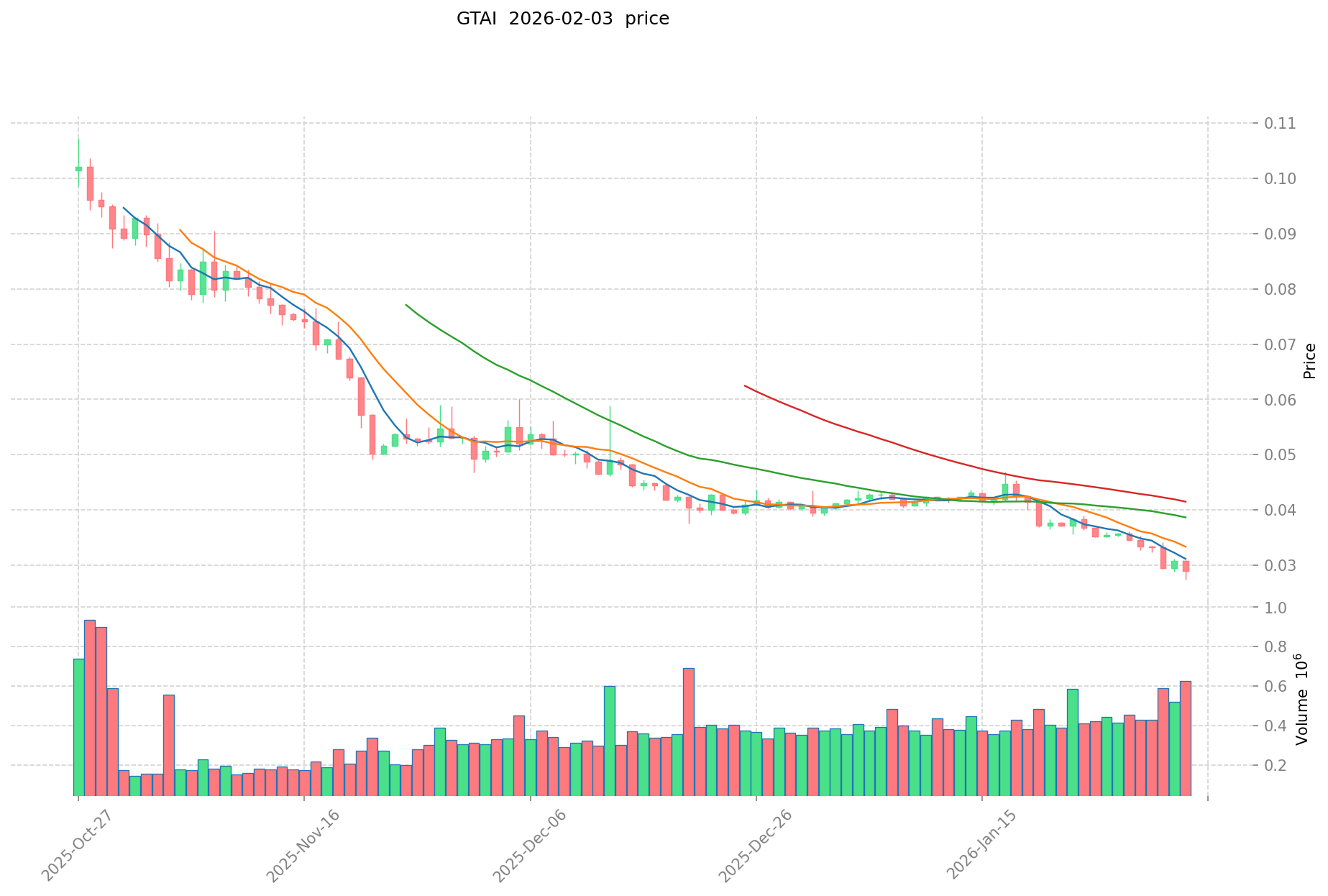
GT-Protocol reached a notable price level of $5.4994 on March 10, 2024, during a period of heightened market activity and interest in AI-powered Web3 solutions.
The token's lowest recorded price was $0.02736, occurring on February 2, 2026, amid broader market corrections and reduced trading volumes.
These fluctuations reflect evolving market sentiment, adoption patterns, and the dynamic nature of the AI and Web3 intersection sector.
Click to view current GTAI market price
On-Chain Metrics
- 24-Hour Trading Volume: $18,451.29 (indicating current market activity levels)
- Holder Addresses: 18,487 addresses (reflecting the breadth of token distribution)
- Market Capitalization: $1,176,326.63 (representing current circulating value)
- Fully Diluted Valuation: $2,174,250.00 (projecting total network value at full circulation)
GT-Protocol Ecosystem Applications and Partners
Core Use Cases
GT-Protocol's ecosystem supports multiple applications:
- AI-Powered Trading: The protocol enables AI-driven portfolio management and trading execution across CeFi, DeFi, and NFT markets through conversational interface technology.
- Cross-Platform Integration: GT-Protocol facilitates seamless interaction between Web3 and Web2 platforms, democratizing access to sophisticated investment strategies through voice commands and AI prompts.
Strategic Partnerships
While specific partnership details are not extensively documented in available materials, GT-Protocol's technology design emphasizes compatibility with both centralized and decentralized platforms, laying groundwork for ecosystem expansion.
Controversies and Challenges
GT-Protocol faces several challenges:
- Market Volatility: The token has experienced significant price fluctuations, with a 1-year decline of 91.3% and 30-day decrease of 30.40%
- Competition Pressure: The AI-driven crypto trading space continues to evolve with emerging competitors
- Adoption Hurdles: Achieving the ambitious goal of onboarding 100 million users requires sustained development and market acceptance
These issues have sparked discussions within the community while driving ongoing innovation efforts.
GT-Protocol Community and Social Media Sentiment
Community Engagement
GT-Protocol maintains an active community presence with 18,487 token holders as of February 3, 2026. The project's social channels facilitate discussions around AI integration in crypto trading and investment democratization.
Social Media Dynamics
Sentiment on X platform shows mixed perspectives:
- Supporters highlight GT-Protocol's innovative AI conversational interface and user-friendly approach to complex investment strategies, viewing it as a tool for financial accessibility.
- Critics focus on price volatility and market performance concerns, particularly given the substantial decline from historical peaks.
Recent trends indicate cautious sentiment as the market evaluates the protocol's long-term value proposition.
Trending Topics
X users actively discuss GT-Protocol's AI execution technology capabilities, market positioning, and adoption trajectory, revealing both the transformative potential and the challenges in achieving mainstream acceptance.
More Information Sources about GT-Protocol
- Official Website: Visit GT-Protocol Official Site for features, use cases, and latest developments.
- X Platform: GT-Protocol maintains presence at @gt_protocol on X, sharing updates on technological advancements, platform integrations, and community initiatives.
- Blockchain Explorer: Track GT-Protocol token activity on BSC Scan.
GT-Protocol Future Roadmap
- Platform Enhancement: Continue developing AI execution capabilities and conversational interface improvements
- Ecosystem Goals: Work toward the vision of onboarding 100 million users to create a comprehensive AI Layer for Web3
- Long-Term Vision: Establish GT-Protocol as a leading AI-powered investment platform bridging Web2 and Web3 ecosystems
How to Participate in GT-Protocol?
- Purchase Channels: GTAI tokens are available on Gate.com and other supported exchanges
- Storage Solutions: Use compatible BSC-supporting wallets to securely store GTAI tokens
- Community Engagement: Follow official channels to stay updated on platform developments and participate in community discussions
- Ecosystem Building: Explore integration opportunities through the platform's AI execution technology for investment applications
Summary
GT-Protocol leverages AI technology to transform crypto investment accessibility, offering conversational interfaces, automated portfolio management, and cross-platform compatibility. With its innovative approach to democratizing sophisticated investment strategies, the protocol aims to bridge the gap between traditional and decentralized finance.
Despite facing market volatility and adoption challenges, GT-Protocol's technological foundation and clear vision position it as a noteworthy project in the AI-crypto intersection. Whether you're a newcomer exploring AI-driven trading or an experienced participant seeking innovative tools, GT-Protocol represents an interesting development in the evolution of accessible crypto investment solutions.
FAQ
What is GTAI and what is its purpose in the cryptocurrency ecosystem?
GTAI is an AI-driven protocol that simplifies crypto trading, investing, and portfolio management. It enhances transaction efficiency and user experience through intelligent automation in the Web3 ecosystem.
How can I buy and store GTAI tokens safely?
Purchase GTAI tokens through decentralized exchanges using Web3 wallet. Store tokens in a secure non-custodial wallet with private key control. Enable two-factor authentication and backup your recovery phrases offline.
What are the key features and technological advantages of GTAI compared to other cryptocurrencies?
GTAI delivers exceptional transaction speed and minimal fees, enabling fast, cost-effective transfers. Its advanced blockchain architecture provides superior security and scalability. The innovative consensus mechanism ensures efficient, reliable operations across the network.
What are the risks and security considerations when investing in GTAI?
GTAI investments carry market volatility risks and potential losses. Key considerations include smart contract audits, wallet security, liquidity risks, and regulatory uncertainty. Always conduct thorough research and use secure storage solutions.
Who are the team members and what is the development roadmap for GTAI?
GTAI is backed by a professional development team with over 4,000 developers since 2019. The roadmap includes multiple testing phases and continuous updates. Specific release timelines will be announced through official channels.
Share
Content
GT-Protocol's Positioning and Significance
Origin and Development History
How GT-Protocol Works
GT-Protocol Market Performance
GT-Protocol Ecosystem Applications and Partners
Controversies and Challenges
GT-Protocol Community and Social Media Sentiment
More Information Sources about GT-Protocol
GT-Protocol Future Roadmap
How to Participate in GT-Protocol?
Summary
FAQ
How to Buy Cryptocurrency


Trending Cryptocurrencies



XZXX: A Comprehensive Guide to the BRC-20 Meme Token in 2025

What Is a Phantom Wallet: A Guide for Solana Users in 2025

Ethereum 2.0 in 2025: Staking, Scalability, and Environmental Impact
2025 Layer-2 Solution: Ethereum Scalability and Web3 Performance Optimization Guide

What is BOOP: Understanding the Web3 Token in 2025

Altcoin Season Index 2025: How to Use and Invest in Web3

Comprehensive Guide to Automated Market Makers

ZERC vs BAT: A Comprehensive Comparison of Emerging Technologies and Market Leaders in the Digital Economy
EMYC vs ADA: A Comprehensive Comparison of Two Leading Blockchain Platforms in the Crypto Market
P00LS vs VET: A Comprehensive Comparison of Two Leading Blockchain Utility Tokens

UNIBOT vs APT: A Comprehensive Comparison of Two Leading Automated Trading Bots in the Cryptocurrency Market