What is MVL: Understanding the Multi-Value Logic System in Modern Computing

2025-09-28 14:42:33
Altcoins
Blockchain
Crypto Ecosystem
DePIN
Web 3.0
Article Rating : 4
0 ratings
The article explores the Multi-Value Logic (MVL) system in modern computing and its transformative role in the mobility industry through blockchain technology. It highlights MVL's evolution, its decentralized architecture, and its substantial user base. The content addresses how MVL enhances transparency and efficiency in ride-hailing and electric vehicle sectors, catering to technologists and blockchain enthusiasts. Structured to provide a comprehensive understanding, the article covers MVL's origins, market impact, ecosystem applications, and potential challenges, presenting a detailed analysis for readers interested in blockchain-based mobility innovations. Key information includes participation methods through Gate.
What is MVL: Understanding the Multi-Value Logic System in Modern Computing

MVL's Positioning and Significance

In 2018, MVL Foundation introduced MVL (MVL), aiming to innovate the mobility industry using blockchain technologies.

As a blockchain-based mobility ecosystem, MVL plays a crucial role in ride-hailing, electric vehicles, and infrastructure sectors.

As of 2025, MVL has become an established player in the mobility blockchain space, with 220,000 drivers and 2.6 million passengers participating in its ecosystem. This article will analyze its technological architecture, market performance, and future potential.

Origins and Development History

Birth Background

MVL was created by the MVL Foundation in 2018, aiming to solve inefficiencies and lack of transparency in the traditional mobility industry.

It was born during the blockchain technology boom, with the goal of innovating the mobility sector through decentralized technologies.

MVL's launch brought new possibilities for ride-hailing services and electric vehicle infrastructure.

Important Milestones

  • 2018: Mainnet launch, introducing blockchain-based mobility services.
  • 2019: Launch of TADA, a ride-hailing service in Southeast Asia.
  • 2021: Introduction of ONiON, an electric vehicle and infrastructure business.
  • 2023: Ecosystem expansion, with over 600 vehicles participating in the network.

With support from the MVL Foundation and a team of over 300 employees worldwide, MVL continues to optimize its technology, security, and real-world applications.

How Does MVL Work?

Decentralized Control

MVL operates on a decentralized network of computers (nodes) spread across the globe, free from control by a single entity.

These nodes collaborate to validate transactions, ensuring system transparency and attack resistance, empowering users with greater autonomy and improving network resilience.

Blockchain Core

MVL's blockchain is a public, immutable digital ledger that records every transaction.

Transactions are grouped into blocks and linked through cryptographic hashes to form a secure chain.

Anyone can view the records, establishing trust without intermediaries.

MVL leverages blockchain technology to enhance transparency and efficiency in the mobility sector.

Ensuring Fairness

MVL uses a consensus mechanism to validate transactions and prevent fraudulent activities like double-spending.

Participants maintain network security through running nodes and validating transactions, and are rewarded with MVL tokens.

Its innovation includes integrating real-world mobility services with blockchain technology.

Secure Transactions

MVL uses public-private key encryption to protect transactions:

  • Private keys (like secret passwords) are used to sign transactions
  • Public keys (like account numbers) are used to verify ownership

This mechanism ensures fund security, while transactions maintain a level of pseudonymity.

Additional features include data sharing through DEPIN map and revenue sharing with token holders.

MVL's Market Performance

Circulation Overview

As of September 28, 2025, MVL has a circulating supply of 27,202,958,863.10265 tokens, with a total supply of 27,802,958,863.

Price Fluctuations

MVL reached its all-time high of $0.010655 on November 12, 2024. Its lowest price was $0.002524, recorded on September 28, 2025. These fluctuations reflect market sentiment, adoption trends, and external factors.

Click to view the current market price of MVL
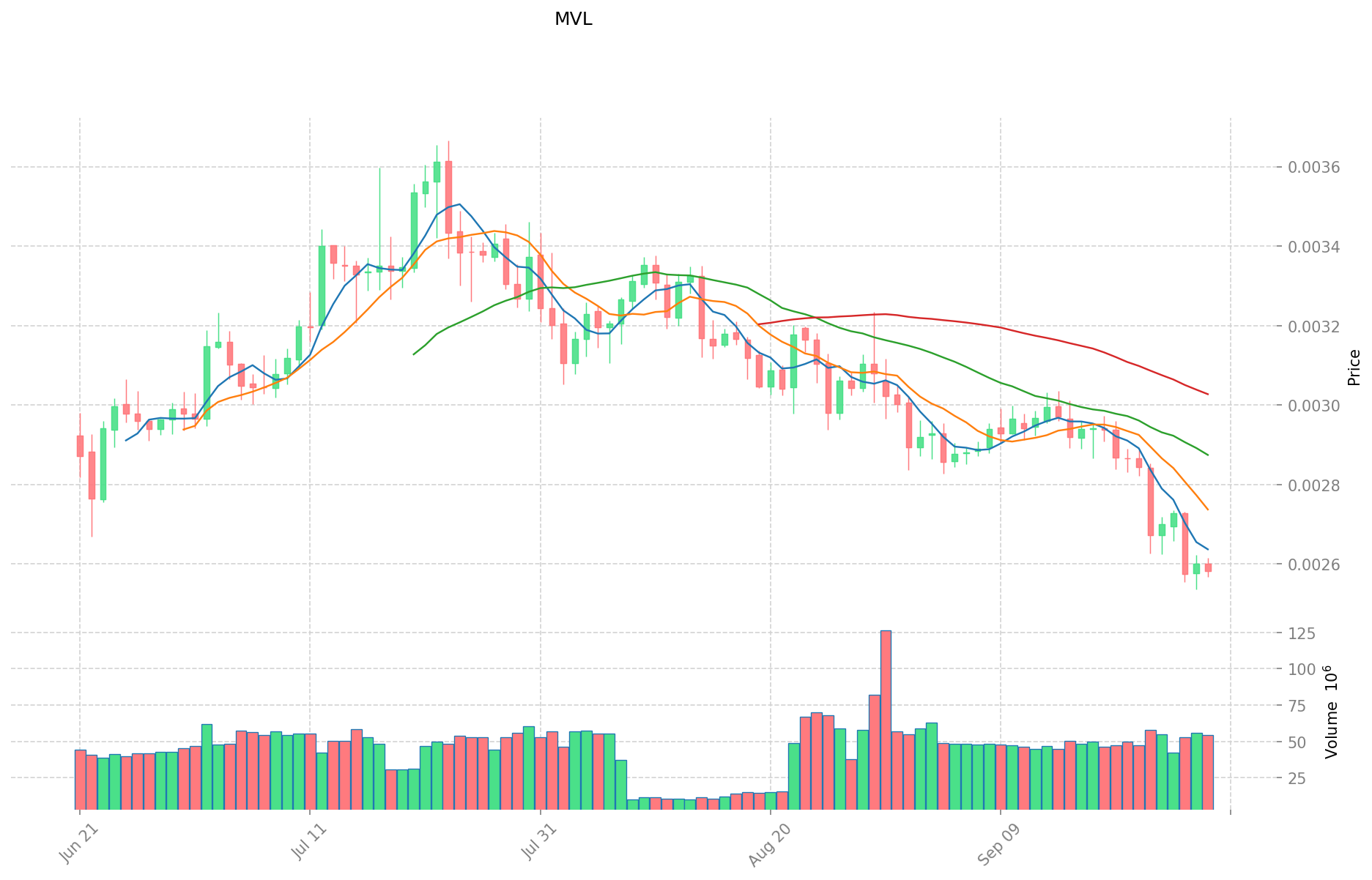
price-image

On-Chain Metrics

  • Daily Transaction Volume: $140,659.2817257 (indicating network activity)
  • Active Addresses: 11,698 (reflecting user engagement)

MVL Ecosystem Applications and Partnerships

Core Use Cases

MVL's ecosystem supports various applications:

  • Ride-hailing: TADA, providing on-demand transportation services.
  • Electric Vehicles: ONiON, driving innovation in sustainable mobility.

Strategic Collaborations

MVL has established partnerships with 220,000 drivers and 2.6 million passengers, enhancing its market presence. These partnerships provide a solid foundation for MVL's ecosystem expansion.

Controversies and Challenges

MVL faces the following challenges:

  • Market Competition: Competing with established ride-hailing services
  • Regulatory Risks: Potential regulations in the mobility sector
  • Adoption Barriers: Encouraging widespread use of blockchain in transportation

These issues have sparked discussions within the community and market, driving continuous innovation for MVL.

MVL Community and Social Media Atmosphere

Fan Enthusiasm

MVL's community is vibrant, with 220,000 drivers and 2.6 million passengers participating. On X platform, related posts and hashtags (like #MVL) often trend, with monthly post volumes reaching significant numbers. Price movements and new feature releases ignite community enthusiasm.

Social Media Sentiment

Sentiment on X shows a mix of opinions:

  • Supporters praise MVL's innovation in the mobility sector and blockchain integration.
  • Critics focus on challenges in market adoption and competition with traditional services.

Recent trends indicate growing interest in blockchain-based mobility solutions.

Hot Topics

X users actively discuss MVL's integration of blockchain in transportation, revenue sharing model, and DEPIN map data sharing, showcasing its transformative potential and the challenges of mainstream adoption.

More Information Sources for MVL

  • Official Website: Visit MVL official website for features, use cases, and latest updates.
  • Whitepaper: MVL whitepaper details its technical architecture, goals, and vision.
  • X Updates: On X platform, MVL uses @mvlchain actively, as of September 28, 2025, with posts covering technical upgrades, community events, and partnership news.

MVL Future Roadmap

  • Ecosystem Goals: Support expansion of TADA and ONiON services
  • Long-term Vision: Become a leading blockchain-based mobility infrastructure

How to Participate in MVL?

  1. Purchase Channels: Buy MVL on Gate.com
  2. Storage Solutions: Use secure wallets for storing MVL tokens
  3. Participate in Governance: Engage in community decisions through official channels
  4. Build the Ecosystem: Visit MVL GitHub to contribute code or develop applications

Summary

MVL is redefining the mobility industry through blockchain technology, offering innovative ride-hailing services and electric vehicle solutions. Its active community, rich resources, and strong market performance make it stand out in the cryptocurrency field. Despite facing challenges in market adoption and competition, MVL's innovative spirit and clear roadmap position it as a significant player in the future of decentralized mobility technology. Whether you're a newcomer or an experienced player, MVL is worth watching and participating in.

FAQ

How does MVL work?

MVL operates on blockchain, rewarding users for sharing mobility data. It uses tokens to incentivize participation in its ecosystem, connecting various transportation services.

What is the MVL short for?

MVL stands for Mass Vehicle Ledger, a blockchain-based ecosystem for the automotive and mobility industry.

How much does a MVL cost?

As of 2025, MVL's price fluctuates in the crypto market. It typically ranges from $0.50 to $2.00 per token, depending on market conditions and project developments.

What is MVL in finance?

MVL stands for Members' Voluntary Liquidation, a process to wind up a solvent company that has ceased trading. It's initiated by company members and legally ends the company's existence.

* The information is not intended to be and does not constitute financial advice or any other recommendation of any sort offered or endorsed by Gate.
Related Articles
XZXX: A Comprehensive Guide to the BRC-20 Meme Token in 2025

XZXX: A Comprehensive Guide to the BRC-20 Meme Token in 2025

XZXX emerges as the leading BRC-20 meme token of 2025, leveraging Bitcoin Ordinals for unique functionalities that integrate meme culture with tech innovation. The article explores the token's explosive growth, driven by a thriving community and strategic market support from exchanges like Gate, while offering beginners a guided approach to purchasing and securing XZXX. Readers will gain insights into the token's success factors, technical advancements, and investment strategies within the expanding XZXX ecosystem, highlighting its potential to reshape the BRC-20 landscape and digital asset investment.
2025-08-21 07:51:51
Survey Note: Detailed Analysis of the Best AI in 2025

Survey Note: Detailed Analysis of the Best AI in 2025

As of April 14, 2025, the AI landscape is more competitive than ever, with numerous advanced models vying for the title of "best." Determining the top AI involves evaluating versatility, accessibility, performance, and specific use cases, drawing on recent analyses, expert opinions, and market trends.
2025-04-18 08:03:51
Detailed Analysis of the Best 10 GameFi Projects to Play and Earn in 2025

Detailed Analysis of the Best 10 GameFi Projects to Play and Earn in 2025

GameFi, or Gaming Finance, blends blockchain gaming with decentralized finance, letting players earn real money or crypto by playing. For 2025, based on 2024 trends, here are the top 10 projects to play and earn, ideal for beginners looking for fun and rewards:
2025-04-21 07:39:08
Kaspa’s Journey: From BlockDAG Innovation to Market Buzz

Kaspa’s Journey: From BlockDAG Innovation to Market Buzz

Kaspa is a fast-rising cryptocurrency known for its innovative blockDAG architecture and fair launch. This article explores its origins, technology, price outlook, and why it’s gaining serious traction in the blockchain world.
2025-04-30 05:34:48
Best Crypto Wallets 2025: How to Choose and Secure Your Digital Assets

Best Crypto Wallets 2025: How to Choose and Secure Your Digital Assets

Navigating the crypto wallet landscape in 2025 can be daunting. From multi-currency options to cutting-edge security features, choosing the best crypto wallet requires careful consideration. This guide explores hardware vs software solutions, security tips, and how to select the perfect wallet for your needs. Discover the top contenders in the ever-evolving world of digital asset management.
2025-04-30 02:49:30
Popular GameFi Games in 2025

Popular GameFi Games in 2025

These GameFi projects offer a diverse range of experiences, from space exploration to dungeon crawling, and provide players with opportunities to earn real-world value through in-game activities. Whether you’re interested in NFTs, virtual real estate, or play-to-earn economies, there’s a GameFi game that suits your interests.
2025-04-21 07:31:13
Recommended for You
BC vs ETH: A Comprehensive Comparison of Bitcoin and Ethereum's Market Performance and Technological Innovation

BC vs ETH: A Comprehensive Comparison of Bitcoin and Ethereum's Market Performance and Technological Innovation

This comprehensive guide compares Blood Crystal (BC), a blockchain gaming token launched in 2024, with Ethereum (ETH), the leading smart contract platform. The article examines historical price trends, current market status, and technological ecosystems, revealing ETH's stronger market resilience with trading volume of $599.1M versus BC's $11.6K. It analyzes tokenomics differences, institutional adoption patterns, and ecosystem maturity across DeFi, NFTs, and Layer 2 solutions. The analysis includes detailed price forecasts through 2031, risk assessments covering market volatility and regulatory factors, and tailored investment strategies for different risk profiles. Designed for both new and experienced investors, this resource addresses key decision factors to determine which asset aligns with individual investment objectives and risk tolerance in the current market environment.
2026-02-02 00:14:44
RFD vs ZIL: A Comprehensive Comparison of Two Leading Storage Technologies

RFD vs ZIL: A Comprehensive Comparison of Two Leading Storage Technologies

This comprehensive guide compares RFD and ZIL, two distinct cryptocurrency assets with different market positioning and investment profiles. RFD, a meme token launched in 2023, contrasts sharply with ZIL, an established high-throughput blockchain infrastructure platform operational since 2018. The analysis examines historical price performance, current market status as of February 2026, tokenomics, institutional adoption, technical ecosystem development, and macroeconomic influences affecting both assets. Price predictions through 2031 suggest varying growth trajectories, with ZIL showing stronger momentum potential alongside higher trading liquidity. Investment strategies differ significantly based on risk tolerance: conservative investors may favor ZIL's established presence, while aggressive investors might explore RFD's speculative opportunities. The article addresses market risks, regulatory considerations, and provides personalized allocation recommendations for different investor profiles on Gate platf
2026-02-02 00:14:30
CTP vs XRP: Which Blockchain Payment Solution Offers Better Value for Cross-Border Transactions?

CTP vs XRP: Which Blockchain Payment Solution Offers Better Value for Cross-Border Transactions?

This comprehensive analysis compares CTP and XRP as blockchain payment solutions, examining their distinct market positions and value propositions for cross-border transactions. CTP, launched in 2021, operates as an emerging skincare-tech token with Scan-to-Earn mechanisms, currently ranking #2223 with a $1.53 million market cap. XRP, established since 2013, functions as established payment infrastructure through RippleNet, holding the #5 position with a $96.8 billion market cap. The article evaluates historical price performance, supply mechanisms, institutional adoption patterns, technological ecosystems, and investment strategies across multiple timeframes through 2031. Key differentiators include liquidity characteristics—XRP commands $125.2 million daily volume versus CTP's $58,394—and volatility profiles reflecting different risk-return dynamics. The analysis addresses investor considerations across conservative, aggressive, and institutional categories, providing risk assessments, allocation strategies
2026-02-02 00:12:43
ARCHAI vs GMX: A Comprehensive Comparison of Two Leading DeFi Trading Protocols

ARCHAI vs GMX: A Comprehensive Comparison of Two Leading DeFi Trading Protocols

This comprehensive guide compares ARCHAI and GMX, two distinct DeFi assets with different market positioning and investment profiles. ARCHAI, a 2025 AI infrastructure project ranked #2227, offers early-stage growth potential through ChainGraph technology, while GMX, an established perpetual exchange ranked #415, provides proven revenue generation mechanisms accruing 30% of platform fees. The article analyzes historical price trajectories, tokenomics, technological ecosystems, and 2026-2031 price forecasts to help investors determine optimal allocation strategies. GMX suits conservative investors seeking established DeFi infrastructure, while ARCHAI appeals to experienced investors targeting emerging AI ecosystem development. Detailed risk analysis, portfolio allocation recommendations, and FAQ address key investment considerations for novice, experienced, and institutional investors evaluating these assets on Gate exchange.
2026-02-02 00:12:21
How Bitcoin Futures Trading Works: Principles, Advantages and Disadvantages

How Bitcoin Futures Trading Works: Principles, Advantages and Disadvantages

This comprehensive guide introduces cryptocurrency futures trading fundamentals for beginners. It covers the core concepts of futures contracts, their mechanisms, and Bitcoin-specific applications, explaining how they differ from spot trading through leverage opportunities and dual market directional trading. The article details contract types—standard futures and perpetual swaps—their operational differences, and margin requirements ranging from 5-15%. It compares advantages including profit potential with small capital against significant risks from price volatility and liquidation. The guide highlights major trading platforms including CME and leading centralized exchanges, emphasizing regulatory compliance and security considerations. Practical sections address risk management strategies, stop-loss implementation, and position sizing techniques. The FAQ section resolves common questions about leverage mechanics, platform selection, and price differences between futures and spot markets, equipping novice t
2026-02-02 00:12:12
Digital Art for Beginners: 7 Top Ideas

Digital Art for Beginners: 7 Top Ideas

Discover how to leverage blockchain and NFTs to create and safeguard digital art. This comprehensive beginner’s guide covers types of digital art, essential tools, and initial projects. Explore trading on Gate and strategies for monetizing your creations.
2026-02-02 00:09:20

