This comprehensive analysis compares CTP and XRP as blockchain payment solutions, examining their distinct market positions and value propositions for cross-border transactions. CTP, launched in 2021, operates as an emerging skincare-tech token with Scan-to-Earn mechanisms, currently ranking #2223 with a $1.53 million market cap. XRP, established since 2013, functions as established payment infrastructure through RippleNet, holding the #5 position with a $96.8 billion market cap. The article evaluates historical price performance, supply mechanisms, institutional adoption patterns, technological ecosystems, and investment strategies across multiple timeframes through 2031. Key differentiators include liquidity characteristics—XRP commands $125.2 million daily volume versus CTP's $58,394—and volatility profiles reflecting different risk-return dynamics. The analysis addresses investor considerations across conservative, aggressive, and institutional categories, providing risk assessments, allocation strategies
Introduction: CTP vs XRP Investment Comparison
In the cryptocurrency market, the comparison between CTP and XRP has become a topic of interest for investors exploring different asset classes. These two digital assets exhibit notable differences in market capitalization ranking, application scenarios, and price performance, representing distinct positioning within the crypto ecosystem.
CTP (Ctomorrow Platform): Launched in 2021, this token operates within the skincare and AI-driven data utilization space, featuring a Scan-to-Earn (S2E) system that rewards users through the CTomorrow application.
XRP (Ripple): Since its introduction in 2013, XRP has been recognized for its role in facilitating efficient cross-border payments and serves as one of the established digital assets in terms of trading volume and market presence.
This article will analyze the investment comparison between CTP and XRP across multiple dimensions, including historical price movements, supply mechanisms, institutional adoption patterns, technological ecosystems, and future outlook, aiming to address the fundamental question that concerns investors:
"Which aspects should be considered when evaluating these two assets?"
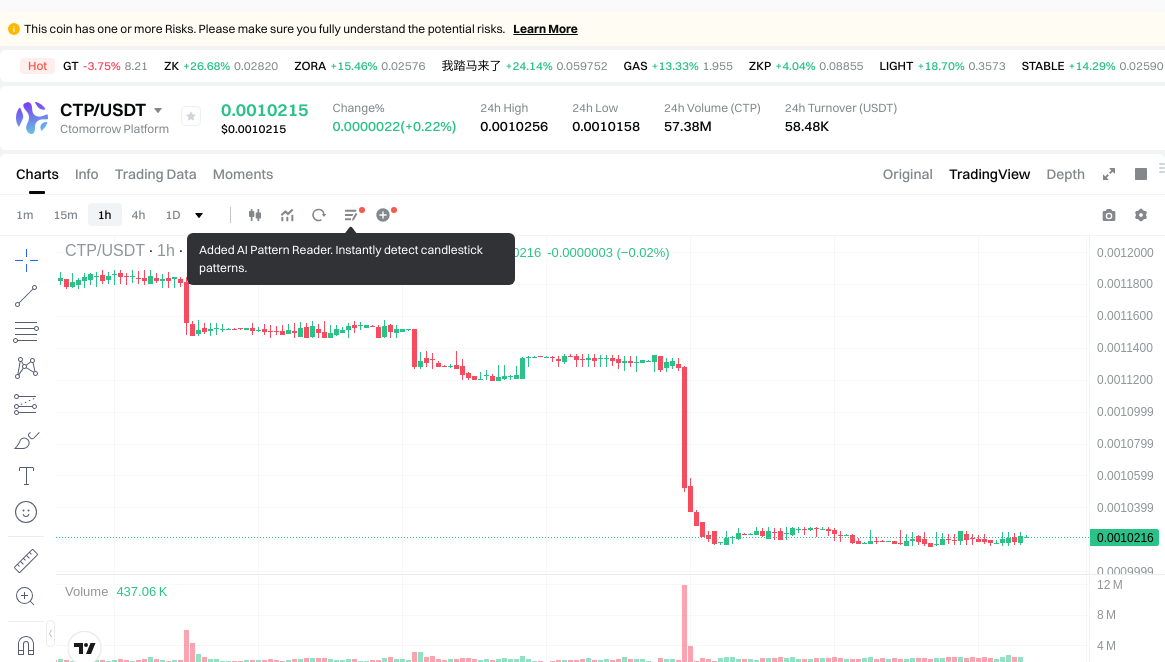
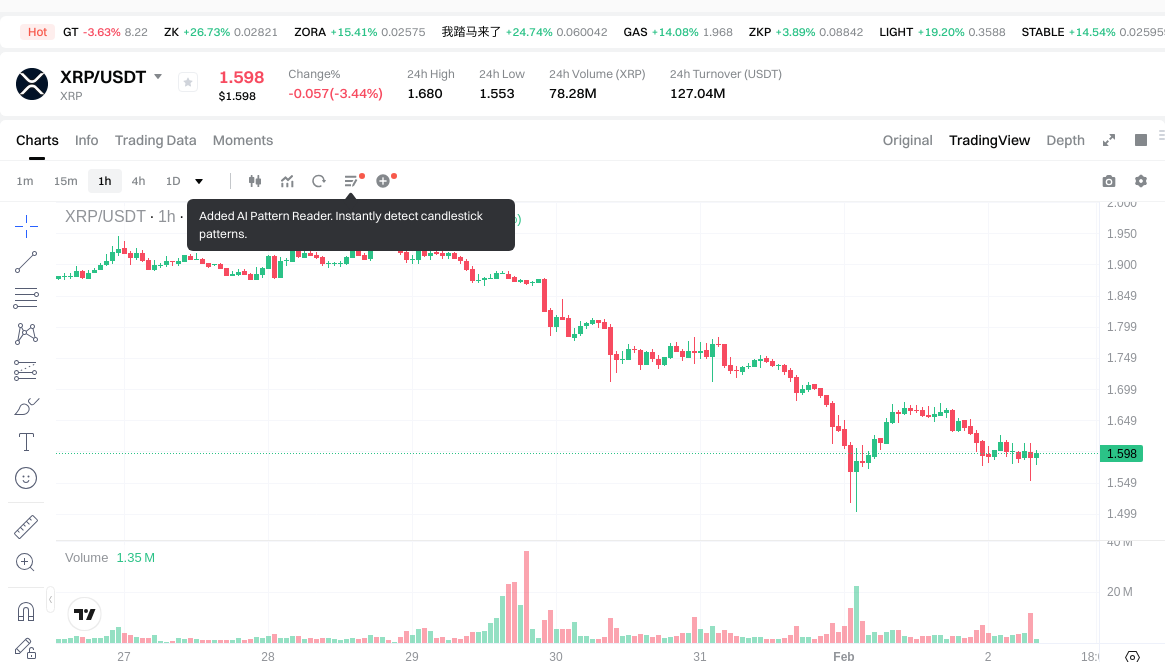
As of February 2, 2026, CTP ranks #2223 with a market cap of approximately $1.53 million and a current price of $0.0010221, while XRP holds the #5 position with a market cap exceeding $96.8 billion and trades at $1.591. The substantial difference in scale and market maturity between these assets reflects their divergent stages of development and risk-return profiles.
I. Historical Price Comparison and Current Market Status
CTP (Coin A) and XRP (Coin B) Historical Price Trends
- 2024: CTP reached its all-time high of $0.007032 on May 30, 2024, followed by a significant decline to its all-time low of $0.00077 on the same date, reflecting high volatility during its early trading period.
- 2025: XRP experienced notable price movement, reaching an all-time high of $3.65 on July 18, 2025, driven by improved regulatory sentiment and increased institutional interest in the asset.
- Comparative Analysis: During the recent market cycle, CTP declined from its peak of $0.007032 to current levels around $0.0010221, representing an approximate 85% decrease, while XRP fell from $3.65 to approximately $1.591, marking a roughly 56% decline from its peak.
Current Market Status (2026-02-02)
- CTP Current Price: $0.0010221
- XRP Current Price: $1.591
- 24-Hour Trading Volume: CTP recorded $58,394.70 compared to XRP's significantly higher $125,240,378.58
- Market Sentiment Index (Fear & Greed Index): 14 (Extreme Fear)
View real-time prices:
II. Core Factors Influencing CTP vs XRP Investment Value
Supply Mechanism Comparison (Tokenomics)
- CTP: Specific supply mechanism details are not available in the provided materials.
- XRP: Supply mechanism details are not available in the provided materials.
- 📌 Historical patterns regarding how supply mechanisms drive price cycle changes are not covered in the reference materials.
Institutional Adoption and Market Application
- Institutional Holdings: The reference materials do not provide comparative data on institutional preference between CTP and XRP.
- Enterprise Adoption: According to available information, XRP's investment value may be influenced by RippleNet expansion and ODL (On-Demand Liquidity) adoption rates. Analysts suggest that if RippleNet continues to expand and ODL adoption increases, XRP could benefit. However, specific comparative data on enterprise adoption between CTP and XRP in cross-border payments, settlements, or investment portfolios is not available.
- National Policies: The materials mention that regulatory clarity is a significant factor for XRP. Regulatory developments, particularly in the United States and Hong Kong, may impact XRP's investment environment. Specific policy stances from different countries toward CTP are not documented in the reference materials.
Technology Development and Ecosystem Building
- CTP Technology Upgrades: Information regarding CTP's technology upgrades and their potential impact is not available in the provided materials.
- XRP Technology Development: The materials indicate that XRP's investment value depends on factors including RippleNet expansion and regulatory environment improvements. However, specific technical upgrade details are not provided.
- Ecosystem Comparison: Comparative analysis of DeFi, NFT, payment systems, and smart contract implementation between CTP and XRP ecosystems is not available in the reference materials.
Macroeconomic Environment and Market Cycles
- Performance in Inflationary Environments: The reference materials do not provide data comparing the inflation-hedging properties of CTP versus XRP.
- Macroeconomic Monetary Policy: The materials do not discuss how interest rates or the US Dollar Index specifically affect CTP or XRP.
- Geopolitical Factors: While cross-border transaction demand is mentioned as relevant to XRP through RippleNet adoption, specific comparative analysis of geopolitical factors affecting CTP versus XRP is not available in the provided materials.
III. 2026-2031 Price Prediction: CTP vs XRP
Short-term Forecast (2026)
- CTP: Conservative $0.000950088 - $0.0010216 | Optimistic $0.0010216 - $0.00112376
- XRP: Conservative $1.48707 - $1.599 | Optimistic $1.599 - $1.83885
Mid-term Forecast (2028-2029)
- CTP may enter a consolidation phase, with projected price range of $0.00106088052 - $0.0014774611614
- XRP may enter an expansion phase, with projected price range of $1.6424328375 - $2.46364925625
- Key drivers: institutional capital inflows, ETF developments, ecosystem growth
Long-term Forecast (2031)
- CTP: Baseline scenario $0.001569489462555 - $0.000816134520528 | Optimistic scenario $0.002197285247577
- XRP: Baseline scenario $2.631992568254765 - $2.210873757334003 | Optimistic scenario $3.132071156223171
View detailed price predictions for CTP and XRP
Disclaimer
CTP:
| Year |
Predicted High Price |
Predicted Average Price |
Predicted Low Price |
Price Change |
| 2026 |
0.00112376 |
0.0010216 |
0.000950088 |
0 |
| 2027 |
0.001394484 |
0.00107268 |
0.0007401492 |
4 |
| 2028 |
0.00127058946 |
0.001233582 |
0.00106088052 |
20 |
| 2029 |
0.0014774611614 |
0.00125208573 |
0.0011018354424 |
22 |
| 2030 |
0.00177420547941 |
0.0013647734457 |
0.001323830242329 |
33 |
| 2031 |
0.002197285247577 |
0.001569489462555 |
0.000816134520528 |
53 |
XRP:
| Year |
Predicted High Price |
Predicted Average Price |
Predicted Low Price |
Price Change |
| 2026 |
1.83885 |
1.599 |
1.48707 |
0 |
| 2027 |
2.49244125 |
1.718925 |
1.56422175 |
8 |
| 2028 |
2.46364925625 |
2.105683125 |
1.6424328375 |
32 |
| 2029 |
2.35320617634375 |
2.284666190625 |
1.370799714375 |
43 |
| 2030 |
2.945048953025156 |
2.318936183484375 |
1.808770223117812 |
45 |
| 2031 |
3.132071156223171 |
2.631992568254765 |
2.210873757334003 |
65 |
IV. Investment Strategy Comparison: CTP vs XRP
Long-term vs Short-term Investment Strategies
-
CTP: May suit investors seeking exposure to emerging skincare-tech integration with AI-driven reward mechanisms, focusing on niche ecosystem potential and early-stage growth opportunities. The asset's high volatility profile suggests suitability for those with higher risk tolerance and longer time horizons.
-
XRP: May appeal to investors interested in established digital payment infrastructure with demonstrated institutional interest and regulatory development progress. The asset's relative market maturity and liquidity characteristics may align with those seeking more established market positioning.
Risk Management and Asset Allocation
- Conservative Investors: CTP 5-10% vs XRP 15-25% (within overall crypto portfolio allocation)
- Aggressive Investors: CTP 15-25% vs XRP 30-40% (within overall crypto portfolio allocation)
- Hedging Tools: stablecoin allocation for liquidity management, options strategies for downside protection, cross-asset portfolio diversification
V. Potential Risk Comparison
Market Risk
-
CTP: Exposure to significant volatility due to lower market capitalization ($1.53 million) and limited trading volume ($58,394.70 daily), resulting in potential liquidity constraints and price impact from smaller transaction volumes. The 85% decline from peak levels reflects substantial downside risk characteristics.
-
XRP: Subject to broader market sentiment shifts and regulatory developments, particularly in major jurisdictions. Despite higher liquidity ($125.24 million daily volume) and established market presence (#5 ranking), the asset experienced a 56% decline from peak levels, demonstrating sensitivity to market cycles and regulatory news flow.
Technical Risk
-
CTP: Information regarding network scalability, infrastructure stability, and technical development roadmap is limited in available materials, presenting uncertainty regarding long-term technical viability.
-
XRP: Technical considerations may include network dependency on validator operations and infrastructure reliability. Specific technical vulnerabilities are not detailed in the reference materials.
Regulatory Risk
- Global regulatory frameworks may affect both assets differently based on their functional classifications. XRP faces ongoing regulatory considerations related to its payment infrastructure role, particularly in the United States and emerging markets. CTP's regulatory positioning within the skincare application and reward token category may evolve as jurisdictions develop frameworks for utility tokens. Regulatory clarity developments could significantly impact investment viability for both assets.
VI. Conclusion: Which Is the Better Buy?
📌 Investment Value Summary:
-
CTP Characteristics: Early-stage asset with niche positioning in skincare-tech integration, featuring Scan-to-Earn mechanisms. Demonstrates high volatility with significant downside from peak levels. Limited market capitalization and trading volume present both opportunity and risk considerations.
-
XRP Characteristics: Established digital asset with substantial market capitalization ($96.8 billion) and institutional recognition. Positioned within cross-border payment infrastructure with ongoing regulatory developments. Demonstrates relative liquidity advantages and broader market adoption compared to emerging assets.
✅ Investment Considerations:
-
New Investors: May consider prioritizing established assets with higher liquidity and clearer regulatory pathways. Focus on understanding fundamental differences in market maturity, volatility profiles, and risk-return characteristics between emerging and established digital assets.
-
Experienced Investors: May evaluate portfolio allocation based on risk tolerance, investment horizon, and conviction regarding specific use cases. Consider incorporating both established payment infrastructure assets and emerging niche applications within diversified crypto exposure strategies.
-
Institutional Investors: Assessment may focus on regulatory clarity, liquidity depth, custody solutions availability, and alignment with institutional investment mandates. Established assets with clearer regulatory frameworks may align more readily with institutional risk management requirements.
⚠️ Risk Disclosure: Cryptocurrency markets exhibit substantial volatility and risk. This content does not constitute investment advice. Investors should conduct independent research and consider their financial situation, risk tolerance, and investment objectives before making any investment decisions.
VII. FAQ
Q1: What are the main differences between CTP and XRP in terms of market positioning and use cases?
CTP and XRP serve fundamentally different purposes within the cryptocurrency ecosystem. CTP is an early-stage token launched in 2021, operating within the skincare and AI-driven data utilization space with a Scan-to-Earn (S2E) reward system through the CTomorrow application. It ranks #2223 with a market cap of approximately $1.53 million. In contrast, XRP has been established since 2013 as a digital asset designed for efficient cross-border payments through RippleNet, holding the #5 market position with a market cap exceeding $96.8 billion. The scale difference reflects their divergent stages of development—CTP represents a niche application in skincare-tech integration, while XRP functions as established payment infrastructure with demonstrated institutional adoption.
Q2: How do the volatility profiles of CTP and XRP compare for risk assessment purposes?
Both assets demonstrate significant volatility but at different magnitudes. CTP experienced an approximately 85% decline from its all-time high of $0.007032 (May 30, 2024) to current levels around $0.0010221, reflecting extreme price fluctuations typical of low-capitalization assets. XRP showed a roughly 56% decline from its peak of $3.65 (July 18, 2025) to approximately $1.591, indicating substantial but relatively more moderate volatility compared to CTP. The daily trading volume disparity—$58,394.70 for CTP versus $125,240,378.58 for XRP—further illustrates liquidity differences that contribute to CTP's higher susceptibility to price impact from smaller transaction volumes. Investors should recognize that CTP's lower market capitalization and limited liquidity create greater downside risk potential compared to XRP's more established market presence.
Q3: What regulatory considerations should investors evaluate when comparing CTP and XRP?
Regulatory frameworks affect these assets differently based on their functional classifications. XRP faces significant regulatory considerations related to its role as payment infrastructure, particularly in the United States where regulatory clarity developments have historically impacted its price performance and institutional adoption. Regulatory developments in major jurisdictions like the United States and Hong Kong may influence XRP's investment environment. CTP's regulatory positioning falls within the utility token category for skincare applications and reward mechanisms, which may evolve differently as jurisdictions develop specific frameworks for such tokens. However, limited information exists regarding CTP's regulatory status across different countries. Investors should recognize that both assets carry regulatory uncertainty, but XRP's regulatory pathway appears more defined due to its longer market presence and higher profile within financial infrastructure discussions.
Q4: How do the liquidity characteristics of CTP and XRP impact trading and investment strategies?
Liquidity differences between these assets significantly influence trading execution and investment approaches. XRP's daily trading volume of $125.24 million and #5 market ranking provide substantially higher liquidity, enabling larger transactions with minimal price impact and facilitating entry/exit strategies for both retail and institutional investors. CTP's daily volume of $58,394.70 and market cap of $1.53 million create liquidity constraints that may result in wider bid-ask spreads, difficulty executing larger orders without significant price slippage, and challenges for investors seeking to exit positions quickly. Conservative investors typically prefer assets with higher liquidity like XRP for easier portfolio management, while aggressive investors willing to accept illiquidity premiums might allocate smaller portions to emerging assets like CTP. The liquidity disparity also affects risk management—stop-loss orders and hedging strategies execute more reliably in liquid markets.
Q5: What allocation strategies might different investor types consider when evaluating CTP versus XRP?
Investment allocation should align with risk tolerance and investment objectives. Conservative investors might consider allocating 5-10% of their crypto portfolio to CTP compared to 15-25% for XRP, reflecting CTP's higher risk profile and XRP's more established market position. Aggressive investors with higher risk tolerance might increase exposure to 15-25% for CTP and 30-40% for XRP within their overall cryptocurrency holdings. New investors may prioritize XRP due to its higher liquidity, clearer regulatory pathways, and established market presence, which facilitate easier portfolio management and reduced execution risks. Experienced investors might incorporate both assets strategically—using XRP for core crypto exposure to payment infrastructure and allocating smaller portions to CTP for exposure to emerging skincare-tech integration opportunities. Institutional investors typically focus on assets like XRP that offer regulatory clarity, liquidity depth, and custody solutions availability, though some may explore emerging assets like CTP through dedicated venture or innovation portfolios with appropriate risk controls.
Q6: What are the key price performance factors that differentiate CTP's and XRP's investment outlook through 2031?
Price trajectory drivers differ substantially between these assets. For CTP, the 2026-2031 forecast projects conservative ranges from $0.000950088-$0.0010216 in 2026 to $0.000816134520528-$0.001569489462555 by 2031, with an optimistic scenario reaching $0.002197285247577. These projections reflect potential growth tied to niche ecosystem development within skincare-tech applications. XRP's forecast shows conservative ranges from $1.48707-$1.599 in 2026 to $2.210873757334003-$2.631992568254765 by 2031, with optimistic scenarios reaching $3.132071156223171. XRP's price drivers include RippleNet expansion, ODL (On-Demand Liquidity) adoption rates, regulatory clarity improvements, and institutional capital inflows potentially through ETF developments. The forecasts suggest CTP may offer higher percentage growth potential from a low base but with significant execution risks, while XRP presents more moderate percentage gains from an established position with comparatively lower fundamental uncertainty.
Q7: How should investors interpret the current market sentiment indicators when evaluating these assets?
As of February 2, 2026, the market sentiment index (Fear & Greed Index) stands at 14, indicating "Extreme Fear" conditions across the cryptocurrency market. This metric suggests prevailing pessimism and risk-off sentiment that affects both CTP and XRP, though with different implications. During extreme fear periods, established assets like XRP with higher liquidity and institutional recognition may experience selling pressure but typically demonstrate better price resilience and recovery potential compared to low-capitalization assets. CTP's limited liquidity and lower market capitalization make it more vulnerable to prolonged downward pressure during fear-dominated market conditions, as reduced trading activity can amplify price declines. Historically, extreme fear readings have preceded market recoveries, potentially creating accumulation opportunities for both assets—though investors should recognize that timing market bottoms carries substantial risk. The extreme fear environment underscores the importance of risk management, appropriate position sizing, and maintaining longer-term investment perspectives rather than attempting short-term speculation during highly uncertain market conditions.
Q8: What due diligence considerations should investors prioritize when comparing these assets?
Comprehensive evaluation requires examining multiple dimensions beyond price performance. For CTP, critical assessment areas include: verification of the Scan-to-Earn mechanism's user adoption and retention metrics, understanding of the CTomorrow application's competitive positioning within skincare-tech applications, transparency regarding tokenomics and supply mechanisms (currently limited in available materials), and evaluation of the development team's track record and project sustainability. For XRP, key considerations include: monitoring RippleNet expansion progress and ODL adoption statistics, tracking regulatory developments particularly in major jurisdictions, assessing institutional partnership announcements and their materiality, and understanding validator network decentralization and infrastructure robustness. Both assets require evaluation of custody solutions availability, tax treatment implications in relevant jurisdictions, and correlation patterns with broader crypto market cycles. Investors should recognize that limited information availability for emerging assets like CTP necessitates higher risk premiums and smaller position sizes compared to established assets like XRP where more extensive fundamental data supports investment analysis.
* The information is not intended to be and does not constitute financial advice or any other recommendation of any sort offered or endorsed by Gate.