I. Why Look at “Structure” Before Discussing Opportunities?
In the crypto world, many assets may appear to have the same price, name, and chart, but once the underlying structure differs, the nature of the risk changes entirely. This is especially true for tokenized stocks, which span TradFi, crypto, and legal systems: price is not the risk. It’s structure.
Therefore, this lesson will not discuss:
- Price trends
- Investment advice
- Long-term bullish or bearish outlooks
We answer only one question: What exactly is the token?
II. Structure 1: Centralized Custody + On-Chain Mapping Model
This is the earliest and most straightforward tokenized stock structure in history.
Model Structure Breakdown
The basic logic is as follows:
- The platform or its affiliated entity buys real stocks in the traditional financial market
- Stocks are held in custody with a broker or custodian bank
- The platform issues an equivalent amount of tokens on-chain
- Users trade tokens, not the actual stocks
You can think of it as: “A broker issuing an IOU on-chain.”
What do users actually hold?
From a legal and risk perspective, users hold:
- A creditor’s claim against the platform
- Not direct ownership of the stock
In the official stock registration system:
- Users’ names do not appear
- Only the platform’s or SPV’s name appears
Main Risk Points
Risks in this structure are highly concentrated in centralized intermediaries:
- Counterparty risk
- Platform bankruptcy risk
- Opaque custody risk
It also faces:
- Risk of unauthorized securities issuance
- Cross-border compliance issues
- Regulatory freeze or forced redemption suspension risk
Key Conclusion
This is not “decentralized stock,” but rather centralized stock with an on-chain trading interface.
III. Structure 2: SPV / Regulated Entity Mapping Model
This is currently seen as the most “legitimate” structure and is the most cited model in RWA narratives.
Model Structure Breakdown
A typical process looks like this:
- Establish an SPV (Special Purpose Vehicle) in a specific jurisdiction
- The SPV legally buys and holds stocks
- The SPV issues tokens representing claims
- Token holders indirectly enjoy economic benefits
The core relationship is:
Token ≠ Stock; it’s more akin to a claim against the SPV
Where is it “compliant”?
Compared to the first model, this structure usually features:
- A clearly defined legal entity
- Audit and disclosure mechanisms
- Investor restrictions (KYC / geographic compliance)
But it’s important to note: What’s compliant is the “issuance structure”. A token does not automatically become stock.
Key Remaining Limitations
In most real-world cases, users still:
- Do not have direct voting rights
- Are not listed in the official shareholder registry
- Must assert rights through the SPV
Key Conclusion
What users truly trust remains:
- The legal structure
- The enforcement capability of the jurisdiction
Not the blockchain itself.
IV. Structure 3: Synthetic Asset Model (Synthetic Equity)
This is the most crypto-native structure and also the one most easily mistaken for “tokenized stocks.”
Model Structure Breakdown
The core features of synthetic assets are:
- No actual stocks are held
- Stock prices are referenced via oracles
- Collateral and liquidation mechanisms maintain price pegs
Users gain:
- Long/short exposure to stock prices
- Not the stocks themselves
What does it resemble?
Financially, it’s closer to:
- Perpetual contracts
- CFDs (Contracts for Difference)
The only difference is:
- Trading occurs on-chain
- Settlement uses DeFi mechanisms
Risk Concentration Points
Main risks for synthetic assets come from:
- Oracle failure
- Insufficient collateralization
- Systemic liquidation during extreme market conditions
However, they do not include risks such as:
- Corporate governance risk
- Custodied stock disappearance risk
- Stock ownership disputes
Essentially, these products are DeFi derivatives based on stock prices.
V. Core Differences Among the Three Structures
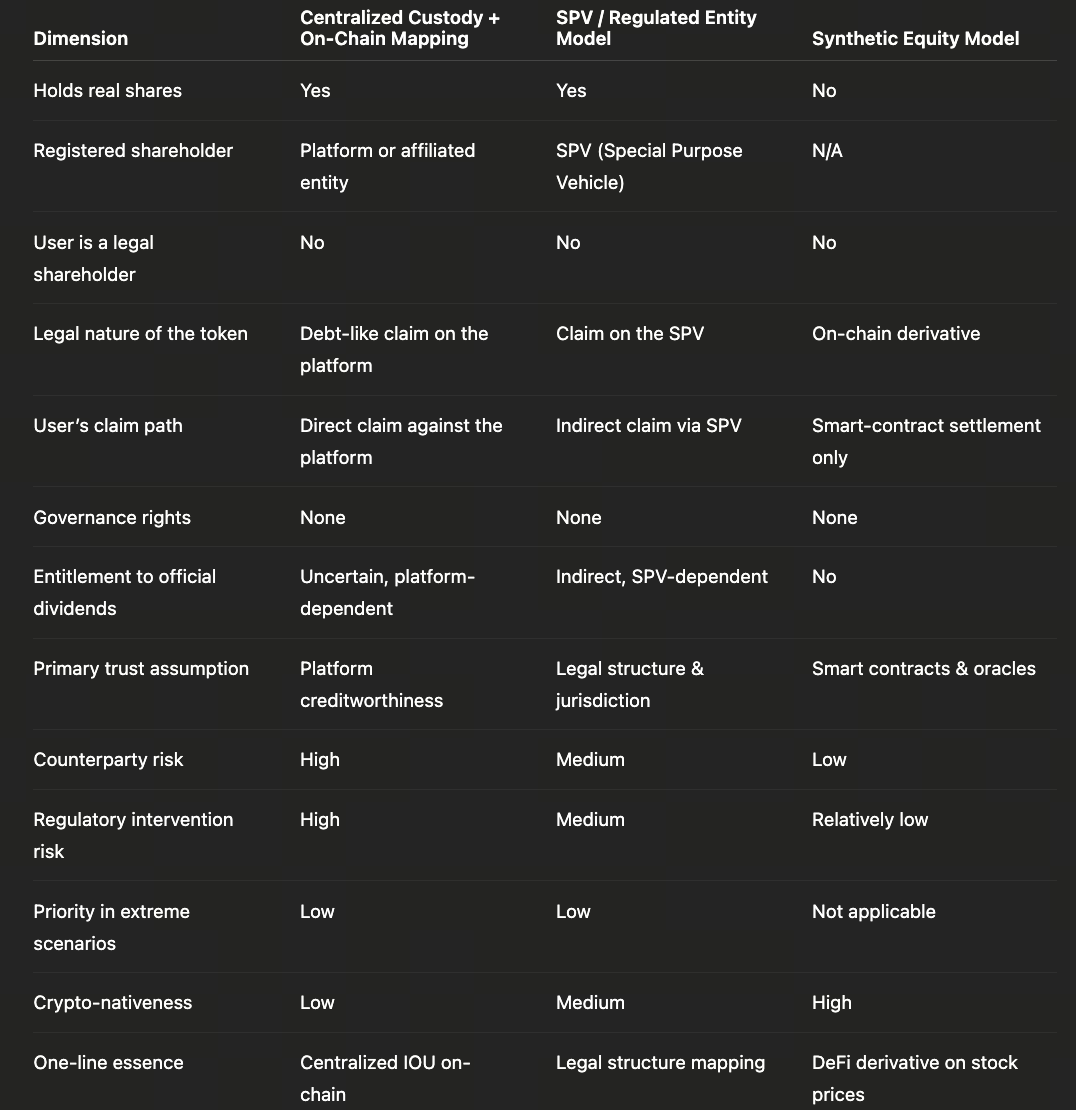
So-called “tokenized stocks” are not a single unified product, but three fundamentally different structural choices. Under the centralized custody model, users essentially hold credit exposure to the platform; in the SPV compliance model, users hold indirect claims on a legal structure and jurisdiction; while the synthetic asset model doesn’t involve stocks at all. Users are simply trading on-chain derivatives of stock prices. The three models differ systematically in whether real stocks are held, trust targets, counterparty risk, and regulatory risk. So when assessing tokenized stock risk, the first step should never be to look at price or pegging mechanism. It should be to examine which structure is used.
VI. A Key Question: In Extreme Scenarios, Who Fails First?
This is an unavoidable question for all tokenized stock structures.
When any of these occur:
- Platform bankruptcy
- Sudden regulatory intervention
- Extreme market volatility
Different structures can lead to completely different outcomes.
In reality, investigations typically proceed in this order:
- Custodial relationships and compliance structures are reviewed first
- Token holders’ rights are discussed last
- On-chain transparency cannot substitute for legal adjudication